Maidenhair Fern Care Guide: Adiantum raddianum Indoors
Adiantum raddianum
Maidenhair Fern needs humidity above 60 %, consistently moist soil (never dry), bright indirect light, and protection from cold drafts. Cut all collapsed fronds to the soil line - new ones emerge in 2–4 weeks.
Maidenhair Fern Care Guide: Adiantum raddianum Indoors
Start with wateringThe most common care mistake for Maidenhair FernWatering guide →Maidenhair Fern care essentials
Light
medium indirect light
Water
Every 2–3 days - keep soil consistently moist. Never allow the root ball to dry out. Use filtered or rainwater. Check soil daily in hot weather.
Soil
50 % potting compost + 30 % coco coir + 20 % fine orchid bark. Moisture-retaining but well-draining. pH 5.5–7.0.
Humidity
60–80%
Temperature
16–24°C (60–75°F)
Fertilizer
Use half-strength balanced liquid fertilizer and stop if the plant is stressed, newly repotted, or not actively growing. Over-fertilizing-leaves brown at tips from salt build-up.
About Maidenhair Fern
Maidenhair Fern is native to Tropical Americas, typically reaches 30–60 cm tall and wide indoors, with moderate growth. Maidenhair Fern has a fern like growth habit and part of the Pteridaceae family. It is also known as Delta Maidenhair, Trailing Maidenhair, and Adiantum fern.
| Detail | Information |
|---|---|
| Also known as | Delta Maidenhair, Trailing Maidenhair, Adiantum fern |
| Native region | Tropical Americas |
| Mature size | 30–60 cm tall and wide |
| Growth rate | Moderate |
| Growth habit | Fern Like |
| Scientific name | Adiantum raddianum |
| Family | Pteridaceae |
Maidenhair Fern Care Guide: Adiantum raddianum Indoors
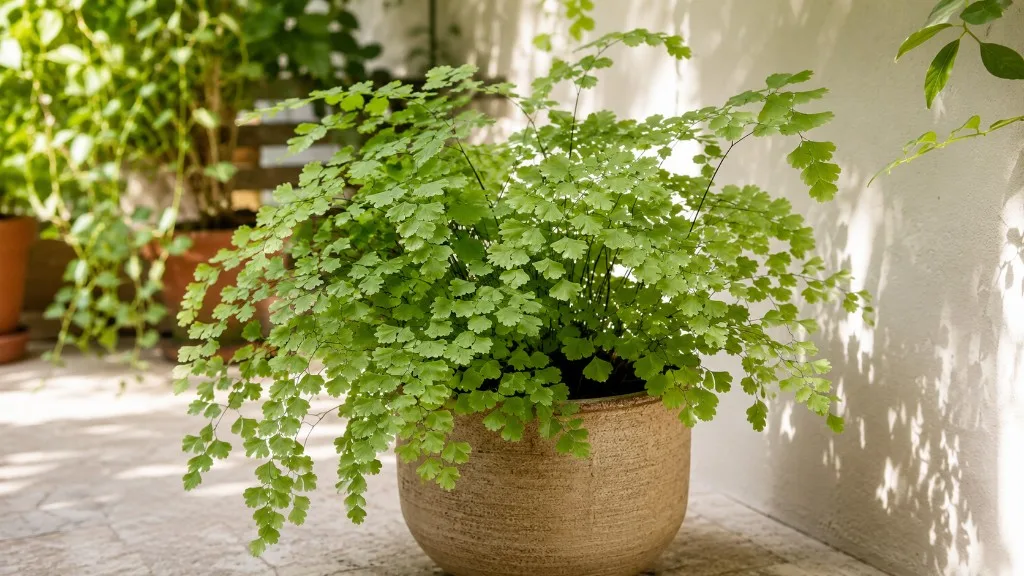
Walk into a plant shop, pick up a pot of maidenhair fern, and the first thing you notice is the foliage: fan-shaped leaflets on wiry black stems, layered like green lace. The second thing you learn - often within a week - is that Maidenhair Fern overview does not forgive dry soil or dry air the way a pothos or snake plant does. Adiantum raddianum, the delta maidenhair fern sold in most houseplant sections, is a true fern from the Pteridaceae family, native to the Tropical Americas and West Indies, and it evolved beside waterfalls and moist rock crevices where the root zone never dries and the air stays humid. Indoors, your job is to approximate that stability, not to water on a calendar and hope for the best.
This guide covers what the plant actually is, how to set light, water, humidity, soil, and temperature so it stays lush, what to do when fronds brown or collapse overnight, how to propagate and repot without triggering a meltdown, and why it is one of the few elegant foliage plants that is genuinely pet-safe - if you can keep both the plant and your cat away from each other.
For related Maidenhair Fern care, see Calcium Deficiency on Maidenhair Fern, Chemical Damage on Maidenhair Fern, Cold Damage on Maidenhair Fern.
What Maidenhair Fern Actually Is (A True Fern With Unforgiving Tolerances)
Unlike the asparagus “fern,” which is not a fern at all, maidenhair fern is a real fern. It belongs to the genus Adiantum, from the Greek adiantos, meaning “unwetted” - a reference to the way water beads off the leaf surface rather than soaking in. The Missouri Botanical Garden’s Plant Finder entry for Adiantum raddianum describes delta maidenhair fern as perhaps the most commonly grown of the non-hardy maidenhair ferns, with triangular, 4-pinnate fronds on dark stems emerging from a dense rhizome. Fronds typically reach about 12 inches wide and 18 inches long in cultivation, and the whole plant usually settles at 30–60 cm tall and wide (roughly 1–2 feet), per the North Carolina Extension Gardener Plant Toolbox.
That botanical detail matters for care expectations. Ferns reproduce by spores borne on the undersides of fronds (in sori covered by reflexed leaf margins), not by flowers and seeds. They spread in nature by creeping rhizomes, which is why division at Maidenhair Fern repotting guide works so well at home. The fronds themselves are thin and membranous - the NC State toolbox calls them “delicate, lace-like” - which means they lose water to the air quickly. A thick-leaved philodendron can ride out a missed watering; a maidenhair often cannot.
Outdoors, A. raddianum is winter hardy only in USDA zones 10–11 (NC Extension lists 9b–10b for the species). In most of the United States it is grown as a houseplant, where the Missouri Botanical Garden notes it “can be a difficult plant to grow” outside of a very humid atmosphere. That is not a reason to avoid it. It is a reason to read your room honestly before you buy.
The Species You Are Likely Growing
The name “maidenhair fern” covers several Adiantum species. Care overlaps, but knowing which one you have helps with hardiness expectations if you ever move the plant outdoors.
Adiantum raddianum (Delta Maidenhair)
This is the plant in most indoor pots, also sold as delta maidenhair, trailing maidenhair, or simply Adiantum fern. It is native to tropical South America and the West Indies, with arching fronds made of small triangular pinnae on glossy dark stipes. The RHS lists it as a moist but well-drained house or conservatory fern needing bright, indirect light, high humidity, and free watering in the growing season with sparing water in winter. It is the reference species for this guide.
Other Adiantum Species You May See in Shops
Adiantum capillus-veneris (southern maidenhair) appears in terrariums and specialty shops; Clemson University’s HGIC indoor fern factsheet notes it needs high humidity around 50%, north-window light, and soil kept moist at all times - and calls maidenhairs difficult in most homes without special care. Adiantum pedatum (northern maidenhair) is a hardy garden fern in temperate climates (zones 3–8) with a different frond architecture; it is not the same plant as the tropical delta form, though the common name overlaps. If your tag says only “maidenhair,” assume A. raddianum unless the frond shape or hardiness rating clearly points elsewhere.
Light: Bright Indirect, Never Direct Sun
Maidenhair ferns are forest-floor and rock-crevice plants. Indoors, they want bright, indirect light or diffused sun - enough brightness to keep fronds dense and green, but no direct sun falling on the leaflets. The Missouri Botanical Garden is explicit: the plant “dislikes direct sun,” and if grown in full shade, foliage loses vitality. Direct sun scorches the thin fronds quickly, producing dark brown patches that do not green up again.
The practical placement that works in most homes: 3–6 feet back from an east- or north-facing window, or behind a sheer curtain on a south- or west-facing window. BBC Gardeners’ World recommends a spot with plenty of bright, indirect light but no direct sunshine. An east window is often ideal because morning sun is gentle and afternoon heat never hits the fronds. If the only bright spot is a south window, pull the pot back from the glass or filter the light; a few hours of direct sun through clear glass is enough to crisp an entire frond.
Low light is survivable for a short time but shows up as pale, weak fronds and sparse new growth. If you are growing in a bathroom with a small frosted window, check whether the plant is actually receiving enough brightness - steam does not replace photons. A supplemental LED grow light on a 12–14 hour timer, placed 12–18 inches above the crown, can rescue a fern in a dim room as long as heat from the fixture does not bake the fronds.
Watch the plant, not the label. Bleached or scorched leaflets mean too much light or a sudden move into stronger sun. Thin, stretched fronds mean too little. Adjust placement gradually; ferns hate abrupt light changes almost as much as dry soil.
Watering: Never Let the Root Ball Dry Out
If you remember one rule for maidenhair fern watering, make it this: roots must never be allowed to dry out. The Missouri Botanical Garden states that plainly, and the RHS pairs “water freely” in summer with the same moist-but-not-soggy standard. This is not a plant that wants to dry halfway down the pot between drinks. When the top centimeter of mix feels barely dry, water again. In many homes that means checking every 2–3 days in spring and summer, and every 5–7 days in winter - but the interval is a starting point, not a schedule.
The collapse is fast. Thin fronds lose turgor quickly when the rhizome dries; what looked fine in the morning can look like wet paper by evening. Clemson HGIC warns that none of the delicate ferns should be allowed to dry out completely, and that applies doubly here. At the same time, do not let the pot sit in standing water. Water thoroughly until it runs from the drainage holes, then empty the saucer within 30 minutes. Constantly saturated mix invites Pythium and Rhizoctonia root pathogens - a real risk when humidity is high and airflow is poor.
How to Read Soil Moisture Without Guesswork
The finger test remains the most reliable tool. Insert your finger to the first knuckle; if the mix at that depth feels cool and slightly damp, wait. If the surface is barely dry and the pot feels light for its size, water slowly until the whole root ball is evenly moist. Lift the pot after watering a few times until you learn the weight difference between properly moist and too dry.
Water quality matters more than many growers expect. Several extension and horticultural sources note sensitivity to fluoride and chlorine in tap water, which can accumulate in thin leaflets and cause brown tips even when soil moisture is correct. Rainwater, distilled water, or filtered water at room temperature is the safer default. University of Minnesota Extension recommends lukewarm or room-temperature water for tropical ferns because cold water can shock roots.
In winter, growth slows and the pot may stay wet longer, but complete dry-out is still fatal. Reduce the volume per watering slightly if needed, but keep the root zone consistently moist. A plant that is dropping fronds in February is more often fighting dry air than asking for drought.
Humidity: The Variable That Decides Success
High humidity is the other half of the equation. Target 60–80% relative humidity for steady growth; 50% is a workable floor cited by Clemson HGIC for southern maidenhair and several care references for A. raddianum. The problem is that heated indoor air in winter often sits at 30–40%, which pulls moisture from thin fronds even when the soil is correct. That is why the plant “does everything right” on watering and still browns at the edges.
University of Minnesota Extension is direct about misting: it is not very effective for raising humidity, and it increases the likelihood of foliar leaf spot diseases. The same guidance recommends relying on room humidifiers instead. That aligns with the botanical reality of the plant: the hydrophobic leaf surface that gives Adiantum its name repels mist droplets rather than absorbing them, so a spray bottle provides a brief, local bump at best.
Humidifier, Pebble Tray, Bathroom, or Terrarium
Ranked by reliability for most homes:
A cool-mist humidifier set to maintain 55–65% RH near the plant is the most dependable fix outside a dedicated grow cabinet. Pair it with a small hygrometer so you are measuring reality, not guessing. Grouping humidity-loving plants raises the local microclimate a few points through shared transpiration; it helps, but it rarely reaches target alone in a dry living room.
A pebble tray - gravel or clay pebbles in a shallow tray, water kept below the top of the stones so the pot base never touches liquid - raises humidity immediately around the fronds through evaporation. The Missouri Botanical Garden and RHS both recommend placing the container on a tray of moist gravel or pebbles. It is simpler than a humidifier but less powerful; in winter you may need both.
Bathroom or kitchen placement works when there is enough light and the room stays above roughly 60°F (15°C) overnight. Shower steam adds ambient moisture that misting cannot replicate, which is why the NC Extension toolbox notes the fern does well in bathrooms. Avoid placing the pot directly beside a shower splash zone where water hits the crown repeatedly unless you have excellent drainage and airflow.
A closed or mostly closed terrarium is one of the best environments for A. raddianum because enclosed glass holds humidity with minimal effort. UMN Extension notes terrariums as effective mini-greenhouses for moisture-loving plants. Leave some ventilation so fronds do not stay constantly wet and cold; fungal problems appear when humidity is high and airflow is zero.
Temperature and Draft Protection
Maidenhair ferns want warm, stable indoor temperatures, roughly 16–24°C (60–75°F) during the day. BBC Gardeners’ World suggests 15–21°C as a comfortable range and warns not to let the plant go below 10°C (50°F) in winter. The Missouri Botanical Garden tells you to avoid drafty areas and locations near heat registers - both dry the air and shock the fronds.
Cold drafts from a winter window, an air-conditioning vent, or a frequently opened door can trigger mass frond drop even when soil moisture is fine. Heat registers and radiators are equally damaging because they create a micro-desert within a foot of the pot. Move the plant at least a few feet from heating and cooling sources, and in deep winter pull it back from cold window glass at night if condensation or chill radiates through the pane.
Some growers give the plant a slight winter rest: slightly cooler nights, reduced but never absent watering, and no fertilizer. That mirrors the RHS advice to water sparingly in winter while still keeping the mix from drying out. Do not interpret “rest” as “neglect.”
Soil and Pot Choice
The mix should be moisture-retaining but well-draining - rich enough to hold water near the rhizome, porous enough that the center of the root ball does not stay anaerobic. The RHS recommends a peat-free houseplant compost in a container with good ventilation at the surface. A practical recipe aligned with what this species tolerates in cultivation: 50% quality potting compost, 30% coco coir, and 20% fine orchid bark, with optional perlite for extra aeration and a small amount of worm castings for organic matter. Target pH 5.5–7.0; most peat-free indoor mixes already fall in that range.
Avoid heavy garden soil and dense, compacted store mixes that turn to mud when wet. The NC Extension toolbox lists good drainage with occasionally wet conditions as the native cultural pattern - moist, not swampy. If water sits on the surface or the pot stays heavy for days after every watering, the mix is too dense or the pot is too large.
For containers, drainage holes are non-negotiable. Glazed ceramic or plastic retains moisture longer than terracotta, which breathes and can dry the root ball too quickly for this species in a warm, airy room. If you love terracotta aesthetically, check soil daily and accept that you may water more often. Choose a pot only slightly larger than the root ball; an oversized pot holds water the rhizome cannot use and is a common post-repotting death sentence.
Fertilizer: Light Feeding in Active Growth Only
Maidenhair ferns are moderate feeders, not hungry monsters. The RHS advises a half-strength general liquid feed monthly from mid-spring to late summer. University of Minnesota Extension notes that ferns should be fertilized only when actively putting on new growth or when foliage looks paler green than normal. In practice, that means monthly half-strength balanced liquid fertilizer from roughly April through August, then stop entirely in autumn and winter.
Always water the plant first, then apply fertilizer to already-moist soil. Feeding dry roots concentrates salts and burns delicate fronds. If you see brown tips with no drought symptoms, suspect salt buildup from fertilizer or tap water; flush the pot with plain water until it runs clear from the drainage holes, then pause feeding for several weeks.
This plant does not need fertilizer to survive if the basics are right. Light and humidity matter more than any bottle on the shelf. If the fern is stressed, newly repotted, or recovering from collapse, skip feeding until new fronds unfurl cleanly.
Repotting Without Triggering Collapse
Repot every 1–2 years in spring, when new croziers (coiled fronds) are emerging. Signs you are overdue: roots circling the surface, water running straight through dry pockets, or the mix drying out unusually fast despite correct watering. Maidenhair ferns tolerate being slightly root-bound better than being plunged into a huge new pot.
The procedure: water the day before, slide the root ball out gently, and move up only one pot size (about 2–3 cm / 1 inch of additional diameter). Tease away only the outer 10–20% of old mix if it is compacted; disturb the crown as little as possible. Repot at the same depth - burying the rhizome too deep encourages rot. Water lightly after repotting and keep humidity high and light stable for two to three weeks while roots heal.
Do not repot on day one after purchase unless the mix is clearly failing or pests are visible. The first month at home should be boring: learn how fast your pot dries in your light, and change only one variable at a time if problems appear.
Propagation by Division and Spores
Division at repotting is the practical home method. Each section needs healthy rhizome, roots, and at least one frond. Use a clean knife to separate clumps, replant in moist mix, and keep humidity high and light bright but indirect until new growth confirms the division has rooted. Do not propagate from a collapsed or pest-ridden parent; weak divisions fail at a high rate.
Spore propagation is botanically correct - true ferns, true spores - but slow. Mature fronds bear sori on leaflet margins; collected spores are sown on sterile, moist medium under a dome at warm room temperature. Germination and gametophyte development take weeks to months, and the first sporophytes are tiny. Treat spores as a project for patience, not a quick way to fill a shelf.
Pet Safety: Non-Toxic but Fragile
Good news for pet owners: maidenhair fern is non-toxic to cats and dogs. University extension references list Adiantum species, including maidenhair fern, as non-toxic to both cats and dogs. That makes it a legitimate option for pet-aware homes where toxic ornamentals are off the table - a meaningful contrast with asparagus “fern,” which is toxic despite the similar common name.
Pet-safe is not chew-proof. Large amounts of any plant material can cause mild gastrointestinal upset from fiber, and the delicate fronds are easily shredded by curious cats. Placement still matters: a hanging basket, high shelf, or closed terrarium protects the plant from the pet and the pet from eating a mouthful of leaves. If ingestion occurs and symptoms persist beyond 24 hours, contact your veterinarian; mention that extension guides list the plant as non-toxic so they can focus on volume and sensitivity rather than toxin exposure.
Common Problems and Honest Fixes
Most maidenhair problems trace back to water, humidity, light, or airflow, not mysterious fern diseases. The diagnostic order is always the same: touch the soil, measure or estimate humidity, check light and drafts, inspect for pests, review water quality.
Brown, crispy fronds are the signature complaint. The usual causes, often in combination, are dry soil, low humidity, direct sun, heat or AC drafts, and fluoride/chlorine in tap water. Fix the environment before you prune aggressively. Remove fully dead fronds at the base with clean scissors; partially green fronds can stay if the plant is stabilizing.
Yellowing fronds with soggy mix point to overwatering on Maidenhair Fern or poor drainage - roots cannot breathe, and lower fronds yellow first. Unpot if the mix smells sour, trim black or mushy rhizome tissue, and repot in fresh, airy mix. Yellowing with dry mix and crispy edges is drought and low humidity, not nutrient deficiency.
Mass frond drop overnight almost always means the root ball dried or the plant caught a cold or hot draft. Recovery is possible if the rhizome is still firm and pale green or tan inside when you scrape lightly with a fingernail. If the crown is soft, black, and foul-smelling, the plant is gone.
Scale and mealybugs appear on stems and hidden crevices; the Missouri Botanical Garden lists both as pests to watch for. Treat with cotton swabs dipped in 70% isopropyl alcohol on visible insects, then insecticidal soap on a weekly cycle, and raise humidity only after you have improved airflow so fronds do not stay wet overnight.
root rot on Maidenhair Fern from chronic overwatering shows as wilting on wet soil and mushy roots. Unpot immediately, cut away all soft tissue, repot in fresh mix, and withhold heavy watering until new croziers appear. Prevention - a breathable mix, drainage holes, and empty saucers - is far easier than cure.
Reviving a Collapsed Plant
A collapsed maidenhair looks dramatic but is not always dead. If the rhizome is firm:
Cut all collapsed fronds to the soil line with sterile scissors. The plant looks bare, but the crown can still push new croziers. Water slowly until the mix is evenly moist, not flooded. Move the pot to Maidenhair Fern light guide with humidity at 60% or higher - humidifier plus pebble tray if needed. Do not fertilize until new fronds are several inches tall. Wait 2–4 weeks; new growth often emerges from the rhizome once moisture and humidity stay stable. If nothing appears after six weeks and the crown is shrinking or softening, discard the plant and fix the setup before trying again.
Best Placements in a Real Home
The honest best spots, ranked:
Bright bathroom with a window - steam plus indirect light matches the native niche better than most rooms, provided the plant is not sitting in direct splash or on a cold windowsill.
Kitchen shelf near an east window - humidity from cooking helps, and morning light is gentle on fronds.
Terrarium or glass cloche on a bright desk or side table - enclosed humidity without turning the whole room into a rainforest.
Living room with a dedicated humidifier - perfectly viable if you commit to running the humidifier through heating season and checking soil every few days.
Poor fits: dry offices with HVAC, south-facing windowsills with afternoon sun, entryways with winter drafts, and spots beside radiators. Maidenhair fern is a poor choice for beginners, frequent travelers, and low-humidity homes unless you invest in a humidifier or enclosed case from day one.
When shopping, choose plants with firm new croziers, clean frond undersides, and mix that smells neutral - not sour. Cosmetic old-leaf damage is less worrying than collapsed crowns, sticky residue, or wet mix in a dark corner of the shop.
Conclusion
Maidenhair fern care comes down to stability: bright indirect light, consistently moist but never waterlogged soil, and humidity at or above 50% - ideally 60–80% - in warm, draft-free air. Adiantum raddianum is a true fern with delicate fronds that punish dry roots and dry air faster than almost any popular houseplant, but it is also non-toxic to cats and dogs and genuinely beautiful when the environment matches its tropical-American origins.
If you can check the pot every few days, run a humidifier through winter, and resist the urge to repot, fertilize, and relocate all in the same week, this plant will produce fresh black-stemmed fronds for years. If your home is dry and your schedule is unpredictable, a tougher fern or a closed terrarium setup is the more honest path. Know which camp you are in before you buy - the plant will tell you within the first month either way.
When to use this page vs other Maidenhair Fern guides
- Maidenhair Fern overview - Canonical hub for this species - care topics and problems branch from here.
- Maidenhair Fern problems - Symptom-first path when you already know something is wrong.
Related Maidenhair Fern guides
- Maidenhair Fern watering
- Maidenhair Fern light
- Maidenhair Fern soil
- Maidenhair Fern propagation
- Maidenhair Fern fertilizer
- Maidenhair Fern repotting
- Maidenhair Fern pruning
- Aphids on Maidenhair Fern
- Bacterial Wilt on Maidenhair Fern
- Black Spots on Maidenhair Fern
- Blight on Maidenhair Fern
- Brown Tips on Maidenhair Fern
How to care for Maidenhair Fern?
How much light does Maidenhair Fern need?
medium indirect light
- medium indirect light - medium indirect light.
When should you water Maidenhair Fern?
Every 2–3 days - keep soil consistently moist. Never allow the root ball to dry out. Use filtered or rainwater. Check soil daily in hot weather.
- Daily touch check; use weight of pot as a guide - Check soil daily in hot weather.
- Drain excess water - Use filtered or rainwater.
What soil works best for Maidenhair Fern?
50 % potting compost + 30 % coco coir + 20 % fine orchid bark. Moisture-retaining but well-draining. pH 5.5–7.0.
- coco coir - 50 % potting compost + 30 % coco coir + 20 % fine orchid bark.
- perlite - Light white granules that keep soil airy and help prevent compaction.
- fine orchid bark - 50 % potting compost + 30 % coco coir + 20 % fine orchid bark.
Grower notes for Maidenhair Fern
What matters most with Maidenhair Fern
Maidenhair Fern is less forgiving of dry air and missed watering than tough foliage plants. The trick is steady moisture with oxygen, not a swampy pot. In practice, the care checkpoint is simple: medium indirect light. Pair that with 50 % potting compost + 30 % coco coir + 20 % fine orchid bark. Moisture-retaining but well-draining; pH 5.5–7.0, and avoid changing water, pot size, and placement all at once.
Best placement in a real home
Maidenhair Fern belongs where medium indirect light is realistic for most of the day, not only where the pot looks good. Every 2–3 days - keep soil consistently moist. Never allow the root ball to dry out. Use filtered or rainwater. Check soil daily in hot weather. If the pot stays wet longer than expected, move the plant into better light or reassess the mix before watering again. Humidity target: 60–80%. Temperature comfort zone: 16–24°C (60–75°F).
Before you buy this plant
Choose Maidenhair Fern with firm new growth, clean leaf undersides, and soil that does not smell sour or feel compacted. Be cautious if you see brown-tips, sticky residue, collapsed crowns, or a pot that is wet in poor light. Cosmetic old-leaf damage is less worrying than weak roots or active pests.
First month after bringing it home
Do not repot Maidenhair Fern on day one unless the mix is failing or pests are obvious. Quarantine it, learn how fast the pot dries, and keep care boring while it adjusts. Watch especially for brown-tips, yellow-leaves, and root-rot. If problems appear, correct the condition first rather than stacking fertilizer, repotting, and pruning together.
Pet-aware note for Maidenhair Fern
Maidenhair Fern is a better choice for pet-aware homes than toxic ornamentals, but pet safe does not mean the plant should be chewed. Use hanging, shelf, or room placement if pets dig in soil or shred leaves, and choose sturdier plants for high-traffic pet zones.
How to tell Maidenhair Fern is settling in
Also sold as Delta Maidenhair, Trailing Maidenhair, and Adiantum fern, this plant should be judged by stable new growth rather than label names alone. If you plan to multiply it later, common methods include Division. Repot only when you see roots tight in pot and very rapid drying. If yellow-leaves shows up early, inspect light, watering, and roots before assuming the plant is permanently weak.
Is Maidenhair Fern safe for pets?
Maidenhair Fern is non-toxic to cats, dogs, and humans. It is a safe choice for households with pets.
Adiantum raddianum is listed as non-toxic by ASPCA. Safe for cats, dogs, and children.
Watering Maidenhair Fern
For Maidenhair Fern, daily touch check; use weight of pot as a guide and water check every 2–3 days; water whenever top cm is barely dry. Keep consistently moist year-round; reduce very slightly in winter.
| Detail | Information |
|---|---|
| How often | Check every 2–3 days; water whenever top cm is barely dry |
| How to check | Daily touch check; use weight of pot as a guide |
| Seasonal changes | Keep consistently moist year-round; reduce very slightly in winter |
Signs of overwatering
- yellowing fronds
- soil that never dries
- soggy roots
Signs of underwatering
- immediate frond collapse and browning
- mass leaf drop
Soil & potting for Maidenhair Fern
Use a mix of coco coir, perlite, fine orchid bark, worm castings for Maidenhair Fern. Moderate-holds moisture but drains freely. Target soil pH around 6.0–7.0. Repot every 1–2 years, ideally in spring.
| Detail | Information |
|---|---|
| Recommended mix | coco coir, perlite, fine orchid bark, worm castings |
| Drainage | Moderate-holds moisture but drains freely |
| Soil pH | 6.0–7.0 |
| Repotting frequency | Every 1–2 years |
| Best season to repot | Spring |
Signs it needs repotting
- roots tight in pot
- very rapid drying
Humidity & temperature for Maidenhair Fern
Maidenhair Fern prefers 60–80%, though normal home humidity is usually fine. Keep temperatures around 16–24°C (60–75°F).
| Detail | Information |
|---|---|
| Humidity | 60–80% - normal home humidity is fine. |
| Ideal temperature | 16–24°C (60–75°F) |
Fertilizer & pruning for Maidenhair Fern
Use use half-strength balanced liquid fertilizer and stop if the plant is stressed, newly repotted, or not actively growing. Over-fertilizing-leaves brown at tips from salt build-up. for Maidenhair Fern.
| Detail | Information |
|---|---|
| Fertilizer type | Use half-strength balanced liquid fertilizer and stop if the plant is stressed, newly repotted, or not actively growing. Over-fertilizing-leaves brown at tips from salt build-up. |
Common problems on Maidenhair Fern
Aphids
MediumLikely cause: Getting rid of aphids and caring for your maidenhair fern may seem daunting, but with the right strategies, you can protect your plant and enjoy its beauty for years to come.
Quick fix: Confirm diagnosis on your Maidenhair Fern, then address the most likely care or pest factor described in current extension guidance.
Full fix guide →Bacterial Wilt
HighLikely cause: Aug 14, 2025 · Maidenhair ferns prefer stable temperatures, ideally between 60°F and 75°F (15°C to 24°C). Sudden drops below 50°F (10°C) or exposure to cold drafts stress the plant, causing fronds to brown and wilt . Keep the fern away from
Quick fix: Confirm diagnosis on your Maidenhair Fern, then address the most likely care or pest factor described in current extension guidance.
Full fix guide →Black Spots
MediumLikely cause: Dec 9, 2025 · Understanding the causes behind these spots is crucial for restoring your Maidenhair Fern to its former glory and ensuring its continued health. This blog post will delve into the common culprits, offering practical solutions
Quick fix: Confirm diagnosis on your Maidenhair Fern, then address the most likely care or pest factor described in current extension guidance.
Full fix guide →Blight
MediumLikely cause: Aug 14, 2025 · Botrytis blight , also known as gray mold, can appear as a fuzzy gray growth on decaying tissue, particularly in overly damp environments. This fungal disease thrives in cool, humid conditions with poor ventilation. Proper ai
Quick fix: Confirm diagnosis on your Maidenhair Fern, then address the most likely care or pest factor described in current extension guidance.
Full fix guide →Brown Tips
HighLikely cause: Low humidity or fluoride in tap water
Quick fix: Increase humidity to 60%+; switch to filtered water
Full fix guide →Calcium Deficiency
MediumLikely cause: Jul 31, 2024 · In addition to these primary macronutrients, ferns also require micronutrients like magnesium, calcium , iron, and manganese. These trace elements play vital roles in photosynthesis and growth.
Quick fix: Confirm diagnosis on your Maidenhair Fern, then address the most likely care or pest factor described in current extension guidance.
Full fix guide →Chemical Damage
MediumLikely cause: Nov 25, 2022 · The data suggest that even low levels of exogenous metals induce an oxidative imbalance, although no visible damage is observed, and that the responses of ferns to metals are similar to those of...
Quick fix: Confirm diagnosis on your Maidenhair Fern, then address the most likely care or pest factor described in current extension guidance.
Full fix guide →Cold Damage
MediumLikely cause: Jun 3, 2024 · In this article, we'll explore what you can do to nurse your maidenhair fern back to health after cold damage . We’ll cover everything from identifying signs of cold stress to providing practical tips on how to revive your pla
Quick fix: Confirm diagnosis on your Maidenhair Fern, then address the most likely care or pest factor described in current extension guidance.
Full fix guide →Deformed New Growth
MediumLikely cause: Mar 9, 2024 · In this article, we'll explore how to get your maidenhair fern thriving with new growth . We’ll cover everything from choosing the right spot in your home, to understanding their watering needs, and even tackling those pesky p
Quick fix: Confirm diagnosis on your Maidenhair Fern, then address the most likely care or pest factor described in current extension guidance.
Full fix guide →Drooping Leaves
MediumLikely cause: One of the most common factors that lead Maidenhair Fern plants to lose their leaves is consistent underwatering and dry soil. This is because the roots will begin to crisp up and your plant won’t be able to keep all of its leaves and stems
Quick fix: Confirm diagnosis on your Maidenhair Fern, then address the most likely care or pest factor described in current extension guidance.
Full fix guide →Dry Hydrophobic Soil
MediumLikely cause: Jan 21, 2024 · For maidenhair ferns , the right soil provides the perfect blend of moisture retention and drainage, so the roots have constant access to water without being suffocated. Improper soil can lead to a host of problems. Too dense
Quick fix: Confirm diagnosis on your Maidenhair Fern, then address the most likely care or pest factor described in current extension guidance.
Full fix guide →Exposed Roots
MediumLikely cause: Feb 8, 2023 · Root rot: Caused by overwatering, root rot presents as dark, mushy roots . To resolve, cut away affected roots , repot the plant in fresh soil, and adjust your watering routine.
Quick fix: Confirm diagnosis on your Maidenhair Fern, then address the most likely care or pest factor described in current extension guidance.
Full fix guide →Faded Leaves
MediumLikely cause: It’s normal for your Maidenhair Fern to prioritise its energy on new bigger growth, meaning it will lose its oldest leaves in order to mature. As long as your Maidenhair Fern is growing more new leaves than it is losing them, then you don’t
Quick fix: Confirm diagnosis on your Maidenhair Fern, then address the most likely care or pest factor described in current extension guidance.
Full fix guide →Fertilizer Burn
MediumLikely cause: Aug 11, 2025 · Too much fertilizer can lead to chemical burn , impairing water and nutrient absorption. While some fertilization supports healthy growth, over-fertilization poses a significant risk. When selecting a fertilizer for maidenhai
Quick fix: Confirm diagnosis on your Maidenhair Fern, then address the most likely care or pest factor described in current extension guidance.
Full fix guide →Heat Stress
MediumLikely cause: Oct 13, 2023 · Keeping your Maidenhair Fern happy in hot weather involves understanding its temperature preferences and adjusting its environment accordingly. By monitoring signs of stress and providing the right conditions, you can ensure
Quick fix: Confirm diagnosis on your Maidenhair Fern, then address the most likely care or pest factor described in current extension guidance.
Full fix guide →Holes in Leaves
MediumLikely cause: Jan 11, 2025 · Yellow leaves on a maidenhair fern can be a sign of several issues, ranging from overwatering to nutrient deficiencies. It's important to diagnose the root cause to address the problem effectively.
Quick fix: Confirm diagnosis on your Maidenhair Fern, then address the most likely care or pest factor described in current extension guidance.
Full fix guide →Iron Deficiency
MediumLikely cause: Common nutrient deficiencies: – Iron deficiency can cause yellowing between leaf veins – Magnesium deficiency may result in older fronds turning yellow while veins remain green To address nutrient deficiencies, consider using a specialized
Quick fix: Confirm diagnosis on your Maidenhair Fern, then address the most likely care or pest factor described in current extension guidance.
Full fix guide →Leaf Miners
MediumLikely cause: Mar 18, 2024 · The Southern maidenhair fern, or A. capillus-veneris, has fronds with a drooping or weeping habit. The petioles are unbranching, and leaflets extend off of straight leafstalks .
Quick fix: Follow extension or botanical guidance for Maidenhair Fern leaf miners; adjust care before applying broad treatments.
Full fix guide →Leaf Spot Disease
MediumLikely cause: Jan 21, 2024 · In this guide, we'll take a closer look at some common diseases that can affect your maidenhair fern , how to identify them, and what you can do to nurse your plant back to health.
Quick fix: Confirm diagnosis on your Maidenhair Fern, then address the most likely care or pest factor described in current extension guidance.
Full fix guide →Leggy Growth
LowLikely cause: Nov 23, 2024 · Although maidenhair ferns prefer indirect light, they can become leggy if they're not getting enough. Imagine if you had to squint all day because the room was dim—that's a bit how your fern feels when it's stuck in a shaded
Quick fix: Confirm diagnosis on your Maidenhair Fern, then address the most likely care or pest factor described in current extension guidance.
Full fix guide →Magnesium Deficiency
MediumLikely cause: Common nutrient deficiencies: – Iron deficiency can cause yellowing between leaf veins – Magnesium deficiency may result in older fronds turning yellow while veins remain green To address nutrient deficiencies, consider using a specialized
Quick fix: Confirm diagnosis on your Maidenhair Fern, then address the most likely care or pest factor described in current extension guidance.
Full fix guide →Mealybugs
MediumLikely cause: Aug 5, 2024 · Maintaining a healthy Maidenhair Fern involves vigilance against potential pest threats such as aphids, mealybugs , spider mites, scale insects, and whiteflies. By knowing how to identify these common pests and employing effec
Quick fix: Confirm diagnosis on your Maidenhair Fern, then address the most likely care or pest factor described in current extension guidance.
Full fix guide →Mold on Soil
LowLikely cause: I just noticed this mould growing on the top of the soil , there are brown and white patches. No idea what this is, if it's good or bad or how to get rid of them.
Quick fix: Confirm diagnosis on your Maidenhair Fern, then address the most likely care or pest factor described in current extension guidance.
Full fix guide →Mosaic Virus
MediumLikely cause: Feb 28, 2007 · Maidenhair fern showing symptoms associated with possible virus infection were collected from the Chadwick Arboretum on the campus of The Ohio State University, Columbus. The leaves of the affected plants were slightly malfor
Quick fix: Confirm diagnosis on your Maidenhair Fern, then address the most likely care or pest factor described in current extension guidance.
Full fix guide →Nitrogen Deficiency
MediumLikely cause: Jul 31, 2024 · Yellowing Leaves If you notice yellowing leaves, it may indicate a nitrogen deficiency . Adjust your fertilization regime by incorporating more nitrogen -rich options.
Quick fix: Confirm diagnosis on your Maidenhair Fern, then address the most likely care or pest factor described in current extension guidance.
Full fix guide →No Drainage Hole
MediumLikely cause: Aug 14, 2025 · Maidenhair ferns do not require heavy feeding. Improper soil drainage plays a significant role in overwatering problems. Heavy, compacted potting mixes retain too much moisture, creating an environment conducive to root rot.
Quick fix: Confirm diagnosis on your Maidenhair Fern, then address the most likely care or pest factor described in current extension guidance.
Full fix guide →Not Enough Light
MediumLikely cause: May 21, 2026 · A simple fix for insufficient light is to move your plant to a brighter location in your home or use a grow light. LED grow lights are perfect as they won’t burn the fern ’s sensitive leaves Mar 30, 2026 · If growth is slow o
Quick fix: Confirm diagnosis on your Maidenhair Fern, then address the most likely care or pest factor described in current extension guidance.
Full fix guide →Nutrient Lockout
MediumLikely cause: Jul 31, 2024 · During winter, refrain from fertilizing your maidenhair fern entirely. The plant enters a resting phase where growth slows down significantly, and additional nutrients are unnecessary and may even harm the plant.
Quick fix: Confirm diagnosis on your Maidenhair Fern, then address the most likely care or pest factor described in current extension guidance.
Full fix guide →Overwatering
HighLikely cause: Can I save my maidenhair fern if it’s severely overwatered? Yes, you can! By following the steps outlined, you can rescue your fern. I recommend acting quickly to prevent further damage. Aug 7, 2025 · When an overwatered maidenhair fern is
Quick fix: Confirm diagnosis on your Maidenhair Fern, then address the most likely care or pest factor described in current extension guidance.
Full fix guide →Poor Drainage
MediumLikely cause: Jan 11, 2025 · Root rot is a serious condition that can cause significant damage to your maidenhair fern . It's usually caused by overwatering and poor drainage . Signs of Root Rot: Look for wilting, yellowing leaves and a foul smell coming
Quick fix: Confirm diagnosis on your Maidenhair Fern, then address the most likely care or pest factor described in current extension guidance.
Full fix guide →Pot Too Large
MediumLikely cause: Jul 31, 2024 · When choosing a pot for your maidenhair fern , consider the size carefully. A pot that is too small will restrict the plant’s growth, while a pot that is too large can lead to overwatering issues. A 6-8 inch pot is typically
Quick fix: Confirm diagnosis on your Maidenhair Fern, then address the most likely care or pest factor described in current extension guidance.
Full fix guide →Powdery Mildew
HighLikely cause: Aug 5, 2024 · Powdery mildew is a fungal disease characterized by white or gray powdery spots on leaves and stems. It develops in warm, dry conditions with poor air circulation, making it more prevalent during late summer or in poorly venti
Quick fix: Confirm diagnosis on your Maidenhair Fern, then address the most likely care or pest factor described in current extension guidance.
Full fix guide →Purple Leaves
MediumLikely cause: Mar 18, 2024 · Beneath the leaves , spores are produced during the summer months. When the weather is very dry or cold, the plant sheds its leaves . As with all ferns , maidenhair fern is non-flowering. There are about 250 species of Adiant
Quick fix: Follow extension or botanical guidance for Maidenhair Fern purple leaves; adjust care before applying broad treatments.
Full fix guide →Red Leaves
MediumLikely cause: Dec 29, 2025 · Maidenhair ferns (Adiantum species) are some of the most elegant and delicate ferns you can find. Their airy, finely divided leaves and glossy black stems make them a stunning addition to any plant collection. With about 250
Quick fix: Confirm diagnosis on your Maidenhair Fern, then address the most likely care or pest factor described in current extension guidance.
Full fix guide →Repotting Stress
MediumLikely cause: Aug 7, 2025 · Watering the fern thoroughly a day or two before repotting can help ease the plant’s removal from its old pot and minimize stress on the roots during the process. Begin the repotting process by gently removing the maidenhair f
Quick fix: Confirm diagnosis on your Maidenhair Fern, then address the most likely care or pest factor described in current extension guidance.
Full fix guide →Root Bound
MediumLikely cause: Apr 17, 2026 · Maidenhair ferns prefer to be root-bound , so container-grown plants should be repotted when their root system fills their current container. Regular repotting every two years or sooner if necessary is essential to ensure opt
Quick fix: Confirm diagnosis on your Maidenhair Fern, then address the most likely care or pest factor described in current extension guidance.
Full fix guide →Root Rot
MediumLikely cause: Persistent waterlogging from poor drainage
Quick fix: Ensure drainage holes clear; repot in airy moist mix
Full fix guide →Rust Disease
MediumLikely cause: Jul 10, 2024 · This article will walk you through everything you need to know about maidenhair fern rust fungus , from identifying the problem to treating and preventing it. We’ll also share some tips on how to keep your ferns healthy and t
Quick fix: Confirm diagnosis on your Maidenhair Fern, then address the most likely care or pest factor described in current extension guidance.
Full fix guide →Salt Build-up
MediumLikely cause: Jan 20, 2024 · Over-fertilizing can lead to salt build-up in the soil, which can harm the plant. If you notice white crusts on the soil surface or leaf tips turning brown, it might be a sign to flush the soil with water to remove excess sal
Quick fix: Confirm diagnosis on your Maidenhair Fern, then address the most likely care or pest factor described in current extension guidance.
Full fix guide →Scale Insects
MediumLikely cause: Scale insects are tiny, hard-to-spot bugs that like to attach themselves to the leaves and stems of various plants, including maidenhair ferns . They feed on plant sap, weakening the fern and causing the foliage to yellow or wilt.
Quick fix: Confirm diagnosis on your Maidenhair Fern, then address the most likely care or pest factor described in current extension guidance.
Full fix guide →Seedlings Falling Over
MediumLikely cause: Feb 13, 2024 · This post will explore the common reasons why maidenhair ferns might fall over and provide practical tips to keep your plant happy and upright. From watering habits to lighting conditions, we’ll help you troubleshoot and nurt
Quick fix: Confirm diagnosis on your Maidenhair Fern, then address the most likely care or pest factor described in current extension guidance.
Full fix guide →Slow Growth
LowLikely cause: Insufficient humidity or light
Quick fix: Increase humidity; move to brighter indirect light
Full fix guide →Soil Too Alkaline
MediumLikely cause: Jan 17, 2025 · The ideal soil type for maidenhair ferns is well-draining, rich, deep hummus with an alkaline pH , contrasting with most ferns that prefer slightly acidic soil. A recommended soil mix consists of one part potting mix, one par
Quick fix: Confirm diagnosis on your Maidenhair Fern, then address the most likely care or pest factor described in current extension guidance.
Full fix guide →Stem Rot
HighLikely cause: Jan 19, 2024 · In this article, we're going to chat about what causes Maidenhair Fern stem rot and, more importantly, what you can do about it. We'll break it down into manageable steps, offer practical tips, and hopefully, help you keep yo
Quick fix: Confirm diagnosis on your Maidenhair Fern, then address the most likely care or pest factor described in current extension guidance.
Full fix guide →Sticky Leaves
MediumLikely cause: Aug 14, 2025 · Increasing humidity can deter them, while wiping leaves with a damp cloth or applying insecticidal soap or neem oil controls infestations. A strong spray of water can also dislodge them.
Quick fix: Confirm diagnosis on your Maidenhair Fern, then address the most likely care or pest factor described in current extension guidance.
Full fix guide →Stunted Growth
MediumLikely cause: Nov 19, 2023 · In this article, we'll cover five potential reasons behind the stunted growth of your maidenhair fern . From lighting conditions to humidity levels, we'll provide practical tips and insights to help you get your plant back on
Quick fix: Confirm diagnosis on your Maidenhair Fern, then address the most likely care or pest factor described in current extension guidance.
Full fix guide →Likely cause: Dec 13, 2023 · Saving a sunburnt maidenhair fern isn't just about addressing immediate damage—it's about creating an environment where your plant can thrive long-term. From adjusting light exposure to refining watering routines, each step p
Quick fix: Confirm diagnosis on your Maidenhair Fern, then address the most likely care or pest factor described in current extension guidance.
Full fix guide →Thrips
MediumLikely cause: Nov 10, 2024 · Today, we're going to chat about how to tackle these little nuisances specifically on your Maidenhair Fern . We’ll cover everything from identifying thrips to getting rid of them and even some tips on preventing them in the f
Quick fix: Confirm diagnosis on your Maidenhair Fern, then address the most likely care or pest factor described in current extension guidance.
Full fix guide →Transparent Leaves
MediumLikely cause: Are you searching for Maidenhair Fern png hd images or vector? Choose from 20+ Maidenhair Fern graphic resources and download in the form of PNG, EPS, AI or PSD.
Quick fix: Confirm diagnosis on your Maidenhair Fern, then address the most likely care or pest factor described in current extension guidance.
Full fix guide →Underwatering
MediumLikely cause: Feb 27, 2026 · Recognizing the signs of underwatering in your maidenhair fern is the first step to ensuring its health and vitality. By understanding its unique needs and providing consistent care, you can help your fern thrive and enjoy it
Quick fix: Confirm diagnosis on your Maidenhair Fern, then address the most likely care or pest factor described in current extension guidance.
Full fix guide →Water Stress
MediumLikely cause: Watering is perhaps the most critical aspect of Maidenhair Fern care. These ferns absolutely abhor dry soil, and even a brief period of dryness can cause significant damage to their delicate fronds. The goal is to keep the soil consistently
Quick fix: Confirm diagnosis on your Maidenhair Fern, then address the most likely care or pest factor described in current extension guidance.
Full fix guide →White Spots
MediumLikely cause: Aug 5, 2024 · Powdery mildew is a fungal disease characterized by white or gray powdery spots on leaves and stems. It develops in warm, dry conditions with poor air circulation, making it more prevalent during late summer or in poorly venti
Quick fix: Confirm diagnosis on your Maidenhair Fern, then address the most likely care or pest factor described in current extension guidance.
Full fix guide →Whiteflies
MediumLikely cause: Jul 31, 2024 · The trailing maidenhair fern (Adiantum caudatum) is an elegant addition to any indoor garden but requires vigilance against common pests such as aphids, spider mites, scale insects, mealybugs, fungus gnats, and whiteflies .
Quick fix: Confirm diagnosis on your Maidenhair Fern, then address the most likely care or pest factor described in current extension guidance.
Full fix guide →Yellow Leaves
MediumLikely cause: Too much direct light or overwatering
Quick fix: Move to bright indirect light; ensure drainage
Full fix guide →Yellow Seedlings
MediumLikely cause: May 14, 2025 · Growing maidenhair ferns indoors can be tricky, as you need to replicate the conditions in their native habitat in the tropical Americas and the West Indies—indirect or dappled light, warm, humid conditions, and constantly mo
Quick fix: Follow extension or botanical guidance for Maidenhair Fern yellow seedlings; adjust care before applying broad treatments.
Full fix guide →Fungus Gnats
MediumLikely cause: Fungus gnats on Maidenhair Fern mean the soil surface stays wet too long - common when growers keep a moisture-loving fern constantly topped up. First step: set yellow sticky traps at soil level, appl
Quick fix: See plant-specific guide for step-by-step fixes.
Full fix guide →Low Humidity
MediumLikely cause: Low humidity hits Maidenhair Fern first at frond tips and margins. Run a humidifier toward 60–80%, relocate to a bright bathroom, or use a pebble tray while keeping soil evenly moist.
Quick fix: See plant-specific guide for step-by-step fixes.
Full fix guide →Spider Mites
MediumLikely cause: If a paper tap shows moving specks and you see fine webbing on black stipes, treat as spider mites - isolate, wash fronds, and raise humidity above 60%. Uniform tip browning without stippling or mites
Quick fix: See plant-specific guide for step-by-step fixes.
Full fix guide →Wilting
MediumLikely cause: Wilting Maidenhair Fern (*Adiantum raddianum*) is acute frond collapse - not gradual droop. First step: lift the pot. Light and dry means soak now; heavy and wet means inspect roots before any drink.
Quick fix: See plant-specific guide for step-by-step fixes.
Full fix guide →