Heat Stress on Maidenhair Fern: Causes, Checks & Fixes
Quick answer
Heat stress on Maidenhair Fern shows as sudden frond collapse, crisp margins, and rapid browning when air or soil gets too hot and dry. First step: move the fern to a cooler spot with bright indirect light, away from hot windows, radiators, and AC vents.
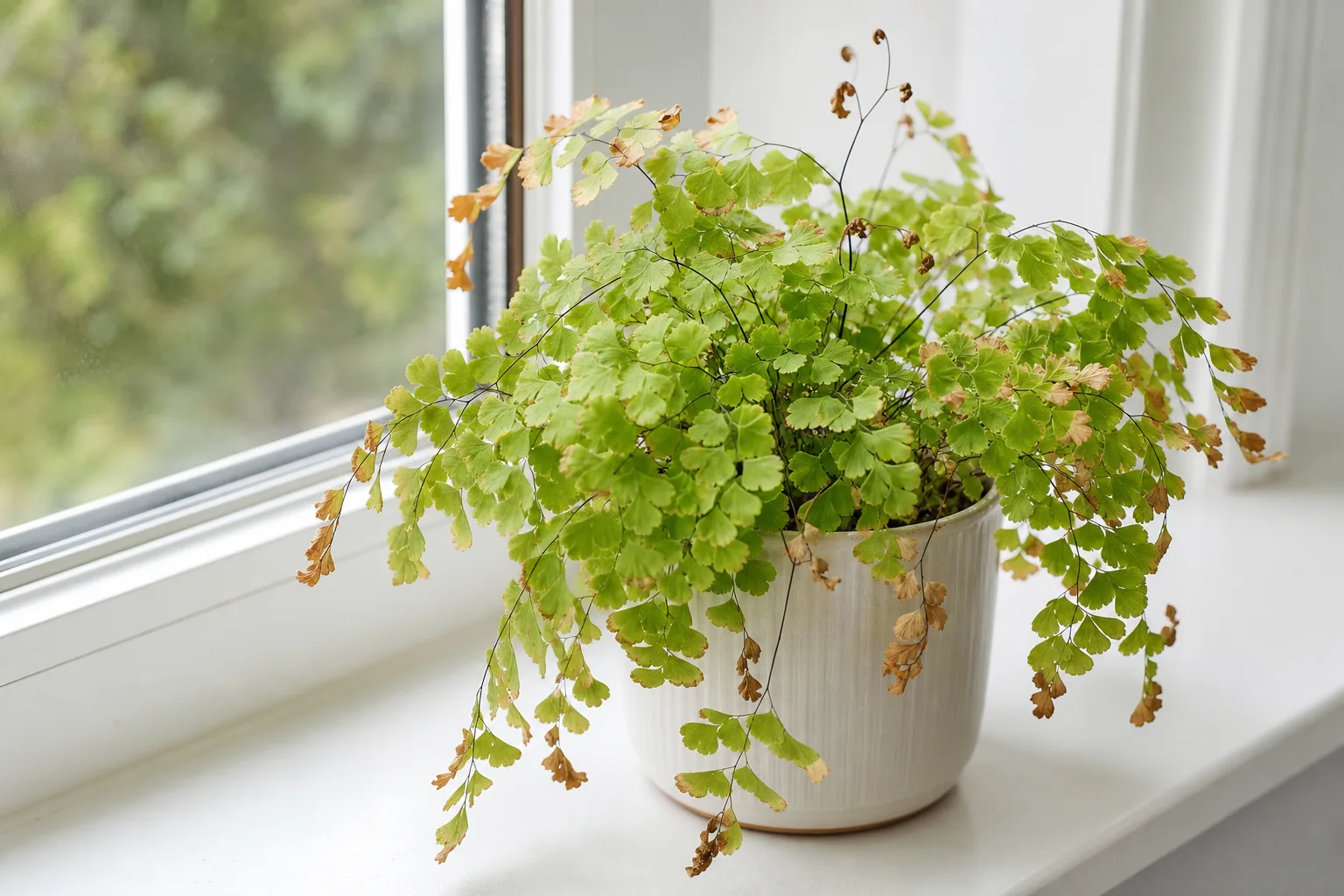
Heat Stress on Maidenhair Fern: Causes, Checks & Fixes
This guide covers heat stress on Maidenhair Fern. See also the general Heat Stress guide, watering, and light pages for this plant.
Heat Stress on Maidenhair Fern: Causes, Checks & Fixes
Quick answer
If your maidenhair collapsed overnight after a heat spell, a move to a sunny sill, or a ride home from a humid nursery bench, start here - not with more water.
Heat stress on Maidenhair Fern (Adiantum raddianum) hits this fern harder than most houseplants because its fan-shaped leaflets have almost no buffer against hot, dry air. The classic picture is sudden frond limpness, crisp brown margins, and whole pinnae turning papery within a day or two - often while the soil is still moderately moist.
Critical trap: moist soil + afternoon limp on a hot day means relocate and humidify - not add water. Dry air pulls moisture from thin leaflets faster than roots replace it even when the mix feels damp.
First step: move the fern to the coolest bright indirect spot you have, away from hot window glass, radiators, heat registers, and AC vents. Do not shower, repot, or fertilize on day one. Stabilize temperature and airflow first, then address humidity and watering rhythm once the plant stops actively declining.
Heat stress vs. low humidity vs. sunburn - which guide to use
Maidenhair Fern has three environmental problem pages that overlap on crisp fronds. Route by trigger and pattern:
| Problem | Main trigger | Soil moisture | Damage pattern | Start here |
|---|---|---|---|---|
| Heat stress (this page) | Heat wave, hot glass, radiator, HVAC blast | Often moist with afternoon limp | Sudden whole-frond collapse, one-sided vent/window damage | Cool + humidify |
| Low humidity | Dry heated winter air, long-term RH below 50% | Usually correct | Gradual tip browning over weeks | Humidifier first |
| Sunburn | Direct or harsh reflected sun | Usually correct | Bleached or dark patches on sun-facing pinnae only | Shade immediately |
| Underwatering | Missed drinks, dry root ball | Bone dry, light pot | Rapid collapse with dry mix | Thorough soak |
| Spider mites | Dry heat-stressed air | Variable | Fine stippling + webbing on undersides | Rinse + treat pests |
Limp fronds on a hot windowsill can blend heat and sunburn - check whether dark scorch patches face the glass. Winter tip burn with no recent temperature spike usually belongs on the low-humidity page instead.
What heat stress looks like on Maidenhair Fern
Maidenhair Fern does not wilt slowly like a pothos. Heat and dry air compound quickly on thin, delicate fronds.
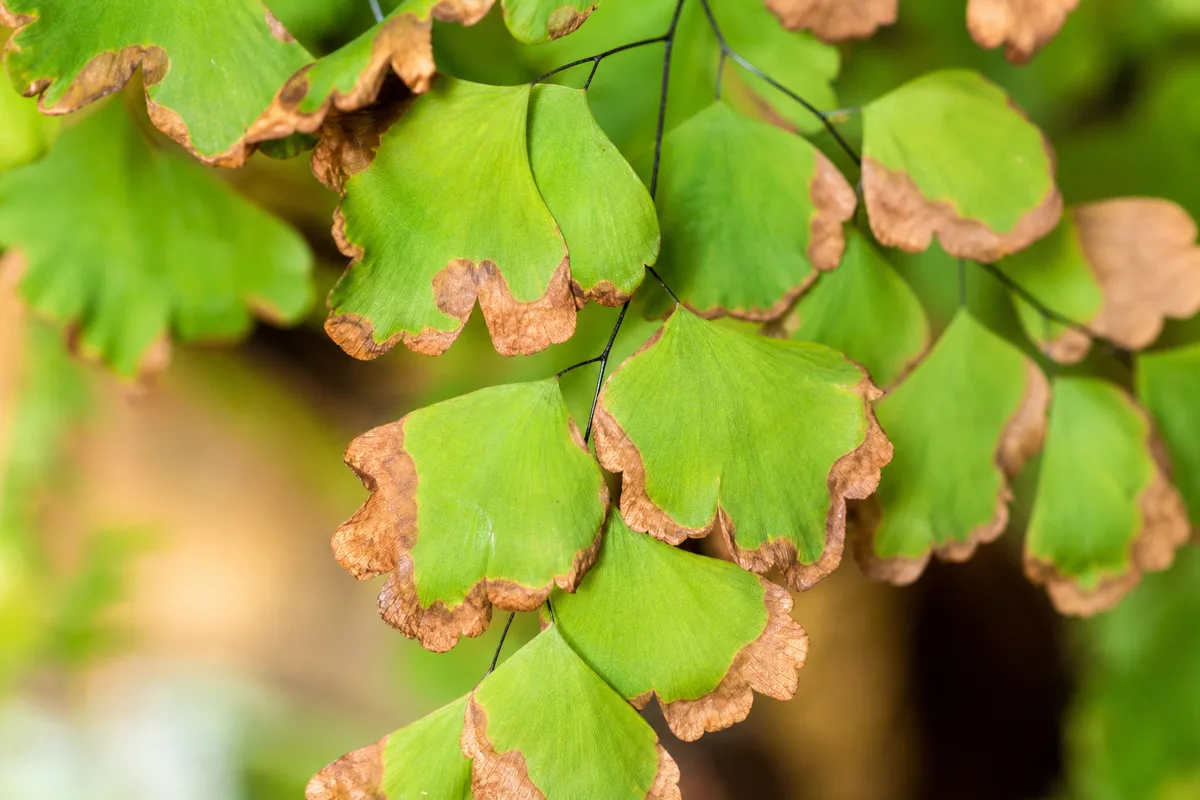
Heat Stress symptoms on Maidenhair Fern - compare with healthy tissue on the same plant.
Typical heat stress signs:
- Sudden frond droop across the whole plant or on the side nearest a heat source
- Crisp brown margins and tips spreading inward on outer fronds
- Papery, desiccated leaflets that crumble when touched
- Mass frond drop within days after a heat spell or move to a hot windowsill
- New croziers browning as they unfurl - a serious heat-and-humidity signal
- Afternoon limp on moist soil during extreme indoor heat, with partial overnight recovery
Direct sun scorch overlap:
- Dark brown patches on the sun-facing side of fronds, not gradual tip crisping alone
- Symptoms concentrated on fronds touching hot glass or receiving direct afternoon sun - see sunburn scorched leaves when patches are localized to the window side
Leaves may scorch in direct sun on this species, and fronds die back quickly if soils are allowed to dry out - heat accelerates both problems at once.
Diagnostic snapshot (no photo needed): One-sided crisp pinnae on the radiator or south-window side while sheltered fronds stay green points to localized heat. Uniform limp across the crown after a room-wide July heat wave with moist soil fits ambient heat stress. Dark bleached patches on only the glass-facing leaflets suggest sunburn layered on heat - shade and cool together.
Why Maidenhair Fern is vulnerable to heat
Thin leaflet structure and tropical understory origin
Thin leaflet structure - High surface area and no waxy cuticle mean leaflets lose water fast when air temperature and vapor pressure deficit rise. NC State Extension describes A. raddianum as a delicate, lace-like fern from the Tropical Americas that needs moist soil and partial shade - conditions that disappear fast in a hot, dry living room.
Heat registers, window glass, and HVAC microclimates
Narrow temperature comfort zone - Maidenhair Fern grows best around 16–24°C (60–75°F) in a warm, humid room. Clemson HGIC lists 60–70°F as the ideal daytime range for most indoor ferns, with nights about 10°F cooler. Sustained readings above the upper end, especially paired with dry air, outpace what this tropical understory fern tolerates indoors.
Heat registers and window glass - Avoid placing the plant in drafty areas or near heat registers. South- and west-facing glass intensifies afternoon heat; fronds pressed against warm panes cook even when room air feels acceptable.
Summer AC and winter heating - Air conditioning and furnaces strip humidity while shifting temperature. Indoor plants are sensitive to drafts or heat from registers, and most indoor environments lack sufficient humidity - a fern that survived spring can crash in July heat or December radiator season without a humidifier.
Greenhouse-to-home shock
Greenhouse-to-home shock - Plants moved from cool humid nursery benches to a hot, dry living-room shelf often show heat-stress collapse within the first week. The Maidenhair Fern care overview notes this species evolved beside moist rock crevices - your home microclimate rarely matches the bench it left.
Missed watering during hot spells - Hot weather dries pots faster. Even brief root-ball dryness during a heat wave triggers collapse faster than the same dry spell in cool conditions - but if soil is still moist and fronds limp in afternoon heat, cooling beats watering.
How to confirm the cause
Work through these checks before you change watering or repot:
- Environmental trigger - Did symptoms start after a heat wave, a move closer to a window, turning on heat, or placing the pot near an oven or electronics?
- Thermometer at frond height - Hold a small thermometer beside the crown, not at the wall thermostat. Readings consistently above 24°C (75°F) near the plant support heat stress, especially with humidity below 50%. A room that reads 21°C on the wall can sit at 28°C (82°F) on a south-facing sill.
- Heat-source audit - Radiators, floor registers, hot glass, and AC vents within 1 m of the fronds?
- Soil moisture - Top centimeter barely dry or still moist with limp fronds points to air stress, not drought. Bone-dry, light pot with collapse suggests underwatering compounded by heat.
- Pattern on the plant - One-sided damage facing a window or vent confirms localized heat; uniform crisping after a room-wide heat spell confirms ambient stress.
- Time of day - Afternoon-only limp on a hot day with moist soil fits temporary heat wilt - moisture evaporates from leaves faster than roots supply it, and the plant firms up when temperatures drop; all-day collapse fits sustained stress.
Rule out low humidity alone (gradual tip browning over weeks), fluoride burn (mineral crust on soil), and spider mites (stippling and webbing on undersides in dry heat-stressed air).
First fix for Maidenhair Fern
Relocate to cooler bright indirect light (cooling before watering)
Relocate to a cooler location with bright indirect light - today.
Move the pot away from hot window glass, radiators, heat registers, and direct AC airflow. Choose the coolest room that still offers bright indirect or diffused light - a north-facing window or a spot several feet back from an east window often works. See the light guide for placement that stays bright without baking fronds.
Do not repot, prune heavily, or fertilize while the plant is actively crisping. Do not compensate with extra watering if soil is already moist - soggy mix in a still-hot spot invites root problems without fixing heat damage.
Thermometer at frond height and humidifier 60–80% RH
After relocation, place a hygrometer and thermometer at frond height beside the crown. Target 60–80% relative humidity with a cool-mist humidifier - this fern needs a very humid atmosphere, and heat damage and dry air are paired problems on Maidenhair Fern.
AC and fan placement: Point vents away from the pot so cold air does not blast fronds directly after heat collapse - rapid temperature swings shock delicate tissue. Gentle room circulation helps; do not aim a desk fan at the crown. In summer, keep the fern out of the path of cold AC while still away from the hottest window microclimate.
Step-by-step recovery
- Move to cooler bright indirect light and leave the plant there for at least one week.
- Raise humidity toward 60–80% with a cool-mist humidifier at frond height.
- Check soil daily in hot weather; water when the top centimeter is barely dry using room-temperature filtered or rainwater per the watering guide.
- Improve airflow without drafts - gentle room air circulation helps, but do not aim a fan directly at fronds.
- Trim fully crisp or black fronds at the soil line once decline stops - partial green tissue on a mostly dead frond can wait.
- Hold fertilizer until new croziers unfurl cleanly for two to three weeks.
- Monitor new growth - clean emerging leaflets confirm recovery; repeated crozier browning means conditions are still too hot or dry.
Recovery timeline
Partial turgor may return within 24–48 hours after relocation if stems are still firm and heat was the main trigger. New fronds typically appear within two to four weeks once temperature and humidity stabilize.
Scorched or fully crisp leaflet tissue never re-greens. Expect to trim dead fronds and judge success by fresh croziers, not old damage.
Sustained heat above 27°C (80°F) with dry air can collapse a crown beyond recovery - honest limit on this species.
Lookalike symptoms
Underwatering - Dry, light pot; frond collapse often with soil pulled away from pot edges. Fix is thorough rehydration per underwatering, not just cooling.
Low humidity - Gradual brown tips over weeks in heated winter air; less sudden than acute heat-wave collapse. Humidifier fixes both, but heat stress adds a clear temperature trigger - use the low-humidity guide when RH is the primary story.
Direct sun scorch - Brown, crispy fronds can follow harsh sun or a nearby radiator; dark patches on sun-facing pinnae mean move out of direct rays per sunburn scorched leaves, not just to a cooler room still in blazing sun.
Spider mites - Fine stippling and webbing surge when heat dries air; inspect undersides on the spider mites page before assuming environment alone.
Wilting and drooping - Wilting and drooping leaves cover broader collapse patterns when heat is not the clear trigger.
Causes to rule out
- Overwatering in a hot spot - Wet, heavy mix with yellowing and sour smell; stems may soften at the base. See overwatering.
- Cold draft shock - Frond drop after an AC blast or cold window contact; opposite trigger, similar collapse.
- root rot on Maidenhair Fern - Mushy rhizomes and foul soil after chronic waterlogging; not fixed by moving to shade.
What not to do
Do not leave the fern on a hot windowsill hoping extra misting will compensate - mist raises humidity for minutes, not hours. Do not blast cold AC directly onto fronds. Avoid Maidenhair Fern repotting guide during active collapse. Do not fertilize a heat-shocked fern to “perk it up.” Do not trim every frond to soil level on day one unless tissue is fully dead - wait until decline stops.
How to prevent heat stress next time
Treat 16–24°C (60–75°F) and 60–80% humidity as paired requirements, not optional extras - aligned with the overview temperature section. Keep pots away from heat registers and hot glass year-round. Run a humidifier during summer heat waves and winter heating season. Check soil daily when indoor temperatures spike. Acclimate new plants gradually over seven to ten days when moving from a cool shop to your home.
Consider siting pots in bathrooms where atmospheric humidity is generally higher only where bright indirect light is adequate - humidity alone does not fix a hot windowsill. A steamy bathroom with a frosted window and no usable light will not prevent heat stress on glass-adjacent shelves.
Log temperature at frond height once a week in summer - a sticky note on the pot (“moved off sill 6/10, croziers clean 7/1”) helps you repeat what worked.
Related Maidenhair Fern problems
Heat stress rarely arrives alone. Use these guides when symptoms overlap:
- Maidenhair Fern overview - baseline temperature, humidity, and streamside habitat context
- Low humidity - gradual winter tip burn when RH is the main issue
- Sunburn scorched leaves - localized light injury on window-facing pinnae
- Watering - moisture rhythm after cooling; avoid overwatering moist soil
- Wilting and drooping leaves - broader collapse when heat is not the clear trigger
- Spider mites - dry heat-stressed air invites pests
- Propagation - crown salvage by division if heat correction fails but rhizomes stay firm
High temperature pulls moisture from leaflets while speeding pot drying and lowering effective humidity. Fixing heat without humidity support, or watering heavily without cooling the environment, both fail. Align placement, temperature, humidity, and moisture together.
When to worry
Worry when new croziers brown during unfurling, multiple fronds crisp within 24 hours, or the plant sits in direct sun through a heat wave. Crown tissue that stays soft and black after a week in stable cool conditions suggests damage beyond simple heat stress - inspect rhizomes before investing more effort.
If relocation, 60–80% humidity, and correct watering fail for several weeks, contact your local cooperative extension office for hands-on diagnosis - chronic failure on Adiantum raddianum usually means an unresolved microclimate problem, not a missing product.
Closing note
Use this page when a temperature or heat-source trigger explains sudden collapse - especially moist soil with afternoon limp on a hot day. Route gradual winter tip burn to low humidity; route sun-facing scorch patches to sunburn. Move cooler first, humidify second, water only when the top centimeter actually needs it.
When to use this page vs other Maidenhair Fern guides
- Maidenhair Fern watering guide - Use for routine moisture checks before assuming heat stress is the main issue.
- Maidenhair Fern problems hub - Browse all 55 common issues on this species.
- Drooping Leaves on Maidenhair Fern - Different entry point when symptoms overlap with heat stress.