Underwatering on Maidenhair Fern: Causes, Checks & Fixes
Quick answer
Underwatered Maidenhair Fern collapses fast - fronds wilt and brown within hours of a dry root ball. Soak the pot thoroughly, raise humidity, and never let the root ball dry completely again.
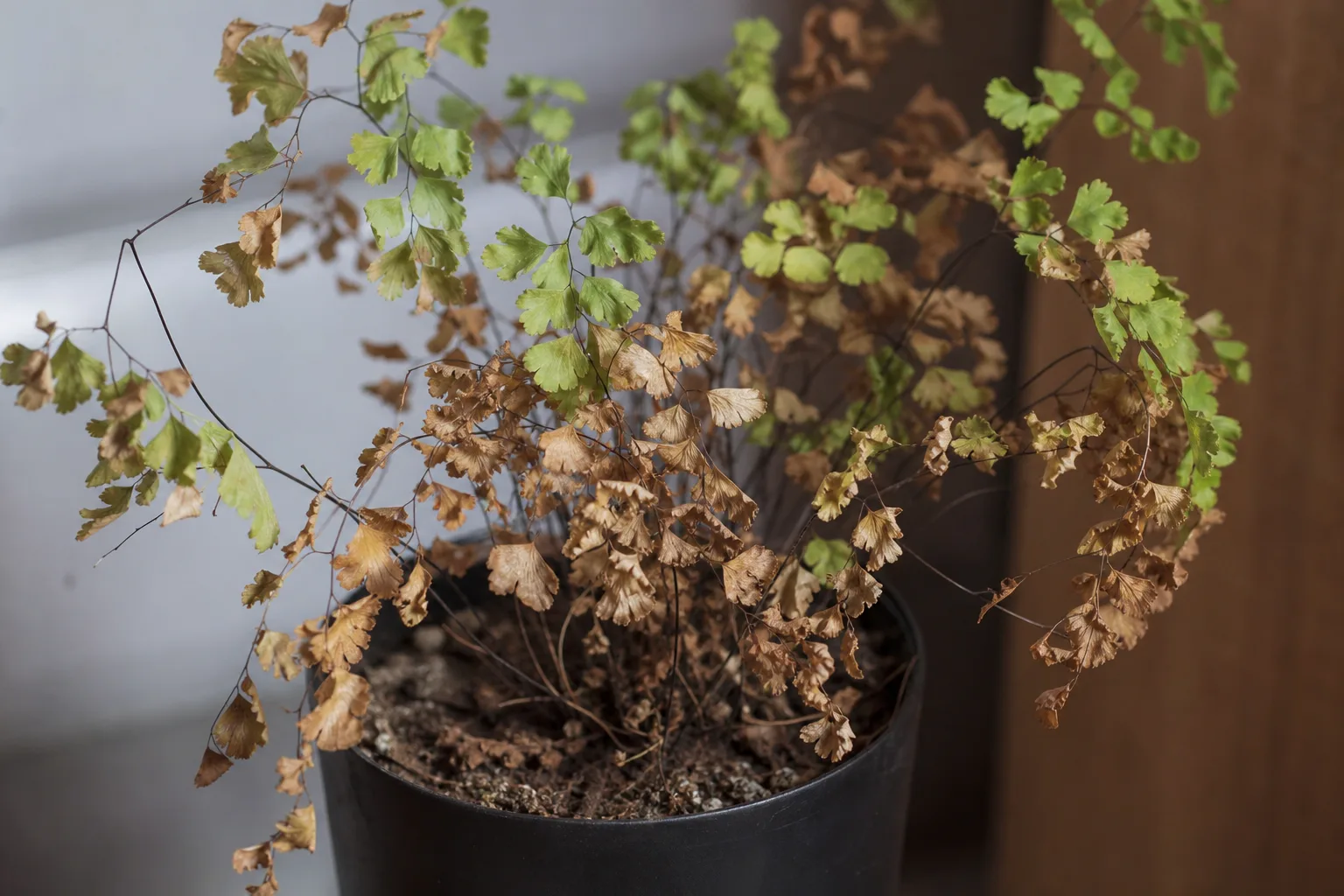
Underwatering on Maidenhair Fern: Causes, Checks & Fixes
This guide covers underwatering on Maidenhair Fern. See also the general Underwatering guide, watering, and light pages for this plant.
Underwatering on Maidenhair Fern: Causes, Checks & Fixes
Quick answer
Underwatering on Maidenhair Fern (Adiantum raddianum) triggers rapid frond collapse - this species stores almost no drought reserve in its creeping rhizome. First step: soak the pot thoroughly until mix is evenly moist, raise humidity, and establish a check-when-barely-dry watering rhythm from the Maidenhair Fern watering guide.
Roots should not be allowed to dry out on this fern, per NC State Extension. Fronds die back quickly if soils are allowed to dry out - faster than most houseplants. A missed weekend watering in a dry, sunny room can destroy the visible frond crown while firm rhizomes may still survive.
What underwatering looks like on Maidenhair Fern
Underwatered Maidenhair Fern fails dramatically and quickly:
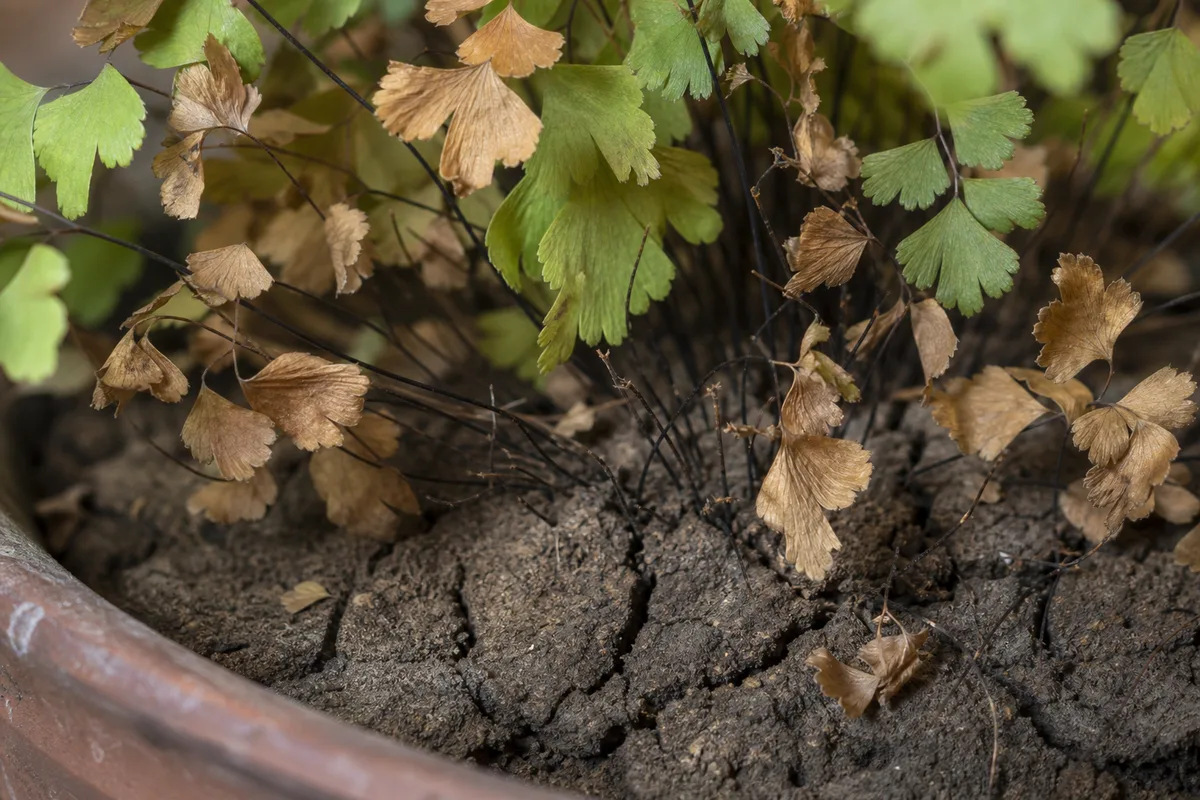
Underwatering symptoms on Maidenhair Fern - compare with healthy tissue on the same plant.
- Whole fronds wilt, then turn crisp brown or black within hours to a day
- Pot feels light; mix pulls away from pot walls
- Dry mix may become hydrophobic - water runs down sides without soaking in
- Mass leaf drop from outer fronds inward along wiry black stipes
- Black stems remain wiry while leaflets desiccate completely
This contrasts with overwatering - heavy wet pot, sour smell, yellow limp fronds with saturated mix throughout.
Why Maidenhair Fern gets underwatered
Calendar under-watering - Watering weekly like a pothos while this fern needs checks every 2–3 days in warm bright conditions per the watering guide. Gardeners’ World notes maidenhair needs consistently moist soil through the growing season - not a wide dry-down window.
Hydrophobic dry mix - Peat or coir that dried completely repels water; surface looks damp after a splash while the root ball stays dry. When repeated soaks fail to darken the core, switch to the dry-hydrophobic-soil guide - this page covers uniformly dry root balls that accept water on first soak.
Terracotta and sunny windows - Unglazed terracotta wicks moisture through porous walls; a maidenhair on a bright south-facing sill in a 10 cm clay pot may need water every two days in summer while a plastic nursery pot in the same spot holds moisture longer. Heat and AC drafts accelerate surface dry-down without changing your calendar.
Travel or neglect - Maidenhair Fern is a poor choice for frequent absence; even brief dry spells cause visible collapse. Self-watering reservoirs can read “full” while peat inside dries hard and repels water from the wick.
Fear of overwatering - After a rot scare, growers withhold water too long; fine fern roots die from drought before rot returns. See overwatering for the wet-soil mirror diagnosis.
Lookalike symptoms to rule out
| What you see | Likely cause | First action |
|---|---|---|
| Light dry pot, rapid crisp collapse | Underwatering (this page) | Soak thoroughly; raise humidity |
| Watered recently but core still dry; water channels down walls | Dry hydrophobic soil | Bottom-soak until surface darkens |
| Heavy wet pot, yellow limp fronds, sour smell | Overwatering | Stop watering; inspect roots |
| Moist appropriate soil, tip browning over days | Low humidity | Humidifier; pebble tray |
| Crisp fronds on sun-exposed side, soil still moist | Heat or sun scorch | Move to bright indirect light |
| Wet soil, mushy rhizomes after rehydration | Advancing root rot | Trim decay; repot |
| Gradual drooping without dry pot | Multiple causes - check weight first | Follow drooping-leaves guide |
How to confirm the cause
- Pot weight - Light pot with collapsed fronds strongly indicates dryness.
- Probe depth - Dry mix 2+ cm down confirms underwatering; if you watered yesterday and the core is still dusty, test for hydrophobic repellency.
- Root check - Firm, pale, slightly dry roots support drought diagnosis; mushy roots suggest rot instead.
- Timeline - Did fronds collapse shortly after a missed watering, heat spike, or travel gap?
- Hydrophobic test - Water pools on surface and runs through quickly without absorbing → escalate to dry-hydrophobic-soil if mix refuses to darken after one thorough soak.
First fix for Maidenhair Fern
Rehydrate the root ball thoroughly and raise humidity immediately.
Simple dry-down - Mix is uniformly dry but accepts water: place the pot in a sink and water slowly until mix is evenly moist and water drains freely. Bottom-water 20–30 minutes until the surface darkens, then drain completely.
Hydrophobic dry core - Water ran through without soaking: bottom-soak longer (30–60 minutes for a 4-inch pot) or follow the dry-hydrophobic-soil guide before assuming one splash fixed thirst.
Cut fully collapsed black or brown fronds at soil level. Move to bright indirect light with 60–80% humidity via humidifier or bathroom placement. Pots may be set in a tray of wet pebbles to increase humidity during recovery.
Do not fertilize until new fronds are several inches tall.
Step-by-step recovery
- Assess pot weight and soil dryness - confirm underwatering before soaking.
- Water thoroughly top-down or bottom-up until mix is evenly rehydrated.
- Discard drainage; never leave standing saucer water long-term, but initial soak is required.
- Trim all desiccated fronds at soil line.
- Run humidifier or relocate to steamy bright bathroom - NC State Extension recommends bathrooms and terrariums for humidity.
- Check soil daily; water when top centimeter is barely dry - not fully dry.
- Expect new croziers in 2–4 weeks if rhizomes stayed firm.
- Repot only if mix remains hydrophobic after repeated soaks - refresh with 50% compost, 30% coco coir, 20% fine bark per the soil guide.
Sample recovery timeline (editorial case)
A 4-inch maidenhair on a sunny east windowsill in terracotta returned from a missed weekend with a feather-light pot and every frond collapsed black. Bottom-soak 25 minutes darkened the mix; pot weight doubled. Dead fronds trimmed at soil line. New croziers appeared at day 18 with 70% humidity from a bathroom placement - within the typical 2–4 week window after thorough rehydration.
Recovery timeline
New fronds in 2–4 weeks is typical after thorough rehydration and stable humidity. Severe dehydration may require cutting all fronds to the crown - Maidenhair Fern often resprouts from firm creeping rhizomes when moisture returns.
Repeated dry-collapse cycles weaken the plant permanently; prevention matters more than rescue.
Causes to rule out
- Root rot - Wet heavy pot, sour smell, mushy roots with limp fronds.
- Heat scorch - Crisp fronds on sun-exposed side with moist soil.
- Low humidity - Tip browning over days, not hour-scale collapse with dry pot.
- Cold draft damage - Frond drop after exposure to cold air; soil may still be moist.
- Yellow leaves - Often overwatering or light stress; pair with pot weight before soaking again.
What not to do
Do not wait hoping wilted fronds recover without water - they will not. Do not mist instead of watering the root ball; mist adds brief surface humidity without rehydrating fine rhizome roots. Delicate ferns should not be allowed to dry out completely - surface moisture does not replace root-zone water. Avoid leaving a dry fern in direct sun during recovery. Do not repot into dry fresh mix without soaking thoroughly first. Do not interpret “barely dry top centimeter” as permission to let the whole root ball go bone dry.
How to prevent underwatering next time
Check soil daily in warm weather; water when the top centimeter is barely dry. Use consistently moist but well-drained potting soil that re-wets easily - the site’s 50% compost, 30% coco coir, 20% fine bark blend from the soil guide holds moisture without turning anaerobic.
Maintain 60%+ humidity to reduce leaflet desiccation. Consider siting pots in bathrooms where atmospheric humidity is generally higher if you struggle with dry-down speed. Use pot weight as your primary cue, not day counting.
Terracotta, travel, and self-watering traps
Prefer plastic or glazed pots in dry homes if you cannot check daily. Before travel, test whether your self-watering setup actually keeps the rhizome zone damp - many fail when peat dries and repels the wick. A bathroom relocation plus a sitter who lifts the pot beats a full reservoir that reads wet while the core starves.
When to worry - escalate to dry-hydrophobic-soil or root rot
Switch to dry hydrophobic soil on Maidenhair Fern when:
- You watered recently but fronds collapsed anyway
- Water beads on the surface or channels down pot walls
- Mix 2–3 cm down stays dusty after a full top watering
- Gap visible between mix and pot rim after dry-down
Switch to root rot on Maidenhair Fern when:
- Rhizomes feel soft or mushy after rehydration attempt
- Sour rot smell accompanies wet soil
- Fronds collapse while mix stays saturated despite your soak
This page covers dry root ball collapse when mix accepts water. Hydrophobic soil covers water-repellent mix after drought. Root rot covers below-soil decay when tissue is already failing.
How this guide was verified
This guide focuses on hour-scale dry root ball collapse for Adiantum raddianum - distinct from hydrophobic mix that repels water and from wet-cycle root rot. Recommendations were checked against extension and botanical references, including NC State Extension, Missouri Botanical Garden, BBC Gardeners’ World, and University of Minnesota Extension tropical fern guidance. Inline citations sit next to the claims they support.
Author: sai-ananth · Reviewer: LeafyPixels Review Board · Reviewed: June 2026
Related Maidenhair Fern guides
- Maidenhair Fern watering guide - pot-weight checks and moisture rhythm
- Dry hydrophobic soil on Maidenhair Fern - when water runs through without soaking
- Overwatering on Maidenhair Fern - wet-pot lookalike with opposite fix
- Root rot on Maidenhair Fern - mushy rhizome salvage after rehydration
- Drooping leaves on Maidenhair Fern - gradual wilt overlap
- Yellow leaves on Maidenhair Fern - symptom overlap
- Best soil for Maidenhair Fern - 50/30/20 mix and drainage tests
- Maidenhair Fern overview - full care hub