Dry Hydrophobic Soil on Maidenhair Fern: Causes, Checks &
Quick answer
Hydrophobic soil on Maidenhair Fern repels water after the mix dries completely - you watered yesterday but fronds collapsed today because water ran down pot sides while the root ball stayed dry. First step: bottom-soak until mix darkens throughout, drain fully, then keep the root ball evenly moist going forward.
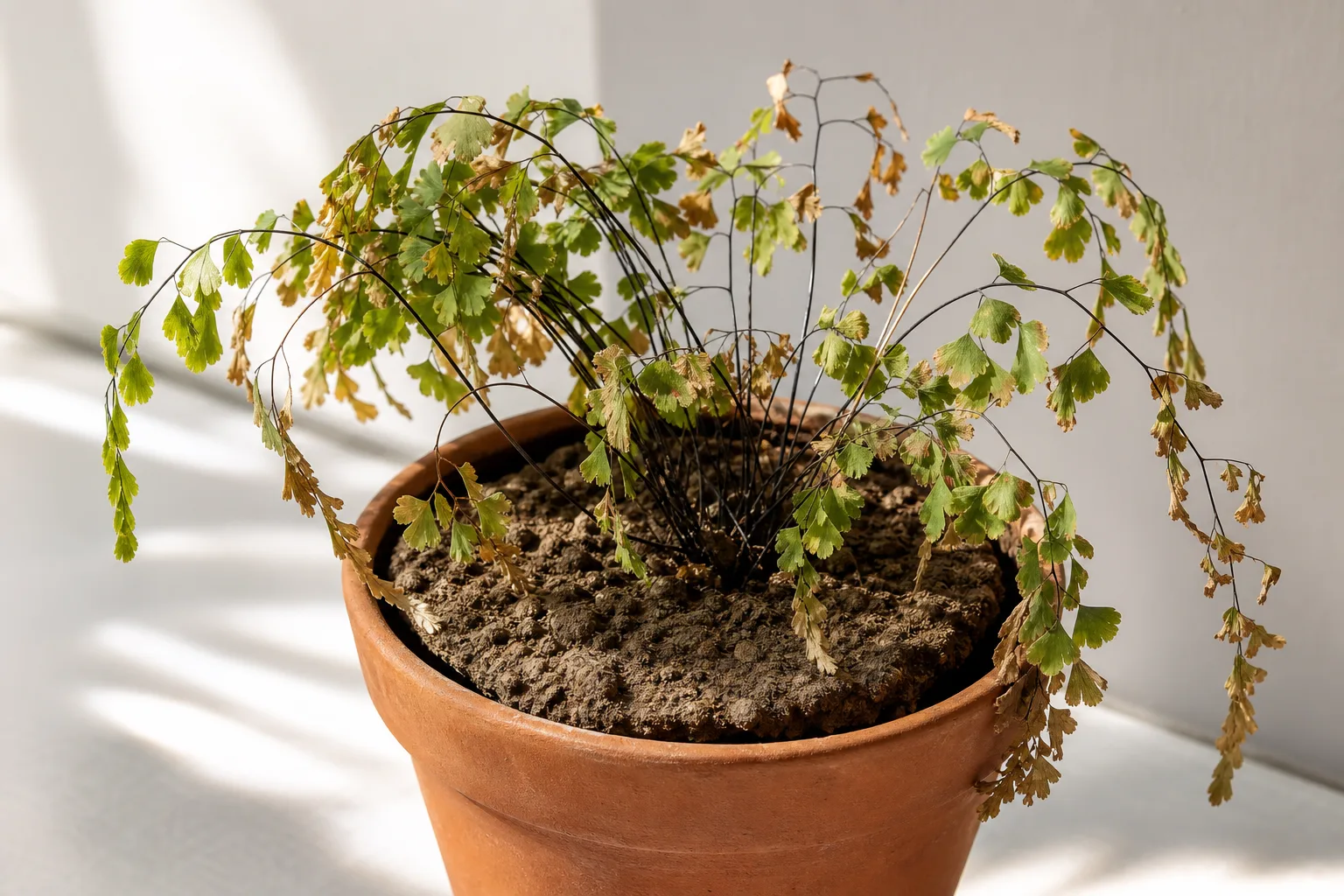
Dry Hydrophobic Soil on Maidenhair Fern: Causes, Checks & Fixes
This guide covers dry hydrophobic soil on Maidenhair Fern. See also the general Dry Hydrophobic Soil guide, watering, and light pages for this plant.
Dry Hydrophobic Soil on Maidenhair Fern: Causes, Checks & Fixes
Quick answer
You watered yesterday - maybe even this morning - yet every frond on your Maidenhair Fern collapsed within hours. That pattern on Adiantum raddianum often means hydrophobic soil: peat or coir dried hard, now repels water so it runs down pot sides while the root ball stays bone dry. This is not the same as forgetting to water; it is a mix that refuses to accept the drink you already gave it.
First step: bottom-soak the pot until mix darkens throughout, drain completely, then adjust rhythm so the root ball never dries out again. Roots must never be allowed to dry out on this species - internal drought inside repellent mix kills as surely as visible underwatering.
| What you observe | Likely problem | First action |
|---|---|---|
| Water beads or channels; core dry 2–3 cm down after top water | Hydrophobic dry-down (this page) | Bottom-soak until surface darkens; drain |
| Uniformly dry mix that darkens on first slow pour | Underwatering | Soak thoroughly; humidify 60–80% |
| Heavy wet pot, sour smell, mushy rhizomes | Root rot / overwatering | Stop watering; unpot; inspect roots |
| Moist soil at depth, crisp leaflet tips, normal pot weight | Low humidity | Humidifier; do not keep soaking |
| Wilt after heat spike with otherwise moist mix | Water stress | Stabilize temperature; reassess in 24 hours |
For daily moisture rhythm and pot-weight checks, see the Maidenhair Fern watering guide. This page covers water-repellent mix after drought - the hidden dry core inside a pot you think you watered.
What hydrophobic soil looks like on Maidenhair Fern
Hydrophobic mix mimics underwatering from across the room - but adding water from the top does not fix it:
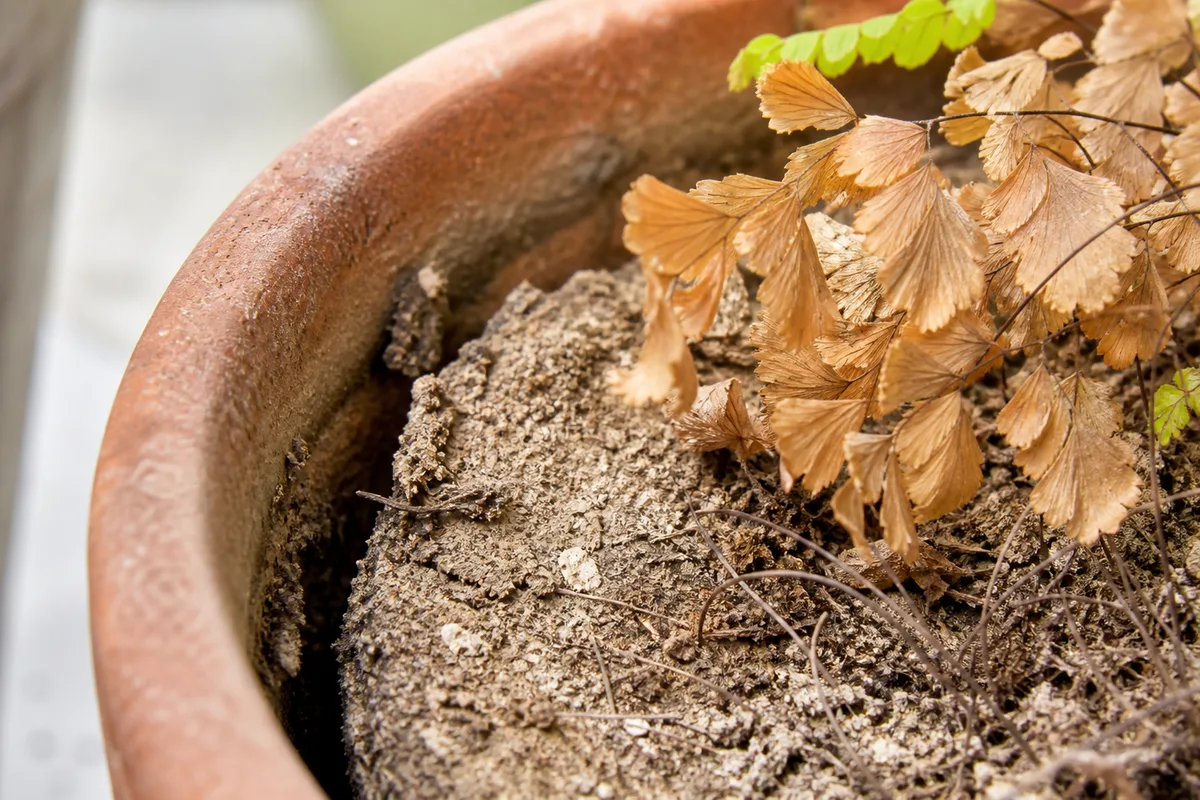
Dry Hydrophobic Soil symptoms on Maidenhair Fern - compare with healthy tissue on the same plant.
- Water beads on the surface or channels down the inside wall without soaking in
- Pot feels light; mix may pull away from the rim leaving a gap at the pot wall
- Fronds wilt, then crisp brown or black within hours despite your watering can
- Surface looks briefly damp after a splash while 2–3 cm down stays dusty dry
- Mass frond drop from outer pinnae inward, matching drought stress on thin leaflets
This differs from overwatering - heavy wet pot, sour smell, yellow limp fronds with saturated mix throughout. It also differs from simple underwatering, where the whole root ball is uniformly dry and a normal soak absorbs easily on the first slow pour.
Sample recovery timeline (editorial case)
A 4-inch nursery maidenhair in peat-heavy mix returned from a five-day trip with shrunken mix and gap at the pot wall. Bottom-soak 45 minutes darkened the surface; pot weight doubled. Limp green fronds perked within six hours. Fully black fronds were trimmed at soil line. New croziers appeared at day 18 with stable 65% humidity - consistent with typical 2–4 week recovery after thorough rehydration.
Hydrophobic soil vs underwatering on Maidenhair Fern
Both show wilt and a light pot. The acceptance test when pouring slowly separates them:
| Check | Hydrophobic (this page) | Simple underwatering |
|---|---|---|
| Surface after slow pour | Water pools, beads, or runs off edges | Surface darkens within seconds |
| Mix 2–3 cm down after top water | Still dusty or pale dry | Moist or evenly damp |
| Gap between mix and pot wall | Often visible | Usually not |
| Recent watering history | You watered; fronds wilted anyway | Missed drinks; uniformly dry ball |
| First fix | Bottom-soak or submerge to rewet core | Top or bottom soak once mix accepts water |
| Guide | This page | Underwatering |
The watering guide rhythm - water when the top centimeter is barely dry - fails mid-cycle once peat turns repellent. Surface moisture reads “okay” while the rhizome starves. That false security is why hydrophobic dry-down deserves its own diagnostic path, not a bullet inside the underwatering page alone.
Why Maidenhair Fern mix turns hydrophobic
Peat and coir dry-down on fine fern roots
Peat and coco coir hold moisture well when damp - but when peat moss dries out it is very difficult to re-wet. Organic particles shrink and develop water-repellent coatings when bone-dry. Maidenhair’s fine rhizome roots and creeping rhizome structure described by NC State Extension have almost no drought reserve; fronds die back quickly if soils are allowed to dry out. A repellent dry core starves those roots even while drainage water flows.
Vacation dry-out and post-rot-scare withholding
A weekend away, heat spike, or AC draft can dry peat-heavy mix fully. The next top watering fails to penetrate - classic post-travel collapse. The opposite trap: after a root rot scare, withholding water too long lets fine roots die from drought inside repellent mix before rot could return. Clemson HGIC notes maidenhair ferns with thin, delicate fronds are difficult in most homes partly because they must never dry completely - fear-driven underwatering after overwatering often triggers full-ball dry-down.
Old compacted mix in small pots
Mix not refreshed in 1–2 years breaks down, loses structure, and dries unevenly. Maidenhair ferns need high organic matter and good drainage - stale peat that dried hard in a small pot is a common failure point. Terracotta and sunny windows accelerate surface dry-down; RHS lists moist but well-drained conditions for A. raddianum, which assumes mix that stays wettable, not crusted peat clumps.
How to confirm the cause
Work through these checks in order:
- Runoff test - Pour slowly; water pools or runs down sides instead of darkening the surface within seconds.
- Depth probe - Dry mix 2–3 cm down immediately after a top watering attempt.
- Pot weight - Light pot with wilted or crisp fronds despite recent watering.
- Gap check - Mix shrunk from pot wall, visible channel for water to bypass the root ball.
- Re-wet trial - Bottom-soak 20–60 minutes; surface darkens and fronds perk if roots were dry only.
- Root check - Firm pale rhizomes support hydrophobic diagnosis; mushy roots with wet heavy mix suggest rot instead.
- Smell - Neutral dry smell supports hydrophobic only; sour odor points to rot overlap.
- Mix age - Old peat-heavy substrate that dried completely during travel or neglect.
First fix for Maidenhair Fern
Bottom-soak the pot until the mix fully rehydrates, then drain completely.
Set the pot in a sink or tray of room-temperature water so mix absorbs upward through drainage holes. Bottom watering allows soil to slowly absorb water and may take an hour or more on stubborn dry root balls. Remove once the surface darkens; let excess drain 30 minutes. Do not leave the fern sitting in saucer water long-term - this is a one-time rehydration, not a permanent standing-water setup.
Pot-size guidance: 4-inch nursery pots often need 30–45 minutes; 6-inch mature plants in compacted peat may need 60–90 minutes. Check weight every 15 minutes.
If bottom soaking fails, submerge the pot briefly until air bubbles stop - faster for severely repellent mix. Remove promptly; do not submerge overnight (oxygen loss on fine fern roots). Cut fully collapsed brown or black fronds at soil level. Move to bright indirect light with 60–80% humidity during recovery.
Do not fertilize until new fronds emerge.
Step-by-step recovery
- Confirm hydrophobic mix with runoff and depth-probe tests before treating.
- Bottom-soak 20–60 minutes (longer for 6-inch pots) until mix is evenly moist; drain thoroughly.
- For severe repellency, submerge briefly until bubbling stops, then drain - skip if rhizomes are already soft.
- Poke shallow aeration holes in the crust with a chopstick - avoid damaging rhizomes.
- Trim all desiccated fronds at soil line; judge recovery by new croziers, not old black tissue.
- Run a humidifier or relocate to a steamy bright bathroom while roots recover.
- Check soil daily per the watering guide; water when the top centimeter is barely dry - never bone dry.
- If repellency returns within two weeks, repot into fresh coco coir, fine bark, and compost blend from the soil guide - see repotting for rhizome-safe handling.
Recovery timeline
New croziers in 2–4 weeks is typical after thorough rehydration and stable humidity. Limp green fronds often perk within hours once the core rewets; fully blackened tissue will not green up. Repeated dry-collapse cycles weaken rhizomes permanently - prevention matters more than rescue.
Lookalike symptoms
| Symptom pattern | Likely cause | Key differentiator | Guide |
|---|---|---|---|
| Water runs off; core dry after pour | Hydrophobic dry-down | Beading, gap at wall, light pot after “watering” | This page |
| Uniformly dry mix; first soak absorbs | Underwatering | No surface beading; missed schedule | Underwatering |
| Wet heavy pot; mushy rhizomes; sour smell | Root rot | Water absorbed; fronds stay limp yellow | Root rot |
| Moist soil; crisp leaflet tips over days | Low humidity | No hour-scale collapse; pot weight normal | Low humidity |
| Crisp fronds on sun-exposed side only | Heat scorch | Mix moist below surface | Light guide |
| Sudden drop after cold air blast | Draft damage | Soil often still moist | Water stress |
What not to do
Do not assume drainage water means the root ball is wet - water may run between the pot wall and the hydrophobic root ball while the center stays dry. Do not mist instead of rehydrating the mix. Avoid repotting into dry fresh substrate without soaking the root ball first - see repotting. Do not leave a dry fern in direct sun during recovery. Do not leave pots submerged overnight. Do not reuse hydrophobic peat clumps at repot; discard crusted dry sections.
How to prevent hydrophobic soil next time
Check soil daily in warm weather; water when the top centimeter is barely dry using pot weight from the watering guide - never let the root ball dry completely. Use consistently moist but well-drained potting soil with coco coir and fine bark that re-wets more reliably than aged peat alone - full recipes in the soil guide.
Refresh mix every 1–2 years before organic matter breaks down and compacts. Maintain 60%+ humidity to reduce leaflet desiccation while roots stay wettable. Empty cachepot saucers after bottom-soak recovery so standing water does not rot fine roots.
| Prevention factor | Action | Guide |
|---|---|---|
| Moisture rhythm | Top 1 cm barely dry; pot weight | Watering |
| Wettable mix | Coco coir + fine bark; refresh old peat | Soil |
| Humidity | 60–80%; humidifier in dry rooms | Low humidity |
| Repot timing | Before mix turns to dust every cycle | Repotting |
When to worry / repot escalation
Any dry root ball on Maidenhair Fern is urgent. Escalate to immediate repot when:
- Bottom-soaking twice in one week fails to darken the mix
- Mix shrinks from the rim again within 14 days of a successful soak
- Rhizomes feel soft after rehydration - inspect for rot overlap
- Repellent peat clumps dominate more than half the root ball
Repot into fresh moist blend from the soil guide; pre-moisten mix before setting the rhizome. If more than half the rhizome mass is mushy after trimming, survival odds drop sharply.
Related Maidenhair Fern guides
- Maidenhair Fern overview - species basics and placement
- Watering - pot-weight checks and seasonal rhythm
- Underwatering - uniform dry ball without repellency
- Water stress - overlapping moisture failure modes
- Overwatering - wet-soil intervention before rot
- Root rot - mushy rhizome rescue
- Soil - coco coir and fine bark blend after repeat repellency
- Repotting - refresh compacted peat safely
- Wilting - acute collapse triage including hydrophobic fork
About this guide
This guide was written by sai-ananth and reviewed by the LeafyPixels Review Board against botanical references including NC State Extension Adiantum raddianum, Missouri Botanical Garden PlantFinder, UC Master Gardeners of Santa Clara County hydrophobic soil guidance, UF/IFAS maidenhair fern publication FP013, RHS Adiantum raddianum, Clemson HGIC indoor ferns, and LeafyPixels watering, soil, underwatering, and repotting guides. Factual claims were validated with inline citations on 2026-06-16 (claims-validator-v1). The sample recovery timeline and pot-size soak durations are editorial diagnostics synthesized from extension hydrophobic-soil guidance and maidenhair growth habit - not a single published case study from one lab.
Conclusion
Hydrophobic soil on Maidenhair Fern tricks you into thinking the plant is watered while the root ball stays dry. Run the acceptance test - slow pour, depth probe, pot weight - then bottom-soak until mix rehydrates, trim dead fronds, and never let the root ball dry completely again. If repellency returns within two weeks, repot into fresh wettable mix from the soil guide rather than repeating emergency soaks. When wilt could be drought or rot, start with the wilting guide; when mix simply dried on schedule without beading, use underwatering.