Faded Leaves on Maidenhair Fern: Causes, Checks & Fixes
Quick answer
Faded Maidenhair Fern fronds usually mean too little light, too much direct sun, or normal aging of older leaves. First step: check whether fronds are evenly pale in a dim spot or bleached on the sun side, then adjust to bright indirect light without direct rays.
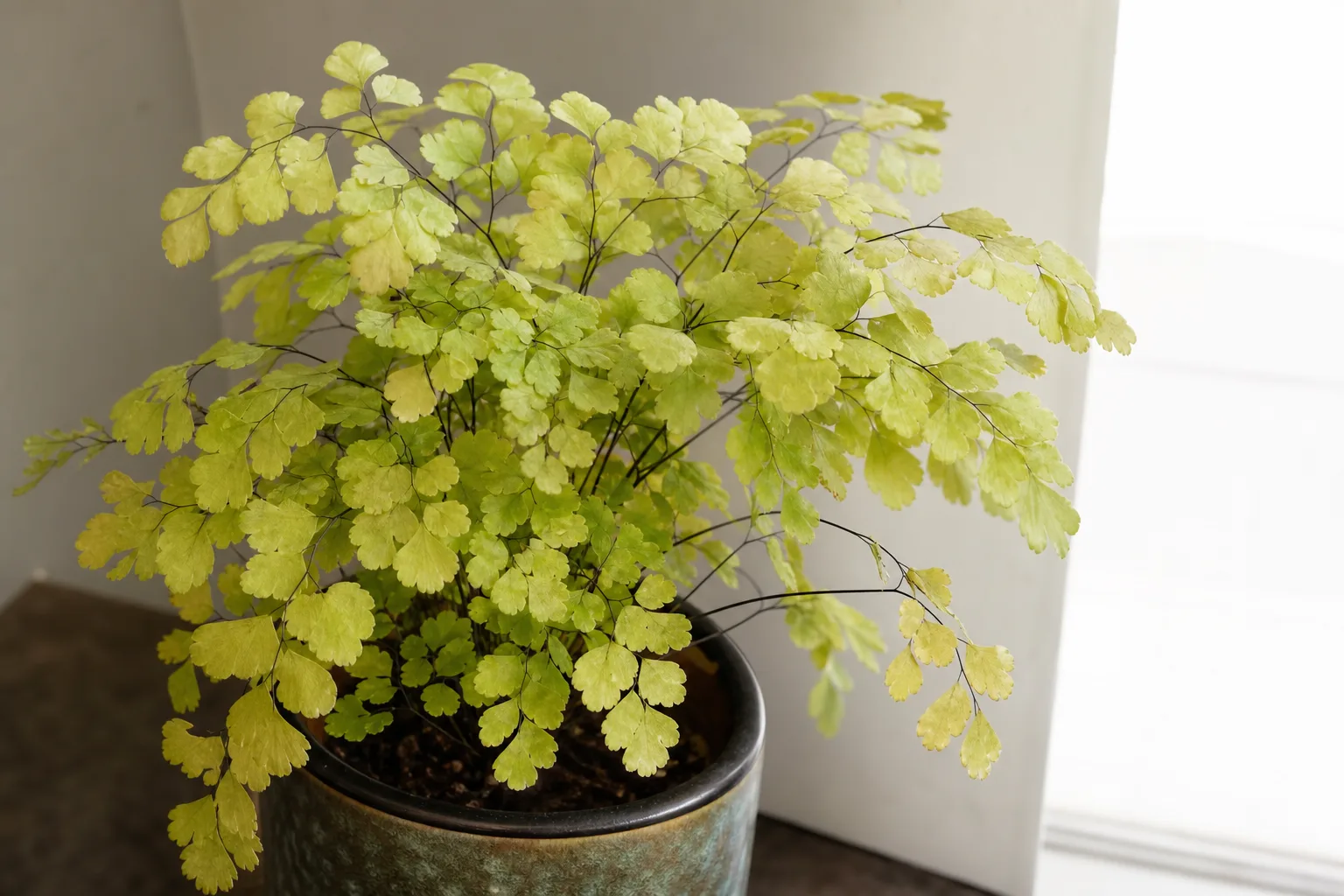
Faded Leaves on Maidenhair Fern: Causes, Checks & Fixes
This guide covers faded leaves on Maidenhair Fern. See also the general Faded Leaves guide, watering, and light pages for this plant.
Faded Leaves on Maidenhair Fern: Causes, Checks & Fixes
Quick answer
Faded leaves on Maidenhair Fern (Adiantum raddianum) mean fronds have lost their deep green color - washed out, pale, or bleached - not necessarily yellow or brown yet. The diagnostic split that saves this fern: even paleness everywhere = too dim; one-sided bleach = too much sun - do not treat both the same way.
First step: assess light at the frond level and determine whether the plant needs brighter indirect exposure or protection from direct rays. For baseline placement, see the Maidenhair Fern light guide. If bleaching escalates to crisp scorch, see sunburn on Maidenhair Fern.
Maidenhair Fern responds best to bright indirect light including diffused sun, but dislikes direct sun. NC State Extension notes this fern needs partial shade to shade but loses vitality in too much shade or full sun. If grown in full shade, foliage will lose its vitality - a common trap when the fern is placed in a bathroom or terrarium for humidity without adequate window brightness.
What faded leaves look like on Maidenhair Fern
On Maidenhair Fern, fading shows as loss of the usual bright green on fan-shaped leaflets along black wiry stems. The pattern tells you which cause is most likely.
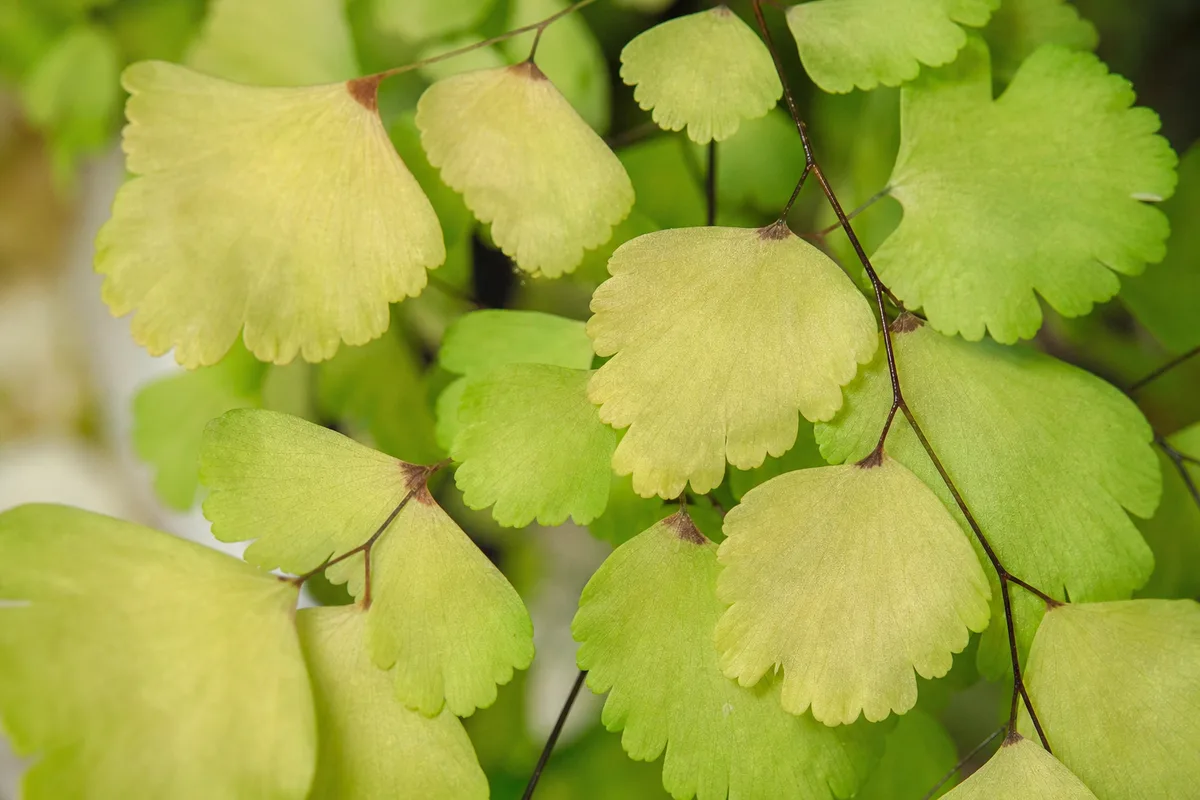
Faded Leaves symptoms on Maidenhair Fern - compare with healthy tissue on the same plant.
Common patterns:
- Uniform pale green-yellow wash across most fronds in a dim corner - too little light
- Bleached or whitish patches on the window-facing side with green tissue elsewhere - too much direct sun
- Gradual dulling of only the oldest outer fronds while new center croziers stay vivid green - normal senescence
- Seasonal paleness that worsens December through February without a care change - winter light drop
- Thin, washed-out new fronds with long gaps between leaflets - etiolation from chronic low light
Fading differs from yellow leaves (often whole-frond chartreuse with wet soil or sun burn) and brown tips from low humidity (margin browning first). Faded tissue may still feel soft and attached - it has simply lost chlorophyll density or been bleached by light stress.
Faded leaves vs lookalikes (quick check)
| Pattern you see | Most likely issue | Fast differentiator | Next guide |
|---|---|---|---|
| Even pale wash across all fronds | Too little light | No crisp scorch; fronds may lean toward window | Not enough light |
| Window-side bleach, green on shaded side | Direct sun bleaching | One-sided damage; may precede scorch | Sunburn |
| Whole-frond chartreuse + limp + wet pot | Overwatering / root stress | Sour smell; heavy pot | Yellow leaves or overwatering |
| Long thin stems, sparse washed-out leaflets | Etiolation from chronic shade | Stretch toward light source | Not enough light |
| Only oldest outer fronds dull at base | Normal senescence | New center croziers stay bright green | No move needed - trim when ready |
| Fine stippling + webbing under leaflets | Spider mites | Speckled, not evenly washed out | Spider mites |
Even paleness everywhere = too dim; one-sided bleach = too much sun - the two most common fade causes need opposite fixes.
Why Maidenhair Fern gets faded leaves
Too little light and etiolation
Too little light is the leading indoor cause. Maidenhair Fern needs bright indirect exposure; full shade drains color and vigor from thin fern fronds. Additional symptoms can include a fading of leaf color and poor growth when light is inadequate. Interior shelves, dark bathrooms chosen for humidity alone, and north rooms without supplemental lighting commonly produce washed-out foliage.
The bathroom trap is frequent: NC State Extension notes this fern does well in bathrooms where it is more humid, but steam without adequate window light still produces pale fronds. Gardeners’ World recommends bathroom or terrarium placement for steamy air - only when the spot supplies enough brightness.
Direct sun bleaching
Direct sun bleaching fades leaflets the opposite way. Leaves may scorch in direct sun, but milder exposure first shows as pale, washed-out patches before crisp brown scorch develops. When a plant gets too much direct light, the leaves become pale, turn brown, and die - south- or west-facing sills without sheer curtains are a frequent trigger. Escalating bleach to papery scorch is covered in the sunburn guide.
Normal frond turnover and seasonal daylight drop
Normal frond turnover causes expected fading at the base. Maidenhair Fern prioritizes energy toward new growth and sheds its oldest fronds as they age. As long as new fronds outnumber fading ones, this is healthy - not a crisis.
Seasonal daylight reduction lowers photosynthesis even when the pot never moved. Winter short days and lower sun angle can pale fronds that looked fine in summer - grow-light supplementation often helps through February.
Overwatering in dim conditions (secondary)
Overwatering in dim conditions sometimes pairs pale limp fronds with wet soil - light and roots both need correction, but the fade pattern usually includes yellowing, not color washout alone. See overwatering on Maidenhair Fern when wet heavy pots accompany widespread pale limp fronds.
How to confirm the cause
Work through these checks before changing watering or fertilizer:
- Light direction test - Is one side of the plant paler than the other? Uneven bleaching confirms sun stress; even paleness suggests low light.
- Shadow at frond level - A very faint midday shadow means insufficient intensity for this species. South- and west-facing windows deliver direct indoor sunlight above 1,000 foot-candles for hours - far beyond what thin fern leaflets tolerate without filtering.
- Frond age pattern - Only oldest outer fronds fading with green new croziers points to senescence.
- Recent moves - Sudden fade after a sunny window placement suggests bleaching; fade after moving to a darker room suggests too little light.
- Soil and roots - Wet sour mix with widespread pale limp fronds adds root stress to the diagnosis; firm roots with dry-weight pot in dim light confirms light as primary cause.
First fix for Maidenhair Fern
Correct light before changing anything else.
If fronds are uniformly pale in a dim spot, move the plant to the brightest indirect location available - east window with sheer curtain, or one to two meters back from south or west glass where fronds never touch direct sun. Acclimate over seven to ten days when jumping from deep shade - increase exposure gradually with morning-only gentle light first so new croziers do not bleach.
If bleached patches appear on the sun-facing side, pull the fern back from direct rays or add a sheer curtain immediately. Do not compensate with extra fertilizer or water.
For normal aging on a few oldest fronds only, trim faded fronds at the soil line once you confirm active new green growth - no relocation needed.
Step-by-step recovery
Low-light recovery with grow-light option
- Identify uniform pale wash or etiolation stretch as the primary pattern.
- Relocate to bright indirect light per the light guide - no direct sun on leaflets.
- Add a full-spectrum grow light 30–45 cm above the crown for 10–12 hours daily if windows are insufficient - especially December through February.
- Maintain a very humid atmosphere when moving closer to drier window zones - humidifier at frond height, pebble tray, or appropriate bathroom placement with adequate brightness.
- Water when the top centimeter is barely dry per the watering guide; brighter corrected placement dries mix faster.
- Wait two to four weeks for new bright green fronds before judging success.
- Remove fully faded fronds at soil level after replacement growth is visible.
- Rotate the pot weekly for even color development.
Hold fertilizer until new fronds show healthy color and the plant is actively growing.
Sun-bleach recovery and escalation path
- Pull the fern out of direct sun today - sheer curtain or relocation to filtered light.
- Do not move a pale fern into direct south sun to “green it up” - bleaching worsens.
- Monitor for crisp scorch developing on bleached patches - if papery brown zones appear, follow the sunburn recovery protocol.
- Trim fully bleached fronds at soil level once new green croziers emerge.
Normal turnover trimming protocol
When only basal outer fronds fade and center croziers stay vivid green, wait for two to three new fronds, then snip faded tissue at the soil line. No light change required.
Recovery timeline
Maidenhair Fern typically produces new green fronds within two to four weeks after light correction. Faded or bleached tissue on old fronds will not re-green - judge recovery by fresh croziers, not old leaflets.
Normal senescence continues slowly year-round; expect occasional oldest-frond fade even on healthy plants.
Severe bleaching across most fronds after prolonged direct sun may leave permanent damage on exposed tissue - new fronds should emerge normal once light is fixed.
Causes to rule out
- Nutrient deficiency - Uncommon in fresh mix; fix light and watering before fertilizing.
- Fluoride in tap water - Usually browns tips, not whole-frond fade; see the watering guide.
- Cold drafts - Cause rapid frond collapse and drop, not gradual paleness.
- Pests alone - Fading without stippling, webbing, or sticky residue is rarely insect-related.
What not to do
Do not move a pale fern into direct south sun to “green it up” - bleaching worsens. Do not keep a sun-bleached fern in place hoping leaves recover; faded patches are permanent. Do not add nitrogen fertilizer to washed-out fronds without confirming light is adequate. Avoid Maidenhair Fern repotting guide on day one unless root rot on Maidenhair Fern accompanies widespread fade with wet sour soil. Do not place grow lights too close - intense LEDs near the crown can bleach delicate pinnae the same way window sun does.
How to prevent faded leaves next time
Site Maidenhair Fern where bright indirect light and humidity coexist - a well-lit bathroom, terrarium near a window, or a humidifier at a bright shelf. Use a consistently moist but well-drained potting soil and ensure the pot drains well per the soil guide.
Clean windows seasonally; grime and obstructions cut usable light more than owners expect. Supplement with grow lights when winter shortens effective daylight. Rotate weekly so one side does not stay permanently dimmer.
Review the Maidenhair Fern overview for the full care cluster: watering, light, and low humidity troubleshooting when margin browning accompanies pale fronds.
Maidenhair Fern care cross-check
Use this quick logic before a second intervention:
- Even pale wash everywhere → brighten placement; see not enough light.
- Window-side bleach only → shade from direct rays; see sunburn if scorch develops.
- Pale + limp + wet pot → inspect roots; see overwatering or yellow leaves.
- Only oldest basal fronds fading → likely senescence; trim after new croziers appear.
Light drives how fast this fern uses water. A pale fern in deep shade often sits wet too long, inviting root problems. Correct light first - then recheck watering rhythm against pot weight rather than a fixed calendar.
How this guide was verified
This guide is written specifically for maidenhair fern faded-frond diagnosis, then checked against extension and botanical references for high-stakes claims. Inline citations are placed directly next to claims they support, and unresolved contradictions are flagged for review rather than silently rewritten.
When to worry
Treat as urgent when rapid mass fading pairs with crown softening, sour wet soil, or bleaching that spread across all new fronds within days of a sunny move. Gradual fading on a few oldest fronds with steady new green growth is normal maintenance, not a rescue situation.
Conclusion
Faded leaves on Maidenhair Fern usually trace to light - too dim for vigor, too harsh for delicate leaflets, or natural aging of old fronds. Even paleness everywhere = brighten; one-sided bleach = shade - then wait for new green croziers before trimming old washed-out tissue. Recovery shows in fresh frond color, not in leaves that already faded.
When to use this page vs other Maidenhair Fern guides
- Maidenhair Fern watering guide - Use for routine moisture checks before assuming faded leaves is the main issue.
- Maidenhair Fern problems hub - Browse all 55 common issues on this species.