Black Spots on Maidenhair Fern: Causes, Checks & Fixes
Quick answer
Black spots on Maidenhair Fern are often normal spore cases along leaflet edges - not disease. If spots are irregular, mushy, or spreading with yellow halos, remove affected fronds and stop wetting foliage before improving airflow.
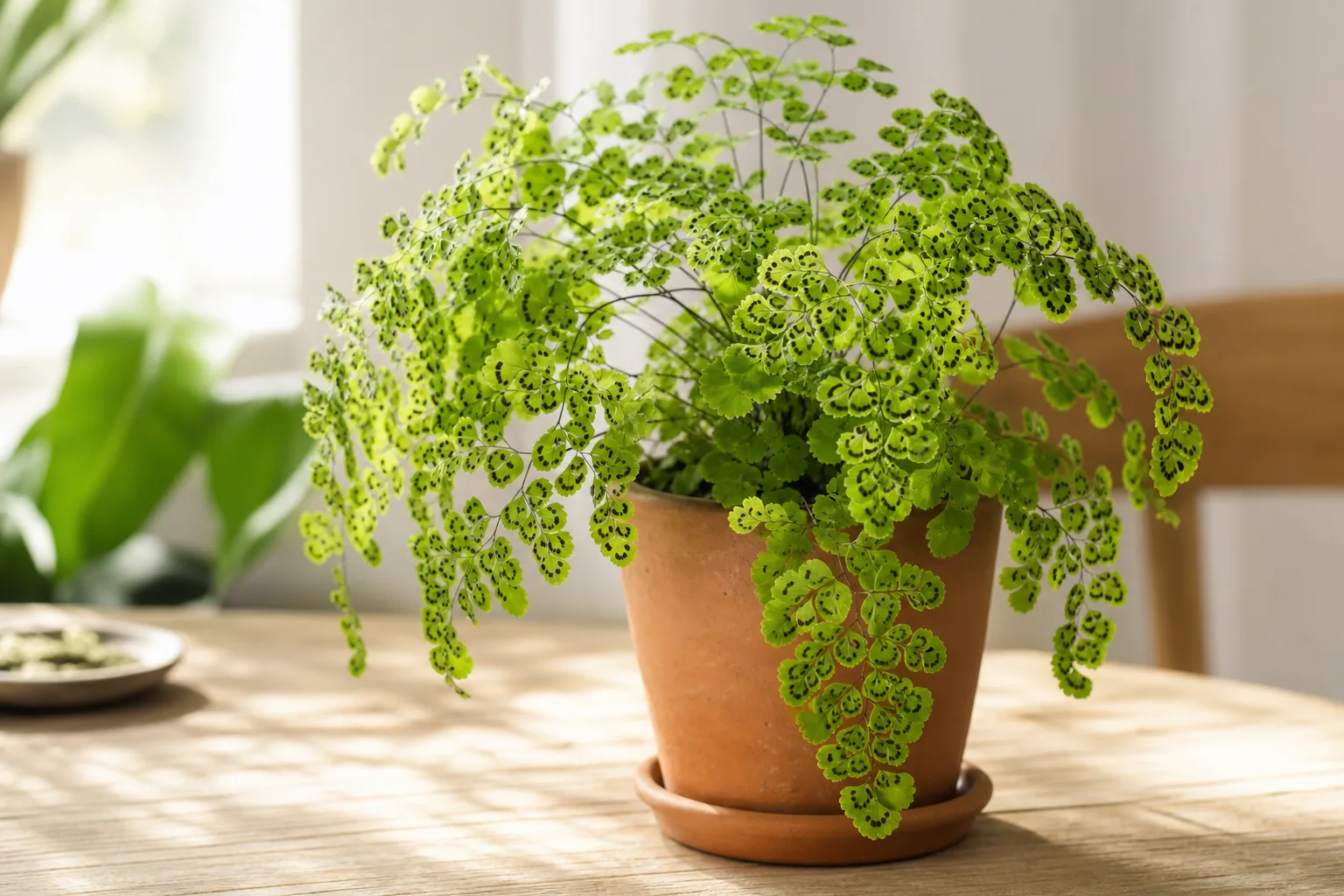
Black Spots on Maidenhair Fern: Causes, Checks & Fixes
This guide covers black spots on Maidenhair Fern. See also the general Black Spots guide, watering, and light pages for this plant.
Black Spots on Maidenhair Fern: Causes, Checks & Fixes
Quick answer
Black spots on Maidenhair Fern fall into two very different categories. Mature fronds often show dark marginal dots that are normal spore cases (sori) - firm, evenly spaced along leaflet edges, and not a sign of illness. Irregular, enlarging spots on the leaflet blade - especially with yellow halos or water-soaked centers - usually mean fungal or bacterial leaf spot from wet foliage and poor airflow.
First step: flip leaflets and confirm sori versus disease before you cut or spray. If margins show organized dark dots that have not changed in weeks, leave the plant alone. If spots are spreading on new growth, remove the worst fronds and stop wetting leaves.
What black spots look like on Maidenhair Fern
On Maidenhair Fern (Adiantum raddianum), the thinnest fan-shaped leaflets hang from black wiry stems. Black markings can mean reproduction or infection - and they look different.
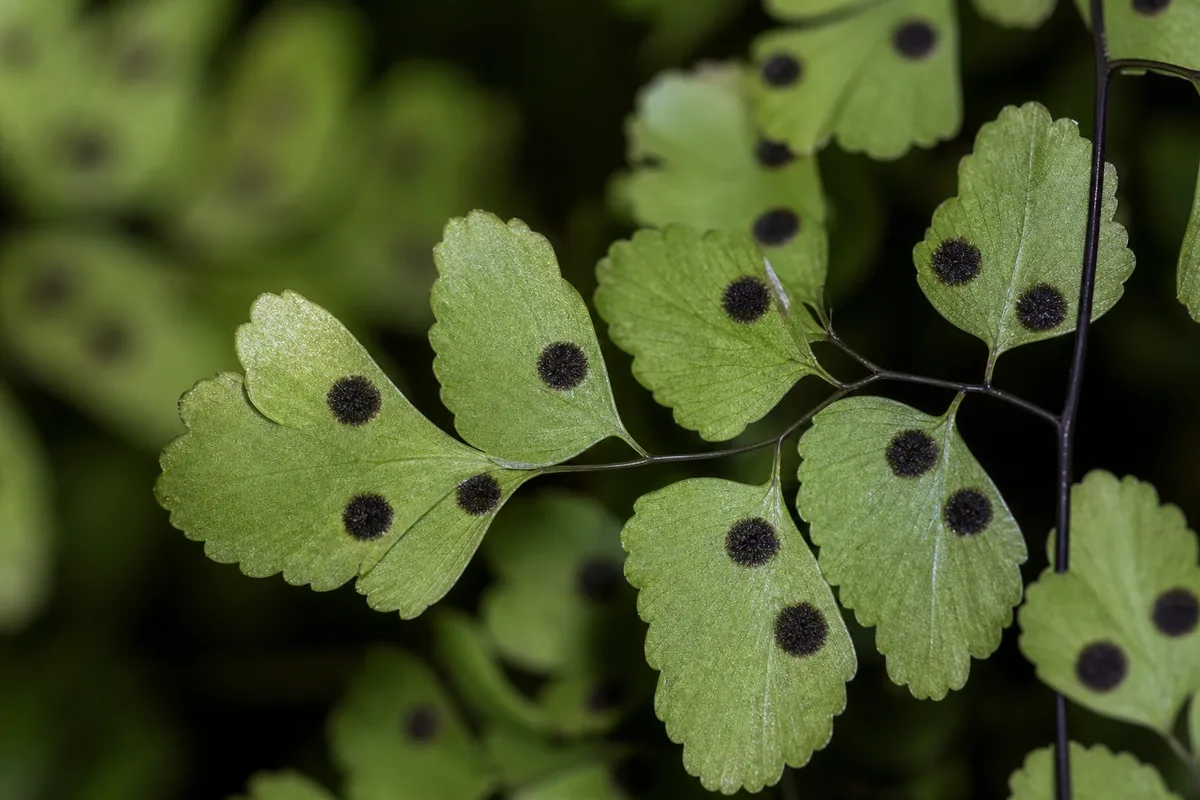
Black Spots symptoms on Maidenhair Fern - compare with healthy tissue on the same plant.
Normal sori (spore cases):
- Small dark dots in rows along the outer leaflet margin, often tucked under the curled edge
- Same size and pattern on multiple leaflets of mature fronds
- Firm when touched; tissue around them stays bright green
- Present for weeks without enlarging or merging
Disease leaf spots:
- Irregular dots or patches anywhere on the leaflet surface, not only at margins
- Spots that start pinhead-small and expand over days, sometimes with yellow halos
- Water-soaked, sunken, or brittle tissue; adjacent leaflets may yellow and drop
- Rapid spread on newest center fronds after misting, showering, or overhead watering
Scale insects can mimic tiny black dots but sit on stems or both leaf surfaces, scrape off with a fingernail, and may leave sticky residue - sori do not.
Why Maidenhair Fern gets black spots
Natural sori appear when the fern reaches reproductive maturity. Maidenhair ferns carry sori around pinna edges under a false indusium formed by the folded leaflet margin - a normal part of the life cycle, not a care failure.
Fungal leaf spot thrives when delicate fronds stay wet too long. Maidenhair Fern wants high humidity and consistently moist soil, which tempts growers to mist leaves or group plants in stagnant bathroom corners. Wet leaflet surfaces plus still air create the microclimate leaf-spot fungi prefer.
Overhead watering and evening misting splash spores and keep tissue damp overnight - a common trigger after someone tries to boost humidity by spraying fronds directly.
Crowded placement in terrariums or dense plant shelves limits airflow between lacy fronds, prolonging leaf wetness even when room humidity is appropriate.
Stress-weakened tissue from root rot on Maidenhair Fern, direct sun scorch, or repeated dry-out cycles is less able to resist infection once spores land.
How to confirm the cause
- Margin pattern - Do dots follow the leaflet edge in neat lines? Likely sori. Random blotches on the blade? Suspect disease.
- Timeline - Have marks been stable for a month on older fronds? Sori. New spots appearing daily on fresh growth? Infection or moisture injury.
- Texture - Firm, dry dots at margins versus mushy, water-soaked, or crumbling centers.
- Care history - Recent misting, foliar feeds, shower rinses, or watering that wets fronds?
- Airflow - Is the fern packed against glass, tucked in a corner, or under a dome with no vent?
- Pest check - Scrape-test suspicious dots; scale and some fungal spots behave differently under pressure.
If most fronds show only marginal dots and the plant pushes clean new growth, you likely do not have a leaf-spot outbreak.
First fix for Maidenhair Fern
Stop wetting foliage and remove the most heavily spotted fronds.
Use sharp, clean scissors to cut diseased fronds at the soil line - not a light trim through spotted leaflets, which leaves infected tissue behind. Bag and discard cuttings; do not compost them.
Switch to soil-level watering only. Raise humidity with a pebble tray, humidifier, or grouping - not foliar misting - until new fronds emerge spot-free for two weeks.
Increase spacing or run a small fan on low nearby so fronds dry within a few hours after any incidental splash.
Do not reach for fungicide on day one if the issue is misidentified sori. Do not repot unless roots are also failing.
Step-by-step recovery
- Confirm sori versus disease using margin pattern and spread rate.
- Isolate the fern if spots are enlarging - leaf pathogens can spread via splash and shared tools.
- Remove fronds with more than roughly one-third spotted tissue; keep lightly marked outer fronds if the plant is sparse.
- Water at soil level early in the day; empty saucers after each drink.
- Improve airflow without blasting direct heat or AC onto fronds.
- Maintain 60%+ humidity through room-level methods, not leaf wetting.
- Monitor new center fronds weekly; successful control means no new lesions on emerging leaflets.
Hold fertilizer until active clean growth returns - stressed ferns do not need extra nitrogen while recovering.
Recovery timeline
Expect to judge progress over two to three weeks, not days. Old necrotic spots remain visible on fronds you kept; they will not heal.
New fronds that open fully green without fresh dots signal the environment is corrected. If spotting continues on every new frond despite dry foliage habits, consider a labeled houseplant fungicide as a secondary step - after sanitation and airflow changes.
Severe collapse - soft crown, foul odor, most fronds blackening within a week - may indicate bacterial rot beyond simple leaf spot. Maidenhair Fern rarely rebounds from advanced crown decay; salvage any firm rhizome sections if present.
Lookalike symptoms
- Normal sori - Marginal, uniform, stable; no yellow halos or spread.
- Brown tips from low humidity - Dry, crisp margins without circular black lesions.
- Sun scorch - Bleached or brown patches on the sun-facing side, not scattered black dots.
- Scale insects - Raised bumps on stems or leaf surfaces; often scrapes off; may produce honeydew.
- Botrytis gray mold - Fuzzy gray growth on dying tissue in cool, stagnant wet conditions - different from dry circular leaf spots.
Causes to rule out
- Spore cases on a healthy plant - No treatment needed; trimming fertile fronds reduces future growth unnecessarily.
- Fluoride or salt burn - Usually tip browning, not discrete black spots.
- Old age - One or two lower fronds fade naturally without spreading lesions on new growth.
What not to do
Do not mist fronds to “fix” humidity while spots are active. Do not shower the entire plant repeatedly without drying afterward. Avoid cutting every frond if only a few show disease - Maidenhair Fern needs foliage to recover. Do not apply fungicide before confirming the spots are not sori. Do not compost infected fronds.
How to prevent black spots next time
Keep Maidenhair Fern in Maidenhair Fern light guide with steady soil moisture but dry leaf surfaces. Water when the top centimeter is barely dry, directing the stream at soil - not fronds.
Use a humidifier or pebble tray rather than foliar sprays. Space plants so air moves between fronds. Sanitize pruning tools between ferns. Remove fallen leaflets from the pot surface promptly.
When you need humidity for Maidenhair Fern overview, solve it in the room - not on the leaves.
Maidenhair Fern care cross-check
This fern tolerates neither drought nor soggy crowns. Black spots often trace to humidity efforts that wet leaves combined with limited airflow - the opposite of what the plant needs. High ambient humidity with dry fronds and moist (not waterlogged) roots is the balance that prevents recurrence.
When to worry
Treat as urgent when spots spread to most new fronds within a week, tissue turns soft or smells rotten, or the crown collapses. Stable marginal dots on mature fronds with continuous green new growth is normal reproductive tissue - not an emergency.
Conclusion
Black spots on Maidenhair Fern are often harmless sori along leaflet margins, not a crisis. Before cutting or spraying, confirm whether marks are organized and firm at edges or irregular and spreading on the blade. For true leaf spot, remove heavily affected fronds, stop wetting foliage, and improve airflow while keeping room humidity high. Judge success by clean new fronds - old spotted tissue will not revert.
When to use this page vs other Maidenhair Fern guides
- Maidenhair Fern watering guide - Use for routine moisture checks before assuming black spots is the main issue.
- Maidenhair Fern problems hub - Browse all 55 common issues on this species.
- Overwatering on Maidenhair Fern - Different entry point when symptoms overlap with black spots.
- Mold on Soil on Maidenhair Fern - Different entry point when symptoms overlap with black spots.
- White Spots on Maidenhair Fern - Different entry point when symptoms overlap with black spots.