Brown Tips on Maidenhair Fern: Causes, Checks & Fixes
Quick answer
Brown tips on Maidenhair Fern usually mean dry air, harsh tap water, or both. White crust on the pot rim points to minerals - switch water first. New fronds browning in dry winter air without crust points to humidity. Keep soil evenly moist, never soggy.
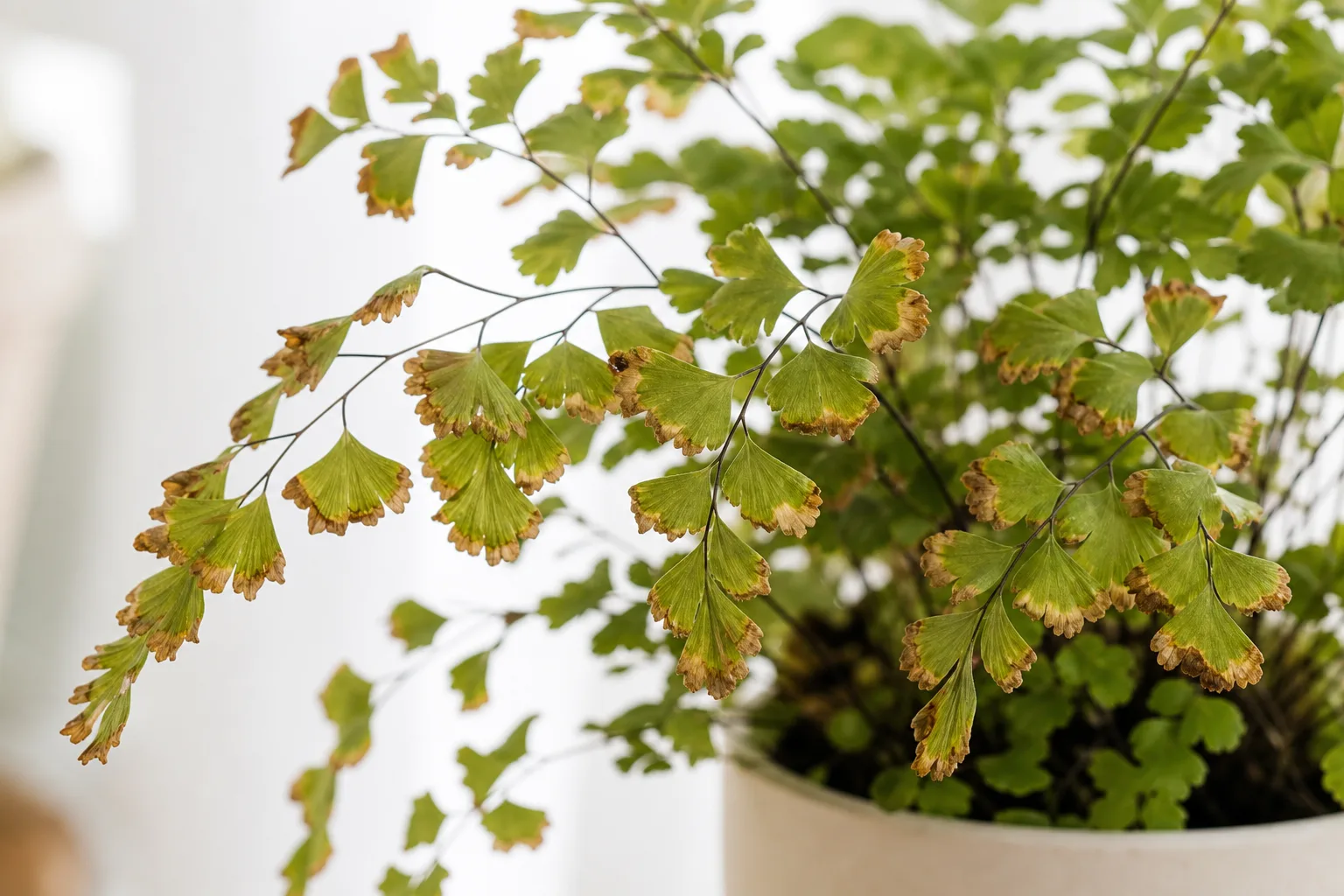
Brown Tips on Maidenhair Fern: Causes, Checks & Fixes
This guide covers brown tips on Maidenhair Fern. See also the general Brown Tips guide, watering, and light pages for this plant.
Brown Tips on Maidenhair Fern: Causes, Checks & Fixes
Quick answer
Brown tips on Maidenhair Fern (Adiantum raddianum) are a margin-and-tip burn pattern on paper-thin leaflets - tan crisping that starts at the outer edge while black stipes often stay firm. This page is the tip-burn and water-quality routing guide. If whole fronds are limp with moist soil and no mineral crust, start with the low humidity guide instead.
Route your first fix by what you see:
| What you notice | Fix first |
|---|---|
| White crust on pot rim or soil; chalky spots after misting tap water | Switch to filtered or rainwater |
| New croziers browning as they unfurl; hygrometer below 50% at frond height; no crust | Raise humidity toward 60–80% |
| Dark brown patches on sun-facing fronds | Move out of direct sun - see sun scorch |
| Tip burn plus sour wet soil and yellowing | Inspect roots - see root rot |
Maidenhair ferns evolved beside moist rock faces and stream spray in tropical regions. Delicate, lace-like fronds lose moisture to dry indoor air faster than thick-leaved houseplants, and fluoride in municipal water can accumulate in leaf margins on sensitive species. Heated homes at 30–40% humidity are a common trigger - but mineral crust tells you water quality is the lead suspect, not air alone.
What brown tips look like on Maidenhair Fern
On Maidenhair Fern, browning starts at frond tips and leaflet margins, not randomly across whole leaves like sun scorch on tougher houseplants. Affected tissue turns tan, then crispy brown, while the black petiole often stays intact.
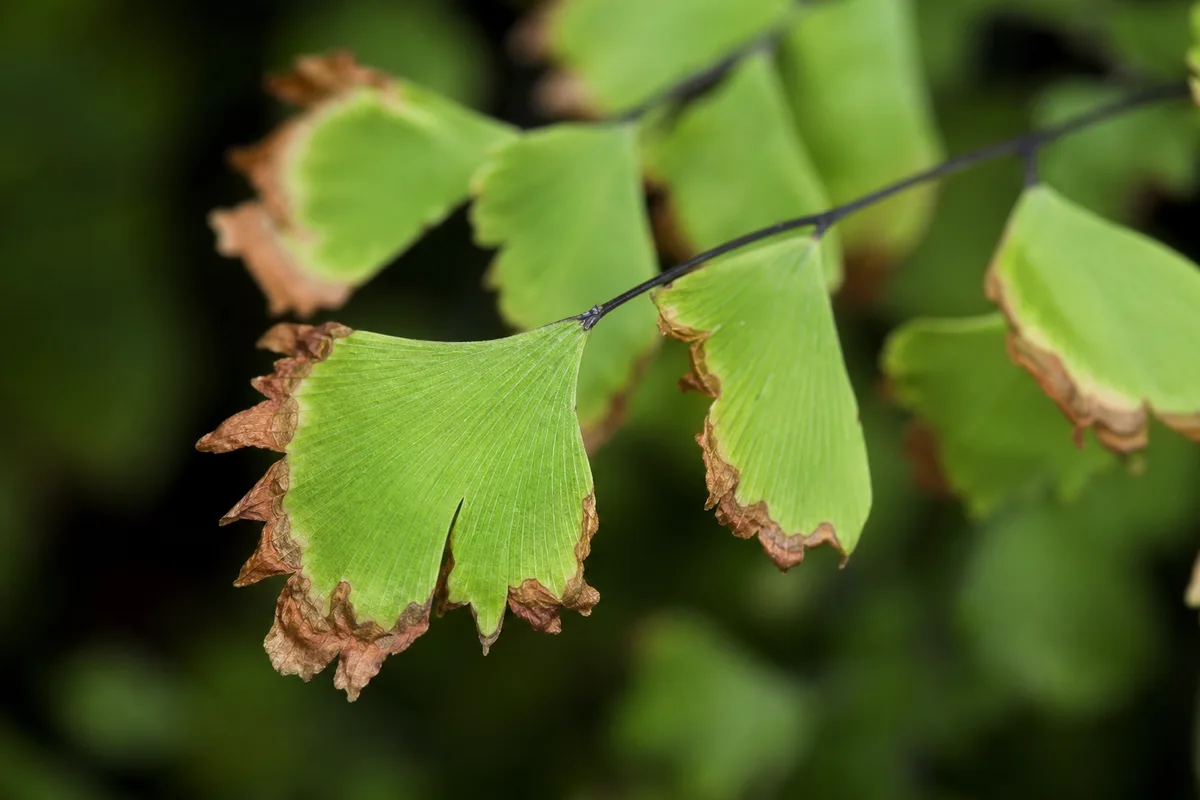
Brown Tips symptoms on Maidenhair Fern - compare with healthy tissue on the same plant.
Patterns that fit brown tips:
- Dry, papery edges on outer leaflets while inner fronds still look green
- Newest fronds emerging with minor tip damage when humidity drops or tap water is harsh
- White mineral crust on pot rims or soil surface from evaporated tap water
- Browning worsening near heat registers, sunny windows, or forced-air vents
Fronds die back quickly if soils are allowed to dry out, but chronic underwatering usually collapses whole fronds - not just tips. Direct sun creates dark scorch marks on fronds facing the window rather than gradual tan crisping at margins. Clemson HGIC notes maidenhairs with thin, delicate fronds develop brown leaflets at low humidity - the same species shows a different pattern when salts, not air, are the driver: crust on the pot plus tip burn despite reasonable humidity.
Why Maidenhair Fern gets brown tips
Low humidity and thin leaflet desiccation
Low humidity is the leading cause indoors when soil moisture is appropriate but air is dry. Maidenhair Fern needs a humid environment with moist soil - conditions most living rooms do not provide without help. Tip tissue dries out first because it receives water last along the transpiration stream and loses moisture fastest in dry indoor air.
In a heated living room at 32% RH with correct watering, leaflets at the frond edge can crisp within days while the crown still feels firm - that is humidity-only tip burn, not root failure.
Tap-water minerals, fluoride, and white crust
Fluoride and salts in tap water accumulate in fine fern roots and leaf margins. Municipal water fluoridation can cause necrotic tips and margins on sensitive plants, and fluoride does not evaporate when water sits overnight the way chlorine can. University of Minnesota Extension warns that repeated softened-water use accumulates salts that eventually injure roots.
White crust on the pot rim is evaporated mineral residue - a visual clue that tip burn may continue even after you add a humidifier. Filtered, distilled, or rainwater reduces mineral stress; resting tap water alone is insufficient when fluoride is the problem.
Inconsistent moisture (never dry, never soggy)
Inconsistent moisture contributes. Roots must never fully dry, yet waterlogged anaerobic mix damages fine roots and limits uptake to tips. Roots must never be allowed to dry out on this species - but stale wet soil in dim corners causes a different failure pattern (yellowing, rot smell) covered on the overwatering and wilting pages.
Compensating for dry air by pouring more water without raising humidity often worsens tip burn: saturated mix limits root function while leaflets still desiccate in dry air above.
Drafts, heat registers, and localized dry zones
Drafts and heat strip humidity from delicate fronds within hours. Avoid placing the plant in drafty areas or near heat registers. UMN Extension notes ferns hung too close to the ceiling encounter hotter, drier air that browns frond tips - the same localized dryness hits a shelf above a radiator.
How to confirm the cause
Work through this order before repotting or fertilizing:
- Mineral crust and water source - White rim crust or chalky misting spots? Do you use straight tap or softened water?
- Humidity at frond height - Is the reading below 50%? Is the plant near AC, heat, or a frequently opened door?
- Soil moisture rhythm - Does the top centimeter dry slightly between drinks, or does mix stay wet for days?
- Light exposure - Any direct sun hitting fronds midday?
- New vs. old fronds - Tip burn on newest growth confirms an active environmental stress, not old leaf senescence alone.
If tips brown while soil smells sour and fronds yellow despite wet mix, inspect roots for rot on the root rot guide before blaming humidity alone.
Lookalike symptoms to rule out
| What you see | Likely cause | First check |
|---|---|---|
| Tan crisp tips and margins; moist appropriate soil; RH below 50% | Low humidity | Humidifier at frond height; see low humidity |
| Tip burn plus white pot crust; burn persists above 50% RH | Tap-water minerals / fluoride | Switch to filtered or rainwater |
| Dark brown patches on sun-facing side only | Direct sun scorch | Move to bright indirect; see sun scorch |
| Tip burn plus crusty white soil surface after feeding | Fertilizer burn | Flush or repot; hold fertilizer |
| Tip burn with sour wet soil, yellowing, limp fronds | Root rot overlap | Unpot; see root rot |
| Oldest outer fronds only; new growth clean | Normal aging | Trim basal fronds; no environmental fix needed |
First fix for Maidenhair Fern
Priority: humidity or water quality first?
When white crust or chalky misting spots are present: Switch to filtered, distilled, or rainwater for every drink and any misting - today. Mineral buildup stops accumulating immediately; existing crust can be gently brushed from the pot rim. Do not wait for a humidifier delivery before changing water.
When new croziers brown as they unfurl with no crust and RH below 50%: Start a humidifier or relocate to a bright bathroom first. Soil moisture can be correct while air still pulls water from thin leaflets faster than roots supply it.
When both air is dry and water is harsh: Switch water immediately, then run a humidifier within the same week. Fixing only one leaves tip burn active on the other path.
Humidifier setup and 60–80% RH target
Run a cool-mist humidifier at frond height, not on the floor across the room - localized readings matter. Target 60–80% near the foliage; 50% is a minimum in most homes per the overview humidity guidance. Pots may be set in a tray of wet pebbles to increase humidity - keep the pot base above the water line. Pebble trays help marginally in heated winter rooms; they rarely replace a humidifier when furnaces hold RH near 30%.
Bathroom relocation works when the spot gets plenty of bright, indirect light but no direct sunshine - a dim bathroom trades one stress for another. Winter drafts from an exterior window can crisp fronds even with shower steam.
Filtered, rested, or rainwater protocol
Use room-temperature filtered or rainwater for all watering per UMN Extension tropical fern guidance. Resting tap water 24 hours may reduce chlorine but does not remove fluoride. When crust is present, assume filtration or rainwater is required, not optional.
Water when the top centimeter feels barely dry, thoroughly enough that a small amount drains, then discard saucer water - full rhythm on the watering guide.
Do not stack fertilizer, repotting, and heavy pruning on the same day. One environmental correction first; read the plant’s response for two weeks.
Step-by-step recovery
- Move the fern away from vents, radiators, and direct sun to bright indirect light.
- Switch all watering to filtered or rainwater; brush white crust from the pot rim.
- Start a humidifier at frond height or use a pebble tray; target 60%+ near the foliage.
- Trim fully brown fronds at soil level with clean scissors - they will not green up.
- Water when the top centimeter is barely dry; never let the root ball go completely dry.
- Hold fertilizer until new fronds emerge without tip burn.
- Monitor weekly with a hygrometer at frond level; adjust humidity before increasing water frequency.
Recovery timeline
New fronds may take 2–4 weeks to emerge clean after humidity and water quality stabilize. Existing browned tips will not recover - judge success by unstained new growth and firm black stems.
A typical indoor recovery: winter furnace air at 34% RH near a heat register, white crust on the pot rim, switched to filtered water and added a tabletop humidifier 12 inches from fronds. RH held 62–68% at leaflet height; new croziers emerged without tip burn at roughly three weeks. Existing tan margins stayed crisp until trimmed.
Mild tip burn on a few outer leaflets with firm crown: correction within one to two weeks stops spread; clean new pinnae in two to four weeks.
Severe dehydration collapse (whole fronds limp and black): longer recovery - may require cutting all fronds to the crown. Maidenhair Fern often resprouts when roots stay firm and moisture returns; see the overview revival section for crown-firmness checks.
What not to do
Do not rely on misting alone in a dry room - UMN Extension notes misting is not very effective for humidity and raises moisture briefly, not steadily. Do not assume pebble trays alone suffice in a 30% RH heated living room. Do not use heavy garden soil or pots without drainage. Do not cut green tissue hoping tips will regrow. Avoid repotting into an oversized container while diagnosing tip burn. Do not pour extra water to compensate for dry air without fixing humidity - that path leads to overwatering.
How to prevent brown tips next time
Site Maidenhair Fern in bright indirect light with steady humidity - bathroom, terrarium, or humidifier-supported shelf. Use consistently moist but well-drained potting soil with coco coir and fine bark for moisture without stagnation per the soil guide.
Water with low-mineral water on a pot-dryness schedule from the watering guide, not a rigid calendar. Remove any browned foliage immediately so the plant directs energy to new fronds.
Keep a hygrometer at frond height through winter heating season. When RH drops below 50%, start the humidifier before tips crisp - prevention is easier than recovery on this species.
Maidenhair Fern care cross-check
Brown tips often mean humidity failed, water quality failed, or both while watering looked “correct.” Use this path before adding more water:
| What you find | Likely cause | Next step |
|---|---|---|
| White crust + tip burn; RH above 50% | Tap-water minerals | Filtered water; see this page |
| No crust; RH below 50%; moist soil | Low humidity | Humidifier; see low humidity |
| Tip burn + heavy wet pot + sour smell | Root dysfunction | Root rot - do not increase water |
| Dry light pot + whole-frond collapse | Underwatering | Soak once; see watering guide |
| Sun-facing dark patches | Sun scorch | Relocate; see sun scorch |
A fern watered daily in a dry, dim corner still tip-burns because leaflets desiccate faster than roots can supply water. Fix placement, water quality, and humidity before increasing water volume.
When to worry
Escalate if new fronds brown within days of unfurling despite 60%+ humidity and filtered water, the crown feels soft, or tip burn pairs with yellowing and sour soil - root dysfunction may be involved on the root rot page. Cosmetic tips on a few lower fronds in winter are manageable with humidity and water changes alone.
How this guide was verified
This guide focuses on tip-burn and tap-water mineral routing for Maidenhair Fern - distinct from whole-frond low-humidity collapse on the low humidity guide. Recommendations were checked against extension and botanical references, including NC State Extension Adiantum raddianum, Clemson HGIC indoor ferns, Missouri Botanical Garden, BBC Gardeners’ World, University of Minnesota Extension tropical ferns, and MSU Extension fluoride toxicity. Inline citations sit next to the claims they support.
Author: sai-ananth · Reviewer: LeafyPixels Review Board · Reviewed: June 2026
Related Maidenhair Fern guides
- Low humidity on Maidenhair Fern - whole-frond crisping when air is dry but water quality is fine
- Maidenhair Fern watering guide - pot-weight checks and moisture rhythm
- Root rot on Maidenhair Fern - when tip burn overlaps sour wet soil
- Wilting on Maidenhair Fern - limp fronds with different moisture paths
- Sun scorch on Maidenhair Fern - dark patches vs. tan margin crisping
- Fertilizer burn on Maidenhair Fern - salt crust from feeding, not tap water
- Salt build-up on Maidenhair Fern - chronic mineral accumulation in mix
- Maidenhair Fern overview - full care hub and streamside habitat context