Maidenhair Fern Fertilizer: When, How, and Mistakes
Maidenhair Fern Fertilizer: When, How, and Mistakes
Maidenhair Fern Fertilizer: When, How, and Mistakes
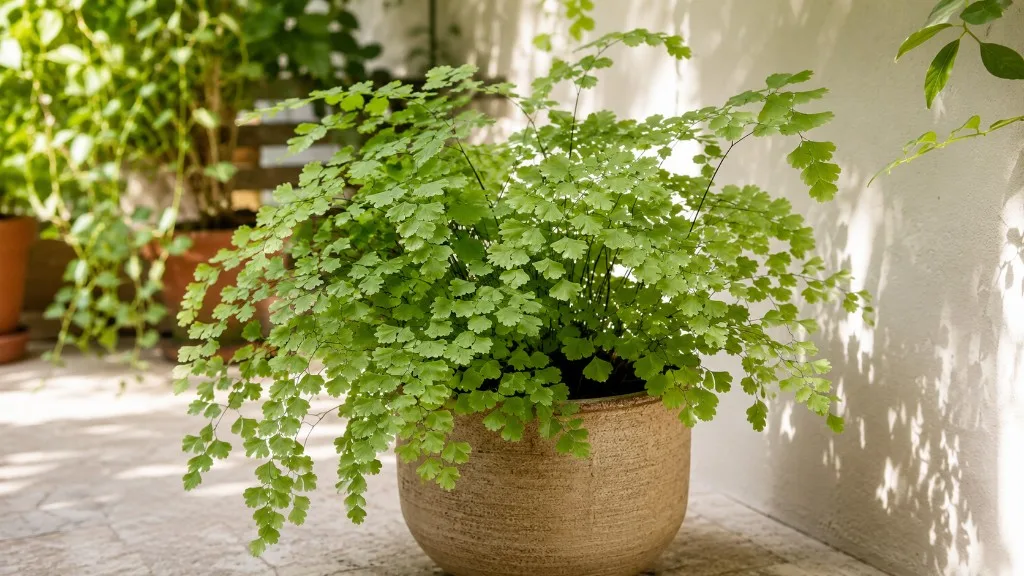
Maidenhair fern fertilizer is one of the few care topics where doing less is almost always safer than doing more. Adiantum raddianum - the delta maidenhair fern sold in most houseplant shops - grows from a mat of fine rhizomes and black-stalked fronds that evolved under humid forest canopies, receiving nutrients in small doses through rain and decaying leaf litter. Indoors, that biology means concentrated salts hit delicate roots faster than they hit a pothos or even a Boston fern in the same window. The practical program is straightforward: half-strength balanced liquid fertilizer on already-moist soil during active spring and summer growth, a leaner 6–8-week interval for sensitive specimens in small pots, and a full pause from late autumn through early spring - plus no feeding at all until new croziers are several inches tall after collapse or repotting.
This guide covers why maidenhair is a lean feeder, which N-P-K formulas work, a worked dilution example, a month-by-month schedule, seven-step application, how to match dose to your room, salt-flush recovery, post-collapse timing, terrarium caveats, and internal links to the rest of the maidenhair fern care hub.
Why Adiantum raddianum Needs Lean, Conservative Feeding
Maidenhair fern is a moderate feeder during active growth and a non-feeder the rest of the year. The RHS advises a half-strength general liquid feed monthly from mid-spring to late summer for A. raddianum grown as a houseplant. University of Minnesota Extension adds the sharper rule: fertilize only when the plant is actively putting on new growth, or when foliage looks paler green than normal - and warns that ferns can be damaged more easily than most houseplants if you over-fertilize, with browning that starts at frond tips and works inward.
That combination matters because maidenhair growers often arrive at this page after the plant already collapsed from a missed watering, then made things worse by “helping” with full-strength feed on stressed roots. Fertilizer cannot fix drought, low humidity, or cold drafts. It can accelerate salt injury when any of those stressors are already present.
Fine Roots, Black Stipes, and Forest-Floor Nutrient Logic
Adiantum raddianum is a tender evergreen fern from the tropical Americas and West Indies, typically reaching 30–60 cm tall and wide with black-stalked, triangular fronds and delicate fan-shaped leaflets. NC State Extension describes the species as needing good drainage with occasionally wet conditions - moist rhizosphere, not a nutrient swamp.
The root system is a shallow mat of fine rhizomes rather than thick storage roots. Fine roots have a high surface-area-to-volume ratio, which helps maidenhair absorb water quickly when the mix is right - and pulls dissolved salts into tissue just as fast when fertilizer is too strong or applied to dry soil. The glossy black stipes (leaf stalks) are a visual signature; when salt burn or drought hits, margins brown along those thin pinnae while the stipe may stay dark, which confuses growers trying to separate fertilizer damage from underwatering.
In habitat, nutrients arrive slowly. Your indoor goal is to mimic that small, periodic dose during crozier emergence - the coiled new fronds that unfurl from the crown - not to push bulk nitrogen for “fuller” foliage. Clemson HGIC states plainly that ferns are very sensitive to over fertilizing. Maidenhair is not an exception; if anything, its fine roots make it the cautionary example in the fern group.
Compared with Boston fern (Nephrolepis exaltata), which University of Wisconsin–Madison Extension cites feeding every 4–6 weeks at half strength during active growth, maidenhair tolerates the same dilution but benefits from treating 6–8 weeks as the safer default in small pots, dry rooms, or post-stress recovery. Both are foliage ferns, not bloom crops. Neither needs high phosphorus “bloom booster” formulas.
Best Fertilizer Type and N-P-K for Maidenhair Fern
The best default for most indoor A. raddianum is a complete, water-soluble, balanced liquid fertilizer such as 10-10-10 or 20-20-20, always diluted to half the label strength (and sometimes weaker for fish emulsion or hard-water homes). BBC Gardeners’ World recommends feeding once a month in spring and summer with a weak balanced liquid feed - language that aligns with RHS monthly half-strength guidance.
N-P-K labels show nitrogen (N), phosphorus (P), and potassium (K). Nitrogen drives chlorophyll and green pinnae color. Phosphorus supports root and rhizome function. Potassium helps regulate water movement inside tissues. Maidenhair needs all three because it produces delicate foliage continuously through the warm months while maintaining a fine root mat in a relatively small container. A balanced formula is appropriate; you do not need elevated nitrogen for “leafier” growth on this solid-green fern - excess nitrogen on salt-sensitive roots tends to produce soft, brittle pinnae that brown at the tips rather than the crisp, deep green arching habit the plant is known for.
Choose a product with micronutrients (iron, manganese, magnesium). Peat-free or coco-heavy indoor mixes contribute little mineral nutrition on their own. If you irrigate with rainwater, distilled, or very soft water, a complete fertilizer matters more because irrigation water is not supplying background minerals. UMN Extension also notes that repeated softened water can accumulate salts in soil and injure roots - a separate stacking risk when you add fertilizer salts on top.
Balanced Liquid Formulas, Fish Emulsion, and What to Skip
Liquid houseplant fertilizer is the most controllable option for maidenhair in 10–15 cm pots: you dilute precisely, apply to moist soil, and stop cleanly when growth slows. Colorado PlantTalk recommends liquid houseplant fertilizer at about one-half the recommended rate from April through September when ferns are actively growing.
Fish emulsion and diluted seaweed extract can work as gentle supplements at quarter to half label strength once a month during active growth, but fish emulsion smells indoors and is not a complete N-P-K replacement on its own. A practical organic-friendly approach: mild balanced liquid as the primary feed, with optional diluted seaweed once or twice in summer. Worm castings mixed lightly into fresh mix at repotting (roughly 10% by volume) provide slow background nutrition - not a substitute for skipping the post-repot pause.
Skip or use extreme caution with:
- Slow-release pellets top-dressed in small pots - heat and constant moisture release unevenly and are hard to pause when the plant stalls
- Full-strength label doses on any formula
- Foliar feeding on delicate pinnae unless a product is explicitly labeled for ferns and used at very low dilution
- Stacked products in the same week (synthetic liquid + Epsom salt + fish emulsion + osmocote)
Worked Half-Strength Dilution Example (10-10-10 Label Math)
Half strength is not vague - it is measurable. Suppose your liquid fertilizer label says 1 teaspoon (5 ml) per gallon (3.8 L) of water for indoor houseplants. Half strength for maidenhair means ½ teaspoon per gallon. If your watering can holds 2 liters, scale proportionally: roughly ¼ teaspoon per 2 L, mixed thoroughly before pouring.
For a 20-20-20 concentrate with the same 1 tsp/gallon indoor rate, the maidenhair dose is still ½ tsp per gallon - the N-P-K numbers change concentration of each nutrient, not the dilution discipline. When in doubt, err toward weaker, especially after repotting, in terrariums, or when tap water is already hard.
Application volume: Water the plant with plain water first if the mix is dry. Then pour diluted fertilizer through moist soil until a little drains from the holes - same as a normal watering pass, but with nutrients in the solution. Never pour concentrate onto dry peat or coco; the osmotic shock pulls water out of fine roots and shows up as tip burn within days.
Seasonal Feeding Schedule: Spring Through Winter
Maidenhair follows a seasonal rhythm indoors even without outdoor frost. Day length, room temperature, and humidity shift nutrient demand. Feed when you see active crozier production, taper when emergence slows, stop in winter, restart only when spring growth is obvious.
| Season (Northern Hemisphere) | Growth phase | Feeding frequency | Dilution |
|---|---|---|---|
| March – April | Waking up | First feed only after new croziers visible | ½ label strength |
| May – August | Peak active growth | Monthly half-strength feed (or every 6–8 weeks if pot is small, plant recently stressed, or hard water stacks minerals) | ½ label strength |
| September | Slowing | At most one light feed if fronds still emerging; otherwise skip | ½ label strength |
| October – February | Rest / low growth | No fertilizer | - |
| March (next year) | Restart | Resume after second new crozier or 2–3 weeks of steady emergence | ½ label strength |
UNH Extension recommends light fertilization only when ferns are actively growing spring through fall, using liquid houseplant fertilizer at half the recommended rate to avoid burning foliage. That half-rate rule is the backbone of the table above.
Winter exception: If you run grow lights that keep the plant producing croziers through December, you may offer one dilute feed every 8–10 weeks at most - still half strength, still on moist soil. Most homes without supplemental light should pause completely; a plant that is not growing cannot metabolize nutrients, and salts accumulate in the root zone.
Seven-Step Application on Moist Soil Without Root Burn
- Check the calendar and the crown. If it is October through February and growth has stalled, stop - do not feed by habit.
- Inspect stress flags. Skip feeding if the plant is wilted, newly repotted (under four to six weeks), recovering from collapse, or showing white salt crust on the soil surface.
- Water first if dry. Give plain room-temperature water until the mix is evenly moist and excess has drained. UMN Extension emphasizes room-temperature water for tropical ferns; cold water stresses roots.
- Mix fertilizer at half label strength in a watering can. Stir well.
- Pour slowly through the soil surface, not over pinnae, until a small amount exits the drainage holes.
- Empty the saucer after a few minutes so the pot is not sitting in concentrated runoff.
- Log the date and watch the next crozier. Clean unfurling without tip burn means the dose was appropriate. Brown tips within a week suggest salts - flush and pause.
Colorado PlantTalk adds that newly potted plants should not be fertilized for four to six months unless there are clear signs of active growth - a rule that overlaps with maidenhair’s post-repot sensitivity.
Matching Feed Rate to Light, Water, Humidity, and Pot Size
Fertilizer dose is not independent of the rest of the care system. A maidenhair in bright indirect light near an east window transpires faster and may use a monthly half-strength feed during peak summer if soil moisture and humidity are stable. The same plant in a dim winter corner should receive no fertilizer even if you water carefully - without growth, nutrients become salts.
High humidity (60–80% in bathrooms or terrariums) keeps pinnae from drying but does not increase nutrient demand automatically; it often means you can stay on the 6–8-week lean schedule because the plant is not losing leaf surface to drought stress. Low humidity dry rooms make drought browning mimic burn; fix humidity and watering before increasing feed strength.
Container size changes salt concentration. A 6 cm nursery pot holds little mix; monthly feeding can build crust faster than in a 15 cm pot with more soil volume. Terracotta breathes and may leach salts slightly faster than glazed ceramic; plastic retains moisture and salts longer. Hard tap water adds calcium and magnesium before you open the fertilizer bottle - if your kettle furs quickly, treat maidenhair as a lean feeder and flush monthly with plain water even on weeks you do not feed.
Signs Your Feeding Routine Is Working
Success on A. raddianum is visible in the crown, not in a fertilizer label promise. Look for:
- New croziers emerging regularly through spring and summer, unfurling without crinkled brown tips
- Deep green pinnae on fresh fronds, with characteristic black stipes staying glossy
- Steady but not explosive size increase - maidenhair is never a fast bulk grower indoors
- No white or yellow crust on the soil surface or pot rim
- Soil that smells neutral, not sour, after feeding weeks
Pale new growth with good light and consistent moisture may justify continuing half-strength on the current interval - not jumping to full strength. If older fronds yellow while soil stays soggy, suspect overwatering or root rot before adding nitrogen.
Over-Fertilizing, Salt Buildup, and Flush Recovery
Over-fertilizing is one of the most common preventable mistakes on maidenhair fern. UMN Extension describes the signature: browning and drying that begins at the tips, then works back into the fronds. You may also see white crystalline crust on the soil surface, stunted or burned croziers shortly after a feed, and wilting despite moist soil when root function is impaired by salts.
Recovery protocol:
- Stop feeding immediately.
- Scrape visible salt crust off the surface without damaging crown rhizomes.
- Flush the pot with plain room-temperature water three to four times, letting it drain fully between passes. The goal is to move dissolved salts out of the root zone.
- Pause fertilizer for four to six weeks minimum.
- Resume at half strength only when new croziers unfurl with clean tips - not when you feel impatient.
If the mix is old, compacted, or heavily crusted, repot into fresh soil blend after flushing, and still wait before feeding.
Fertilizer Burn vs Drought Browning on Black Stipes
Both problems brown pinnae, but the context differs:
| Signal | Fertilizer burn / salt buildup | Drought / low humidity |
|---|---|---|
| Timing | Often within days after feeding or winter feeding | After missed watering or dry heating season |
| Soil | May be moist; crust on surface | Dry top layer; light pot weight |
| Frond pattern | Tips and margins on multiple fronds; new croziers may stall burnt | Whole fronds collapse quickly; pinnae feel papery |
| Crown | Rhizome often firm if caught early | Rhizome may still be firm; recovery possible with moisture |
| Fix | Flush, pause feed, review dose | Rewater evenly, raise humidity, no feed until stable |
When hard water and fertilizer stack, tips brown even when you dilute correctly. Switching to filtered or rainwater for a month while pausing feed often clarifies the diagnosis faster than adding more nutrients.
Under-Fertilizing vs Light, Water, and Root Problems
Maidenhair can look pale or slow without being starved for nutrients. Before increasing fertilizer, rule out:
- Insufficient light - pinnae thin and stretch toward the window (light guide)
- Chronic underwatering - collapse and crisp edges (underwatering)
- Low humidity - marginal browning on otherwise moist soil (low humidity)
- Root damage from soggy mix - yellowing lower fronds on wet soil
- Fluoride/chlorine in tap water - tip burn unrelated to N-P-K
True under-fertilization shows as overall pale green on new growth across seasons when light and water are confirmed good, sometimes with smaller pinnae than usual. If that pattern appears mid-summer after months without any feed, resume half-strength monthly on moist soil and reassess in three to four weeks. Maidenhair rarely needs full-strength doses indoors.
Post-Collapse and Post-Repot Feeding Pause
If your maidenhair collapsed overnight - the classic dry-root turgor crash - fertilizer is the wrong first response. Follow the overview revival protocol: cut collapsed fronds to the soil line, rewet evenly, raise humidity, stabilize light. Do not fertilize until new croziers are several inches tall and unfurling cleanly. Roots recovering from drought or salt shock need moisture and oxygen, not nitrogen pushes.
After repotting or division, wait four to six weeks before the first half-strength feed unless the new mix already contains a small amount of worm castings and the plant is actively growing. Fresh cut rhizome surfaces are vulnerable to burn. When you restart, use the normal spring interval, not a “boost” dose.
This dedicated fertilizer page exists because feeding timing is where growers often overcorrect after a scare - exactly when A. raddianum is least forgiving.
Common Maidenhair Fern Fertilizer Mistakes
- Feeding on a calendar in winter while the plant is dormant - salts accumulate with no growth to use them.
- Applying fertilizer to dry soil - concentrates salts at fine root surfaces.
- Using full label strength because “half seems too weak” - tip burn follows within days on maidenhair.
- Feeding immediately after repotting or collapse - burns recovering rhizomes and sets revival back weeks.
- Ignoring tap-water minerals - hard water plus monthly feed doubles salt load; flush with plain water between feeds.
- Slow-release pellets in small pots - cannot be paused when growth stalls.
- Chasing brown tips with more fertilizer when the real issue is drought, fluoride, or overwatering.
- Stacking multiple products in the same month - one well-diluted balanced liquid is enough.
How Fertilizer Connects to Watering, Light, and Soil
Fertilizer only works inside a stable growing system. Think of it as the last variable to adjust, not the first.
- Watering - moist, oxygenated root zone; never feed dry or flooded stressed plants
- Light - bright indirect drives growth that can use nutrients; dim stalls make feed risky
- Soil - airy, moisture-retentive mix prevents anaerobic rot that blocks uptake
- Overview - full species context, humidity targets, and collapse recovery
- Problem pages when symptoms persist: fertilizer burn, brown tips, salt build-up, slow growth
If you fixed light and water and the plant still looks pale after one conservative summer feeding cycle, then revisit N-P-K - not before.
Terrarium and Bathroom Feeding Notes
Closed terrariums recycle moisture and limit leaching. Nutrients stay in the system longer, so maidenhair often needs fewer feeds - sometimes two to three half-strength applications per growing season rather than monthly. Watch for pinnae tip burn as the early signal that the enclosed system is salt-heavy. Ventilate briefly if fronds stay constantly wet and cold.
Bright bathrooms combine steam humidity with moderate light. Feeding can follow the standard monthly half-strength schedule if croziers are actively emerging and soil drains well. Do not assume shower steam replaces soil checks; a plant can brown from drought in a humid room while you skip fertilizer unnecessarily, or burn from monthly feed in a tiny pot on a windowsill with hard water.
Pet and Child Safety
Maidenhair fern is non-toxic to cats and dogs per university extension references and the ASPCA maidenhair fern listing. That makes A. raddianum a legitimate choice for pet-aware homes. Pet-safe is not chew-proof: large amounts of any plant material can cause mild gastrointestinal upset, and shredded fronds are a mess. Keep pots off high-traffic pet routes if digging is an issue. Fertilizer products themselves are not pet-safe - store concentrates locked away and wipe spills. If a pet ingests fertilizer solution, contact your veterinarian or poison control with the product label in hand.
Conclusion
Maidenhair fern fertilizer success comes down to respecting Adiantum biology: half-strength balanced liquid on moist soil during active growth, a leaner 6–8-week option when pots are small or water is hard, and a full stop through winter and any collapse or repot recovery. Watch croziers, not the calendar - clean unfurling without tip burn means your rate is right; crust, stalled croziers, or tip browning after a feed mean flush, pause, and fix the care foundation in watering and light before you reach for the bottle again.
When to use this page vs other Maidenhair Fern guides
- Maidenhair Fern overview - Start here for whole-plant context before deep-diving this topic.
- Maidenhair Fern problems hub - Jump to symptom-specific fix guides when this care topic does not resolve the issue.
- Salt Build-up on Maidenhair Fern - Escalate here when fertilizer adjustments are not enough.
- Fertilizer Burn on Maidenhair Fern - Escalate here when fertilizer adjustments are not enough.
- Nitrogen Deficiency on Maidenhair Fern - Escalate here when fertilizer adjustments are not enough.
Related Maidenhair Fern guides
- Maidenhair Fern overview
- Maidenhair Fern watering
- Maidenhair Fern light
- Maidenhair Fern soil
- Maidenhair Fern propagation
- Maidenhair Fern repotting
- Salt Build-up on Maidenhair Fern
- Fertilizer Burn on Maidenhair Fern
- Nitrogen Deficiency on Maidenhair Fern
- Maidenhair Fern problems
Related tool
Try the Fertilizer Dilution Calculator with maidenhair-fern pre-selected to estimate needs for your setup.