Stunted Growth on Maidenhair Fern: Causes, Checks & Fixes
Quick answer
Stunted growth on Maidenhair Fern usually means roots, humidity, or light are capping new tissue - not that the plant needs heavy fertilizer. First, slide the fern from its pot and inspect roots and mix; then correct humidity toward 60%+ and bright indirect light.
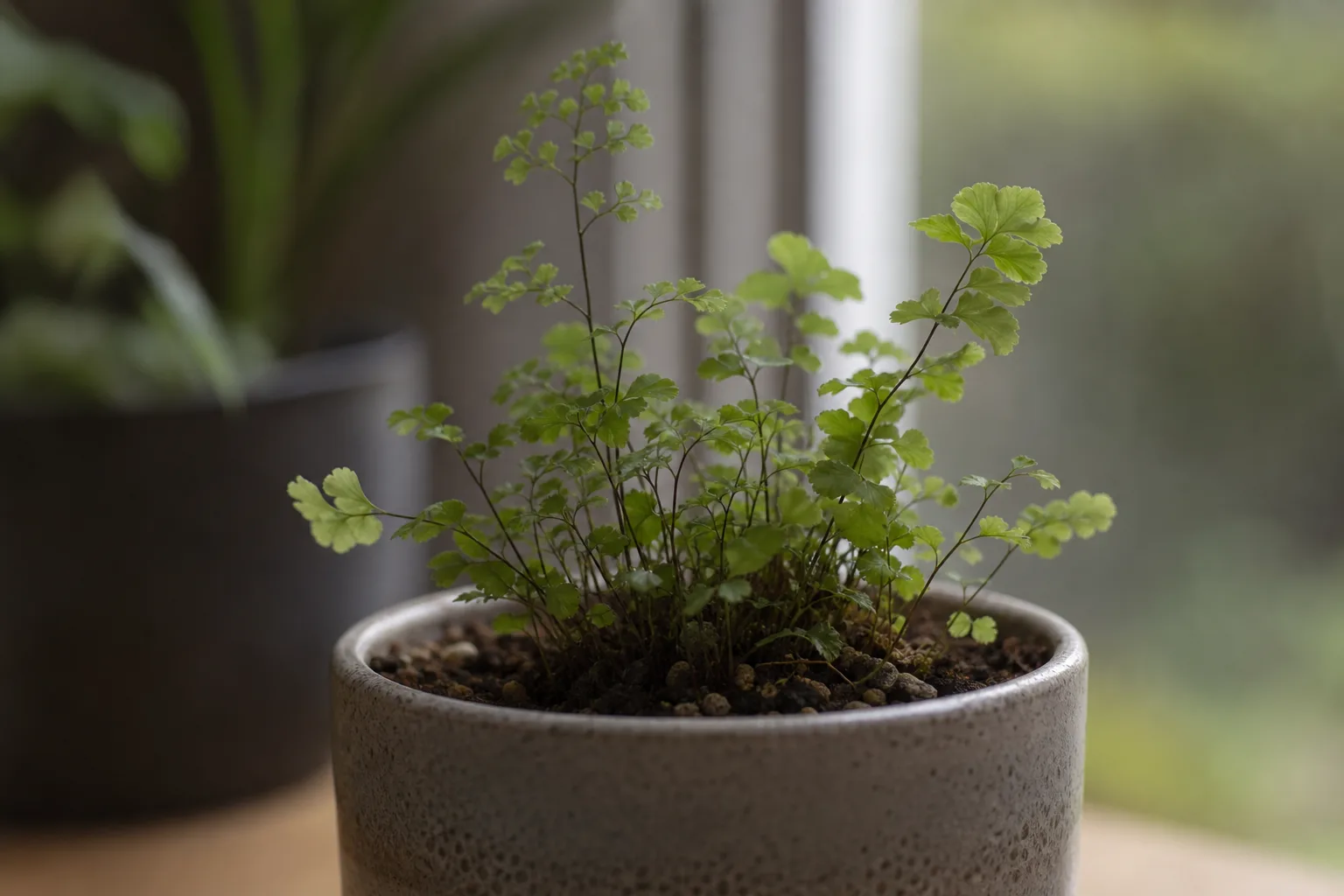
Stunted Growth on Maidenhair Fern: Causes, Checks & Fixes
This guide covers stunted growth on Maidenhair Fern. See also the general Stunted Growth guide, watering, and light pages for this plant.
Stunted Growth on Maidenhair Fern: Causes, Checks & Fixes
Quick answer
Stunted growth on Maidenhair Fern (Adiantum raddianum) means the plant stays small and produces undersized fronds despite routine care - a different pattern from a healthy fern that simply grows at a moderate pace. First step: slide the fern from its pot and inspect roots and mix before reaching for fertilizer. Exhausted soil, tight roots, or damaged roots cap new tissue long before nutrient sprays help.
Maidenhair Fern needs a very humid atmosphere and bright indirect light including diffused sun to build full-sized fan-shaped pinnae. When humidity, light, or the root zone fails, new croziers may emerge but never reach the scale of established fronds. For baseline culture, see the Maidenhair Fern overview and watering guide.
Stunted vs. slow growth - which page fits?
| Pattern | What you see | Start here |
|---|---|---|
| Stunted | New fronds clearly smaller than six-month-old fronds; cramped pinnae; no crown fill-out | This page |
| Slow | New fronds reach normal size at a reduced pace | Slow growth |
| Decline | Mass yellowing, crown collapse, sour soil | Root rot or overwatering |
| Leggy | Stretched stems, wide gaps between pinnae clusters | Not enough light or leggy growth |
What stunted growth looks like on Maidenhair Fern
Healthy Adiantum raddianum adds black-stemmed fronds with expanding fan-shaped leaflets through warm months. NC State Extension rates this species high maintenance indoors - stunting often appears when one environmental limit caps cell expansion even though the plant survives.
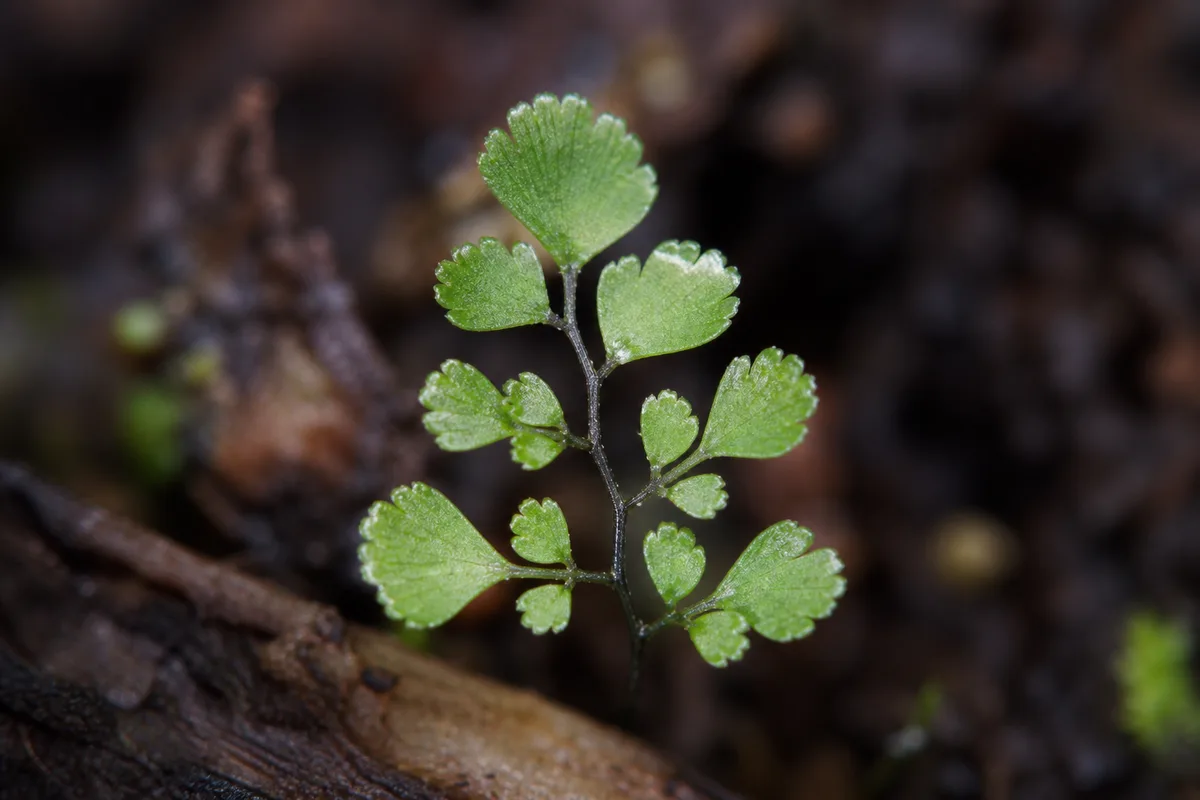
Stunted Growth symptoms on Maidenhair Fern - compare with healthy tissue on the same plant.
Typical stunting signs:
- No meaningful size gain over a full growing season
- New fronds consistently smaller or thinner than older ones
- Croziers that unfurl partially then stall with cramped pinnae
- Sparse, weak frond coverage despite months in the same pot
- Thin black stems with wide gaps between pinnae clusters - stretched but not filling out
This differs from slow growth, where new fronds still reach normal proportions at a reduced pace. Stunting means the plant cannot complete normal frond development. It also differs from active decline - mass yellowing, crown collapse, or sour soil point to rot or severe stress, not sizing limits alone.
Why Maidenhair Fern gets stunted growth
Root-bound or exhausted mix - After one to two years, fine fern roots fill the pot and old coco coir–bark mix loses structure. Little fresh soil remains to hold moisture and oxygen, so new growth stalls even when you water faithfully. See root-bound on Maidenhair Fern when circling roots dominate the root ball.
Chronic low humidity - This fern needs a very humid atmosphere. Heated homes at 30–40% force the plant to produce minimal tissue. New leaflets stay miniature because the plant cannot expand cells in dry air - overlap with low humidity when tips brown alongside undersized fronds.
Insufficient light - If grown in full shade, foliage will lose its vitality and frond production weakens. Deep interior rooms stall structural growth; the fern may survive but never build a full crown. See not enough light when the “read without a lamp” test fails.
Unstable moisture - Roots must never be allowed to dry out, yet waterlogged mix also limits oxygen. Repeated dry–wet swings stress fine roots and pause crozier development mid-season - see water stress when the pattern swings between extremes.
Salt and fluoride buildup - Tap water and accumulated fertilizer salts in old mix brown tips and restrict new pinnae. The plant looks fed but cannot use locked nutrients - see salt build-up and the fertilizer guide.
Cool temperatures - Growth slows below about 16°C (60°F). Winter pause is normal; stunting through a warm spring is not.
How to confirm the cause
- Root slide test - Gently remove the plant. White firm roots in airy moist mix support growth; dense circling roots or sour compacted soil confirm constraint.
- Frond scale comparison - Are new fronds clearly smaller than fronds from six months ago?
- Humidity at frond height - Below 50% for most of the day strongly implicates dry air.
- Light check - Can you read comfortably near the fronds without a lamp? Deep shade fails this test.
- Moisture rhythm - Does soil dry completely between drinks, or stay wet for days?
- Season - Some winter quiet is normal; spring stalling after a care change points to a fixable limit.
| Finding | Likely cap | First fix |
|---|---|---|
| Circling roots, exhausted mix | Root-bound / soil failure | Repot spring into fresh 50/30/20 mix |
| Firm roots, dry air, tip burn | Low humidity | Humidifier or bathroom placement |
| Pale mini-fronds, dim room | Insufficient light | Bright indirect spot |
| Sour wet mix, mushy roots | Rot, not stunting alone | Root rot guide |
| Crisp tips, white crust on mix | Salt buildup | Flush or repot; filtered water |
First fix for Maidenhair Fern
Inspect roots and soil before any other treatment.
Slide the fern from its pot and look at root color, smell, and how much open mix remains. Firm pale roots in fresh airy mix need humidity and light correction - not immediate repotting. Dense circling roots, exhausted mix, or mushy brown roots need repotting into fresh mix one size up in spring.
Repot mix for stunted plants with bound roots - use the 50/30/20 recipe from the soil guide:
| Component | Share | Role |
|---|---|---|
| Quality potting compost | 50% | Organic matter and structure |
| Coco coir | 30% | Even moisture retention |
| Fine orchid bark | 20% | Air channels around fine roots |
Do not fertilize a stunted fern until you know roots are healthy and new croziers are forming. Fertilizer on stressed or rotting roots worsens salt buildup without fixing the cap.
Step-by-step recovery
- Complete the root inspection and note whether roots are healthy, bound, or rotting.
- If mix is exhausted or roots circle tightly, repot in spring into airy moisture-retaining mix one container size larger - follow the repotting guide.
- If roots are mushy, trim damaged tissue, repot into fresh mix, and water lightly until firm new growth appears.
- Raise humidity toward 60–80% with a humidifier or bright bathroom placement.
- Move to the brightest indirect spot available - east window with sheer curtain, or a few feet back from south glass.
- Water when the top centimeter is barely dry; use filtered water if tips show salt burn.
- Remove spent fronds at soil line to redirect energy toward new croziers.
- After four weeks of clean new frond emergence at normal pinnae size, feed half-strength balanced liquid fertilizer monthly through summer.
Recovery timeline
Expect visible new croziers within two to four weeks once humidity, light, and root conditions align in warm weather. Full crown fill-out may take a full growing season.
Plants recovering from root rot or chronic dehydration need root healing first - judge progress by firm roots and fronds that unfurl to normal pinnae size, not by overall height alone.
Lookalike symptoms
| Symptom pattern | Likely cause | Guide |
|---|---|---|
| Mini-fronds, normal pace | Stunting (this page) | Root inspect + repot/humidity |
| Full-sized fronds, slow pace | Slow growth | Slow growth |
| Stretched stems, sparse pinnae | Low light | Leggy growth |
| Brown tips, crisp margins | Dry air | Low humidity |
| Stippling + webbing | Spider mites | Spider mites |
Causes to rule out
- Winter rest - Mild slowdown with firm roots in cool months is normal; resume fixes if spring brings no full-sized fronds.
- Over-fertilization - Salt burn browns tips and stalls growth from damage, not hunger.
- Oversized pot - Extra wet mix around a small root ball encourages rot over expansion - see pot too large.
- Pest pressure alone - Inspect leaflet undersides before assuming soil failure.
Mistakes to avoid
Do not pile on high-nitrogen fertilizer to force size on a humidity-starved fern. Do not repot into a much larger pot hoping for faster growth - excess wet mix slows fine roots. Avoid moving the plant repeatedly while it tries to resume crozier production. Do not interpret stunting as needing less water; dryness collapses this species and shrinks new tissue further.
How to prevent stunted growth next time
RHS recommends repotting in early spring before roots circle tightly - roughly every one to two years for active indoor specimens. Site Maidenhair Fern where bright indirect light and 60–80% humidity are sustainable - bathroom, terrarium, or humidifier-supported shelf. Clemson HGIC notes delicate ferns should not dry out completely.
Use filtered or rainwater if tap causes tip burn. Feed lightly only during active frond production after environment is stable. Avoid drafty areas and heat registers that dry air locally.
When to worry
Worry when stunting pairs with yellowing, sour soil, crown softness, or fronds collapsing faster than new ones emerge - inspect for root rot immediately. A small but stable plant with firm roots through winter is lower urgency; act in spring if full-sized fronds do not return.
Related Maidenhair Fern guides
- Slow growth on Maidenhair Fern - pace vs. scale routing
- Root-bound on Maidenhair Fern - upstream cause of stalled sizing
- Low humidity on Maidenhair Fern - miniature pinnae from dry air
- Not enough light on Maidenhair Fern - weak structural growth
- Leggy growth on Maidenhair Fern - stretch vs. stunting
- Best soil for Maidenhair Fern - 50/30/20 repot mix
- Maidenhair Fern fertilizer guide - when feeding is safe
- Maidenhair Fern overview - full care hub