Leaf Spot Disease on Maidenhair Fern: Causes, Checks & Fixes
Quick answer
True leaf spot on Maidenhair Fern shows spreading brown or black spots with yellow halos on wet, crowded fronds. First step: isolate, cut spotted fronds at the base, and water at soil level without wetting delicate leaflets overnight.
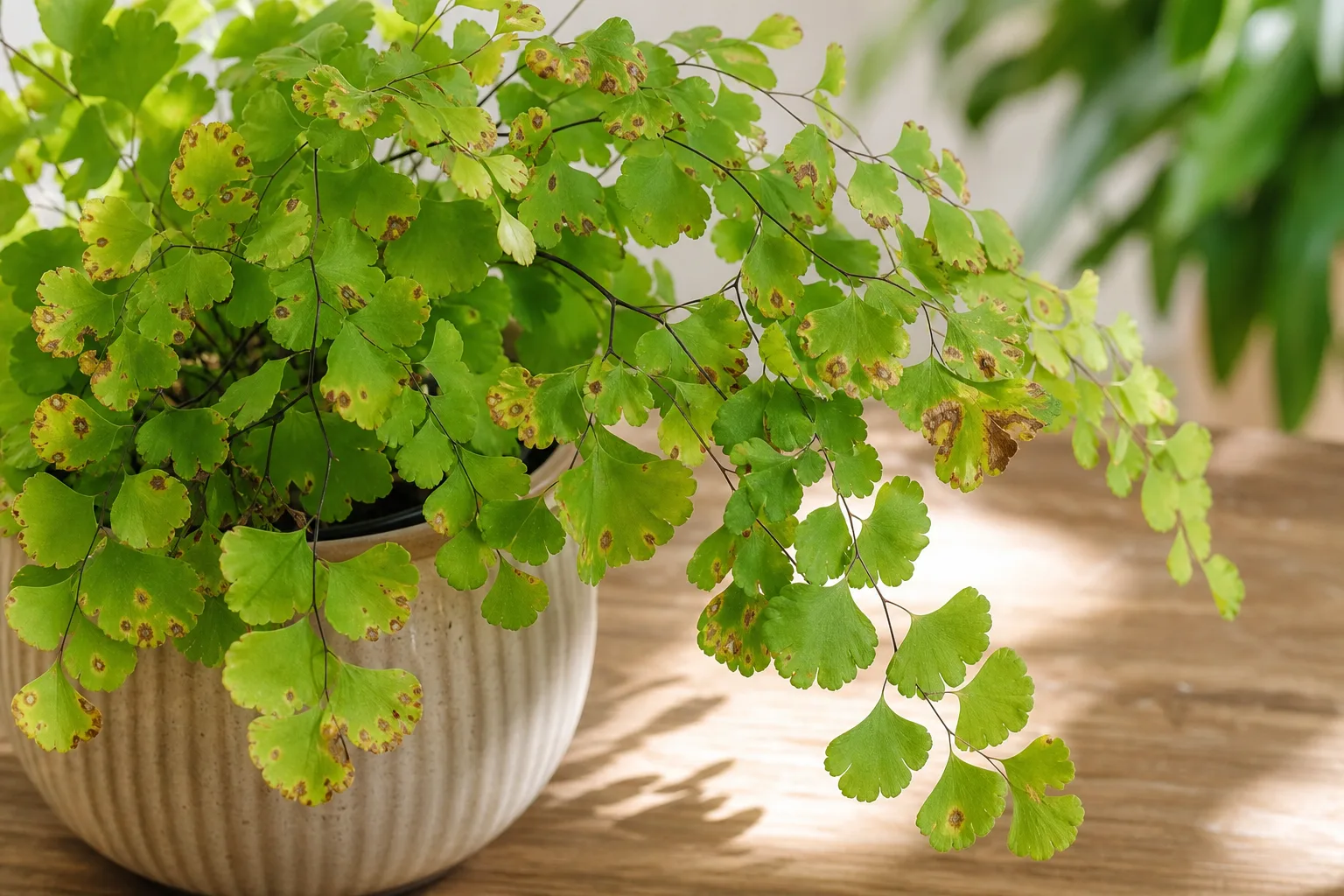
Leaf Spot Disease on Maidenhair Fern: Causes, Checks & Fixes
This guide covers leaf spot disease on Maidenhair Fern. See also the general Leaf Spot Disease guide, watering, and light pages for this plant.
Leaf Spot Disease on Maidenhair Fern: Causes, Checks & Fixes
Quick answer
Spreading halos on mid-blade pinnae mean treat for leaf spot - not sori. On Maidenhair Fern (Adiantum raddianum), true leaf spot disease shows brown or black circular spots with yellow halos that enlarge over several days on wet, crowded fronds - not the firm marginal dots that mark normal reproduction.
First step: isolate the plant, remove every spotted frond at soil level, and switch to base watering so paper-thin leaflets dry before night. Maidenhair Fern needs high humidity, but its leaflets hold water longer than thick houseplant leaves; when fronds stay wet after evening misting or shower spray, fungal leaf spot pathogens spread via splashing water on stressed tissue.
For baseline culture while you diagnose, see the watering guide and overview.
Leaf spot disease vs. black spots - which guide to use
This page covers confirmed or strongly suspected fungal and bacterial leaf spot - spreading lesions on the leaflet blade after wet-frond conditions. Route to sibling guides when the search intent differs:
| What you see | Primary guide | Why |
|---|---|---|
| Spreading halos on mid-blade pinnae after misting or overhead water | This page | Active leaf spot disease treatment protocol |
| Black margin dots stable for weeks, organized in rows under curled edges | Black spots | Sori-vs-disease triage for “black spots” queries |
| Brown tips only, no circular halos on green tissue | Brown tips or low humidity | Dry-air damage, not infection |
| Raised bumps that scrape off, sticky honeydew | Scale insects | Insect mimic, not fungus |
| White fuzzy growth on leaf surfaces | Powdery mildew | Different pathogen and treatment |
| Gray mold on soil or crown debris | Mold on soil | Soil-surface saprophyte, not blade leaf spot |
Rule of thumb: dots that have not changed in a month along leaflet margins → black spots guide first. Spots that appeared this week on new growth after leaves stayed wet overnight → this page.
What leaf spot looks like on Maidenhair Fern
On this fern, fungal leaf spot shows small tan to brown or black circular spots that may develop yellow halos or a target-like ring pattern. Lesions can merge into larger brown patches and cause whole pinnae or frond segments to die back.
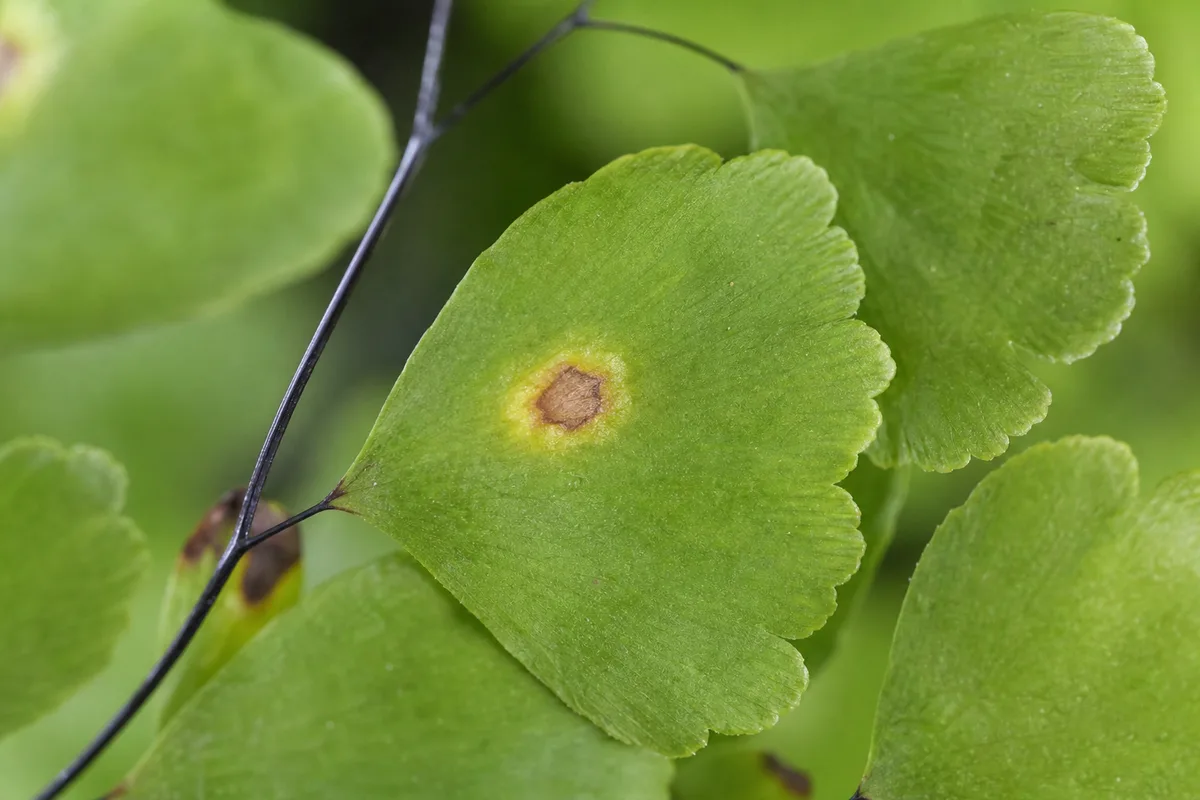
Leaf Spot Disease symptoms on Maidenhair Fern - compare with healthy tissue on the same plant.
Spots often start on lower or inner fronds where splash from watering hits soil and bounces upward. You may see tiny black dots in dead tissue - the fungal fruiting bodies described in Clemson HGIC guidance on houseplant leaf spots.
Unlike tip browning from dry air, leaf spot damage is patchy and spreading on otherwise green tissue. Severe infections trigger mass leaflet drop - Maidenhair Fern sheds stressed pinnae quickly, so spot disease can look like sudden collapse if ignored.
Bacterial leaf spot caveat
Bacterial leaf spots show more uniform water-soaked lesions, sometimes with sticky ooze and angular margins between veins - less common on Maidenhair Fern than fungal spots but worth noting if halos are absent and tissue feels mushy with a rotten smell. Systemic bacterial infections have no cure; discard plants that collapse despite dry-frond culture.
Why Maidenhair Fern gets leaf spot disease
Wet foliage overnight - the main trigger
Care guides often recommend misting for humidity, but on Maidenhair Fern that leaves leaflets damp for hours - especially in cool bathrooms with poor airflow. Watering early in the day and keeping leaf surfaces dry reduces infection risk. Evening mist is the most common indoor trigger on Adiantum because paper-thin pinnae do not dry before night.
Crowded placement and terrarium domes
Terrariums, bottle gardens, and packed plant shelves look lush but limit air movement between delicate pinnae. Closed domes recycle spores from fallen debris; daily ventilation is mandatory during active infection.
Infected debris on soil
Fallen spotted leaflets and splashed spores from old mix restart the cycle after you trim visible damage. Mold and decay on the soil surface can harbor spores that splash upward at the next watering.
Stress-weakened tissue
Recent Maidenhair Fern repotting guide, root issues, draft exposure, or letting the root ball dry completely weakens fronds even though Adiantum raddianum is generally free of major diseases under good care. Stressed pinnae succumb faster once spores land.
How to confirm the cause
Do not treat every brown mark as fungus. Work through this five-step spread test:
- Spread test - Do spots enlarge over 3–7 days after wetting? Static marks that never grow suggest lookalikes.
- Watering history - Recent overhead spray, shower placement, or saucer splash strongly supports fungal leaf spot.
- Pattern check - Random spots on both sides of pinnae vs. organized dots along leaf margins (often normal sori - see black spots guide).
- Texture - Soft water-soaked margins suggest active infection; hard raised bumps that scrape off may be scale insects.
- Airflow - Stagnant humid corners vs. open placement with gentle fan movement.
Symptom lookalike comparison table
| Symptom pattern | Likely cause | Next step |
|---|---|---|
| Round tan-brown spots with yellow halos, spreading after misting | Fungal leaf spot | Isolate, trim at soil line - this page |
| Firm dark dots in rows along leaflet margins, stable weeks | Normal sori | Black spots guide - no treatment |
| Raised brown bumps, sticky honeydew | Scale insects | Scale insects |
| Pale straw-colored static spots after cold rinse | Cold water splash | Cold damage |
| Crisp brown patches on window-facing fronds | Sun scorch | Sunburn |
| Dry margins without halos, roots firm | Low humidity | Low humidity |
| Tiny dark spots at frond bases that enlarge (rare indoors) | Foliar nematode | Discard severely affected plants per Penn State fern disease guidance |
First fix for Maidenhair Fern
Isolate, remove spotted fronds at the base, and water at soil level only - then improve airflow without dropping humidity to desert levels.
Cut every frond with active spots or more than one-third spotted tissue. Use clean scissors; wipe blades with alcohol between cuts. Bag trimmed material and discard - do not compost indoors. Individual infected leaves can be picked off and destroyed to reduce spore load.
Move the fern to a bright indirect spot with space between neighbors. Run a small fan on low nearby if the room is closed. Continue high humidity via pebble trays or a humidifier directed away from wetting leaflets directly - the overview streamside-condition guidance explains why ambient moisture and dry leaf surfaces must coexist.
Hold fertilizer until new fronds emerge clean. Most home cases clear with hygiene and dry foliage alone.
Why misting and evening watering fail during active infection
Evening mist on Adiantum leaflets is the single most common relapse trigger. Fine, thin-leafed ferns need extra humidity in heated homes, but humidity must come from the air - pebble trays, grouped pots, or humidifiers - not from water sitting on pinnae overnight. Shower steam plus stagnant bathroom air invites reinfection after every trim cycle.
Fungicide escalation when cultural fixes fail
If spots persist 10–14 days after isolation, frond removal, and dry-frond culture:
- Potassium bicarbonate - Houseplant-labeled products with this active ingredient are contact fungicides that disrupt fungal cell processes on leaf surfaces. Test spray one frond, wait 48 hours, then treat remaining foliage if no burn appears. Apply in morning so leaflets dry; repeat at label intervals only while spots are still spreading.
- Copper fungicides - Effective against some leaf spot and bacterial pathogens but phytotoxic on sensitive ornamentals and risky on paper-thin fern tissue. Clemson HGIC warns that pesticide sprays injure many ferns - read labels, test one frond for 7–10 days, and avoid copper under terrarium heat or grow lights unless a test frond shows no injury.
- Registered houseplant fungicides - UMD Extension notes that labeled products may be used when cultural changes are insufficient; cultural control should always come first on this sensitive species.
Never fungicide-bath the whole plant on day one before removing infected tissue and fixing airflow.
Step-by-step recovery
- Quarantine the fern away from other humidity lovers.
- Remove all spotted or yellowing fronds at soil level.
- Brush fallen debris off the soil surface; top-dress with fresh mix if heavily contaminated.
- Water at the base until a small amount drains; empty saucers completely per the watering rhythm.
- Maintain 60–80% humidity without soaking leaflets - pebble trays or humidifiers beat evening mist here.
- Monitor daily for new spots; repeat trimming if spread continues.
- Resume weak monthly feeding only after two weeks of clean new growth.
Recovery timeline
Mild leaf spot with firm roots and a healthy crown may show clean new fronds in 2–4 weeks once foliage stays dry. Judge success by spot-free emerging pinnae, not immediate fullness - Maidenhair Fern fills in slowly.
Spotted tissue does not heal; only new growth replaces it. Remove browned foliage immediately so decay does not invite secondary problems.
Severe crown involvement with soft base tissue and mass blackening often kills the plant despite trimming. Rhizome division of firm sections with attached healthy fronds is the salvage path when any clean tissue remains.
What not to do
Do not mist spotted fronds hoping humidity will help - it keeps pathogens wet. Do not overhead water in the evening. Do not leave infected leaflets on the soil surface. Avoid broad fungicide baths on day one before removing tissue and fixing airflow. Do not confuse margin sori with infection and scrape healthy reproductive tissue - use the black spots guide first. Do not fertilize a stressed fern immediately after heavy pruning. Do not seal a spotted fern in a closed terrarium without daily ventilation.
Maidenhair Fern care cross-check
This fern needs humidity without wet leaves - the tension every owner must manage. A steamy bathroom helps atmospheric moisture, but shower spray plus stagnant air invites leaf spot. Match humidity to the root ball (consistently moist, never waterlogged) and keep leaflets dry between waterings. Maidenhair ferns need very humid atmosphere indoors with high humidity among cultural requirements - deliver that through the air, not through wet pinnae.
When to worry
Escalate if spots double in size within a week, fronds blacken from the crown outward, or multiple plants show identical lesions after sharing a tray. Consider fungicide only after cultural changes fail for 10–14 days. Discard plants with soft crowns and no clean rhizome tissue - recovery is unlikely. Chronic outbreaks despite correct culture may warrant contacting your local cooperative extension office or a fern society for specimen diagnosis when foliar nematode is suspected.
Related Maidenhair Fern problems
- Black spots - sori vs. disease triage when margin dots cause panic
- Scale insects - raised bumps and honeydew mimic
- Low humidity - tip browning without spreading halos
- Mold on soil - debris and spore splash from pot surface
- Overwatering and root rot - stress that weakens pinnae
- Propagation - rhizome salvage after crown failure
When to use this page vs other Maidenhair Fern guides
- Maidenhair Fern watering guide - Use for routine moisture checks before assuming leaf spot disease is the main issue.
- Maidenhair Fern problems hub - Browse all 55 common issues on this species.