Jade Plant Care: Light, Water, Soil & Tips
Crassula ovata
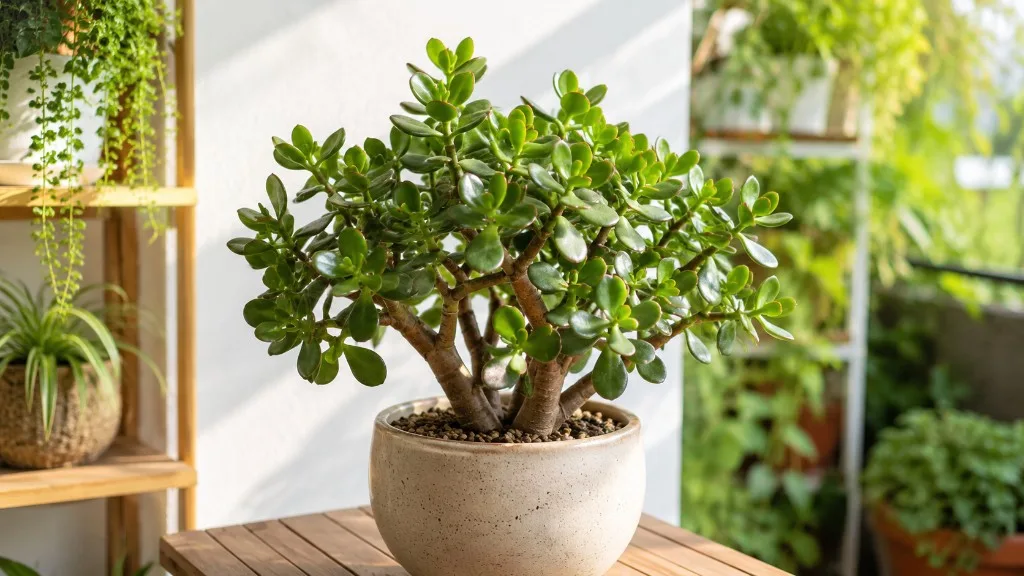
Jade plant can live for decades. Needs bright direct light and very infrequent watering - top inch must be dry. Excellent drainage essential. Frost-tender. Slow trunk development is part of its appeal.
Jade Plant Care: Light, Water, Soil & Tips
Start with wateringThe most common care mistake for Jade PlantWatering guide →Jade Plant care essentials
Light
bright indirect light to 4 hours of direct sun
Water
Water when top inch is completely dry. Every 2–3 weeks summer; every 4–6 weeks winter. Never in standing water.
Soil
Very fast-draining succulent mix: compost 40% + perlite 30% + coarse grit 30%. Terracotta essential.
Humidity
30–50%
Temperature
18–24°C (65–75°F)
Fertilizer
About Jade Plant
Jade Plant is native to South Africa and Mozambique, typically reaches 2–4 ft tall indoors; thick woody stems with fleshy oval leaves indoors, with slow growth. Jade Plant has a bushy growth habit and part of the Crassulaceae family. It is also known as Money Tree, Lucky Plant, Friendship Tree, and Dollar Plant.
| Detail | Information |
|---|---|
| Also known as | Money Tree, Lucky Plant, Friendship Tree, Dollar Plant |
| Native region | South Africa and Mozambique |
| Mature size | 2–4 ft tall indoors; thick woody stems with fleshy oval leaves |
| Growth rate | Slow |
| Growth habit | Bushy |
| Scientific name | Crassula ovata |
| Family | Crassulaceae |
Jade Plant Care: Light, Water, Soil & Tips
What Is Jade Plant?
Jade plant is a woody succulent grown for thick, glossy, oval leaves on stout stems that slowly thicken into a miniature tree form. The accepted scientific name is Crassula ovata, though older tags and references may list Crassula argentea - botanists treat these as the same species for practical care purposes. You will also see common names such as lucky plant, money plant, friendship plant, and jade tree. One naming trap worth clearing up immediately: “money plant” sometimes refers to Pachira aquatica, a completely different species with different care needs. If your plant has fleshy coin-shaped leaves on woody stems, you are working with Crassula ovata regardless of what the shop called it.
Indoors, jade plant typically reaches 2 to 4 feet (60 to 120 cm) tall over many years, developing a bushy, tree-like habit with a thick caudex-like trunk base when grown in bright light and allowed to mature without constant Jade Plant repotting guide. Growth is slow compared with most tropical foliage houseplants - a feature many growers appreciate because it means less frequent repotting, less aggressive pruning, and a stable silhouette that suits desks, windowsills, and long-term display pots. Mature specimens can produce clusters of small star-shaped white or pink flowers in winter under specific light-and-temperature conditions, though flowering is a bonus, not a baseline expectation for a young indoor plant.
If you are deciding whether jade plant fits your home, the honest summary is this: jade rewards bright light, patient dry-down watering, and fast-draining soil - and it punishes overwatering on Jade Plant, dim corners, and heavy peat mixes faster than its tough appearance suggests. It is easier than a finicky calathea and less forgiving than a snake plant when water arrives too often. The payoff is a sculptural succulent that can live for decades, train into bonsai form, and propagate freely from stem cuttings. One critical caveat for pet owners: jade plant is toxic to cats and dogs according to the ASPCA, which surprises many people who assume compact succulents are automatically pet-safe.
Botanical Background and Common Names
Jade plant belongs to the family Crassulaceae, a group of succulents that share a few baseline rules worth learning once and applying broadly. Crassulaceae species store water in leaves and stems, photosynthesize using CAM metabolism (opening stomata at night to reduce water loss), and tolerate drought far better than wet roots. They dislike compacted, water-retentive soil, sudden cold, and stagnant humidity around the crown. Most problems - yellowing, leaf drop, black stem bases - begin at the roots long before the foliage tells the full story.
The species is native to South Africa, where it grows as a hardy shrub in rocky, well-drained slopes with strong sun and seasonal dry periods. In USDA Hardiness Zones 11 and 12, jade plant survives outdoors year-round and can reach shrub size. In cooler climates it is grown almost exclusively as a container houseplant or a summer patio plant moved indoors before frost. Any exposure to freezing temperatures kills the plant, and sustained temperatures below about 50°F (10°C) stress roots and increase rot risk if the soil is not bone dry.
Commerce also sells related Crassula species and cultivars - including variegated forms, compact “mini jade” selections, and hybrids with slightly different leaf shapes - under the jade plant umbrella. Tags are not always precise. If your plant came with a botanical name, keep it. If not, judge care by the plant’s visible traits: thick fleshy leaves, woody stems, and slow upright growth point to Crassula ovata-type care regardless of marketing nickname.
Why Native Range Matters for Indoor Care
Treating jade plant as a generic houseplant is the most common mistake new growers make. Its South African origin sets the practical ceiling and floor for light, water, soil, and temperature in your home. In habitat, the plant experiences bright sun, cool dry winters, and warm growing seasons with infrequent but deep rain. Indoor care works best when you mirror that rhythm rather than applying a tropical foliage schedule.
The native context explains three behaviors that confuse beginners. First, jade plant slows growth sharply in short, cool days - not because it is dying, but because it is entering semi-dormancy. Second, it stores water in leaves and stems, so wrinkled foliage can mean drought, but soft mushy foliage almost always means excess moisture at the roots. Third, it needs strong light to stay compact; dim survival is possible for months, but the plant stretches, weakens, and becomes far more vulnerable to rot because it uses less water while the soil stays wet longer. When in doubt, adjust toward brighter light and drier soil rather than more water and fertilizer.
Best Growing Conditions for Jade Plant
Jade plant performs best when your room approximates the bright, dry, well-drained conditions of its native range. The four variables that decide almost every outcome are light, water, soil, and temperature. Align those and feeding, repotting, pruning, and propagation become straightforward maintenance. Misalign one - especially water in low light - and no amount of leaf wiping or weak fertilizer will recover the plant until the environment changes.
Light Requirements
Jade plant needs bright light - ideally four to six hours of strong light daily, including some direct sun once acclimated. A practical indoor target is Jade Plant light guide plus up to four hours of direct sun, with east-facing windows often ideal because morning sun is strong enough to keep growth compact but gentle enough to avoid scorch on acclimated plants. South- and west-facing sills work well for mature specimens that have been gradually introduced to stronger rays; filter harsh midday summer sun with a sheer curtain if you see bleaching or brown patches on sun-facing leaves.
The fastest diagnostic for incorrect light is new growth, not old damage. Compact internodes, firm plump leaves, and red-tinted margins on some cultivars mean the plant is probably receiving enough energy. Leggy, floppy stems with small pale leaves spaced far apart - a condition called etiolation - mean the plant wants more light. Bleached white patches, crispy brown sunburn, or sudden leaf collapse after a window move mean it wants less direct exposure or a slower acclimation period. Move gradually over one to two weeks when shifting from a dim shop shelf to a bright sill; leaves formed in low light contain less protective pigment and burn easily under abrupt strong sun.
Low light is a poor long-term setup. Jade plant may survive a dim corner for a while because its stored water buffers short stress periods, but it will not thrive there. In reduced light, slow the Jade Plant watering guide because the plant transpires less and the pot stays wet longer - a combination that invites root rot. If a bright window is unavailable, a full-spectrum grow light on a 10–12 hour timer, positioned 12–18 inches above the canopy, can substitute for natural sun during winter or in north-facing rooms. Rotate the pot every few weeks so growth stays symmetrical rather than leaning hard toward the light source.
According to Wisconsin Horticulture Extension, jade plant does best with four or more hours of direct sun but will survive in bright indirect light - though survival lighting produces deep green, drooping stems rather than the tight compact profile most growers want. That distinction matters when you evaluate whether your placement is “good enough.”
Temperature and Humidity
Jade plant prefers stable indoor temperatures between 65 and 75°F (18 and 24°C) during active growth. It tolerates warmer summer rooms when light and watering keep pace, but it struggles below 50°F (10°C) and should never experience frost. Watch problem microclimates: window ledges that drop sharply on winter nights, spots directly under air-conditioning vents, and shelves above radiators can push the plant outside its comfort zone within hours even when the room thermostat reads fine.
Humidity is one of the few variables where jade plant is genuinely easy. It prefers low to average humidity, roughly 30 to 50%, and does not need misting. In fact, misting is counterproductive: the moisture evaporates too quickly to change room humidity meaningfully, and wet leaf surfaces can encourage fungal spotting on crowded plants. Very dry winter air below about 30% can occasionally encourage spider mites, so if you run heat constantly and leaves look dusty or stippled, inspect undersides weekly and consider grouping plants or using a humidifier for the room - not the individual leaves.
If you move jade plant outdoors for summer, acclimate gradually to prevent sunburn, and bring it inside before nighttime temperatures fall toward 50°F (10°C). Outdoor summer light often produces the red leaf margins and sturdiest wood, but the transition back indoors in fall is when many growers overwater a slowing plant - match watering to reduced growth, not to nostalgia for July’s schedule.
Soil and Drainage
Use a very fast-draining succulent mix rather than standard peat-heavy potting soil. A reliable recipe is 40% compost or quality potting base, 30% perlite, and 30% coarse grit such as pumice, horticultural grit, or crushed granite. The exact percentages matter less than the outcome: water should enter quickly, drain freely, and leave abundant air pockets around roots. Heavy mixes compact over time, hold water for days, and recreate the wet-root conditions jade plant never experiences on rocky slopes in South Africa.
Terracotta pots earn their reputation with Jade Plant overview. Unglazed clay breathes through the walls, accelerating dry-down and giving you earlier warning when the root zone is approaching readiness for the next soak. Always use a pot with a drainage hole; a decorative cachepot is fine only if you empty runoff promptly and never let the inner pot sit in standing water. Target substrate pH around 6.0 to 7.5; hobbyists rarely need to measure because a mineral-amended succulent mix naturally sits in that range.
The pot size should match the root mass, not your ambition. Jade plant tolerates being slightly root-bound, and many bonsai growers deliberately restrict pot volume to slow trunk thickening. A pot vastly larger than the root system holds excess wet mix that roots cannot colonize quickly - the classic setup for post-repot rot.
How to Water Jade Plant
The general rule is simple to state and easy to get wrong in practice: water when the soil is genuinely dry, not on a calendar. Jade plant wants a full soak followed by a complete dry-down. Shallow sips that keep the surface damp while the core stays wet are worse than waiting an extra week and watering deeply.
Use your finger, a wooden chopstick, or pot weight to assess moisture two inches (5 cm) into the mix, not just at the surface. The top often looks dry while the root zone remains damp - especially in winter or after a recent repot. When the deeper mix is dry and the pot feels noticeably lighter, water until excess runs from the drainage hole, then empty the saucer so the plant is never standing in runoff. Discard water from cachepots within thirty minutes.
As a starting interval before you learn your pot’s rhythm: every two to four weeks in summer and every four to eight weeks in winter, adjusted for light, pot size, and room temperature. A jade plant under a grow light in a small terracotta pot may dry in ten days during July. The same plant in a large glazed pot in a dim room may need six weeks between drinks in January. The calendar is a reminder to check, not permission to water.
Watering Rhythm During Active Growth
During active growth - typically spring and summer when days are long, temperatures are warm, and new leaves appear regularly - jade plant uses water at its fastest indoor rate. That still means full dry-down between waterings, not constant moisture. Water thoroughly when checks confirm dryness, then wait until checks confirm dryness again. The leaves should remain firm and plump; a slight softness at the end of a dry cycle is normal, but persistent wrinkling means you waited too long or roots are compromised.
Pair watering with light observations. When you move the plant to a brighter spot, expect faster dry-down and check more often for the first month until you learn the new rhythm. When growth is visibly active, modest feeding can resume; when no new leaves appear for weeks, assume the plant is not using water quickly regardless of what the calendar says.
Seasonal Adjustments
In fall and winter, jade plant enters semi-dormancy in most homes: growth slows, water demand drops, and rot risk rises if you maintain summer generosity. Stretch intervals, verify dryness more conservatively, and pause or sharply reduce fertilizer because unused salts accumulate in dry, inactive soil. Wisconsin Horticulture Extension recommends restricted watering in winter when jade is semi-dormant, with soil remaining on the dry side - a striking contrast with summer that catches schedule-driven growers off guard.
Cool night temperatures combined with wet soil are especially dangerous. If your plant sits on a cold windowsill, pull it back slightly from the glass on freezing nights and let the soil stay drier than you would in summer. Resume your active-season rhythm only when new growth is clearly visible and temperatures are stable.
Common Watering Mistakes
The single most common cause of jade plant failure is loving it with water on a schedule. Other frequent errors include watering when only the surface is dry, leaving the pot in a full saucer, using a mix that retains moisture for a week or more, and increasing water when leaves drop without first checking whether the soil is already wet. Leaf drop from overwatering and leaf drop from underwatering can look similar from across the room; soil moisture and pot weight separate the two in under a minute.
Another subtle mistake is watering immediately after repotting into a much larger container. Damaged root hairs need time to heal in barely moist mix. Wait several days after repot unless the plant was fully dry and actively growing, then water lightly and return to full soaks only after new root activity is evident.
How to Feed Jade Plant
Jade plant does not need heavy feeding. A modest, balanced fertilizer during active growth is enough; aggressive doses burn roots and leave salt crust on soil and pot rims. Think of fertilizer as a light supplement for a plant that already stores its own reserves in succulent tissue, not as a substitute for adequate light.
A balanced water-soluble houseplant fertilizer at one-quarter to one-half of the label rate applied every four to six weeks during spring and summer is a safe starting point. Apply to already-moist soil so the solution distributes without concentrating salt at dry root surfaces. If your potting mix includes a starter charge - common in bagged succulent blends - hold supplemental feeding for the first month after repotting.
Pause feeding during dormancy, immediately after repotting, while recovering from pest damage or root pruning, and whenever the plant shows stress symptoms you have not diagnosed. Resume only when new growth is firm and the watering rhythm is stable. Over-fertilizing a plant that cannot use nutrients is how hobbyists accumulate salts that brown leaf margins and damage fine roots.
Repotting and Root Health
Repot jade plant roughly every one to two years, or when physical signs outpace the calendar: roots circling drainage holes, water running straight through without soaking in, a top-heavy plant unstable in its pot, or mix that has compacted and smells sour. The best timing is early active season - late winter into spring - when lengthening days give the plant months to colonize fresh mix before the next dormancy.
Move up only one pot size at a time, or refresh mix in the same pot if the goal is soil renewal without encouraging oversized wet zones. Trim only rotted or mushy roots during repot; healthy white or tan firm roots should remain intact. Let the plant sit in barely moist fresh mix for several days before the first full soak. Avoid burying the stem deeper than it grew before - stem tissue in contact with constantly damp mix can rot.
Signs It Is Time to Repot
The clearest repot signals are mechanical: roots emerging from drainage holes, a plant that tips easily because roots fill the pot, or mix that dries in a day or less because roots have displaced soil. Slower signals include chronic wilting despite careful watering (often root congestion or degraded mix) and white salt crust on the pot rim that flushing no longer corrects. If the plant is healthy, stable, and drying on a predictable rhythm, skipping repot an extra year is safer than upsizing prematurely.
Propagation Methods for Jade Plant
Jade plant is among the easiest woody succulents to propagate at home. Stem cuttings are the most reliable method; leaf cuttings work but take longer and produce smaller initial plants. Division is possible on multi-stemmed mature specimens but is less common because most houseplants are sold as single-trunk forms.
For stem cuttings, select a healthy branch with firm leaves and cut two to four inches (5 to 10 cm) with clean sharp scissors. Remove leaves from the lower inch so bare stem contacts soil. Let the cutting callus in dry air for three to seven days until the cut surface looks sealed and dry - skipping callusing is a top reason succulent cuttings rot instead of root. Insert the callused end into moist, fast-draining mix, support the cutting if it wobbles, and place it in bright indirect light without direct sun until roots anchor.
Water sparingly at first: a light mist or edge watering after the first week, then gradual increases as new growth appears. Roots typically form in two to six weeks depending on temperature and light. A gentle tug met with resistance confirms rooting. Treat the rooted cutting as a young jade plant with slightly more conservative watering until the root system matures.
Do not propagate from stressed, pest-infested, or recently overwatered parent material. Cuttings inherit the parent’s condition, and weak starts fail at much higher rates than cuttings from firm, actively growing stems.
Common Jade Plant Problems
Most jade plant problems are environmental rather than mysterious diseases. Symptoms map to causes if you read them in order: check soil moisture first, then light, then pests, then recent changes such as repotting or relocation. Patience matters because both decline and recovery unfold over weeks.
Yellow Leaves, Brown Tips, and Pests
Yellow leaves are the most common complaint and the least diagnostic on their own. Overwatering produces yellowing that may start on lower leaves and progress with soft stems; underwatering produces yellow wrinkled leaves on a light dry pot. Low light yellows and stretches new growth while old leaves drop slowly. Natural aging sheds an occasional lower leaf on an otherwise firm plant - not a crisis. Check moisture at depth, evaluate recent watering changes, and inspect before adjusting anything.
Brown leaf tips and margins often point to salt buildup, fluoride or chlorine in tap water, or chronic underwatering at the root tips. Flush the pot with plain water quarterly in hard-water homes, and avoid letting fertilizer salts accumulate on dry winter soil. If tips appear only on sun-facing leaves, suspect scorch instead and soften light.
Leaf drop after a move is common shock; hold watering steady and wait for new growth. Sudden mass drop with soft stems and blackening at the base is rot - remove the plant from the pot, excise rotten tissue, callus, and restart from healthy cuttings if the main stem is compromised.
Pests include mealybugs in leaf axils, scale on stems, and spider mites in dry winter air. Weekly inspection catches infestations early. Isolate affected plants, remove pests manually where practical, and treat with insecticidal soap or horticultural oil following label directions. Avoid oil sprays on heat-stressed or sunburned plants.
Wrinkled, shriveled leaves on an otherwise healthy stem usually mean drought - water thoroughly once, then return to dry-down checks. Wrinkling with soft translucent leaves means rot or mechanical root damage; unpot and inspect rather than adding more water.
Getting a jade plant to flower indoors is possible but not guaranteed. Wisconsin Horticulture Extension describes bloom triggers: cool nights around 55°F (13°C), reduced watering in fall, long uninterrupted dark nights, and bright days. Many indoor plants never see that combination. Treat flowers as a pleasant surprise on a mature plant, not a care failure if they never appear.
Is Jade Plant Safe for Pets?
No - jade plant is toxic to cats and dogs. The ASPCA lists Crassula species under “Jade Plant” as toxic to dogs, cats, and horses, with clinical signs including vomiting, depression, and incoordination. ASPCA guidance on houseplant safety notes that most exposures cause mild gastrointestinal upset, though some pets may show lethargy, ataxia, tremors, or elevated heart rate, with cats often more sensitive than dogs. Severe outcomes are uncommon but not impossible.
If you suspect ingestion, contact your veterinarian or the ASPCA Animal Poison Control Center at (888) 426-4435 promptly. Do not wait for severe symptoms before seeking advice. Prevention is straightforward: place jade plant on a high shelf, closed room, or pet-free zone; jade tolerates bright elevated spots many pets cannot reach. If you need a similar look with better pet safety, consider Haworthia or Echeveria species listed as non-toxic by the ASPCA - but verify each plant individually because common names are unreliable.
Conclusion
The most useful thing to know about jade plant is that it is a slow-growing Crassulaceae succulent from South Africa that stores water in leaves and woody stems while expecting bright light, full dry-down between soaks, and fast-draining soil in a breathable pot. If light, water, soil, and temperature fit that description, feeding, repotting, propagation, and optional bonsai training become calm routines. If they do not - especially when dim light pairs with frequent watering - fix the environment first and the plant usually follows.
Jade plant is not a pet-safe choice, not a low-light foliage filler, and not a plant that thrives on constant attention. It is a durable, sculptural succulent that rewards observation over intervention. Check the pot before you water, acclimate light changes gradually, and let new growth tell you whether your setup is working. Get those habits right and jade plant becomes one of the most satisfying long-term houseplants you can grow indoors.
When to use this page vs other Jade Plant guides
- Jade Plant overview - Canonical hub for this species - care topics and problems branch from here.
- Jade Plant problems - Symptom-first path when you already know something is wrong.
Related Jade Plant guides
How to care for Jade Plant?
How much light does Jade Plant need?
bright indirect light to 4 hours of direct sun
- bright indirect light to 4 hours of direct sun - bright indirect light to 4 hours of direct sun.
When should you water Jade Plant?
Water when top inch is completely dry. Every 2–3 weeks summer; every 4–6 weeks winter. Never in standing water.
- Push finger or skewer to the bottom of the pot - Water when top inch is completely dry.
- only water when fully dry - Water when top inch is completely dry.
- Drain excess water - Water when top inch is completely dry.
What soil works best for Jade Plant?
Very fast-draining succulent mix: compost 40% + perlite 30% + coarse grit 30%. Terracotta essential.
- cactus and succulent mix - Very fast-draining succulent mix: compost 40% + perlite 30% + coarse grit 30%.
- perlite (30%) - Very fast-draining succulent mix: compost 40% + perlite 30% + coarse grit 30%.
- coarse grit - Very fast-draining succulent mix: compost 40% + perlite 30% + coarse grit 30%.
Grower notes for Jade Plant
What matters most with Jade Plant
Jade Plant stores water in leaves, stems, roots, or a swollen base, so overcare is usually more dangerous than short dry spells. Strong light and drainage are the safety net. In practice, the care checkpoint is simple: bright indirect light to 4 hours of direct sun. Pair that with very fast-draining succulent mix: compost 40% + perlite 30% + coarse grit 30%. Terracotta essential, and avoid changing water, pot size, and placement all at once.
Best placement in a real home
Jade Plant belongs where bright indirect light to 4 hours of direct sun is realistic for most of the day, not only where the pot looks good. Water when top inch is completely dry. Every 2–3 weeks summer; every 4–6 weeks winter. Never in standing water. If the pot stays wet longer than expected, move the plant into better light or reassess the mix before watering again. Humidity target: 30–50%. Temperature comfort zone: 18–24°C (65–75°F).
Before you buy this plant
Choose Jade Plant with firm new growth, clean leaf undersides, and soil that does not smell sour or feel compacted. Be cautious if you see overwatering, sticky residue, collapsed crowns, or a pot that is wet in poor light. Cosmetic old-leaf damage is less worrying than weak roots or active pests.
First month after bringing it home
Do not repot Jade Plant on day one unless the mix is failing or pests are obvious. Quarantine it, learn how fast the pot dries, and keep care boring while it adjusts. Watch especially for overwatering, etiolation, and mealybugs. If problems appear, correct the condition first rather than stacking fertilizer, repotting, and pruning together.
Safety note for Jade Plant
Jade Plant is not a plant to keep within reach of pets or children. The database flags it for cats and dogs. Use gloves if sap or plant tissue is irritating, and pick a pet-safe alternative for floor pots or low shelves.
How to tell Jade Plant is settling in
Also sold as Money Tree, Lucky Plant, and Friendship Tree, this plant should be judged by stable new growth rather than label names alone. If you plan to multiply it later, common methods include Stem cuttings and Leaf cuttings. Repot only when you see Roots visibly escaping from drainage holes and plant becoming too top-heavy and unstable. If etiolation shows up early, inspect light, watering, and roots before assuming the plant is permanently weak.
Is it pet safe?
Jade plant is mildly toxic to cats and dogs.
Mildly toxic to cats and dogs - causes vomiting, lethargy, ataxia. Not severely toxic but keep out of reach.
Watering Jade Plant
For Jade Plant, push finger or skewer to the bottom of the pot; only water when fully dry and water every 2–4 weeks in summer; every 4–8 weeks in winter. Near-zero watering in winter; jade is dormant and highly susceptible to rot if overwatered in cold months.
| Detail | Information |
|---|---|
| How often | Every 2–4 weeks in summer; every 4–8 weeks in winter |
| How to check | Push finger or skewer to the bottom of the pot; only water when fully dry |
| Seasonal changes | Near-zero watering in winter; jade is dormant and highly susceptible to rot if overwatered in cold months |
Signs of overwatering
- Soft, mushy, discoloured leaves
- leaves dropping spontaneously
- black or brown stem bases
Signs of underwatering
- Wrinkled or shrivelled leaves
- leaves feeling less plump than usual
Soil & potting for Jade Plant
Use a mix of cactus and succulent mix, perlite (30%), coarse grit for Jade Plant. Excellent drainage is essential; terracotta pots preferred. Target soil pH around 6.0–7.5. Repot every 2–3 years; jade is slow-growing and does not need frequent repotting, ideally in spring.
| Detail | Information |
|---|---|
| Recommended mix | cactus and succulent mix, perlite (30%), coarse grit |
| Drainage | Excellent drainage is essential; terracotta pots preferred |
| Soil pH | 6.0–7.5 |
| Repotting frequency | Every 2–3 years; jade is slow-growing and does not need frequent repotting |
| Best season to repot | Spring |
Signs it needs repotting
- Roots visibly escaping from drainage holes
- plant becoming too top-heavy and unstable
- soil depleted and compacted
Humidity & temperature for Jade Plant
Jade Plant prefers 30–50%, though normal home humidity is usually fine. Keep temperatures around 18–24°C (65–75°F).
| Detail | Information |
|---|---|
| Humidity | 30–50% - normal home humidity is fine. |
| Ideal temperature | 18–24°C (65–75°F) |
Fertilizer & pruning for Jade Plant
Common problems on Jade Plant
Likely cause: Some scale insects (soft scales or no shells) produce a substance called honeydew by feeding on the nutritious Jade Plant sap.
Quick fix: Confirm diagnosis on your Jade Plant, then address the most likely care or pest factor described in current extension guidance.
Full fix guide →Aphids
MediumLikely cause: To get rid of aphids on jade plants , mix water, rubbing alcohol, and dish soap in a spray bottle and apply it to the affected areas.
Quick fix: Confirm diagnosis on your Jade Plant, then address the most likely care or pest factor described in current extension guidance.
Full fix guide →Bacterial Wilt
HighLikely cause: ... Pests and Diseases » 4 Common Reasons Your Jade Plant is Wilting ... It might wilt if a Jade Plant were exposed to cold temperatures or frost.
Quick fix: Confirm diagnosis on your Jade Plant, then address the most likely care or pest factor described in current extension guidance.
Full fix guide →Brown Leaves
MediumLikely cause: The lower leaves of my otherwise healthy jade plant are slowly turning brown and rough on just the outside of the leaf.
Quick fix: Confirm diagnosis on your Jade Plant, then address the most likely care or pest factor described in current extension guidance.
Full fix guide →Bud Drop
LowLikely cause: How do I care for a jade plant when some of its leaves turn yellow and drop off? ... drop buds falling off what can i do when to cut back best time to ...
Quick fix: Confirm diagnosis on your Jade Plant, then address the most likely care or pest factor described in current extension guidance.
Full fix guide →Chemical Damage
MediumLikely cause: Jade plants are hard to kill even under neglect; however, attacks by insects or pests can quickly destroy the plant . Besides, these pests leave permanent ugly marks on the plants, stealing your home’s beauty and appeal. Due to overwatering
Quick fix: Confirm diagnosis on your Jade Plant, then address the most likely care or pest factor described in current extension guidance.
Full fix guide →Compacted Soil
MediumLikely cause: Jan 19, 2025 · Since jade plants are prone to root rot, choosing the right soil is one of the most important parts of their care. But what type of soil works best – and how can you mix your own for even better results? Let’s take a look at
Quick fix: Confirm diagnosis on your Jade Plant, then address the most likely care or pest factor described in current extension guidance.
Full fix guide →Crispy Leaves
MediumLikely cause: How to Fix jade plant Crispy Leaves : 4 Texture-Restoring Solutions There’s nothing more disheartening for a plant lover than running your fingers over the leaves of your beloved jade plant and feeling a dry, papery crunch instead of that s
Quick fix: Confirm diagnosis on your Jade Plant, then address the most likely care or pest factor described in current extension guidance.
Full fix guide →Damaged Roots
MediumLikely cause: A pathogenic infection is usually an infection that is carried from the soil to the roots of your jade plant and will quickly lead to jade plant root ...
Quick fix: Confirm diagnosis on your Jade Plant, then address the most likely care or pest factor described in current extension guidance.
Full fix guide →Deformed New Growth
MediumLikely cause: Apr 7, 2026 · Five causes account for nearly all cases of genuine jade plant stunted growth , and each leaves different clues. Use the diagnostic table below to identify yours, then follow the fix for that specific cause.
Quick fix: Confirm diagnosis on your Jade Plant, then address the most likely care or pest factor described in current extension guidance.
Full fix guide →Distorted Leaves
MediumLikely cause: Sep 2, 2025 · Is your jade plant suddenly shedding leaves at the slightest touch? This is another classic sign of stress, often related to watering or a sudden environmental change.
Quick fix: Confirm diagnosis on your Jade Plant, then address the most likely care or pest factor described in current extension guidance.
Full fix guide →Edema
MediumLikely cause: Your jade plant has edema ? Don't panic — Edema appears as small corky bumps or blisters on jade leaves from irregular…. Here's exactly how to fix it.
Quick fix: Confirm diagnosis on your Jade Plant, then address the most likely care or pest factor described in current extension guidance.
Full fix guide →Likely cause: Oct 3, 2023 · To get it to produce flowers , keep your jade plant in an area that is around 60 degrees Fahrenheit during the fall. Avoid exposing it to temperatures below 50 degrees Fahrenheit, which could kill it before it ever gets the ch
Quick fix: Follow extension or botanical guidance for Jade Plant faded flowers; adjust care before applying broad treatments.
Full fix guide →Fungus Gnats
LowLikely cause: Jul 21, 2023 · If you notice gnats buzzing around your jade plant or see small flies emerging from the soil, it’s time to take action and get rid of them. In this article, we will explore effective methods to eliminate gnats from your jade
Quick fix: Confirm diagnosis on your Jade Plant, then address the most likely care or pest factor described in current extension guidance.
Full fix guide →Leaf Drop
MediumLikely cause: Jan 29, 2026 · Is your jade plant losing leaves ? Learn the common causes—from watering mistakes to light issues—and the proven fixes that restore healthy, full growth.
Quick fix: Confirm diagnosis on your Jade Plant, then address the most likely care or pest factor described in current extension guidance.
Full fix guide →Leaf Miners
MediumLikely cause: Oct 11, 2023 · In this article, gardening expert and houseplant enthusiast Madison Moulton walks through how to propagate a jade plant by detailing each step you'll need to take. For those looking for a beginner-friendly, easy-care plant th
Quick fix: Follow extension or botanical guidance for Jade Plant leaf miners; adjust care before applying broad treatments.
Full fix guide →Leggy Growth
LowLikely cause: Jul 8, 2024 · Jade plants can get leggy or lean due to the following reasons: This article will dig into the possible causes and how to address them. I’ll also share some preventive, maintenance, and pruning tips to keep your plants healthy
Quick fix: Confirm diagnosis on your Jade Plant, then address the most likely care or pest factor described in current extension guidance.
Full fix guide →Low Humidity
LowLikely cause: Sep 27, 2024 · Humidity Requirements Jade plants are well-adapted to dry conditions and thrive in low indoor humidity of around 30-50% . It’s crucial to maintain the humidity within this range (day and night all year round) to obtain the fo
Quick fix: Confirm diagnosis on your Jade Plant, then address the most likely care or pest factor described in current extension guidance.
Full fix guide →Magnesium Deficiency
MediumLikely cause: By starting with a soil pH test, applying a direct foliar rescue, correcting the root environment, and committing to balanced, long-term nutrition, you can not only fix manganese deficiency but also foster a more resilient, thriving plant.
Quick fix: Confirm diagnosis on your Jade Plant, then address the most likely care or pest factor described in current extension guidance.
Full fix guide →Mealybugs
MediumLikely cause: Mealybugs colonise jade plant leaf axils and branch forks, protected by the dense foliage
Quick fix: 70% isopropyl alcohol on cotton swab to each affected area; neem oil spray
Full fix guide →Mold on Soil
LowLikely cause: Aug 31, 2025 · Discovering mold on your beautiful jade plant can be disheartening, but now you are armed with a complete jade plant mold guide. You know how to identify the culprit, understand what caused it, and have a toolbox of effective
Quick fix: Confirm diagnosis on your Jade Plant, then address the most likely care or pest factor described in current extension guidance.
Full fix guide →Mosaic Virus
MediumLikely cause: Apr 9, 2021 · In March 2019, an adult jade plant, grown under the trellis system in an experimental area at the campus of the University of São Paulo, Piracicaba, state of São Paulo, was found showing mosaic symptoms typical of a virus infe
Quick fix: Confirm diagnosis on your Jade Plant, then address the most likely care or pest factor described in current extension guidance.
Full fix guide →No Drainage Hole
MediumLikely cause: Jan 22, 2026 · While highly discouraged, maintaining a jade plant in a decorative pot lacking drainage holes requires extreme caution. The most effective strategy is using the decorative container as a cachepot.
Quick fix: Confirm diagnosis on your Jade Plant, then address the most likely care or pest factor described in current extension guidance.
Full fix guide →No New Growth
MediumLikely cause: How do I fix a jade plant with no new growth ? Work through these steps in order: 1) Confirm it is not just dormancy; 2) Check light levels honestly; 3) Check if it is root-bound; 4) Feed during the growing season only; 5) Be patient with r
Quick fix: Confirm diagnosis on your Jade Plant, then address the most likely care or pest factor described in current extension guidance.
Full fix guide →Not Enough Light
MediumLikely cause: 21 hours ago · The jade plant has a reputation as a bulletproof houseplant, which leads a lot of owners to tuck it into a dim corner and wonder why it gets leggy and pale. So do jade plants need a lot of light ? The short answer is yes, the
Quick fix: Confirm diagnosis on your Jade Plant, then address the most likely care or pest factor described in current extension guidance.
Full fix guide →Overwatering
HighLikely cause: Root rot from overwatering or poor drainage is the primary cause of jade plant death
Quick fix: Remove from pot; trim rotted roots; callous 24 hours; repot in dry mix; no water for 2 weeks
Full fix guide →Pale Leaves
MediumLikely cause: Struggling with pale leaves on your Jade Plant ? Discover causes, troubleshooting steps, and proven remedies to restore your plant’s health and vibrancy.
Quick fix: Confirm diagnosis on your Jade Plant, then address the most likely care or pest factor described in current extension guidance.
Full fix guide →Poor Drainage
MediumLikely cause: Your jade plant has poor soil drainage ? Don't panic — Standard potting soil retains too much moisture for drought-adapted jade plant roots.…. Here's exactly how to fix it.
Quick fix: Confirm diagnosis on your Jade Plant, then address the most likely care or pest factor described in current extension guidance.
Full fix guide →Poor Root Growth
MediumLikely cause: Apr 7, 2026 · Five causes account for nearly all cases of genuine jade plant stunted growth , and each leaves different clues. Use the diagnostic table below to identify yours, then follow the fix for that specific cause.
Quick fix: Confirm diagnosis on your Jade Plant, then address the most likely care or pest factor described in current extension guidance.
Full fix guide →Pot Too Large
MediumLikely cause: Aug 31, 2025 · Both pots that are too large and too small create significant issues. Here is a simple jade plant pot size guide to follow. It seems logical, right? Give your plant a big pot with plenty of room to grow! Unfortunately, this i
Quick fix: Confirm diagnosis on your Jade Plant, then address the most likely care or pest factor described in current extension guidance.
Full fix guide →Pot Too Small
MediumLikely cause: Aug 31, 2025 · Both pots that are too large and too small create significant issues. Here is a simple jade plant pot size guide to follow. It seems logical, right? Give your plant a big pot with plenty of room to grow! Unfortunately, this i
Quick fix: Confirm diagnosis on your Jade Plant, then address the most likely care or pest factor described in current extension guidance.
Full fix guide →Red Leaves
MediumLikely cause: Sep 1, 2025 · Seeing red on your jade plant is a moment for celebration, not concern. It’s a sign that you’re in tune with your plant’s needs and are providing it with the environment it needs to not just survive, but truly flourish.
Quick fix: Confirm diagnosis on your Jade Plant, then address the most likely care or pest factor described in current extension guidance.
Full fix guide →Root Bound
MediumLikely cause: Jun 1, 2021 · Jade plant prefers small pots, but these plants don’t like to be root bound as it can lead to stunted growth, droopy leaves, and lack of oxygen and water supply in the plant leading to various other issues.
Quick fix: Confirm diagnosis on your Jade Plant, then address the most likely care or pest factor described in current extension guidance.
Full fix guide →Scale Insects
MediumLikely cause: If you see small pea-shaped bumps on the fleshy leaves or stems of your Jade Plant , there is a high chance you have scale . Scale are small insects with hard waxy shells that feed on the sap of your Jade .
Quick fix: Confirm diagnosis on your Jade Plant, then address the most likely care or pest factor described in current extension guidance.
Full fix guide →Seedlings Falling Over
MediumLikely cause: Sep 1, 2025 · Seeing your beloved jade plant struggling under its own weight can be disheartening, but now you have a complete action plan. You know how to diagnose the problem, provide immediate support, and perform the crucial long-term f
Quick fix: Confirm diagnosis on your Jade Plant, then address the most likely care or pest factor described in current extension guidance.
Full fix guide →Seeds Not Germinating
MediumLikely cause: Jul 26, 2023 · If you are interested in starting your own jade plant from seed, this guide will provide you with all the information you need on storing, sowing, and germinating jade plant seeds .
Quick fix: Confirm diagnosis on your Jade Plant, then address the most likely care or pest factor described in current extension guidance.
Full fix guide →Likely cause: Mar 28, 2025 · Like other jade plants , it requires minimal watering and may bloom in winter with small , pinkish-white flowers . Its rippled foliage and sculptural form make it an excellent choice for unique succulent displays.
Quick fix: Confirm diagnosis on your Jade Plant, then address the most likely care or pest factor described in current extension guidance.
Full fix guide →Soil Too Alkaline
MediumLikely cause: Jul 17, 2025 · Will using acidic soil harm my Jade Plant? No , using acidic soil will not harm your Jade Plant. In fact, it can provide several benefits, including promoting healthy root development, preventing nutrient deficiencies, and en
Quick fix: Confirm diagnosis on your Jade Plant, then address the most likely care or pest factor described in current extension guidance.
Full fix guide →Stem Rot
HighLikely cause: Jan 8, 2021 · Jade Plant Root Rot (Signs, Causes and Step by Step Treatment) Jade Plants have thick fleshy roots similar to their fleshy stems and leaves that we see growing above ground. These roots are prone to rotting if you do not follo
Quick fix: Confirm diagnosis on your Jade Plant, then address the most likely care or pest factor described in current extension guidance.
Full fix guide →Stunted Growth
MediumLikely cause: Apr 7, 2026 · Five causes account for nearly all cases of genuine jade plant stunted growth , and each leaves different clues. Use the diagnostic table below to identify yours, then follow the fix for that specific cause.
Quick fix: Confirm diagnosis on your Jade Plant, then address the most likely care or pest factor described in current extension guidance.
Full fix guide →Thin Stems
MediumLikely cause: Aug 9, 2025 · When a jade plant doesn’t receive enough light, it stretches its stems in search of a brighter source, a phenomenon known as etiolation . This results in unusually long, thin stems with leaves spaced far apart, unlike the dens
Quick fix: Confirm diagnosis on your Jade Plant, then address the most likely care or pest factor described in current extension guidance.
Full fix guide →Thrips
MediumLikely cause: Jul 16, 2023 · If you notice signs of thrips infestation on your jade plant , it’s important to take action promptly to prevent further damage. In this article, we will discuss effective methods to get rid of thrips and restore the health o
Quick fix: Confirm diagnosis on your Jade Plant, then address the most likely care or pest factor described in current extension guidance.
Full fix guide →Transparent Leaves
MediumLikely cause: Search among 62 authentic jade plant transparent background stock photos, high-definition images, and pictures, or look at other jade plant or money tree stock images to enhance your presentation with the perfect visual.
Quick fix: Confirm diagnosis on your Jade Plant, then address the most likely care or pest factor described in current extension guidance.
Full fix guide →Transplant Shock
MediumLikely cause: Signs that your jade plant may be in shock include drooping or wilted leaves, yellowing or browning of the leaves, and a general lack of growth or vitality. Additionally, if you notice that your jade plant is not responding to regular care
Quick fix: Confirm diagnosis on your Jade Plant, then address the most likely care or pest factor described in current extension guidance.
Full fix guide →Weak Stems
MediumLikely cause: Sep 25, 2024 · Jade plants can lose aesthetic value if their stems and leaves start to droop, often signaling plant stress. This article will explore the reasons behind this issue and provide actionable solutions. Jade plants (Crassula ovat
Quick fix: Confirm diagnosis on your Jade Plant, then address the most likely care or pest factor described in current extension guidance.
Full fix guide →White Spots
MediumLikely cause: Sep 2, 2025 · There are two primary reasons you’ll see white dots on your jade. One is incredibly common and benign; the other is less frequent but requires a bit more action. This is, by far, the most likely reason for the white dots . It’
Quick fix: Confirm diagnosis on your Jade Plant, then address the most likely care or pest factor described in current extension guidance.
Full fix guide →Wilting
MediumLikely cause: Sep 3, 2025 · In this complete guide, we’ll get to the bottom of your jade plant wilting woes together. We’ll play plant detective to diagnose the real cause, walk through a step-by-step revival plan, and I’ll share my favorite jade plant w
Quick fix: Confirm diagnosis on your Jade Plant, then address the most likely care or pest factor described in current extension guidance.
Full fix guide →Yellow Leaves
MediumLikely cause: Apr 7, 2026 · Jade plant turning yellow? Overwatering, poor drainage, and low light are the top culprits. Diagnose your plant's issue fast and save it from leaf drop.
Quick fix: Confirm diagnosis on your Jade Plant, then address the most likely care or pest factor described in current extension guidance.
Full fix guide →Yellow Seedlings
MediumLikely cause: Apr 7, 2026 · Jade plant turning yellow ? Overwatering, poor drainage, and low light are the top culprits. Diagnose your plant's issue fast and save it from leaf drop.
Quick fix: Confirm diagnosis on your Jade Plant, then address the most likely care or pest factor described in current extension guidance.
Full fix guide →Brown Tips
MediumLikely cause: Brown tips on Jade Plant usually come from drought rhythm swings, fertilizer/mineral salt buildup, or sudden light increase. Start by resetting a dry-down watering cycle, then branch by symptom patter
Quick fix: See plant-specific guide for step-by-step fixes.
Full fix guide →Drooping Leaves
MediumLikely cause: Drooping leaves on Jade Plant (*Crassula ovata*) usually mean roots cannot supply water-either the mix is too dry or too wet and roots are failing. First step: lift the pot and probe two inches deep b
Quick fix: See plant-specific guide for step-by-step fixes.
Full fix guide →Root Rot
MediumLikely cause: Root rot on jade plant usually starts with chronic wet soil: leaves soften on a heavy pot, roots turn brown and mushy, and the stem base can collapse. Stop watering first, unpot to confirm root condit
Quick fix: See plant-specific guide for step-by-step fixes.
Full fix guide →Slow Growth
MediumLikely cause: Jade plant (Crassula ovata) grows in seasonal pulses-not year-round flushes-and often pauses in winter. A true stall in spring or summer usually means weak light, damp soil stress, or root congestion.
Quick fix: See plant-specific guide for step-by-step fixes.
Full fix guide →Spider Mites
MediumLikely cause: Spider mites on Jade Plant cause fine stippling and silk webbing on crown leaves in hot, dry window air. First step: isolate the plant and rinse leaf undersides with lukewarm water before applying any
Quick fix: See plant-specific guide for step-by-step fixes.
Full fix guide →Underwatering
MediumLikely cause: Underwatering on jade plant shows as wrinkled but firm leaves and a light dry pot when the mix has been dry too long in active growth. Confirm dryness at the pot bottom, water deeply once, then wait f
Quick fix: See plant-specific guide for step-by-step fixes.
Full fix guide →Curling Leaves
MediumLikely cause: Common curling leaves pattern on Jade Plant under indoor care stress.
Quick fix: Inspect roots, watering, light, and pests; adjust one variable and monitor new growth.
Full fix guide →Black Spots
MediumLikely cause: Common black spots pattern on Jade Plant under indoor care stress.
Quick fix: Inspect roots, watering, light, and pests; adjust one variable and monitor new growth.
Full fix guide →Holes in Leaves
MediumLikely cause: Common holes in leaves pattern on Jade Plant under indoor care stress.
Quick fix: Inspect roots, watering, light, and pests; adjust one variable and monitor new growth.
Full fix guide →Whiteflies
MediumLikely cause: Common whiteflies pattern on Jade Plant under indoor care stress.
Quick fix: Inspect roots, watering, light, and pests; adjust one variable and monitor new growth.
Full fix guide →Caterpillars
MediumLikely cause: Common caterpillars pattern on Jade Plant under indoor care stress.
Quick fix: Inspect roots, watering, light, and pests; adjust one variable and monitor new growth.
Full fix guide →Nitrogen Deficiency
MediumLikely cause: Common nitrogen deficiency pattern on Jade Plant under indoor care stress.
Quick fix: Inspect roots, watering, light, and pests; adjust one variable and monitor new growth.
Full fix guide →Iron Deficiency
MediumLikely cause: Common iron deficiency pattern on Jade Plant under indoor care stress.
Quick fix: Inspect roots, watering, light, and pests; adjust one variable and monitor new growth.
Full fix guide →Potassium Deficiency
MediumLikely cause: Common potassium deficiency pattern on Jade Plant under indoor care stress.
Quick fix: Inspect roots, watering, light, and pests; adjust one variable and monitor new growth.
Full fix guide →Calcium Deficiency
MediumLikely cause: Common calcium deficiency pattern on Jade Plant under indoor care stress.
Quick fix: Inspect roots, watering, light, and pests; adjust one variable and monitor new growth.
Full fix guide →