Scale Insects on Jade Plant: Causes, Checks & Fixes
Quick answer
Scale insects on Jade Plant appear as tan or brown waxy bumps glued to woody stems, leaf axils, and crown forks, often with sticky honeydew below. First step: isolate the plant and dab or scrape every visible scale with a cotton swab soaked in 70% isopropyl alcohol.
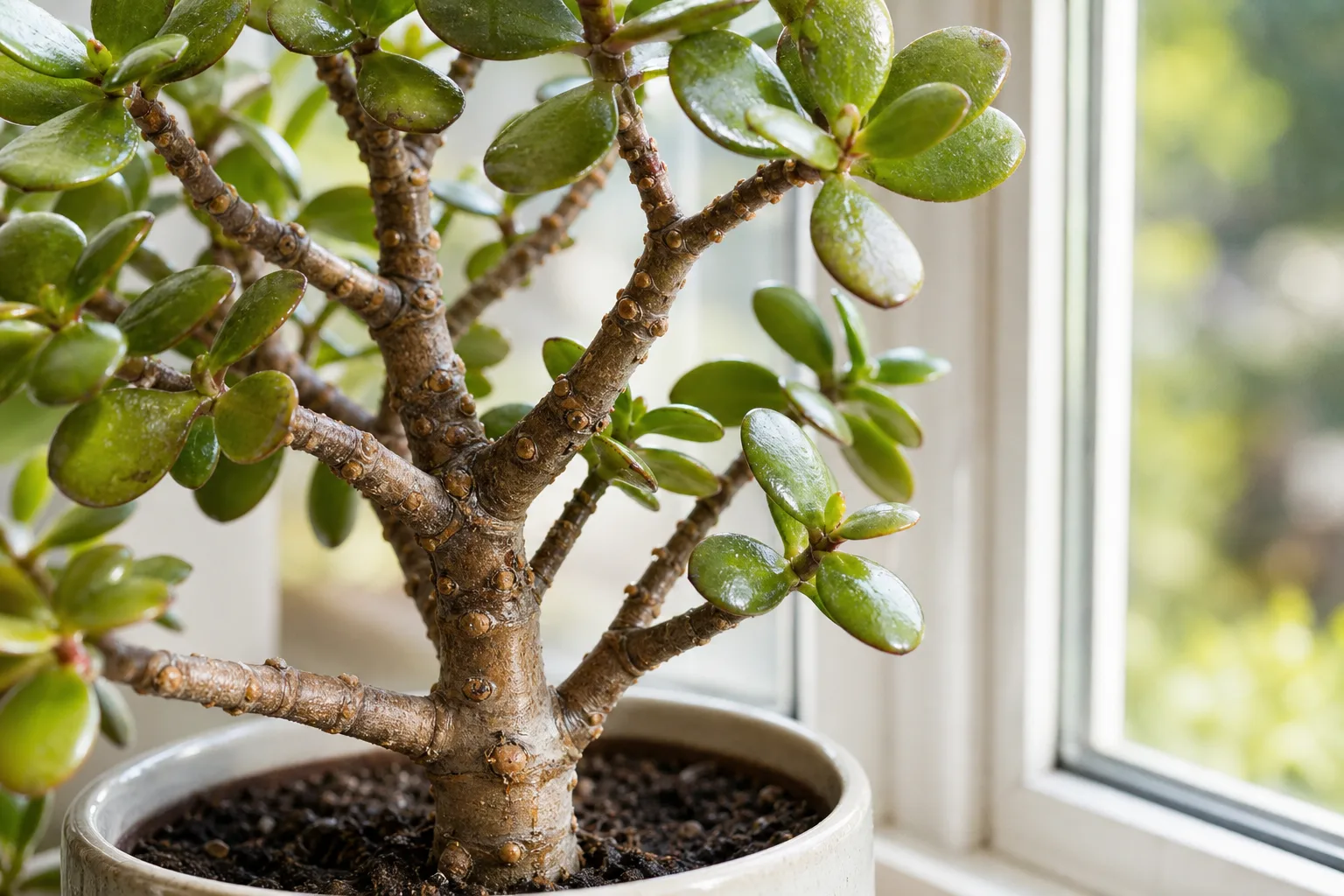
Scale Insects on Jade Plant: Causes, Checks & Fixes
This guide covers scale insects on Jade Plant. See also the general Scale Insects guide, watering, and light pages for this plant.
Scale Insects on Jade Plant: Causes, Checks & Fixes
Quick answer
Scale insects on Jade Plant (Crassula ovata) appear as tan or brown waxy bumps glued to woody stems, leaf axils, and crown forks, sucking sap and leaving sticky honeydew that can turn into black sooty mold on glossy succulent leaves.
First step: isolate the plant and dab or scrape every visible scale with a cotton swab soaked in 70% isopropyl alcohol. On jade’s dense miniature-tree form, contact removal beats a single blanket spray because thick leaf clusters and woody branch forks hide adults that foliar mists never reach.
Scale on jade should be diagnosed on the plant itself-not from a generic pest photo. Crassula ovata develops trunk-like woody stems with fleshy leaves clustered at branch tips. Scale insects settle in the protected gaps at stem joints, along leaf petioles, and under overlapping leaves where casual glances miss them. The useful clues are immobile waxy shells, sticky honeydew, whether crawlers reappear after treatment, and whether neighboring succulents show the same pattern.
What scale insects look like on Jade Plant
On most houseplants, scale insects read as small oval or dome-shaped bumps in tan, brown, or black. UC IPM notes that soft scales secrete honeydew and lack a separate waxy cover, while armored scales have a harder shell that resists contact sprays. On jade, both types often settle on woody stem joints, along leaf petioles where leaves meet stems, at crown forks on bonsai-trained specimens, and occasionally on the undersides of older leaves near the trunk.
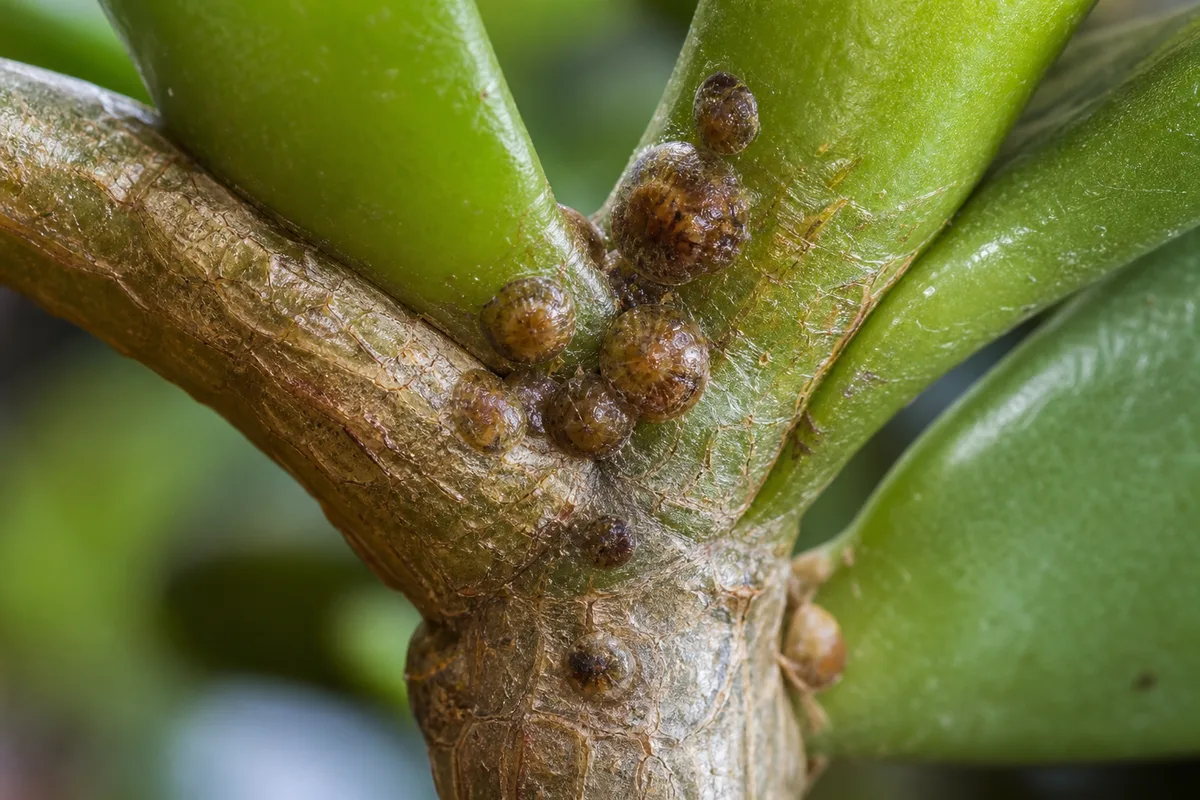
Scale Insects symptoms on Jade Plant - compare with healthy tissue on the same plant.
Jade’s slow growth and long-lived woody stems mean scale can sit unnoticed for months. A few flat tan dots at one branch fork can become a crusted band before the plant shows obvious decline. Honeydew-a sticky, carbohydrate-rich residue from sap feeding-may appear on leaf surfaces, the pot rim, or the shelf below before you spot the insects themselves. Black sooty mold can follow, dulling the normally glossy leaf surface and reducing photosynthesis where the coating is thick.
Unlike mealybugs, mature scale do not move once they settle. They look like part of the stem’s natural corky texture until you try to flick them off. Crawlers-the tiny mobile nymph stage-are pale and easy to miss without magnification, which is why repeat treatments matter even after visible shells are gone.
Typical signs on jade include:
- Tan, brown, or black dome-shaped bumps one-sixteenth to one-eighth inch across, firmly attached to woody stems and leaf axils
- Sticky, shiny residue on leaves or furniture beneath the plant
- Black sooty mold growing on honeydew-coated foliage
- Ant trails on the trunk or pot-ants harvest honeydew and protect scale colonies
- Yellowing or stunted new leaf pairs at branch tips while older leaves still look plump
Heavy feeding can leave permanently blemished leaves. Those leaves will not regain perfect gloss, but the plant can still recover through clean new growth above the damage.
Why Jade Plant gets scale insects
Scale insects are common sap-sucking pests on houseplants that usually arrive on new nursery stock, shared tools, or nearby infested specimens-not because jade is uniquely prone, but because its growth habit gives pests protected hiding spots.
Missouri Botanical Garden lists scale among potential pests on Crassula ovata, alongside aphids, spider mites, and mealybugs. Mealybugs may be more common on jade, but scale still appears often enough on woody stems to warrant quick action.
Hitchhiking on new plants is the most common introduction route. Scale crawlers are tiny and mobile before they settle and grow their protective cover. A single infested succulent added to a shelf can spread pests to a long-lived jade tree over weeks.
Warm, stable indoor temperatures favor year-round scale reproduction. Indoor ornamentals are especially vulnerable because mild temperatures support overlapping generations and natural enemies are absent indoors.
Dense branching hides colonies. As jade matures into a miniature tree, thick leaf clusters shield stem joints from overhead view. Scale on woody bark-colored stems blends with normal texture until you inspect with angled light.
Slow growth delays discovery. Jade pushes new leaf pairs slowly compared to vining houseplants. A colony can build at a branch fork for months while the plant still looks healthy from across the room.
overwatering on Jade Plant does not cause scale directly, but chronically wet mix stresses roots and keeps plants weakened-conditions where sap feeders cause more visible yellowing and stalled new growth on jade.
How to confirm the cause
Start with bright side light and a magnifying glass if you have one. Scale shells are typically one-sixteenth to one-eighth inch across and feel firmly glued to the stem-unlike lint, mineral dust, or mealybug wax that wipes away more easily.
Work in this order:
- Crown and woody branch forks - scan where thick leaves meet brown woody stems, especially on bonsai-trained specimens.
- Leaf axils and petioles - check where each leaf pair attaches along branches.
- Leaf undersides near the trunk - look for bumps on older leaves close to the main stem.
- Soil line and lower trunk - inspect the transition from woody stem to mix.
- Sticky residue test - honeydew feels tacky; dried tap-water spots or dust do not.
- Neighboring plants - inspect every succulent on the same shelf or watering tray.
Rule out lookalikes before treating. White, cottony clusters that dissolve when dabbed with alcohol are mealybugs, not scale. Soft green insects on new tips point to aphids. Fine webbing and stippling suggest spider mites. Edema bumps from overwatering are corky and part of the leaf tissue-they cannot be scraped off.
If you are unsure, try to lift one bump with a fingernail or alcohol swab. Scale should flake off with gentle pressure; mealybugs smear pink or yellow beneath the wax.
First fix for Jade Plant
Isolate the plant immediately-at least arm’s length from other succulents, ideally in a separate room for two weeks while you treat. The first targeted action is manual removal: scrape or dab each visible scale with a cotton swab soaked in 70% isopropyl alcohol, working branch by branch through crown forks, leaf axils, and woody stem joints.
Test alcohol on one leaf first and wait 24 hours to confirm it does not burn the surface-especially on sun-stressed or variegated cultivars. Wisconsin Extension advises caution with insecticides on succulent leaves because phytotoxicity can spot or scar glossy foliage. Do not pour alcohol into the crown or drench the soil on the first pass; contact treatment on visible shells and crawlers is enough to start.
Make only this correction first. Stacking Jade Plant repotting guide, systemic insecticides, heavy pruning, and fertilizer on the same day makes it harder to know what helped and can stress an already weakened plant.
Step-by-step recovery
Once isolation and alcohol dabs are underway, follow a simple cycle for three to four weeks:
Week 1: Scrape or dab all visible scale on woody stems and leaf axils. Wipe honeydew from leaves with a damp cloth. Discard swabs and wipe tools with alcohol between plants.
Week 2: Repeat dabs and add a thorough spray of insecticidal soap or horticultural oil on all leaf surfaces and stem joints, following label rates. Coat branch forks and axils where shells hide in crevices. Oils and soaps target crawlers that lack heavy armor.
Week 3: Inspect for new bumps at stem joints. Repeat alcohol on any survivors. If populations dropped but are not gone, apply soap or oil again rather than escalating to harsh broad-spectrum sprays.
Week 4: If the plant is clean, keep it isolated one more week and inspect daily. Move it back only when two consecutive weekly checks show no new shells or sticky residue.
For heavy armored scale crusts that resist dabbing, consider pruning off severely infested small branches at a clean joint-only if the main trunk remains firm. Systemic soil drenches labeled for indoor soft scale are a later option when contact treatments fail repeatedly; read labels carefully for succulents and indoor use.
Recovery timeline
Existing leaves with sooty mold, yellowing, or pitting from prolonged feeding usually will not look brand new again. Judge progress by whether new leaf pairs emerge firm and bump-free, whether honeydew stops appearing, and whether weekly checks find fewer colonies at woody stem joints.
Light infestations often stabilize within two to three weekly alcohol-and-oil passes. Moderate cases on slow-growing jade commonly need three to four weeks. Heavy infestations involving multiple succulents may take six to eight weeks of consistent monitoring, and badly compromised branches may need pruning after the plant is stable.
Lookalike symptoms
| What you see | Likely cause | Key difference on jade |
|---|---|---|
| Tan/brown immobile bumps on woody stems | Scale insects | Firm waxy domes; honeydew or sooty mold may follow |
| White cottony clusters in branch forks | Mealybugs | Smear pink when dabbed with alcohol; wax wipes away |
| Soft insects on newest leaf tips | Aphids | Mobile pear-shaped bodies; cluster on tender growth |
| Fine webbing and leaf stippling | Spider mites | Tiny moving dots; no hard shells on stems |
| Corky raised patches on leaf blades | Edema from overwatering | Part of leaf tissue; cannot be scraped off |
| White crust that wipes off dry | Mineral deposits or dust | No honeydew; no shell beneath |
| Smooth brown woody texture | Normal mature jade stem | Even color; no individual raised domes |
Scale damage and watering stress can both yellow leaves, but the mechanism differs. Overwatering on jade softens stem bases while soil stays wet and roots may smell foul-without waxy bumps on woody stems. Scale damage more often shows localized tan domes, sticky residue, and sooty mold while soil moisture may be normal.
What not to do
Do not ignore a few tan dots because jade looks tough. Low visible damage can hide a reproducing colony along woody stem joints protected by thick leaves.
Do not spray random household pesticides indoors without reading the label. Broad-spectrum sprays can harm you, pets, and beneficial insects while missing scale hidden in crown forks.
Do not increase watering to “help” a stressed jade while treating pests. This species needs the mix dry between waterings; wet soil worsens root stress and overlaps with other failure patterns.
Do not repot on day one unless roots are rotting or soil is heavily contaminated with honeydew and ants. Unnecessary repotting spreads crawlers to your work surface and adds stress.
Do not pour alcohol into the crown or soak the entire plant in alcohol solution on the first pass-phytotoxicity risk on sun-hot jade leaves is real. Test one leaf first.
Do not place treated plants back on a crowded succulent shelf before two clean weekly inspections. Crawlers travel short distances but infestations often restart from missed nymphs in dense branching.
Do not confuse scale with normal corky stem texture on mature jade. Run the scrape test on any suspect bump before treating.
Wear gloves when handling sap-heavy stems; jade plant is toxic to cats and dogs. Keep isolated plants out of reach during treatment, ventilate when using soaps or oils, and consult a veterinarian if a pet ingests plant tissue or treatment residue.
How to prevent scale insects next time
Prevention is mostly inspection and quarantine. University of Maryland Extension advises quarantining plants with scale and considering disposal of chronically infested material on easily replaced specimens rather than fighting heavy scale indefinitely.
Build these habits for jade:
- Quarantine new purchases for at least two weeks away from existing succulents.
- Inspect woody stem joints and crown forks during every dry-down watering check-not just when leaves look wrong.
- Keep pots spaced for airflow; avoid letting jade branches rest on neighboring plants.
- Wipe dust from glossy leaves monthly so tan bumps show up sooner against the green surface.
- Use clean tools between plants when pruning or taking cuttings.
- Isolate immediately if any plant in the room develops sticky leaves or brown shells.
A healthy jade in strong light with sharp drainage tolerates low pest pressure better than a stressed one, but no cultivar is immune. Catching crawlers before they armored over is the cheapest fix available.
When to worry
Escalate beyond alcohol and soap/oil cycles when:
- New scale shells appear across most woody stem joints after three full weekly treatment rounds.
- You find scale on three or more unrelated houseplants in the same space.
- Sooty mold covers most leaf area and new growth fails to emerge.
- Armored crusts encircle multiple branches and manual removal barely reduces the count.
- Ants farm honeydew across the entire crown despite isolation.
In severe indoor cases, discarding a chronically infested houseplant is sometimes more practical than repeated pesticide applications-especially when the plant is a small cutting easily replaced, not a decades-old specimen tree. That is a last resort, not a first response.
Seek a different diagnosis if stems soften at the base, soil smells sour, or leaves turn mushy while mix stays wet-that is rot or overwatering, not scale alone. See the watering guide and root-rot resources if those signs appear alongside pests.
Conclusion
Scale insects on Jade Plant hide in plain sight as tan or brown bumps on woody stems and crown forks. Confirm with immobile shells, honeydew, and alcohol dabs; isolate; scrape or dab visible scale; repeat weekly; add soap or oil for crawlers; and keep the plant on its normal dry watering rhythm while you monitor. Old damaged leaves may stay blemished, but firm new leaf pairs and pest-free stem joints tell you the fix is working.
Related jade problems: aphids, mealybugs, spider mites, and the jade plant overview.
When to use this page vs other Jade Plant guides
- Jade Plant watering guide - Use for routine moisture checks before assuming scale insects is the main issue.
- Jade Plant problems hub - Browse all 49 common issues on this species.
- Ants on Plant on Jade Plant - Different entry point when symptoms overlap with scale insects.
- Yellow Leaves on Jade Plant - Different entry point when symptoms overlap with scale insects.
- Mealybugs on Jade Plant - Different entry point when symptoms overlap with scale insects.