Jade Plant Light Needs: Best Window, Sun & Warning Signs
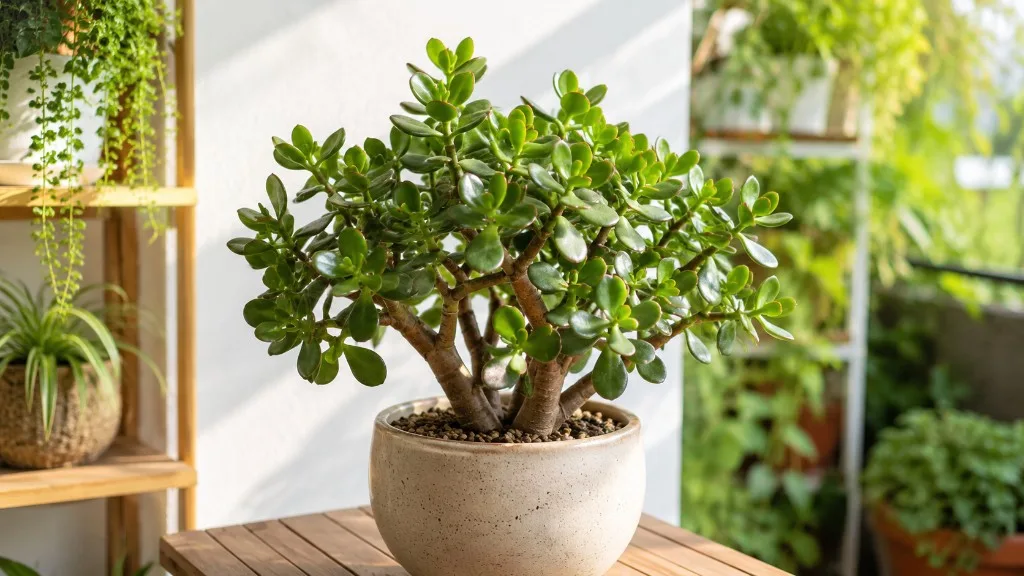
Jade Plant Light Needs: Best Window, Sun & Warning Signs
Jade Plant Light Needs: Best Window, Sun & Warning Signs
Crassula ovata - the jade plant, money plant, lucky plant - is sold as an easy houseplant and then punished with dim corners where no succulent belongs. It will hang on longer than a fern would, because thick leaves store water and slow metabolism buys time. But survival is not the same as the compact, tree-like silhouette that makes a jade worth keeping for decades. Light is the variable that separates a firm, woody specimen with red-tipped leaves from a pale, top-heavy plant that drops leaves every time you water.
The practical goal is straightforward: give your jade enough brightness for short internodes, thick stems, and healthy new growth without scorching foliage against hot glass or shocking an unacclimated plant with sudden outdoor sun. Penn State Extension recommends four or more hours of direct sunlight daily for jade plants grown indoors, noting that insufficient light produces pale green leaves without attractive red edges. (Penn State Extension) University of Wisconsin–Madison Extension adds that jade plants do best with four or more hours of direct sun but will survive in bright indirect light - though inadequate light produces deep green leaves and drooping, stretched stems rather than normal compact growth and reddish coloration. (Wisconsin Horticulture)
This guide focuses on placement decisions you can make today: which window, how much direct sun, when to add a grow light, how to acclimate safely, and how to read the plant’s own warning signs before structure and vigor collapse.
How Much Light Jade Plant Actually Needs
Jade plant is a sun-loving succulent, not a shade-tolerant foliage plant. In its native range of South Africa, it grows in bright, semi-arid conditions where intense light is the default. NC State Extension lists jade plant cultural light requirements as full sun (six or more hours of direct sunlight daily) or partial shade (two to six hours of direct sun), with well-drained soil and bright indoor temperatures. (NC State Extension Plant Toolbox) Indoors, you rarely replicate outdoor full sun, but you should treat bright direct light for a meaningful portion of the day as the target - not a nice bonus.
Human eyes are poor light meters. A living room that feels adequately bright may deliver only a fraction of the photosynthetically active radiation a jade uses efficiently. Research-minded growers sometimes discuss daily light integral (DLI) - the total useful light accumulated across a full day - and note that typical indoor conditions fall far below what succulents receive outdoors. You do not need a PAR meter to grow jade well, but the principle matters: jade wants high daily light totals, not a brief morning glow that fades by noon.
For most home growers, the usable shorthand is this: 4 to 6 hours of direct sun through a window on most days, or bright indirect light plus supplemental grow lighting when that sun target is impossible. A plant that receives only soft ambient light may live for years looking increasingly unhappy - stretched, top-heavy, and vulnerable to overwatering on Jade Plant because it cannot use water at the pace a bright plant would.
The Short Answer for Busy Growers
If you only remember three rules, use these. At a window: place the pot within 12 inches (30 cm) of the glass on your brightest exposure - usually south, then east, then west in the Northern Hemisphere - and confirm that direct sunbeams actually touch the leaves for several hours on clear days. Direct sun: jade tolerates and prefers direct sun when gradually acclimated; do not park a low-light plant against hot south glass in midsummer without stepping up exposure over two to three weeks. Without enough window sun: add a full-spectrum LED grow light 6 to 12 inches (15–30 cm) above the canopy and run it 12 to 14 hours daily on a timer; Penn State Extension notes that twelve hours of artificial light can meet sunlight needs when natural light is insufficient, provided the fixture stays close enough that the plant does not stretch. (Penn State Extension)
Judge success by new growth, not old leaves. Within three to six weeks of better light, new leaves should be smaller, closer together, and firmer. Stems should begin to stiffen. Many cultivars develop red or burgundy margins on fresh foliage when light is adequate - Wisconsin Extension specifically describes green fleshy leaves that should be edged or tinged with red when grown with sufficient light. (Wisconsin Horticulture)
Why Jade Plant Demands More Light Than Most Houseplants
Jade plant did not evolve as an understory dweller. It is a broadleaf evergreen succulent shrub in the stonecrop family that builds woody stems over time and stores water in thick leaves. That biology drives three practical consequences for your windowsill.
First, jade prioritizes directional escape when light is insufficient. Unlike some slow-growing succulents that simply pause, jade stretches toward the brightest source, producing long internodes, smaller leaves, and weak stems that cannot support the weight of the fleshy canopy. This is etiolation - a physiological response to low photosynthetic input, not a cosmetic flaw you can prune away permanently without fixing light.
Second, light intensity affects structure and color, not just speed. Strong light encourages the stems to become thick and woody, which is what gives mature jade plants their miniature-tree appearance. Weak light keeps stems soft and green, producing a perpetually juvenile look no amount of fertilizer will correct. Red, gold, or purple leaf margins on cultivars like ‘Hummel’s Sunset’ or ‘Tricolor’ often appear only when light is strong enough - Penn State Extension notes that several jade cultivars develop their best coloration when exposed to direct sunlight. (Penn State Extension)
Third, light sets the pace for water use and root health. A bright jade photosynthesizes actively, dries its pot on a predictable rhythm, and tolerates the occasional missed watering better than a dim plant can. A stretched jade in a dark corner holds moisture longer, grows slowly, and is more vulnerable to root rot if you keep watering on a schedule designed for a sunny windowsill. Light is not separate from the rest of jade care; it is the throttle that controls everything downstream.
Best Window Placement for Jade Plant Indoors
Indoor jade fails most often because the pot sits where the room looks bright rather than where the plant receives photons for enough hours. Window direction matters, but distance, glass type, outdoor obstructions, and season matter just as much.
Place jade on the sunniest unobstructed window available. In the Northern Hemisphere, that is often south for total daily brightness, east for gentler direct morning sun, and west for strong but heat-heavy afternoon exposure. North windows rarely deliver enough direct sun for compact growth without supplementation.
Keep the pot close to the glass without pressing leaves against freezing winter panes or scorching-hot summer glass. A jade on a table six feet from a south window is not getting south-window light; intensity drops sharply with distance.
South, East, West, and North Windows Compared
A south-facing window delivers the strongest winter sun in northern latitudes and is the default recommendation for jade. Penn State Extension states jade plants prefer full to partial sun and will thrive in a south-facing window. (Penn State Extension) Low winter sun angle can still fall short during the darkest months, and summer afternoon sun through glass can overheat leaves - but south works when the plant sits near the pane, receives several hours of direct sunbeams on clear days, and shows compact new growth.
An east-facing window is underrated and often ideal for jade. Morning sun tends to be bright but cooler than late-day sun. Many kitchens and home offices with east exposure produce excellent jade plants from spring through autumn without scorch. East gives direct sun for a meaningful block of hours, then bright indirect light for the rest of the day - a combination that prevents etiolation while reducing heat stress. If east-window plants lean toward the glass or stretch slightly, add a small LED rather than moving to harsh west sun without acclimation.
A west-facing window can be excellent in spring and fall and risky in midsummer. Late-afternoon sun carries heat as well as intensity. West is a strong choice when you monitor for bleached or crisp leaf edges and pull the pot back slightly, diffuse light with a sheer curtain, or move the plant a few feet from the glass during heat spikes. Unacclimated jade moved suddenly to a west sill in July is a common sunburn scenario.
A north-facing window rarely provides enough direct sun for compact jade on its own. North can sustain slow, stretched survival growth for a while, especially in summer at high latitudes, but treat north windows as grow-light-required if you want the firm, tree-like habit jade is capable of. Do not interpret “surviving” on a north sill as proof the placement is adequate.
Rotate the pot a quarter turn every week or two so stems do not lean hard toward the glass. Leaning is the plant telling you the light source is directional - which all windows are.
Distance From the Glass and Seasonal Changes
Compass labels are shortcuts. A south window blocked by a neighboring building may lose to an unobstructed east window. A west window with a deep overhang behaves differently from an open balcony door.
Use this field test: on a clear day, look at the jade at mid-morning and mid-afternoon. If direct sunbeams touch most of the canopy for only a short period, you are below the target. If leaves heat up enough to wilt by afternoon even with dry soil, heat and light may both be excessive.
Seasonal shifts change the equation more than many growers expect. In summer, south and west glass intensifies; pull the plant back 1 to 3 feet (30–90 cm) or use a sheer curtain during peak heat if you see scorch. In winter, the same south window may become your best asset as the sun stays lower and less harsh - move the pot closer to the glass when cold drafts are not an issue. East windows stay relatively forgiving year-round and are often the lowest-stress placement for jade that has not been fully acclimated to blazing south exposure.
Indoor light also lacks the sky brightness that helps outdoor plants. A jade on a windowsill receives strong directional light from one side. Overhead supplemental light fills in the shadowed side of the canopy and produces more even, compact growth. Even a good window often improves with a small LED above the plant in winter.
Direct Sun vs Bright Indirect Light for Jade Plant
Ranking pages often split into two camps: “jade loves direct sun” versus “jade wants bright indirect light.” Both are partially true because the plant’s current acclimation state and exposure intensity matter as much as the label.
Bright indirect light means the plant sits in a well-lit space where sunbeams may not strike the leaves directly for long, but ambient brightness remains high. Jade can survive here. Wisconsin Extension is explicit that inadequate light in bright indirect conditions produces deep green leaves and drooping stems - functional survival, not the compact, red-edged growth most growers want. (Wisconsin Horticulture)
Direct sun means sunbeams hit the leaf surface. Jade prefers this when properly acclimated. Direct morning sun through east glass is the gentlest entry point. Direct south or west sun for four or more hours matches extension guidance for best appearance. The risk is not direct sun itself - it is sudden direct sun on leaves that formed in lower light, especially through hot glass in summer.
Think of indirect light as a holding pattern and direct sun as the growth and color program. If your only option is indirect light, plan on a grow light rather than accepting permanent etiolation.
How to Acclimate Safely to Stronger Sun
Leaves that developed in dim conditions have physiology tuned to lower light - thinner cuticle, different pigment balance, less tolerance for UV and heat. Moving that plant to intense south or west sun without transition is how sunburn happens indoors.
Acclimate over two to three weeks minimum. Start by placing the jade where it receives bright indirect light with one to two hours of gentle direct morning sun. Each few days, increase direct exposure by an hour or move the pot closer to the glass during the sunniest part of the day. Watch the newest leaves first; older leaves will not retroactively adapt.
If you see bleached patches, brown crisp spots, or sudden leaf drop after a move, pull the plant back to softer light immediately. Do not also repot, fertilize, or radically change watering in the same week - give the plant one variable to recover from.
Variegated cultivars and plants recently repotted or recovering from root issues should acclimate more slowly than healthy green specimens. When in doubt, east-window morning sun beats south-window afternoon trial by fire.
When Direct Window Sun Becomes Too Much
Jade can handle direct sun, but it cannot handle leaf surface temperatures that exceed what its succulent tissue tolerates - especially when water stress, hot glass, or reflected heat from dark sills amplify the damage.
Pull back or diffuse light when you see persistent bleaching on sun-facing leaves, brown crispy patches that do not heal, wrinkled scorched sections, or sudden widespread leaf drop after a placement change. Heat stress sometimes masquerades as sunburn: if soil is moist and leaves wilt or curl at midday against glass, the problem may be root zone overheating as much as photon intensity.
Sheer curtains, moving the pot 2 to 3 feet (60–90 cm) from the pane, or shifting from west to east exposure during July and August are practical fixes. The goal is not to banish sun - it is to keep intensity within the range of what this specific plant, in this specific pot, at this time of year can manage.
Remember that old sun damage does not heal. Scorched leaves may drop and be replaced; judge recovery by firm new growth, not by whether burned patches disappear.
Moving Jade Plant Outdoors for Summer Light
Outdoor sun is the simplest way to give jade the intensity it craves - and the fastest way to destroy an unacclimated plant if you skip steps. Penn State Extension and Wisconsin Extension both note that jade can be moved outdoors for summer but must be gradually acclimated to higher-intensity outdoor sunlight to prevent sunburn, and must return indoors before frost because jade is not frost-hardy. (Penn State Extension; Wisconsin Horticulture)
Start outdoors in bright shade or dappled morning sun for several days. Increase exposure incrementally over 7 to 14 days until the plant sits in a location with several hours of direct sun. Avoid placing a freshly moved jade on dark pavement or against a south-facing wall where reflected heat spikes.
Outdoor jade often needs more frequent watering because light and airflow increase evaporation - but never switch to a heavy hand automatically. Check the pot. Bring the plant inside when nights approach frost, and expect some leaf drop as it readjusts to lower indoor light; that transition is normal if you avoid simultaneous Jade Plant repotting guide and do not panic-water.
How Indoor Light Differs From Outdoor Sun for Jade Plant
Your eyes adapt to dim rooms, so a windowsill that looks “perfectly bright” may deliver a fraction of outdoor PAR. Jade outdoors in partial shade still often receives more usable light than jade six feet inside a south window. That gap explains the most common indoor pattern: the plant lives, stretches, and slowly loses the compact shape that made you buy it.
Three structural reasons windows underperform compared with outdoor placement. Glass filters and reflects part of the light spectrum and intensity. Day length shrinks in winter while jade’s appetite for daily light total does not shrink proportionally. Inverse-square distance means moving a foot away from the window can dramatically reduce intensity at the leaf surface.
A south-facing window in May through September at mid-latitudes may grow decent jade if the pot stays close and the plant is acclimated. The same window from October through March commonly requires supplementation for anything beyond slow survival growth.
Why a Bright Room Often Is Not Enough
The phrase “bright indirect light” gets applied to rooms where no direct sunbeam reaches the plant all day. Jade in those conditions follows a predictable arc: first slight leaning toward the brightest corner, then internode stretching, then pale green new leaves, then top-heavy collapse where the soft stem cannot support the weight of the fleshy canopy.
Low light also changes water dynamics in ways that confuse owners. A dim jade uses water slowly. If you keep watering on the schedule that worked near a sunny window, roots sit in wet mix while the plant looks thirsty - because the real problem is energy input, not hydration. Fix light before you rewrite the watering calendar.
Another failure mode is competition. A jade sharing a windowsill with taller plants or sitting behind furniture may receive far less light than the window direction suggests. Clear the sightline between the plant and the sky. Even a perfect south window fails if something blocks the lower half of the glass where the pot actually sits.
Winter light drop changes two variables at once: lower intensity and shorter photoperiod. Jade is not dormant like a deciduous tree in most indoor conditions; it keeps metabolizing, but growth slows when energy input drops. You may see smaller new leaves, loss of red coloration, increased leaf drop on lower branches, and greater susceptibility to root stress if soil stays wet in cool, dim conditions.
Do not compensate for weak winter light by overwatering or over-fertilizing. Fix the light first. Move the pot to the brightest pane, add a grow light on a timer, and reduce watering frequency to match slower growth. If the plant is already woody and exhausted from years of etiolation, starting fresh from a healthy cutting under good light sometimes beats rescuing a structurally compromised specimen.
Cold windows add another wrinkle: leaves pressed against freezing glass can show damage unrelated to light quality. Keep foliage from touching the pane on winter nights while still maximizing brightness during the day.
Grow Lights for Jade Plant When Natural Light Falls Short
When a window cannot deliver enough daily light, a full-spectrum LED grow light is the most reliable fix. Penn State Extension recommends full-spectrum artificial lighting - containing both red and blue wavelengths - when a south-facing window is unavailable, emphasizing that the source must stay close to the plant because distance causes stretching. (Penn State Extension) LEDs run cooler than older high-intensity setups, use less electricity than many legacy fixtures, and fit on shelves or adjustable arms above a single specimen pot.
Jade does not need exotic spectra for basic compact growth. A full-spectrum white LED rated for seedlings, succulents, or general houseplants is sufficient. Blue-weighted light supports compact foliage; red contributes to overall biomass. Fancy “bloom” switches matter more for fruiting crops than for structural jade development.
Choosing the Right Fixture and Spectrum
Pick a fixture designed for horticultural use or seed starting, not a standard room bulb optimized for human visibility. Practical options include clip-on grow bulbs, bar lights, and panel LEDs sized to cover the whole canopy.
Coverage matters. Light that reaches only the center of the plant creates a dense top and shaded, weaker lower stems. Position the fixture so light spreads across the pot, or rotate the plant under a smaller bulb every few days.
Heat management is real but often overstated with modern LEDs. If leaf edges crisp only under the light and not at the window, raise the fixture or shorten the photoperiod slightly. If the plant stretches toward the LED, lower it incrementally or extend the timer - but not both at once.
Height, Hours, and a Simple Timer Schedule
A practical starting setup: place a full-spectrum LED 6 to 12 inches (15–30 cm) above the jade canopy and run it 12 to 14 hours daily on a timer. Penn State Extension notes that twelve hours of artificial light can meet sunlight needs when natural light is insufficient, and that plants still need hours of darkness to remain healthy - so do not leave lights on 24/7. (Penn State Extension)
Adjust based on plant response, not guesswork. Stretching means more intensity, closer placement, or longer photoperiod. Bleaching or crisping under the lamp only means raise the fixture or reduce hours. Combine window light with supplemental light in winter rather than treating them as either-or; a jade on an east window with a small overhead LED often outperforms either source alone.
Repposition the fixture as the plant grows taller. A light that was perfect at six inches above a young jade becomes too far when the stem elongates - and distance-driven stretching accelerates quickly once it starts.
Warning Signs Your Jade Plant Is Getting the Wrong Light
Jade communicates light problems through growth habit and leaf texture more reliably than through instant collapse. Old damage persists on existing leaves; always evaluate the newest leaves and the topmost stem after any placement change. Wait at least two to three weeks before declaring a new spot a failure, because succulent growth is slow and the plant needs time to produce readable new tissue.
Do not change light, watering, pot size, and fertilizer simultaneously. One variable at a time keeps diagnosis honest.
Symptoms of Too Little Light
Etiolation is the signature problem: long gaps between leaf pairs, smaller pale leaves, soft green stems that lean toward the window, and a top-heavy silhouette that looks less like a tree and more like a lollipop on a weak stick. Wisconsin Extension describes inadequate light as producing deep green leaves and drooping stems with nothing wrong with the plant other than insufficient light for normal compact growth and reddish coloration. (Wisconsin Horticulture)
Other low-light signals include loss of red or gold leaf margins on cultivars that should show color, slow or absent new growth despite warm temperatures and correct watering, lower leaf drop as the plant abandons shaded older foliage, and persistent moisture in the pot because the plant cannot transpire at a sunny-plant pace.
Low light plus overwatering is the classic jade death spiral. If you see stretching and soggy soil that never dries, fix placement before you repot or cut watering alone.
Symptoms of Too Much Light or Heat Stress
Sunburn shows as bleached white or tan patches on sun-facing leaves, brown crispy edges, wrinkled scorched tissue, or sudden leaf drop after a move to a brighter spot. Damage often appears on one side of the plant facing the glass or afternoon sun. Wisconsin Extension notes that if leaves get burnt from sunburn, insecticide damage, or frost, damaged leaves will die and fall off, but new leaves will sprout - so recovery is possible once exposure is corrected. (Wisconsin Horticulture)
Heat stress through hot glass can add midday leaf curling, wilting despite dry soil, or root zone overheating in dark pots on sun-baked sills. If only the leaves touching the glass scorch while the rest of the plant looks fine, distance or a sheer curtain fixes the problem faster than abandoning direct sun entirely.
Too much light is less common indoors than too little, but it spikes in summer west windows, unacclimated outdoor moves, and recent transitions from a dim shop to blazing south glass. The fix is almost always gradual reduction or diffusion, not a permanent sentence to a dark corner.
Use the new-growth test as your ongoing light meter: after any change, the next leaves should be firm, closely spaced, and appropriately colored. If they are not, the placement still needs adjustment - regardless of what the window label says.
Conclusion
Jade plant light needs are simpler to state than to deliver indoors: four or more hours of direct sun daily on most days, from the brightest window you can manage or from a close, timed full-spectrum grow light when windows fall short. Penn State Extension and Wisconsin Extension agree that jade prefers direct sun, shows red leaf coloration when light is adequate, and stretches or droops when it is not. (Penn State Extension; Wisconsin Horticulture)
Start with placement, not products. Put the pot near the glass on south or east exposure, confirm that sunbeams actually reach the leaves, and read new growth after three weeks. Acclimate gradually whenever you increase intensity - especially before summer outdoor moves or hot west-window afternoons. Add a grow light in winter or on north exposures before the plant spends another year etiolating.
Light controls watering pace, stem thickness, and long-term shape. Get brightness right and jade becomes the low-drama, long-lived houseplant its reputation promises. Get it wrong and no amount of careful watering will produce the compact tree you actually wanted.
When to use this page vs other Jade Plant guides
- Jade Plant overview - Start here for whole-plant context before deep-diving this topic.
- Jade Plant problems hub - Jump to symptom-specific fix guides when this care topic does not resolve the issue.
- Not Enough Light on Jade Plant - Escalate here when light adjustments are not enough.
- Leggy Growth on Jade Plant - Escalate here when light adjustments are not enough.
- Leaf Drop on Jade Plant - Escalate here when light adjustments are not enough.
Related Jade Plant guides
- Jade Plant overview
- Jade Plant watering
- Jade Plant soil
- Jade Plant propagation
- Jade Plant fertilizer
- Jade Plant repotting
- Not Enough Light on Jade Plant
- Leggy Growth on Jade Plant
- Leaf Drop on Jade Plant
- Jade Plant problems
Related tool
Try the Plant Problem Diagnosis Tool with jade-plant pre-selected to estimate needs for your setup.