Mosaic Virus on Jade Plant: Causes, Checks & Fixes
Quick answer
Mosaic virus on jade plant shows irregular mottling, chlorotic rings, or dark spots on leaves - often with distorted new growth - and is spread by thrips and other sap-feeders. There is no cure. First step: isolate the plant away from your collection, inspect leaf undersides for thrips, and do not propagate until you rule out virus.
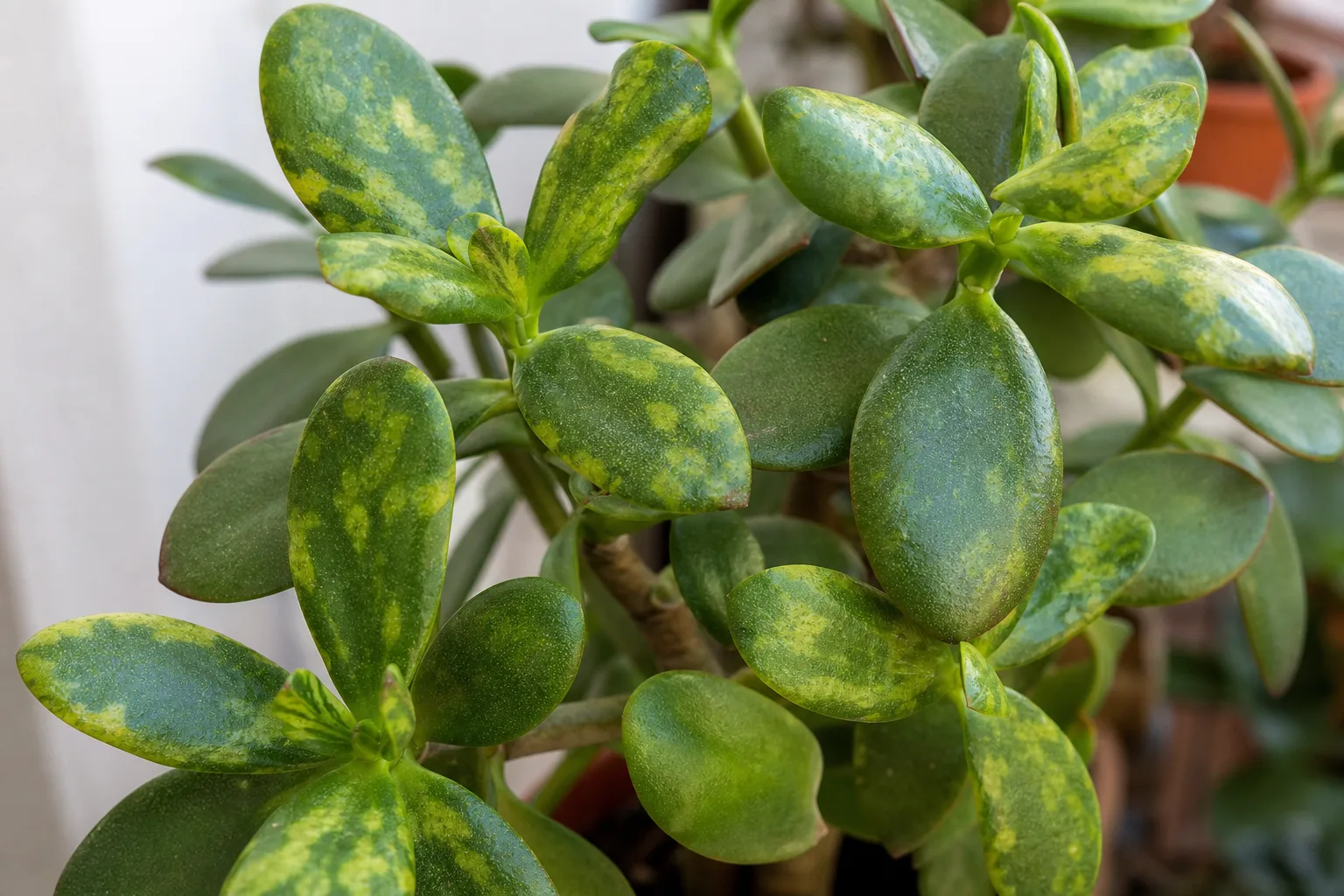
Mosaic Virus on Jade Plant: Causes, Checks & Fixes
This guide covers mosaic virus on Jade Plant. See also the general Mosaic Virus guide, watering, and light pages for this plant.
Mosaic Virus on Jade Plant: Causes, Checks & Fixes
Quick answer
Mosaic virus on jade plant (Crassula ovata) is not a watering mistake - it is systemic viral infection that shows up as irregular mottling, yellow-green patches, ring spots, or dark leaf spots, often with stunted or twisted new growth. On jade, the most documented virus is tomato spotted wilt virus (TSWV), a tospovirus photographed on jade by UMass Extension. Black ring disease - another virus reported on jade - typically forms dark rings or spots on leaf undersides.
First step: isolate the plant before you touch leaves or make cuts. Move it away from other succulents, then inspect leaf undersides and growing tips for thrips - western flower thrips vector INSV and TSWV exclusively. Do not propagate, do not compost pruned pieces, and do not assume fertilizer or dry-down watering will clear mosaic marks.
There is no cure. UMass Extension states there is no cure or chemical treatment for these plant viruses and recommends discarding affected plants, controlling thrips, and quarantining new arrivals. Management is containment, vector control, and honest discard - not rescue pruning.
Jade stores water in thick leaves on slow-growing woody stems. That slow pace means viral patterns on new leaves weeks after thrips are gone still point to systemic infection, not a one-time stress event.
What mosaic virus looks like on jade
Viral mosaic on jade differs from corky edema bumps or sunburn spots if you read the pattern, surface, and progression on new growth.
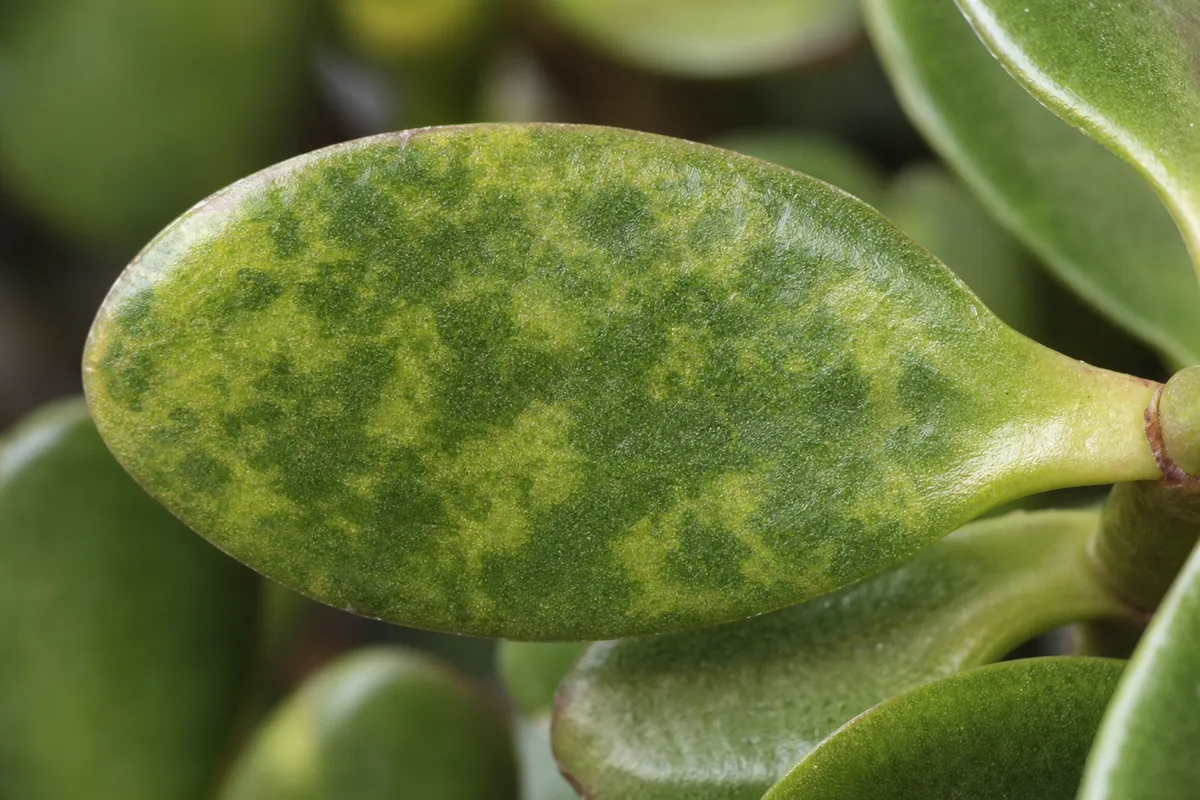
Mosaic Virus symptoms on Jade Plant - compare with healthy tissue on the same plant.
Leaf mottling, rings, and dark spots
- Irregular mosaic - patchy yellow-green or pale mottling across the leaf blade, not a uniform fade from age or nitrogen lack
- Ring spots - concentric chlorotic or necrotic rings; TSWV on ornamentals often shows ring patterns before leaves bronze or brown
- Dark spots or blackening - TSWV can produce dark or black spots on infected jade foliage (UMass jade TSWV photo reference)
- Black ring disease pattern - black rings on the underside of leaves are the classic sign reported for this jade-associated virus; upper surfaces may look less affected
- Bronzing or brown lesions on newest leaves - similar to TSWV bronzing described on other hosts when infection is active
Distorted or stunted new growth
- Small, twisted, or cupped new leaves at branch tips while older wood stays firm
- Slowed internode growth - jade is already slow growing; viral stunting makes new shoots look pinched or delayed
- Pattern spreads to successive leaves over weeks - stress spots from sun or water usually do not march up the branch on every new leaf
What it does not look like
- Firm corky blisters on lower leaves → edema from irregular watering; bumps are raised, not mosaic patches
- Crisp brown patches after sudden direct sun → sun scald on leaves that were indoors; see light guide - marks are sun-exposed upper surfaces, not undersides rings
- White fluffy insects or honeydew → mealybugs or scale - pest bodies visible; virus may follow thrips, which are slender and fast
- Water-soaked mush with odor → bacterial soft rot - tissue liquefies; not a mosaic color pattern
Known viruses on jade - TSWV and black ring disease
Two viruses show up most often in jade references. They overlap in vector biology and no-cure management.
Tomato spotted wilt virus (TSWV)
TSWV is a tospovirus in the genus Orthotospovirus. INSV and TSWV are vectored exclusively by western flower thrips (Frankliniella occidentalis). The virus has an extremely wide host range - more than 1,000 plant species across 85 families - so jade sitting beside flowering ornamentals or vegetable starts can share thrips vectors.
UMass documents TSWV on jade plant with foliar symptoms. In greenhouse and indoor collections, TSWV is the virus most likely when ringed or mottled jade leaves coincide with thrips.
Black ring disease
Black ring disease is a virus reported on jade that produces dark rings or spots on leaf undersides. Garden Design notes the virus does not kill plants but has no effective treatment - remove affected leaves to trash and do not propagate from infected stock. It is spread by feeding insects, like other jade viruses.
Black ring is often cosmetic on established wood but still systemic - cuttings taken from an asymptomatic branch can carry virus.
Why “mosaic virus” is the right search term
Homeowners rarely know TSWV or black ring names first. Mosaic captures the mottled, ringed, or patchy chlorosis pattern they see. This guide maps that search intent to the actual pathogens and vectors on Crassula ovata, not generic succulent care.
Why jade gets viral mosaic
Insect vectors - thrips first
TSWV is transmitted by thrips - small slender insects about 1–2 mm long. The virus is acquired by larval thrips feeding on infected plants, replicates inside the insect, and is spread by adults when they feed. Once a plant is infected, there is no cure - only strategies to limit spread.
Western flower thrips is the primary indoor and greenhouse vector for tospoviruses on jade per UMass Extension. Other sap-feeders can move black ring and related viruses on jade in horticultural reports.
Check thrips before you diagnose mosaic: shake a branch over white paper, inspect growing tips with a hand lens, and read the dedicated thrips on jade guide for treatment - virus management fails if vectors keep reinfecting neighbors.
Systemic infection and spread
Plant viruses on jade are systemic - they circulate in sap throughout stems, roots, and leaves. Pruning off spotted leaves does not eliminate virus from the plant. New growth can keep showing mosaic even from firm woody stems.
Spread pathways indoors:
- Thrips moving from infected jade, weeds, or ornamental bedding plants
- Propagation from infected leaves or stem cuttings - infected jade should not be used for propagation
- Contaminated tools wiping sap between plants during pruning
- New purchases that were asymptomatic for days or weeks after thrips transmission - plants can be asymptomatic for a period after inoculation
Jade’s thick water-storing leaves and stems do not confer viral resistance - they only make the plant tolerate drought while virus replicates in live tissue.
Collection risk factors
- Mixed succulent shelves with flowering plants that host thrips
- Big-box jade benches with shared thrips populations
- Propagation stations where one infected mother supplies dozens of cuttings
- Overhead watering that keeps leaf surfaces wet - favors pest movement and wound entry for other diseases, though virus itself spreads via thrips feeding
Lookalikes to rule out first
Use this table before isolating for virus. Jade viral mosaic is pattern + progression + vectors - not color alone.
| Problem | Key visual clues | Underside check | Progression | First branch |
|---|---|---|---|---|
| Viral mosaic (this page) | Mottling, rings, dark spots; twisted new growth | Black rings (black ring); thrips present | New leaves keep showing pattern | Isolate; test for thrips |
| Edema | Corky raised blisters on lower leaves | Bumps, not rings; tissue firm | Stops when watering stabilizes | Fix water rhythm |
| Sun scald / burn | Crisp brown upper-surface patches | Usually not ringed undersides | After sun move or summer exposure | Filter light per light guide |
| Thrips damage alone | Silvering, stippling, black frass dots | Live thrips visible | Stops on clean new growth after pest control | Treat thrips; re-check new leaves |
| Distorted leaves (cultural) | Etiolated twist in dim rooms | No virus rings | Improves with brighter light | Add light |
| Deformed new growth (pests/nutrition) | Mealy clumps, uniform small leaves | Pests or uniform fade | Tracks with pest or feed history | Confirm pest or care |
| Drought spotting | Foliage spotting from drought on stressed plants | Dry pot, wrinkled firm leaves | Reverses after one dry-down cycle | Water when dry |
| Oedema from wet soil | Tiny water-soaked blisters on lower leaves | Corky later; wet mix history | Stops when mix dries | Drainage fix |
Critical distinction: If new leaves keep showing mosaic or rings for three or more weeks while thrips are controlled, treat as virus even if older leaves look partly normal. If only one leaf shows a spot after a sun blast and the next five leaves are clean, virus is unlikely.
How to confirm the cause - numbered workflow
Work through these in order. Stop when one branch clearly fits.
- Isolate - Move the jade away from other plants before inspection.
- Pattern map - Photograph newest leaves and the same branch’s older leaves. Mosaic virus shows repeating abnormal pattern on successive new growth.
- Underside inspection - Flip leaves. Black rings or spots on undersides support black ring disease pattern. Slender yellow-brown thrips (1–2 mm) support tospovirus risk.
- Thrips shake test - Tap a stem over white paper; thrips crawl quickly. Follow thrips guide if present.
- Edema cross-check - Corky firm bumps on lower leaves with even pattern → edema branch, not virus.
- Sun and water history - Recent move to direct sun? One-time brown upper patches without ring progression → sun branch. Wet pot with blisters only → oedema/oedema branch per PNW jade handbook.
- Propagation link - New mosaic on a cutting line from one mother plant → assume systemic virus in source stock; do not share cuttings.
- Lab testing (optional) - Commercial growers use immunoassay strips for TSWV confirmation (NC State notes field test strips for TSWV). Home growers rarely need labs unless collection value is high - pattern + thrips + progressive new growth is sufficient to act.
If steps 2–4 align - mosaic pattern on new growth plus thrips or known exposure - manage as viral mosaic even without lab confirmation.
First response for jade - isolate, stop propagation, control vectors, discard when needed
Make one primary decision before repotting, fertilizing, or mass pruning. Do not start with fertilizer or dry-down watering - those do not clear virus.
Step 1 - Isolate immediately (always first)
Move the plant to a separate room or closed shelf. UMass recommends discarding affected plants and controlling thrips - isolation is the homeowner equivalent before discard.
Step 2 - Stop all propagation
Do not take cuttings for propagation. Do not leaf-propagate from spotted plants. Infected jade should not be used for propagation. Virus in sap transfers to every new plant.
Step 3 - Vector control on the sick plant and neighbors
If thrips are present:
- Treat the isolated jade and inspect every neighboring succulent - thrips move fast between shelves
- Follow the thrips on jade page for rinse, alcohol wipe on firm leaves, and cautious pesticide notes - jade leaves can react to oils and soaps
- Inspect plant material at arrival and quarantine new shipments
Watch new leaves for four weeks after thrips decline. Clean new growth suggests pest-only damage. Continuing mosaic on new leaves confirms virus - escalate to discard.
Step 4 - Discard decision workflow
| Situation | Action |
|---|---|
| Mosaic on multiple branches + thrips history | Discard plant and potting mix per extension discard guidance |
| Distorted new growth keeps appearing after thrips controlled | Discard - systemic virus |
| Mild underside black rings on few old leaves, no thrips, isolated display plant | Monitor only - bag pruned leaves for trash; never propagate |
| Valuable specimen, uncertain diagnosis | Optional lab test; keep isolated indefinitely |
| Mosaic on one cutting from shared tray | Discard entire tray line - source was likely infected |
Discard protocol:
- Bag the plant and all fallen leaves for household trash - not compost near garden beds
- Discard the potting mix from that container; do not reuse in other succulents
- Sterilize pot and tools (10% bleach 10 minutes or flame on pruners)
- Quarantine neighbors two weeks with weekly thrips checks
What not to do as a “first fix”
- Pruning mosaic leaves only - does not cure systemic virus; sap on tools spreads risk
- Fertilizer or Epsom salt - will not clear mosaic; stresses infected tissue
- Dry-down watering cycles - appropriate for rot, not virus
- Composting infected tissue - can harbor thrips and plant debris near susceptible hosts
Recovery expectations - honest
Viral mosaic on jade does not recover in the sense houseplant owners want. Blemished leaves will not re-green. Black ring and TSWV are persistent in live tissue.
What “management success” actually means:
- Stop new mosaic on leaves that emerge after thrips are controlled - if marks only appear on old foliage and new growth stays clean for months, you may have had pest stippling or one-time stress, not ongoing virus - but re-test if thrips return
- Containment - neighboring plants stay clean after isolation and vector control
- Cosmetic tolerance - some collectors keep a ring-spotted jade alone as a display piece, accepting permanent marks
What failure looks like:
- Every new leaf shows mottling or rings for three or more weeks
- Stunted twisted tips continue after thrips are gone
- Thrips reappear on isolated plant - virus likely still in collection
Do not judge virus management by old leaf appearance - only new growth pattern and collection health matter.
What not to do
Do not propagate from any jade showing mosaic, rings, or unexplained dark spots - do not propagate affected leaves.
Do not compost infected jade leaves indoors or in outdoor piles near ornamental beds - bag for trash.
Do not share pruning tools between collection plants without sterilizing - sap transfer risks mechanical spread of some pathogens and wounds invite other diseases.
Do not return an isolated jade to the main shelf because “it looks stable” while thrips are still on nearby plants.
Do not promise recovery to yourself or gift recipients - set permanent cosmetic damage as the baseline.
Wear gloves when handling cut tissue - jade is toxic to cats and dogs.
How to prevent mosaic virus next time
Prevention is thrips control + quarantine + clean propagation stock - not better watering alone.
- Quarantine new jades two weeks - inspect arrivals before placing in collection
- Weekly thrips checks during routine care - shake test on growing tips
- Separate vegetable and ornamental thrips hosts from jade shelves when possible - TSWV host range is enormous
- Sterilize pruners between plants during pruning season
- Buy propagation stock only from clean mothers - never from big-box mixed benches with stippled leaves
- Control thrips on neighbors before they vector tospoviruses - see thrips guide
Good jade culture - fast-draining mix and dry-between-waterings - prevents rot and edema but does not block virus. Prevention is vector and quarantine discipline.
Practical checks
Urgency check
Treat as urgent when:
- Mosaic or ring patterns appear on newest growth while thrips are visible
- Multiple plants on the same shelf show stippling or mosaic within weeks
- You recently propagated from a mother that later developed rings
- A new purchase brought thrips into a clean collection
Lower urgency when one older leaf shows a single sun or mechanical mark and five subsequent leaves are clean and firm.
Best inspection order
Newest leaves → leaf undersides (rings, thrips) → shake test for thrips → older leaves for pattern spread → neighbor plants on same shelf → propagation trays linked to suspect stock.
Jade care cross-check
Stable jade resists rot when soils dry between waterings and light is adequate - see overview and watering guide. Viral mosaic breaks that stability at the leaf pattern level, not the pot weight level. If soil checks are normal but new leaves keep mottling, stay on the virus branch.
When to worry - discard vs. monitor
Discard immediately when mosaic spreads on successive new leaves, thrips were present, or you cannot isolate from other succulents. UMass management for jade TSWV is discard affected plants.
Monitor in isolation only when:
- Patterns are limited to a few mature leaves
- No thrips found on repeated checks
- New growth stays clean for at least four weeks
- Plant has no neighbors at risk
Seek lab confirmation when the plant is valuable, litigation-grade collection insurance matters, or symptoms overlap TSWV and fungal leaf spots - blurred TSWV margins differ from definite fungal lesions per NC State TSWV guidance.
Related jade plant guides
- Thrips on jade - primary virus vector control
- Distorted leaves - cultural twist vs. viral distortion
- Deformed new growth - pest and care lookalikes
- Edema - corky bump differentiation
- Propagation - only from verified clean stock
- Jade plant overview - baseline care and quarantine habits
Related tool
Use the Plant Problem Diagnosis Tool to narrow causes for mosaic virus on this plant before changing multiple variables at once.