Deformed New Growth on Jade Plant: Causes, Checks & Fixes
Quick answer
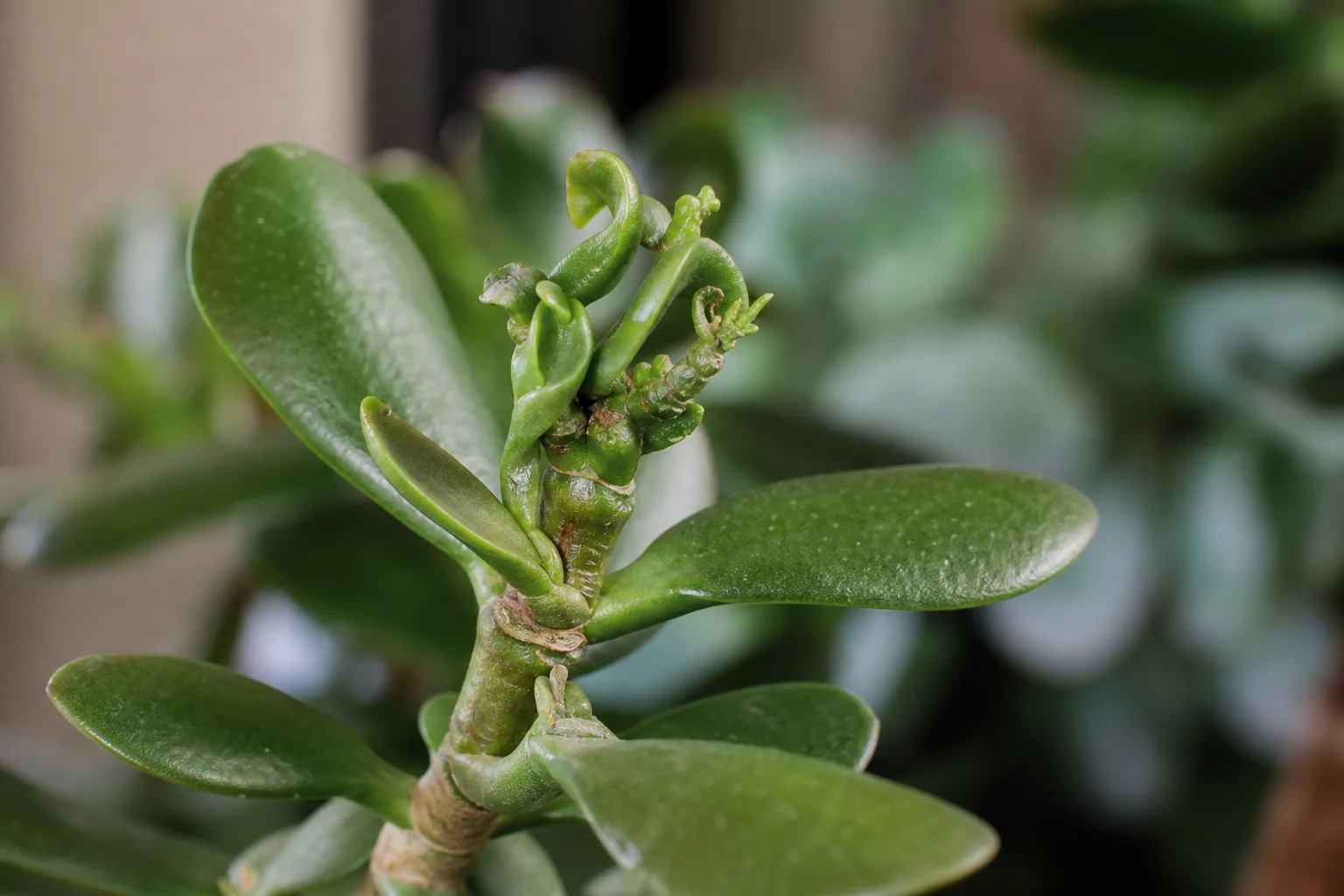
Deformed new growth on jade means the newest leaf pairs look twisted, stacked, mushy, pale-stretched, or mottled-not merely slow. First check the growing tip and pot weight: firm stems with white cotton in leaf axils point to pests; soft tips on a heavy wet pot point to overwatering; pale stretch with long gaps points to low light.
Deformed New Growth on Jade Plant: Causes, Checks & Fixes
This guide covers deformed new growth on Jade Plant. See also the general Deformed New Growth guide, watering, and light pages for this plant.
Deformed New Growth on Jade Plant: Causes, Checks & Fixes
Quick answer
Deformed new growth on Jade Plant (Crassula ovata) means the newest leaf pairs at branch tips look abnormal in shape-twisted, stacked, cupped, mushy, pale and stretched, or mottled-not simply smaller or slower than older leaves. On jade, opposite thick leaf pairs normally emerge symmetric and firm. Deformation at the growing tip is a high-signal clue because jade stores water in mature tissue; when only new tips look wrong, the cause is usually pests at the node, water stress at the root, insufficient light, virus, or cold/chemical shock-not normal lower-leaf drop.
First step: look at the tip and lift the pot before changing anything. Firm woody stems with white cotton in leaf axils → inspect for mealybugs. Soft translucent new tips on a heavy wet pot → stop watering and check for root rot. Long gaps and pale stretch between pairs → move to brighter light per the jade light guide. Mottling that spreads on every new leaf → isolate and rule out mosaic virus.
Do not stack repotting, pruning, fertilizer, and pesticide on the same day-one targeted correction first.
What deformed new growth looks like on Jade Plant
Healthy jade adds opposite pairs of thick oval leaves at branch ends. Each pair sits at right angles to the pair below-a symmetry that makes tip deformation easy to spot.
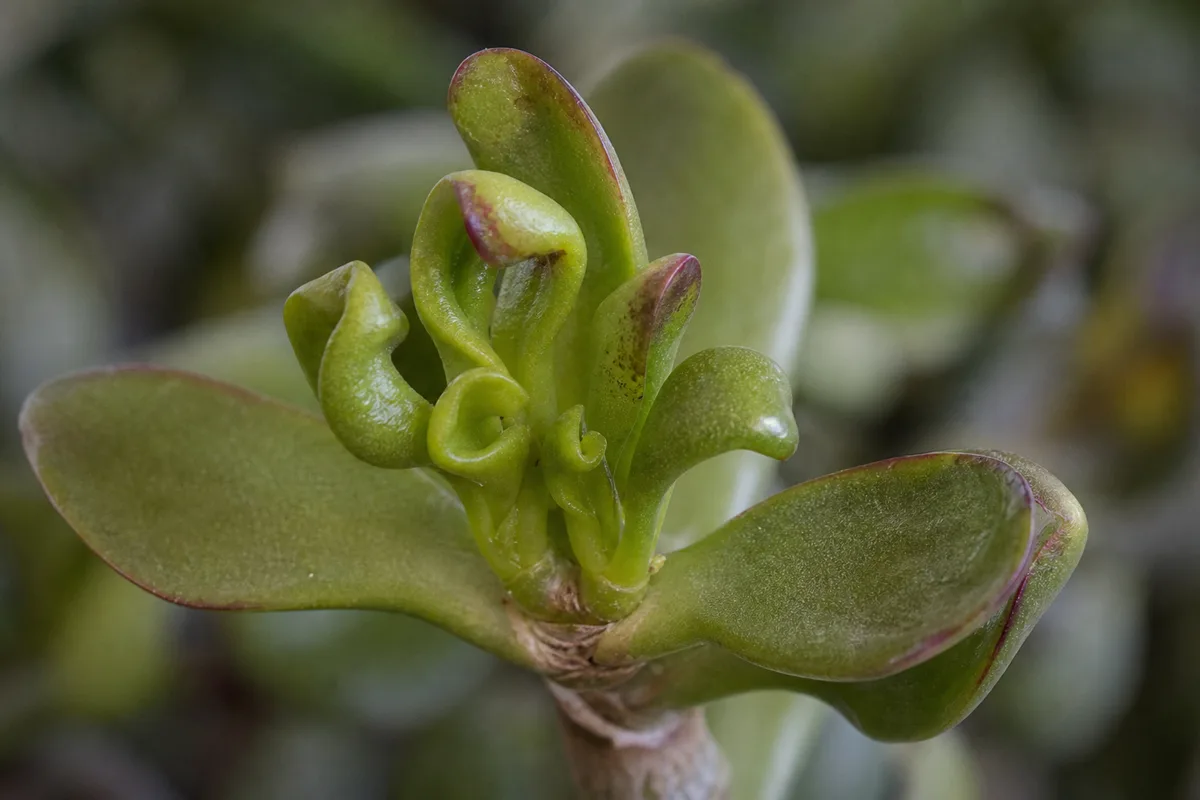
Deformed New Growth symptoms on Jade Plant - compare with healthy tissue on the same plant.
Twisted, stacked, or cupped leaf pairs
- New pairs emerge rotated, overlapping, or crinkled instead of flat and symmetrical
- Leaves may stack tightly like a rosette or fold cupped inward
- Often paired with white cottony mealybug masses at the leaf-stem juncture-Wisconsin Extension notes mealybug infestations can deform new growth on jade
- Stem below the tip usually stays firm if rot has not started
Soft, mushy, or translucent new tips
- Newest leaves look waterlogged, puffy, or see-through before they harden
- Tips may collapse or wrinkle while lower leaves still feel plump
- Pot feels heavy; soil stays damp 10+ days; sour smell may be present
- Pattern matches overwatering or early root rot-Clemson Extension links root rot to soil that does not drain quickly or overly frequent watering
Pale, stretched, weak new tips (etiolation)
- New pairs are smaller and paler with long empty gaps between them
- Stems lean toward the brightest window; internodes lengthen
- Tissue is thin but firm, not mushy-different from rot
- Inadequate light produces deep green drooping stems without compact growth per Wisconsin Extension; see leggy growth and not enough light
Pest distortion at growing nodes
- Mealybugs - fluffy white clusters in leaf axils and branch forks; sticky honeydew; ants on the pot
- Aphids - tiny soft-bodied insects on tender tips; curled or puckered new leaves
- Scale - brown waxy bumps on stems near new growth
- Clemson HGIC lists mealybugs as the most common insect pest of jade, appearing as white puffs of cotton
Virus, edema, cold, or chemical patterns
- Mosaic virus - irregular yellow-green mottling, ring spots, or bronzing on successive new leaves with twisted tips; see mosaic virus on jade
- Edema - corky brown bumps on expanding leaves from wet soil in cool dim rooms; see edema on jade
- Cold or draft shock - brown-black scorched tips on new growth after a cold window night
- Herbicide drift or fertilizer burn - distorted cupped new leaves after spray exposure or heavy feed on stressed roots
Old leaves at the bottom naturally drop as jade ages-that is not deformed new growth. Judge this problem at branch tips only.
Why Jade Plant gets deformed new growth
Jade evolved on dry rocky hillsides in South Africa, storing water in thick leaves and woody stems. New tissue at the tip is the most metabolically active zone-and the first place pests, water imbalance, and light stress show up.
| Cause | Why it deforms tips on jade | Key clue |
|---|---|---|
| Mealybugs / aphids | Sap-feeders cluster on tender new nodes; feeding disrupts cell expansion at the growing tip | White cotton, honeydew, firm stem |
| Overwatering / root decline | Roots in saturated mix cannot regulate uptake; new cells swell and rupture before hardening | Soft translucent tips, heavy wet pot |
| Low light / etiolation | Insufficient photosynthesis produces weak elongated cells between pairs | Pale stretch, long internodes, lean |
| Mosaic virus (TSWV, etc.) | Systemic infection disrupts leaf development on every new flush | Mottling marches up successive leaves |
| Cold, edema, or chemical | Rapid temperature swing or uptake-transpiration mismatch scars expanding tissue | Event-linked timing; corky bumps or scorch |
Because jade’s paired-leaf symmetry is reliable, asymmetric or twisted newest pairs narrow the list faster than checking older foliage.
Diagnostic table: five causes, checks, and first fixes
| Cause | What deformed tips look like | Confirm with | First fix |
|---|---|---|---|
| Pests (mealybugs, aphids) | Twisted, crinkled, or stunted pairs; cottony white in axils | Loupe at newest node; alcohol dab turns pests orange-gray | Isolate; alcohol swab each cluster; repeat weekly - mealybugs guide |
| Overwatering / rot | Mushy, translucent, collapsing new leaves | Heavy pot; wet skewer at bottom; soft stem base | Stop water; unpot if base soft - root rot guide |
| Low light | Pale, small pairs far apart on thin stretchy stem | Fewer than 4 hours direct sun; damp soil in dim corner | Move to brightest window; acclimate 7–14 days - light guide |
| Mosaic virus | Mottled, ring-spotted, bronzed new leaves over weeks | Thrips on undersides; pattern on each new flush | Isolate; no cure - mosaic virus guide |
| Cold / edema / chemical | Scorched tips, corky bumps on margins, cupping after spray | Recent frost, draft, winter overwater, or herbicide event | Fix environment; dry-down watering - edema guide |
Deformed vs. stunted vs. no new growth vs. etiolation
These jade growth pages overlap but answer different questions:
| Problem | Shape of new tissue | Growth rate | Starting page |
|---|---|---|---|
| Deformed new growth (this page) | Abnormal shape-twisted, mushy, mottled | May be normal speed | You are here |
| Stunted growth | Normal shape, just tiny or slow | Very slow | Shape OK, size wrong |
| No new growth | No new pairs at all | Zero tips | Tips bare |
| Leggy growth | Pale stretch, long gaps | Present but weak | Etiolation focus |
A jade in winter dormancy may show no new tips with firm stems-that is no new growth, not deformation. This page applies when new tissue appears but looks wrong.
How to confirm the cause
Work through these checks in order-one variable at a time:
- Newest leaf pair - Twisted with cotton in axils? → pests. Mushy and translucent? → water. Pale and far apart? → light. Mottled on every flush? → virus.
- Pot weight and soil moisture - Lift the pot. Push a skewer to the bottom. Heavy wet mix with soft tips confirms water stress; firm stem with dry mix points away from rot.
- Stem firmness at soil line - Press the woody base. Soft mushy tissue with sour smell → unpot for rot before pruning tips.
- Direct sun hours - Count hours leaves receive direct sun at the pot. Under four hours through a warm season supports etiolation deformation.
- Leaf axils and undersides - Mealybugs, aphids, thrips, and scale hide where leaves meet stems.
- Timeline - Did deformation follow a cold night, repot, herbicide spray, or new plant arrival? Event-linked timing suggests cold, shock, or imported pests.
- Progression - Does every new pair look worse over weeks (virus)? Or was it one bad flush after a watering mistake (water/edema)?
Inspection order for deformation
Newest tip pair → leaf axils at that node → pot weight → stem base firmness → direct sun at pot → leaf undersides for thrips → compare to lookalike table above.
First fix for Jade Plant (by confirmed cause)
One correction first-do not repot, prune, feed, and spray the same day.
If mealybugs or aphids are confirmed: Isolate the plant. Wipe mealybugs with a cotton swab dipped in rubbing alcohol at each affected axil and branch fork. Re-inspect every three to five days for several weeks-eggs hide in crevices. Full protocol: mealybugs on jade and aphids on jade. Use caution with insecticides on succulent jade leaves; Wisconsin Extension warns of phytotoxicity on some products.
If overwatering or soft tips on wet soil: Stop all watering. Move to bright airflow. If the stem base is soft, unpot, trim mushy roots, air-dry 24–48 hours, repot into dry gritty mix. Follow jade plant watering soak-and-dry rhythm after recovery-full dry-down, not surface-only checks.
If low light etiolation: Gradually increase direct sun over 7–14 days. Do not fertilize until new compact pairs appear. Prune stretched tips only after new tight growth confirms the fix.
If mosaic virus is suspected: Isolate immediately. Control thrips vectors. Do not propagate from infected stock. See mosaic virus on jade.
If edema or winter wet-soil bumps: Let mix dry fully; improve light so transpiration matches uptake. See edema on jade.
Mild / moderate / severe recovery branches
| Severity | Signs | Action |
|---|---|---|
| Mild | One or two twisted pairs; firm stem; pests localized or one wet cycle | Targeted fix above; wait for next clean pair |
| Moderate | Multiple deformed flushes; mealybugs on several branches; chronically damp mix | Sustained pest treatment or dry-down + light upgrade; inspect roots |
| Severe | Soft stem base; sour soil; collapsing tips; viral mottling on all new growth | Root-rot surgery or discard/isolate for virus-see escalation below |
Recovery timeline
After pest clearance: New firm symmetric pairs often appear within two to four weeks once feeding stops. Old twisted leaves do not straighten.
After correcting overwatering: Mild cases stabilize in one to two dry-down cycles (often two to four weeks). Severe root loss may take six to eight weeks for clean tips-or require salvage cuttings.
After light improvement: Compact new pairs emerge in two to four weeks during warm months. Stretched stem sections never shorten.
After cold or edema event: Corky scars are permanent; new clean pairs in three to six weeks once environment stabilizes.
Viral deformation: Old leaves do not heal; new flushes may stay distorted indefinitely. No timeline for “recovery”-only containment.
Judge success by firm new leaf pairs at tips, not by old deformed tissue re-greening.
What not to do
- Do not fertilize stressed jade before confirming moisture, roots, and pests. Inactive or damaged roots cannot use nutrients; salts burn tender tissue.
- Do not keep watering because new tips look tired when the pot is already wet.
- Do not prune all deformed tips before confirming cause-you may remove pest evidence and waste stored energy.
- Do not use insecticidal soap on jade without a patch test-Clemson Extension notes insecticidal soap may damage jade plants.
- Do not assume deformation always means pests-a heavy wet pot with mushy tips is water, not insects.
- Wear gloves when handling cut tissue-jade is toxic to cats and dogs.
How to prevent deformed new growth next time
- Bright light - four or more hours of direct sun daily keeps new tissue compact
- Soak-and-dry watering - full dry-down between drinks; restrict sharply in winter - watering guide
- Gritty fast-draining mix in terracotta - soil guide
- Quarantine new plants two weeks; inspect leaf axils before placing near collection
- Monthly tip-and-axil check during routine care-pests are easiest to stop at first cottony cluster
- Protect from frost and cold drafts on window sills in winter
Practical checks
Urgency check
Urgent today: Stem bases soften, soil smells sour, or pests blanket multiple branches-jade rots fast once roots fail. Unpot within 48 hours if rot is suspected.
Medium urgency: Deformed tips spreading over several weeks with mottling-isolate for virus and thrips.
Lower urgency: One twisted pair with visible mealybugs on an otherwise firm plant-treat this week before colonies spread.
Best inspection order
Newest leaf pair → leaf axils at that node → pot weight → stem base → direct sun hours → leaf undersides → event timeline (cold, repot, new purchase).
Jade care cross-check
Also sold as money tree or lucky plant, jade should be judged by firm symmetric new pairs, not by tropical-houseplant growth speed. If tips deform while the pot stays wet for weeks in a dim corner, fix light and watering together-not fertilizer.
When to worry - escalate to root-rot or virus protocols
Root rot escalation: Soft stem at soil line, blackening trunk, sour wet mix, and collapsing new tips together mean advancing rot-not cosmetic deformation. Stop water, unpot, trim all mushy roots, repot dry. See root rot on jade plant. If the main trunk collapses, propagate firm branches per the propagation guide.
Virus escalation: Mottling, ring spots, or bronzing on each successive new leaf after thrips exposure warrants isolation and discard consideration. See mosaic virus on jade.
Related Jade Plant guides
- Jade plant care overview - baseline culture
- Jade plant watering - soak-and-dry and overwatering branches
- Stunted growth on jade - slow but normal-shaped tips
- No new growth on jade - zero tips vs. wrong-shaped tips
- Distorted leaves on jade - older-leaf distortion patterns
- Mealybugs on jade · Aphids on jade · Spider mites on jade
Related tool
Use the Plant Problem Diagnosis Tool to narrow causes for deformed new growth on this plant before changing multiple variables at once.