Leaf Miners on Jade Plant: Causes, Checks & Fixes
Quick answer
True leaf miners on jade are uncommon-serpentine or blotch mines with visible larval trails inside thick leaves are the hallmark. First step: confirm mines are not mealybug fluff, scale shells, or edema scars; remove affected leaves and isolate before broad sprays.
Leaf Miners on Jade Plant: Causes, Checks & Fixes
This guide covers leaf miners on Jade Plant. See also the general Leaf Miners guide, watering, and light pages for this plant.
Leaf Miners on Jade Plant: Causes, Checks & Fixes
Quick answer
Leaf miners on jade plant (Crassula ovata) are uncommon compared with the pests that actually show up on Jade Plant overview indoors. NC State lists mealybugs, scale, spider mites, and aphids as occasional Crassula ovata problems-not leaf miners. Missouri Botanical Garden names the same pest group on jade.
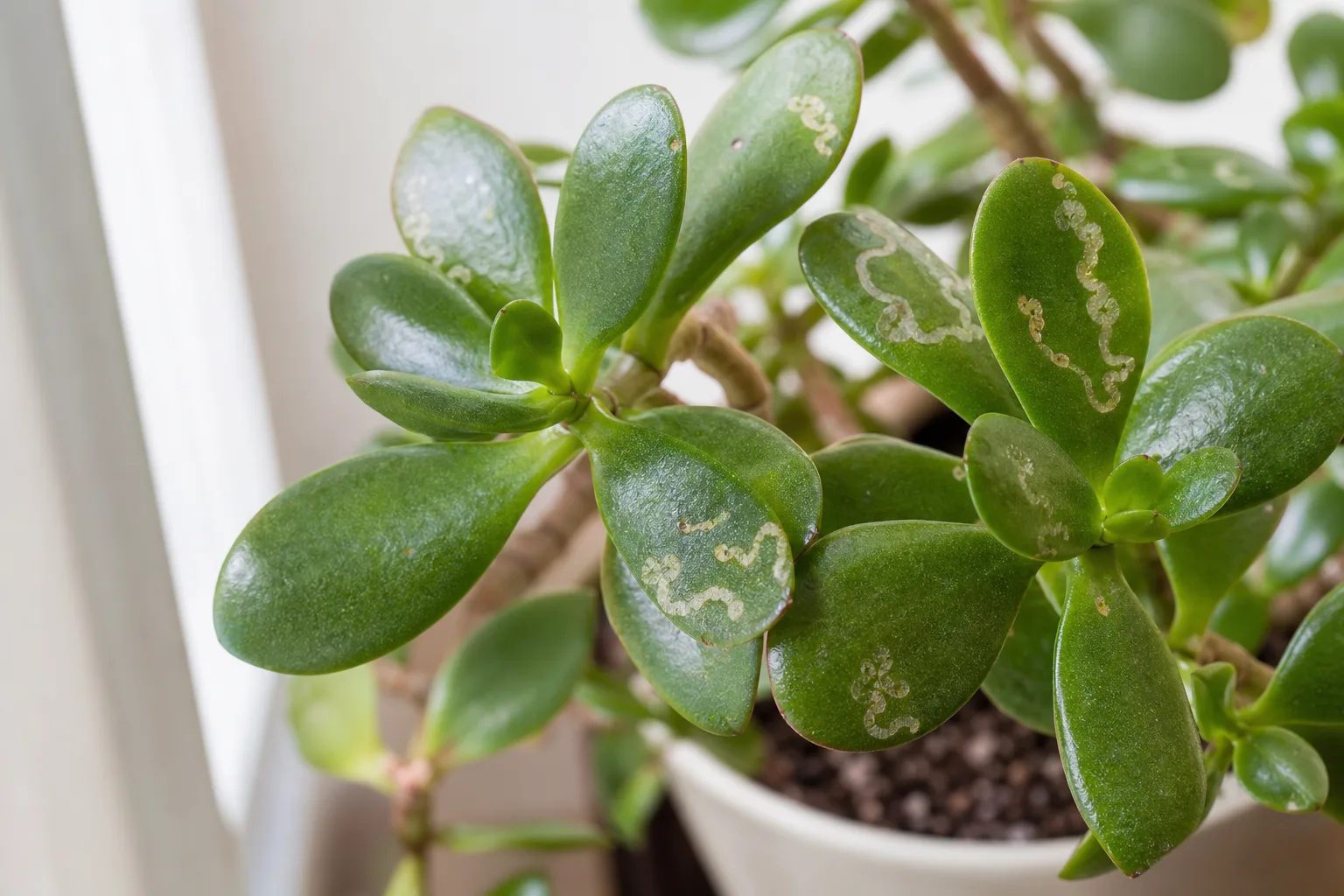
When mines do appear, they show as serpentine (snake-like) pale tunnels or blotch mines inside the thick succulent leaf, often with a visible larval trail or dark frass line. The insect feeds between upper and lower leaf surfaces-damage is internal, not a surface fuzz or bump.
First step: confirm internal mines vs. surface pests. Hold suspect leaves to bright light. If you see translucent winding paths, remove those leaves with clean scissors, bag them for trash, and isolate the plant. If damage is only on the leaf surface without internal tunnels, this is not a leaf miner-check mealybugs, scale, spider mites, or edema instead.
Are leaf miners common on indoor jade?
No-and honesty matters here. Leaf miners are larvae of flies, moths, or beetles that tunnel inside leaf tissue. They favor soft, thin-leaved plants-coleus, chrysanthemum, basil, tomato, spinach-more often than thick succulent Crassula leaves.
Indoor jade collections see mealybugs, scale, and spider mites far more often than mining insects. If you searched “leaf miners on jade” because of pale marks on foliage, there is a strong chance you are dealing with a lookalike-especially white surface speckles (mineral deposits), cottony stem clusters (mealybugs), or corky blisters (edema from irregular watering).
Mines on jade usually trace to:
- Outdoor summer exposure on patio jade or companion plants, then moving pots indoors with hitchhiking larvae
- Adjacent soft-leaved plants hosting miners that occasionally test jade leaves
- Misidentified surface pests or old mechanical scars mistaken for tunnels
That rarity does not mean you should ignore confirmed mines-but it does mean confirm tunnels before pesticide use.
What leaf miners look like on Crassula ovata
True leaf miner damage has a specific signature on jade’s thick oval leaves. Read location, depth, and progression together-not color alone.
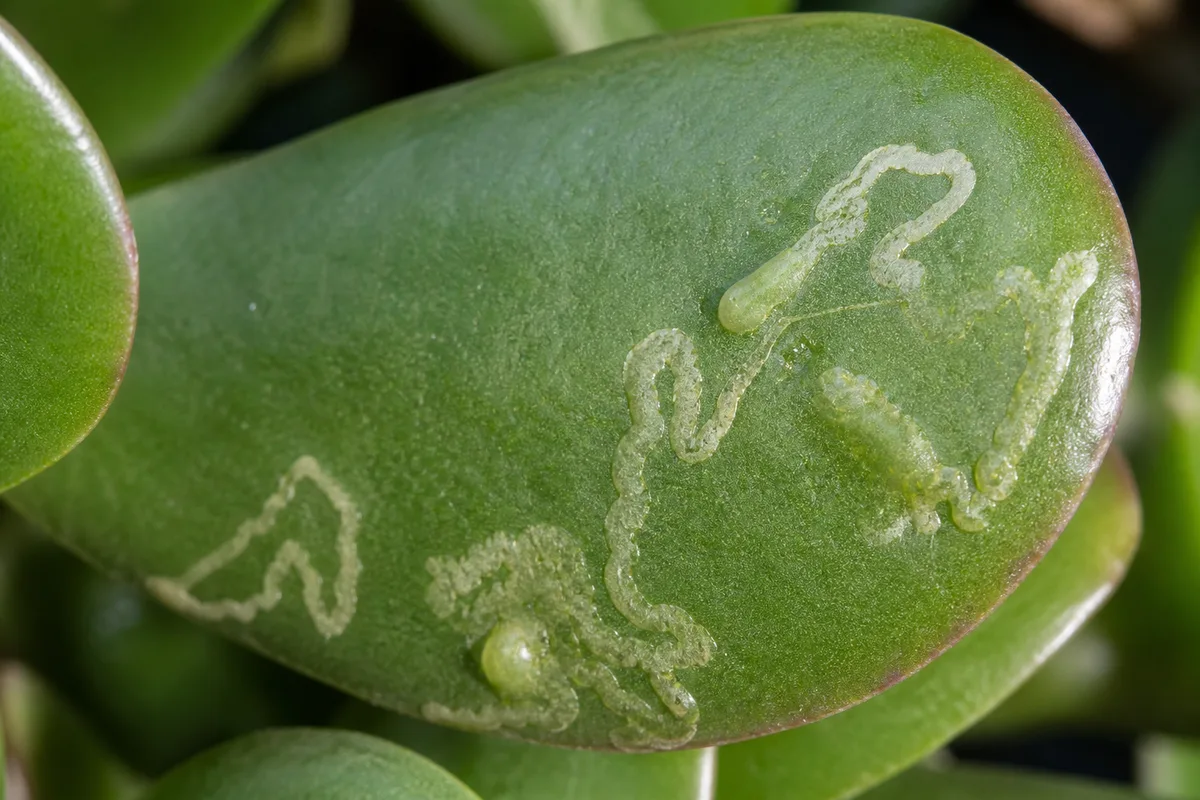
Leaf Miners symptoms on Jade Plant - compare with healthy tissue on the same plant.
Serpentine mines and blotch mines on thick leaves
- Pale winding trails inside the leaf blade-looks like a scribble frozen in green tissue
- Blotch mines - irregular pale patches with one larva feeding inside
- Translucent tunnels when backlit-damage is between leaf surfaces, not on top
- Dark frass lines (larval waste) along the mine path
- Localized damage - one leaf may be mined while neighbors on the same branch stay clean
- Expanding trails over days as the larva feeds and grows-the mine widens toward the leaf edge
On thick jade leaves, early mines can hide until tissue becomes visibly pale or slightly blistered. Backlighting is the fastest home check.
What leaf miners are not on jade
- White cottony tufts at stem joints → mealybugs
- Hard brown disks on leaf faces that scrape off → scale
- Fine stippling and webbing on undersides → spider mites
- Brown crispy tips only → drought, sun scald, or salt burn per watering and light guides
- Watery or corky blisters on lower leaves → edema from overwatering in cool dim rooms
- Surface speckles that wipe off → hard-water mineral deposits-not insects
Leaf miners vs. mealybugs, scale, and mineral speckles
Use this table before removing leaves or spraying. Jade leaf miner reports often resolve to a row that is not this page.
| Problem | Key visual clues | Backlight test | Surface wipe test | First branch |
|---|---|---|---|---|
| Leaf miners (this page) | Pale winding or blotch pattern inside blade | Translucent tunnels visible | Marks stay inside leaf | Remove mined leaves; isolate |
| Mealybugs | White cottony clusters in leaf axils and branch forks | No internal tunnels | Cotton does not wipe clean with water alone | Alcohol swab per mealybug guide |
| Scale | Hard brown or tan disks on stems and leaves | No tunnels | Shell lifts with fingernail or swab | Scrape and treat scale |
| Spider mites | Fine stippling, bronzing, silk webbing at tips | No internal mines | Speckles on surface; moving dots on paper tap test | Rinse and miticide per mite guide |
| Mineral deposits | Uniform white or tan dots on upper leaf surface | No tunnels | Wipes off with damp cloth | Adjust water; cosmetic only |
| Edema | Corky raised blisters, often lower leaves | Bumps, not winding trails | Firm raised tissue | Fix watering rhythm |
| Sun scald / mechanical scar | Crisp brown patch, often one side of leaf | No serpentine path | Static scar; does not expand | Filter light; no pesticide |
Critical distinction: Leaf miners leave trails that widen over several days. Static scars from months ago may be old healed damage-not active mining.
Why leaf miners appear (and what they are not)
Insect larvae-not a watering mistake
Leaf miners are insect larvae, not a cultural overwatering symptom. UF/IFAS describes larvae feeding between leaf surfaces, creating serpentine or blotch mines. Adult flies or moths lay eggs on leaves; hatched larvae tunnel inside tissue where contact sprays reach them poorly.
Overwatering does not cause leaf mines. Soft yellow leaves on wet soil with mushy stems point to root rot or overwatering-a completely different problem class. If both mushy stems and confirmed internal mines appear, address rot first; a collapsing jade will not recover from leaf removal alone.
How miners reach jade indoors
- Unquarantined new plants - miners often start on softer-leaved nursery stock
- Patio season - jade or neighbors outdoors pick up leafminer flies on herbs, tomatoes, or ornamentals
- Weedy hosts nearby - outdoor gardens with basil, chrysanthemum, or other miner-favored plants (UF/IFAS Duval County notes species-specific hosts)
- Misread damage - mealybug honeydew, edema, or mineral speckles reported as “mining”
Jade’s slow growth and thick CAM-adapted leaves make heavy miner damage uncommon-but one confirmed larva still warrants removal before it pupates.
How to confirm leaf miners on jade
Work through these in order. Stop when one branch clearly fits-or when you rule out miners and redirect to a lookalike guide.
- Backlight test - Shine a phone flashlight through the leaf. Internal pale serpentine or blotch tunnels confirm miners; surface-only marks rule them out.
- Trail inspection - Active mines show a widening path and often a dark frass line. Random brown patch without a tunnel → sun, mechanical damage, or old scar.
- Split-leaf check (optional) - On one heavily mined leaf, carefully tear along the mine. A yellowish larva inside confirms leaf miners. Discard the leaf afterward-do not compost indoors.
- Squeeze test - UF/IFAS Duval County notes you can gently squeeze a mined leaf to kill the larva without further damaging healthy tissue-useful when only one leaf is affected.
- Stem and joint check - Cottony white at forks = mealybug. Hard shells = scale. No tunnel inside leaf = not a miner.
- Neighbor plant scan - Inspect softer-leaved houseplants on the same shelf. Miners often appear there first.
- Timeline - Mines expand over days as larvae feed. Static marks unchanged for weeks are not active mining.
Confirmed miners: new internal tunnels on one or more leaves with visible larval paths or frass-especially after outdoor summer or new plant introduction.
First fix for jade plant
Make one primary action before stacking sprays, Jade Plant repotting guide, or fertilizer.
Remove mined leaves immediately
Twist off or cut mined leaves with clean scissors. Bag and discard infested tissue in household trash-do not compost mined leaves indoors where pupae can emerge.
That single step is the correct first fix because UF/IFAS and UC IPM both emphasize removing infested leaves as the most effective leafminer control when infestation is light-larvae die with the tissue they occupy.
Then isolate and monitor
- Isolate the plant from other specimens for 2–3 weeks
- Monitor daily for new mines on remaining leaves
- Inspect companion plants-especially soft-leaved neighbors
- Keep baseline care steady - strong light and dry-down per jade watering so regrowth is vigorous; do not overwater while stressed
When to escalate beyond removal
If new mines appear weekly on multiple branches after thorough leaf removal:
- Re-check softer-leaved neighbors for the true source population
- Consider insecticidal soap on remaining foliage following label directions-test one leaf first; Clemson cautions that insecticidal soap may damage jade plants
- Avoid harsh horticultural oils on jade without label confirmation for succulents
- Chemical controls often have limited efficacy against leafminers because larvae are shielded inside leaf layers-removal and source-plant cleanup usually beat repeated spraying on sparse jade mines
Do not treat overwatering as miners. Do not apply systemic pesticides on pet-accessible jade without need-jade is toxic to cats and dogs.
Recovery timeline
Week 1: No new mines after thorough removal = success. Old mined leaves stay scarred permanently-mined tissue does not re-green.
Weeks 2–4: New clean leaves emerge from branch tips. That clean new growth is your recovery marker-not old blemished foliage.
Mined leaves: Permanent scars. Do not expect mined tissue to heal.
Severe spread: Multiple mining cycles on several branches may require repeat leaf removal plus neighbor-plant cleanup-rare on indoor jade but possible when soft-leaved hosts share a windowsill.
Overlap with root rot: If stems soften at the base while you treat mines, pause pesticide plans and address root rot first-wet roots kill jade faster than leaf miners.
What not to do
- Do not assume every leaf blemish is a leaf miner - confirm internal tunnels before any spray
- Do not treat overwatering or edema as miners - cultural fixes, not pesticides
- Do not apply insecticidal soap or horticultural oil broadly without a one-leaf test - jade foliage can react badly
- Do not stack repotting, fertilizer, and pesticide on the same day - one variable at a time on slow-growing jade
- Do not compost mined leaves indoors - pupae can emerge and reinfect collection plants
- Do not handle cut jade tissue bare-handed around pets - sap and leaves are toxic; wash hands after pruning
How to prevent leaf miners next time
- Quarantine new plants two weeks before placing near jade per UMN Extension indoor pest guidance
- Inspect when moving jade indoors from patio summer-check jade and softer-leaved neighbors
- Remove mined leaves early on any plant in the collection, not only jade
- Keep strong light and proper succulent care so jade outgrows occasional hits-see overview for baseline culture
- Avoid unnecessary broad insecticides that stress succulents when physical removal suffices
Practical checks
Urgency check
| Signal | Urgency | Action |
|---|---|---|
| One mined leaf, no new tunnels after removal | Low | Monitor 2–3 weeks |
| New mines weekly on multiple branches | Medium–high | Remove leaves; inspect all neighbors; consider labeled soap after test leaf |
| Soft mushy stems, sour soil smell | Urgent (not miners) | Root rot branch first |
| Cottony clusters at stem joints | Medium | Mealybug guide-not miners |
Best inspection order
- Backlight suspect leaves
- Check stem joints and leaf undersides for mealybugs and scale
- Tap-test for spider mites per mite guide
- Wipe surface speckles-if they remove, mineral deposits only
- Scan softer-leaved neighbors for active mines
- Review recent outdoor time or new plant purchases
Jade care cross-check
Healthy jade tolerates occasional pest hits better than stressed plants. Confirm:
- Pot feels light before watering per watering guide
- Bright light per light guide-leggy pale jade is more vulnerable to stacked stress
- Fast-draining mix per soil guide-wet roots compound any pest treatment
When to worry
Treat as urgent overlap when soft mushy stems and wet soil accompany leaf damage-that is rot, not mining, until proven otherwise.
Treat miner damage as escalating when:
- New internal tunnels appear on multiple branches after you removed mined leaves
- Softer-leaved neighbors show heavy mining-you may be treating a secondary host while the primary source continues
- Weekly mine expansion continues for more than three weeks after isolation and removal
Most indoor jade “leaf miner” scares end at the lookalike table-mealybugs, scale, minerals, or edema. That is normal and helpful; the goal is the correct fix, not the rarest diagnosis.
Related jade plant pest problems
- Jade plant overview - baseline care and common issues
- Mealybugs on jade - white cottony clusters at stem joints
- Scale on jade - hard brown disks on leaves and stems
- Spider mites on jade - stippling and fine webbing
- Edema on jade - corky blisters from irregular watering
- Distorted leaves on jade - cultural and pest-related twist
Conclusion
Leaf miners on jade are rare and diagnosable-internal serpentine or blotch tunnels distinguish them from mealybugs, scale, mites, mineral speckles, and edema. Remove affected leaves, isolate, and monitor. Most jade mystery damage is not mining insects; confirm with backlight before treating. Clean new growth without new tunnels tells you the fix worked.
When to use this page vs other Jade Plant guides
- Jade Plant watering guide - Use for routine moisture checks before assuming leaf miners is the main issue.
- Jade Plant problems hub - Browse all 49 common issues on this species.