Poor Drainage on Jade Plant: Causes, Checks & Fixes
Quick answer
Poor drainage on jade means water moves through the mix too slowly - the surface stays wet for days, water runs down pot sides without soaking, or the top inch never dries within a week. Stop watering, run a pour-water percolation test, and repot into gritty succulent mix if the mix fails. Jade's plump leaves can hide wet roots until stem bases soften.
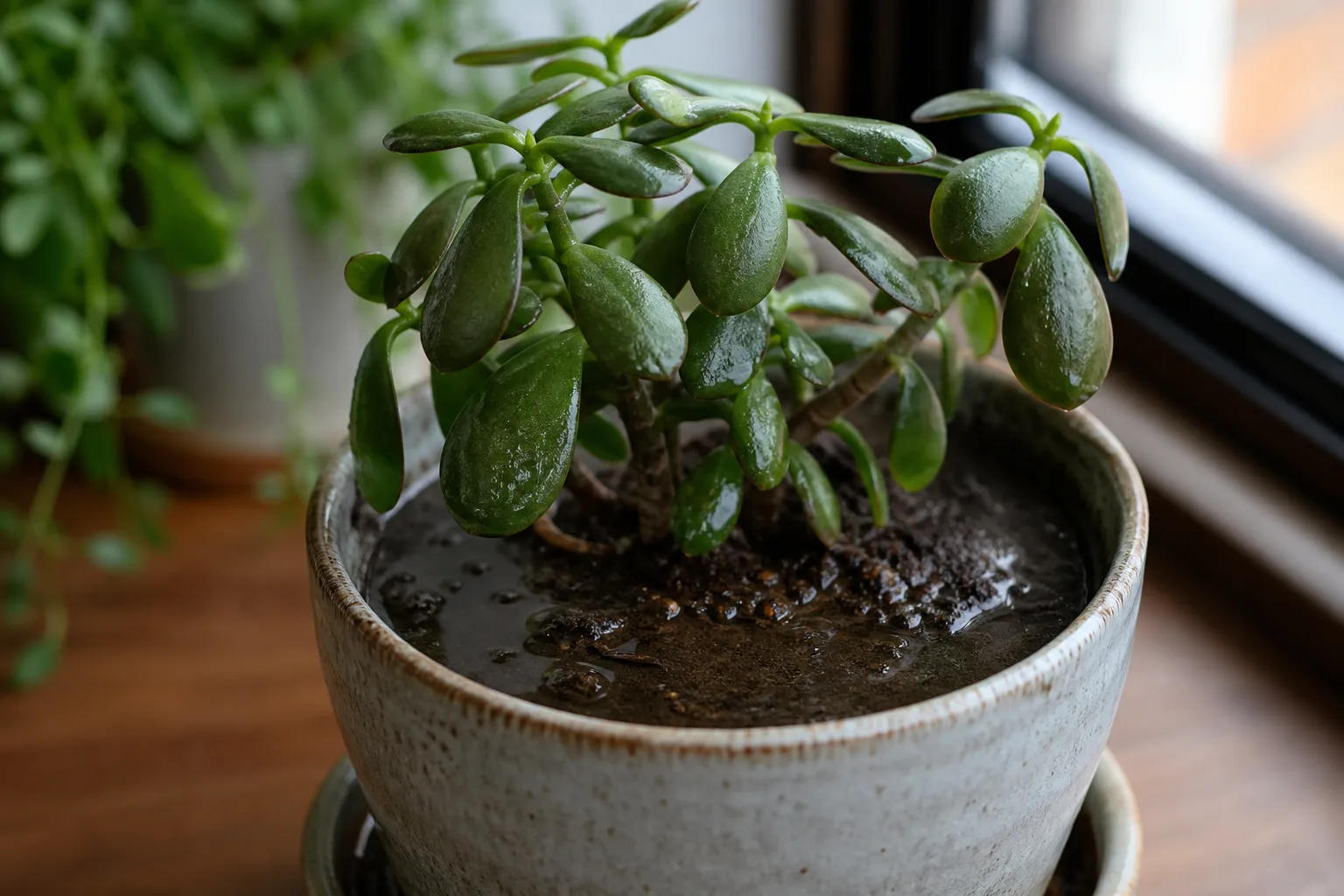
Poor Drainage on Jade Plant: Causes, Checks & Fixes
This guide covers poor drainage on Jade Plant. See also the general Poor Drainage guide, watering, and light pages for this plant.
Poor Drainage on Jade Plant: Causes, Checks & Fixes
Quick answer
Poor drainage on a jade plant (Crassula ovata) means water cannot move through the potting mix fast enough - not that you necessarily water too often. Standard peat-heavy potting soil, fine particles, and degraded organic matter hold moisture around drought-adapted roots long after the surface looks acceptable. Missouri Botanical Garden describes jade as intolerant of moist, poorly-drained soils; the fix is substrate and pot mechanics, not another watering schedule tweak alone.
First step: stop watering and run a pour-water percolation test on dry mix. If water pools on the surface, channels down the pot wall without wetting the center, or the top inch stays damp more than seven days after a full soak, the mix is failing jade’s need for seconds-fast drainage and multi-day dry-down. Confirm with pot weight, a skewer probe to the bottom, and stem-base firmness before repotting into gritty succulent mix.
Jade stores water in thick leaves and woody stems, so plump foliage can mask chronically wet mix longer than thin-leaved houseplants. That delay makes poor drainage especially dangerous - by the time leaves soften, root damage may already be advanced. Full mix guidance: jade plant soil. If you water on a calendar while mix stays wet, also see overwatering on jade plant.
What poor drainage looks like on Jade Plant
Poor drainage shows up in the mix and pot behavior, not only in leaf color. Watch for these jade-specific patterns together:
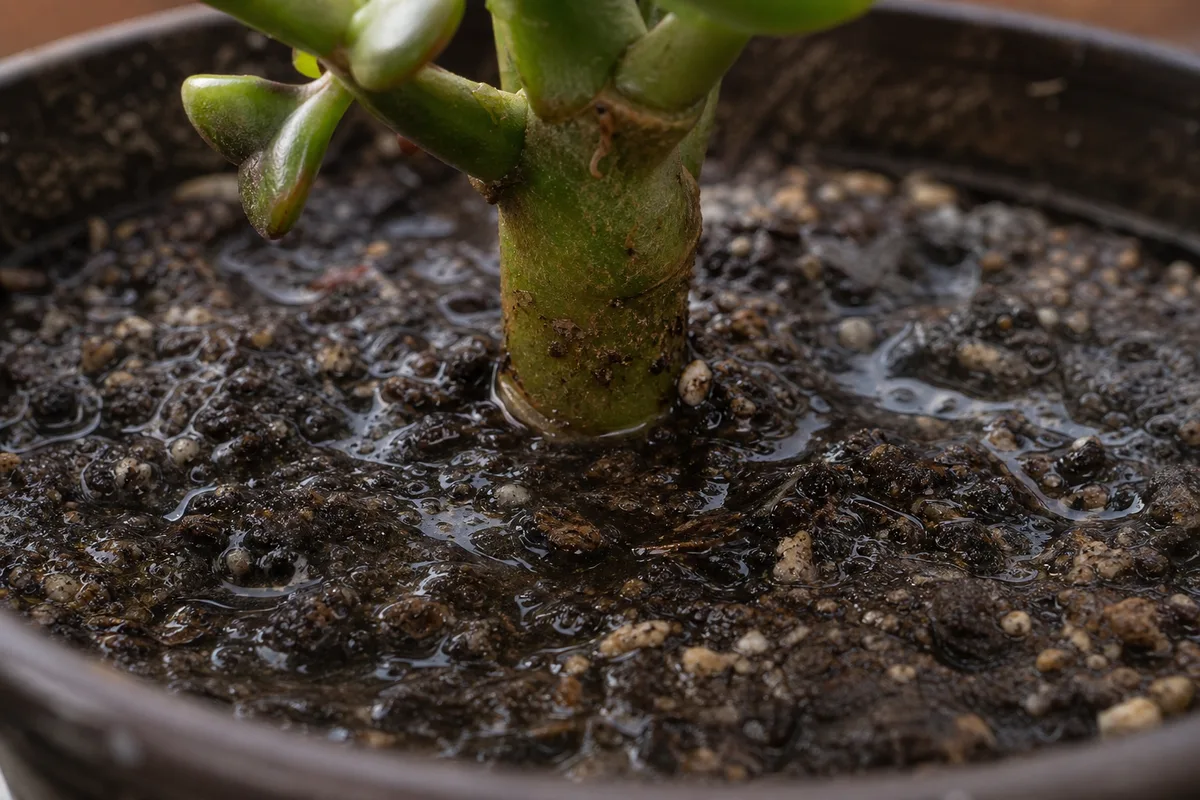
Poor Drainage symptoms on Jade Plant - compare with healthy tissue on the same plant.
Surface and percolation signs:
- Water beads or sits on the surface for minutes after watering instead of sinking in seconds
- Water runs down the inside wall of the pot and out the hole while the center of the root ball stays dry - classic channeling in compacted or peat-dominated mix
- Top inch stays damp ten or more days after a full watering in a typical indoor room
- Mix feels dense and smeared when squeezed - it forms a tight ball instead of crumbling
- White mineral crust or algae on the surface from slow evaporation and repeated shallow waterings
- Sour or swampy smell from the drainage hole even when you water “correctly”
Plant signals that often arrive late on jade:
- Pot stays heavy for weeks while you thought dry-down occurred
- Lower leaves yellow or drop with wet soil - not the crisp brown tips of underwatering
- New growth stalls or emerges smaller despite adequate light
- Stem base softens at soil level while upper leaves still look plump - jade’s internal water storage hides root failure
- White mold on soil surface from chronic moisture
Firm leaves with light pot weight and dusty dry mix throughout point away from drainage failure. A sealed decorative pot with no exit holes is a different problem - see no drainage hole on jade plant. Mix that repels water when bone dry and will not absorb a pour may be compacted soil rather than slow percolation alone.
Worked example
A jade in standard indoor potting soil gets a modest weekly soak. The owner checks the top inch - it feels dry - and waters again. After three weeks the pot still feels heavy, the skewer comes out dark and cool at the bottom, and the stem base feels slightly spongy, but leaves remain firm and glossy. The mix percolates slowly and holds water in the lower half while the surface dries first - poor drainage on a succulent that masks stress in its foliage.
Why Jade Plant suffers in poorly draining soil
Jade evolved on dry rocky slopes in South Africa with infrequent rain and fast runoff through coarse mineral substrate. Indoors, the same biology meets peat-heavy bagged mix engineered for tropical foliage - sponges that stay damp for days. Clemson HGIC recommends cactus mix with added organic matter or a blend heavy on coarse sand because jade roots need oxygen between waterings.
Why standard potting soil fails. All-purpose mix is dominated by fine peat and compost particles. They hold water through capillary action and compact under repeated watering. Jade’s shallow, fleshy root system cannot survive long in saturated fine-textured mix even if you reduce pour volume - root rot usually results from a mix that does not drain quickly.
Why jade hides the problem. Thick leaves and stems store water for weeks. The woody trunk looks stable while roots suffocate below. By the time leaves soften or drop, root and stem rot on Crassula ovata may already be underway - especially in winter when growth slows and wet mix dries even more slowly.
Common drainage killers beyond “wrong soil”:
- Peat-heavy or moisture-control blends labeled for houseplants or African violets
- Fine sand or dust-grade perlite that fills gaps instead of creating air channels
- Oversized plastic pots holding a wet reservoir around a small root ball - see pot too large on jade
- Blocked drainage holes matting shut with roots or saucer debris
- Bottom gravel layers instead of fixing mix texture - Illinois Extension notes gravel in pots does not replace proper mix drainage; homogeneous gritty substrate from top to bottom works better than a stone layer above saturated peat
Wisconsin Horticulture Extension advises adding extra perlite or sharp sand to increase drainage of standard mix before potting - the amendment must be mixed through the column, not layered at the bottom.
How to confirm the cause
Work through this checklist in order. One pour-water test beats guessing from leaf appearance alone.
Six-step inspection checklist
- Pour-water percolation test - On mostly dry mix, pour one cup of water onto the center. Well-draining jade mix absorbs within seconds and runoff appears at the hole quickly. Pooling, beading, or wall-channeling confirms slow percolation.
- Dry-down timing - After a full soak until runoff, the top inch should feel dry within three to seven days in average indoor conditions per the jade soil guide. Ten-plus days means mix or pot size is failing.
- Skewer or finger probe - Push to the bottom. Lower mix wet and cold while surface feels dry indicates perched moisture in fine soil - not healthy jade dry-down.
- Pot weight and smell - Heavy continuously with sour odor points to stagnant mix regardless of watering habits.
- Stem base firmness - Press the woody caudex at soil line. Soft tissue there with wet mix confirms root-zone damage from poor drainage.
- Unpot if unsure - Firm white or tan roots support drainage correction only. Mushy brown roots mean rot rescue - see root rot on jade plant.
Change one variable at a time after diagnosis. Repotting into gritty mix while still watering on the old schedule hides whether mix or habit was the primary failure.
Lookalike symptoms to rule out
| Pattern | Likely cause | Key differentiator |
|---|---|---|
| Wet mix, heavy pot, soft leaves | Overwatering on bad mix | Often both - fix drainage first, then schedule; see overwatering |
| Water runs straight through, mix won’t absorb when dry | Compaction or hydrophobic peat | Repels water on dry surface; see compacted soil |
| No holes, water pools in saucer | Trapped water | Hole issue, not mix alone; see no drainage hole |
| Light pot, wrinkled firm leaves, dry throughout | Underwatering | Mix drains fast - problem is frequency; see underwatering |
| Surface wet, center dry, wall channeling | Poor percolation in fine mix | This page - amend or repot whole column |
First fix for Jade Plant
Stop watering immediately and let the mix dry down only if stem bases are still firm and no sour smell is present. If the caudex is soft or soil smells rotten, skip dry-down and go straight to unpot inspection - holding wet bad mix accelerates rot.
When roots are still healthy:
- Run the pour-water test to document slow percolation.
- Move to bright light with airflow so any remaining moisture evaporates faster - do not sun-scorch a stressed plant; bright indirect is enough for recovery staging.
- Plan full repot into dry gritty succulent mix within a few days if the test fails. Amend-in-place rarely fixes a peat-heavy core where jade roots sit.
Do not fertilize, mist, or “flush” with repeated soaks - more water through bad mix worsens saturation. Do not prune heavily before fixing substrate; jade needs foliage to photosynthesize during recovery.
Step-by-step mix amendment and repot
For chronically poorly draining mix, full repot beats top-dressing. Use the jade plant repotting protocol with these drainage-specific steps:
- Choose a holed pot the same size or one size up - terracotta dries evenly and suits jade well. Plastic works only with an aggressively gritty mix and careful watering.
- Prepare gritty mix - Target roughly 40 percent cactus or bark base, 30 percent perlite or pumice, and 30 percent coarse grit by volume, or blend 50/50 bagged cactus mix with perlite until the squeeze test passes: moist handful crumbles apart, no tight ball. Clemson HGIC suggests one part organic soil, one part peat, and three parts coarse sand as an extension-backed drainage-heavy alternative.
- Unpot gently - Loosen the root ball. Shake off degraded wet peat. Trim only black mushy roots with sterile shears; leave firm roots intact.
- Air-dry cuts - If you trimmed rot, let wounds callus several hours before repotting into dry mix.
- Repot at prior depth - Do not bury the stem deeper. Use one homogeneous mix from top to bottom - no gravel layer.
- Wait before watering - Seven to ten days if rot was trimmed; three to five days for simple mix upgrade on healthy roots. First soak should drain in seconds and exit the hole freely.
- Re-test percolation - Pour water on the new surface. Seconds to absorb confirms success.
If repotting during winter dormancy, water even more sparingly afterward - reduce watering in winter when jade growth slows and poorly draining mix would stay wet longest.
Pet safety during repot
Jade is toxic to cats and dogs. Wear gloves when handling moldy wet mix or trimming roots. Keep discarded soil and cuttings away from pets - this page is not veterinary advice.
Recovery timeline and warning signs
Healthy jade repotted from slow mix before rot: Expect normal dry-down within three to seven days after the first post-repot watering. New firm leaves may appear within two to four weeks in spring and summer growth.
Mild root damage after chronic wet mix: Two to four weeks after trim and dry repot for stabilization. Old yellow leaves will not re-green - judge success by firm stem base and new growth.
Advanced stem softening: Several weeks to months if any salvageable tissue remains; collapsed main trunk often means propagate firm branches only. See jade plant pruning for cutting protocol.
Signs recovery is working:
- Top inch dries within the expected window after each soak
- Pot weight drops predictably between waterings
- Stem base feels hard and woody at soil line
- New leaves emerge plump and glossy
Signs the problem is worsening:
- Softening spreads up the trunk
- Sour smell intensifies
- Most roots brown and mushy on re-inspection
- New growth absent for more than a month in bright active-season light
What not to do
Do not add a layer of gravel at the bottom instead of fixing mix texture - gravel in the bottom does not improve container drainage; roots still sit in saturated fine soil above the stones. Do not sprinkle a handful of perlite on heavy peat; you need 30 to 50 percent amendment by volume mixed through the whole pot.
Do not keep watering because leaves look slightly wrinkled when the skewer shows wet lower mix - that is poor drainage mimicking thirst. Do not use fine play sand or moisture-control potting soil. Do not repot into a larger plastic pot without grittier mix - volume holds more stagnant water.
Do not fertilize stressed jade before drainage is fixed. Do not assume jade toughness survives weeks of wet mix because leaves still look fine.
How to prevent poor drainage next time
Use one homogeneous gritty succulent mix in a holed terracotta or ceramic pot sized to the root ball. Refresh mix every two to three years before peat collapses and percolation slows - organic components break down into fine particles that hold water longer.
Run a pour-water test after every repot. Water only when the top inch is bone dry - match rhythm to dry-down, not a calendar. See jade plant watering for seasonal reduction in winter dormancy.
Empty saucers within fifteen minutes so the pot is not sitting in a reservoir. Confirm drainage holes stay open as roots mat over years. When buying bagged “succulent soil,” open the bag - if it looks like dark fine peat with sparse perlite, amend before potting jade.
When to worry
Treat poor drainage as urgent when:
- Woody stem base softens at soil level
- Soil smells sour while the pot stays heavy
- White mold or algae covers the surface persistently
- Lower leaves yellow and drop together with wet mix
- Unpotting shows more than one-third mushy roots
At that stage, drainage correction alone is insufficient - follow root rot on jade plant rescue steps. Contact your local extension office for advanced cases if the main trunk collapses.
Jade care cross-check
| Factor | Healthy drainage target | Red flag |
|---|---|---|
| Mix grit | 30–50% perlite/pumice/grit by volume; crumbles on squeeze | Tight ball, fine peat appearance |
| Percolation | Water sinks in seconds | Beading, wall channeling |
| Dry-down after full soak | Top inch dry in 3–7 days | Damp 10+ days |
| Pot | Holed terracotta, snug fit | Oversized sealed plastic |
| Watering | When top inch bone dry | Calendar schedule ignoring weight |
| Season | Sharply reduced in winter | Same frequency in dormant months |
If multiple red flags appear, fix mix and pot before adjusting light or fertilizer. Strong light helps jade use water faster but cannot compensate for peat-heavy mix that percolates in minutes instead of seconds.
When to use this page vs other Jade Plant guides
- Jade Plant watering guide - Use for routine moisture checks before assuming poor drainage is the main issue.
- Jade Plant problems hub - Browse all 49 common issues on this species.