Pale Leaves on Jade Plant: Causes, Checks & Fixes
Quick answer
Pale leaves on jade plant usually mean insufficient light (stretched stems with small washed-out leaves), sun bleach on leaves moved too quickly into harsh sun, or overwatering dullness with a heavy wet pot. First step: check internode spacing and pot weight before repotting, pruning, or fertilizing.
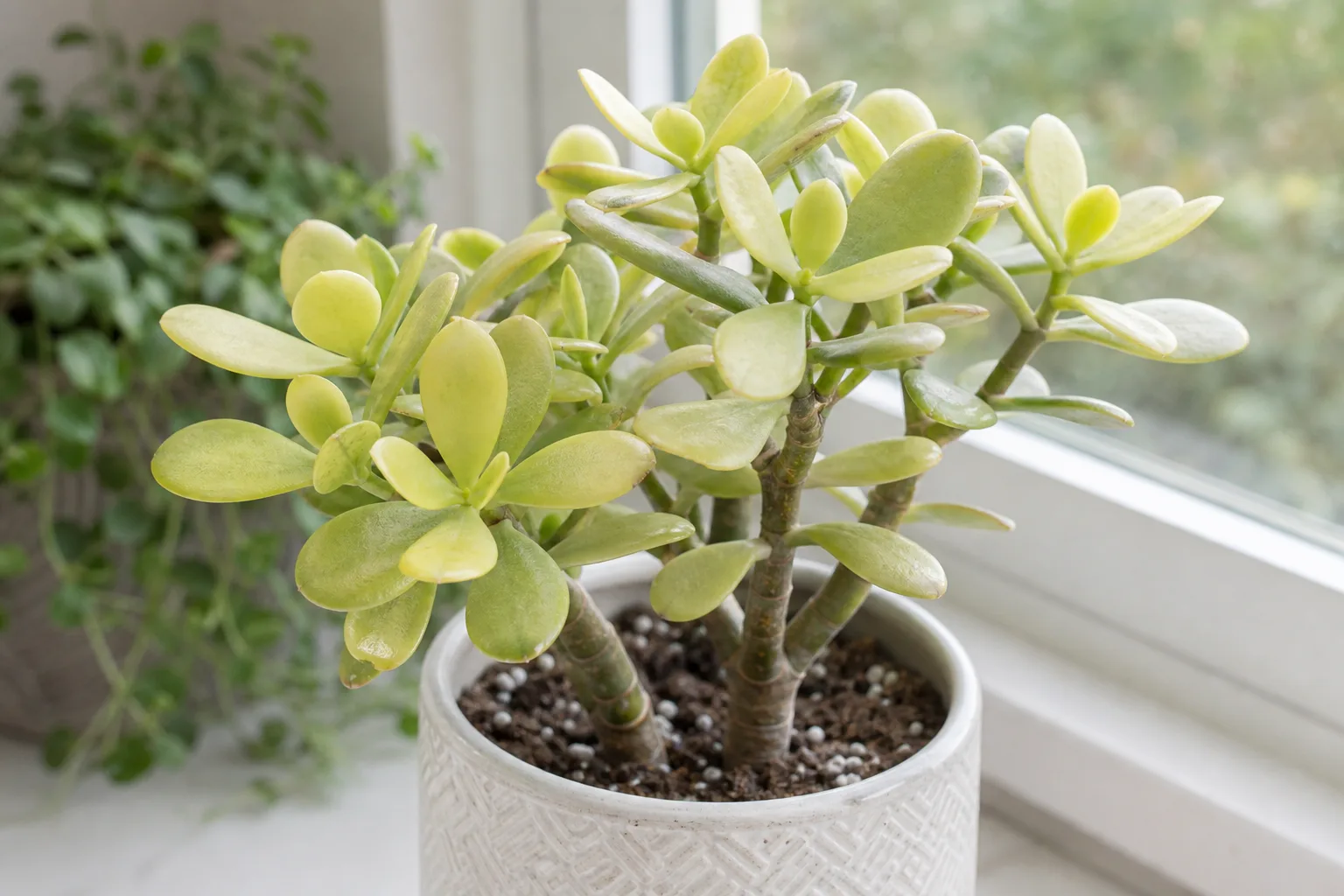
Pale Leaves on Jade Plant: Causes, Checks & Fixes
This guide covers pale leaves on Jade Plant. See also the general Pale Leaves guide, watering, and light pages for this plant.
Pale Leaves on Jade Plant: Causes, Checks & Fixes
Quick answer
Pale leaves on jade plant (Crassula ovata) are a color signal, not a single disease. On this sun-loving succulent, washed-out foliage usually falls into one of three buckets: insufficient light (etiolation with stretched stems and small pale new leaves), sun bleach (whitish patches on leaves after an abrupt move to harsh window sun), or overwatering dullness (flat pale green leaves with a heavy wet pot and possible stem softening). Rare indoors: uniform pale yellowing on old and new leaves in bright sun with proper watering may hint at nutrient stress-but dim-corner jade is almost always a light or water-timing problem first.
First step: read the pattern, not just the color. Stand where the pot sits, measure the gap between recent leaf pairs, lift the pot, and note whether paleness is uniform stretch, sun-facing patches only, or dull green with soggy mix. Do not repot, prune heavily, or fertilize on day one. Fix the most likely cause-light placement, acclimation, or dry-down-before stacking treatments.
What pale leaves look like on Jade Plant
Pale leaves on jade show up as distinct patterns. Matching the pattern beats guessing from color alone.
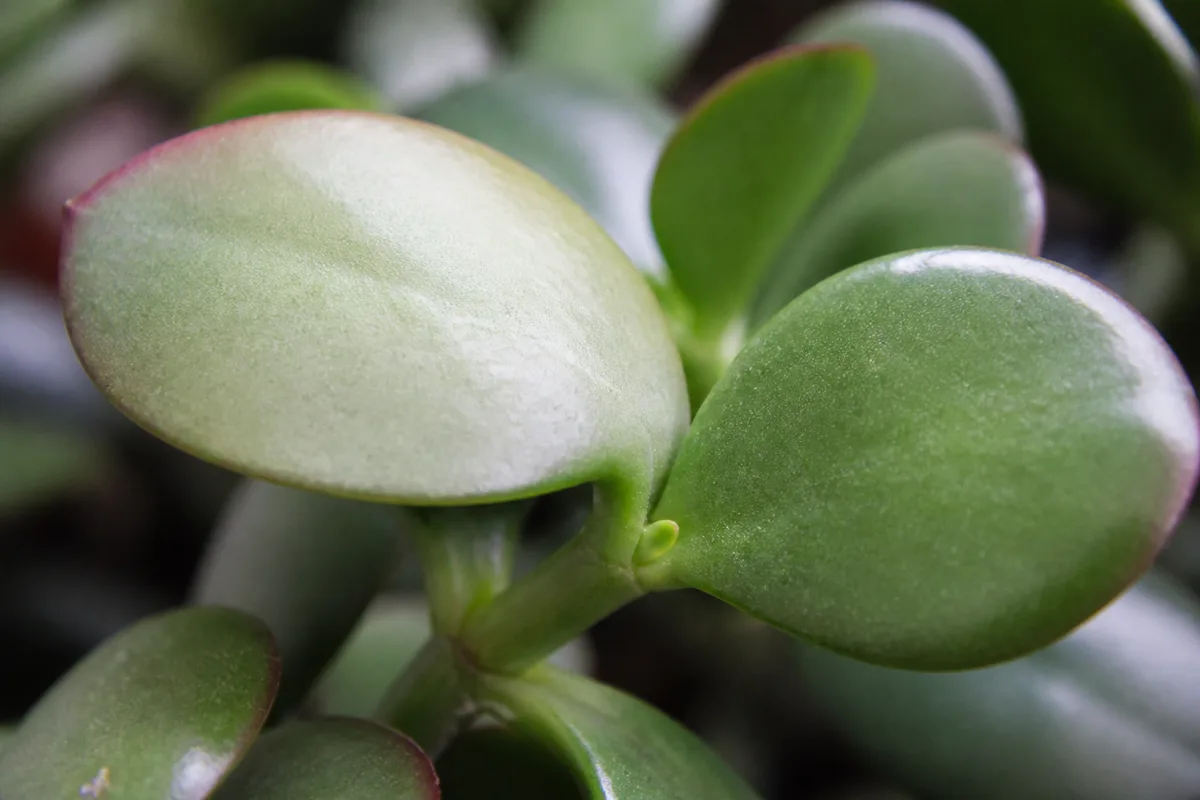
Pale Leaves symptoms on Jade Plant - compare with healthy tissue on the same plant.
Etiolation from insufficient light (most common indoors)
- Long internodes - unusually wide gaps between opposite leaf pairs on stretching stems; new leaves look smaller than mature ones lower on the branch
- Flat washed-out green - leaves lose the glossy depth and red or bronze margins that appear under strong light; overall color looks dull rather than vivid
- One-sided lean - tips track the brightest window within days of rotating the pot
- Slow dry-down - mix stays damp 10–14 days after watering because photosynthesis and transpiration are slow in shade
- Loss of tree shape - thin green stems instead of thick woody branches; see leggy growth for the same stretch mechanism in more detail
Wisconsin Horticulture Extension notes that inadequate light produces deep green leaves and drooping stems without the normal compact growth and reddish coloration-there is nothing genetically wrong with the plant; the environment lacks enough sun.
Sun bleach after abrupt light increase
- Whitish or pale patches on leaves that face the glass-often upper or outer leaves first
- Compact rosette unchanged - internode spacing stays tight; stems are not stretching toward the window
- Follows a recent move - plant jumped from a dim shelf to south or west afternoon sun, or returned indoors from summer patio without filtering
- May pair with red margins on unburned tissue before bleach spreads on the most exposed leaves
- Dry soil common - bleach is a light-intensity problem, not root rot; pot may feel light unless you also underwatered
Houseplants need gradual acclimation to higher light outdoors to prevent sunburn; the same principle applies when upgrading window exposure indoors.
Overwatering dullness
- Dull pale green across multiple leaves-not the bleached white of sun scorch
- Heavy wet pot - mix stays soggy for days; saucer may hold water
- Soft stem base or sour soil smell if rot is advancing
- No stretch toward window - stems may still be compact while color washes out
- Winter dormancy compound - cool dim rooms plus continued calendar watering keep roots wet while growth idles
NC State notes leaf fall and root rot can result from overwatering on jade; pale dull foliage often appears before clear yellowing when roots are stressed but not yet failing completely.
Normal aging and cultivar variation
- Lower leaves only fading to lighter green on firm woody stems with dry mix - often harmless senescence, not a crisis
- Variegated or yellow-tipped cultivars - ‘Hummel’s Sunset’, ‘Tricolor’, and ‘Botany Bay’ are naturally lighter or multi-toned; compare against how the same plant looked in brighter seasons
- Brief post-repot pale flush - one to two weeks of washed-out new growth after disturbance usually stabilizes once roots re-anchor
Why Jade Plant gets pale leaves
Jade evolved on dry rocky hillsides in southern Africa with intense sun for much of the year. Indoors it belongs in the high-light group-roughly a south or west window with direct sun on the leaves-not a dim hallway where low-light foliage plants survive.
Light drives color and water use. In bright sun, jade produces anthocyanins and compact growth; leaves show red margins and glossy green. In shade, the plant stretches toward photons, new leaves stay small and pale, and transpiration drops. Owners who keep the same weekly watering without noticing the pot stays heavy are effectively overwatering a plant that is not using moisture-a pattern that turns pale stretch into rot risk in winter.
Clemson HGIC recommends four or more hours of direct sunlight daily for jade. NC State lists full sun to partial shade as the outdoor norm; indoors that translates to unobstructed east, south, or filtered west glass-not reflected room brightness five feet from a window.
Common triggers for pale leaves on jade:
- Dim winter corners - same shelf all year, but October through February delivers far fewer usable hours
- North-facing rooms without supplemental grow lights
- Post-move sun shock - instant jump to harsh afternoon sun after months in shade
- Calendar watering in slow growth - especially cool winter rest when soil should stay drier longer
- Oversized pots or dense mix - wet root zone long after a single drink
Pale leaves vs. yellow leaves vs. red leaves
Color on jade overlaps, but the pattern tells you which guide to open next.
| What you see | Color character | Stem / pot clues | Likely cause | Read next |
|---|---|---|---|---|
| Small pale leaves, long gaps, lean to window | Washed-out light green | Pot heavy, slow dry-down | Low light etiolation | Not enough light |
| Whitish patches on sun-facing leaves only | Bleached white or pale yellow patches | Compact stems, often follows window move | Sun bleach / scorch | This page - acclimate section |
| Dull pale green, multiple leaves | Light green without bleach patches | Wet heavy pot, soft base possible | Overwatering stress | Overwatering, yellow leaves |
| Clear yellow with droop | Yellow, not just pale green | Wet soil, mushy roots possible | Root stress / rot | Yellow leaves, root rot |
| Red margins spreading on sun-exposed leaves | Red or bronze edges | Firm stems, dry-normal soil | Healthy sun stress (often desired) | Red leaves |
| Lower leaves only, firm trunk | Fade to lighter green | Dry mix, woody stem | Normal aging | Monitor; no urgent fix |
This page focuses on pale-washed-out green, bleach, and dullness-not the clear yellow cascade of advanced overwatering or the intentional red edge of well-lit jade.
How to confirm the cause
Work through these checks in order. Stop when one pattern fits clearly.
- Internode spacing - Measure the gap between two recent leaf pairs. More than about one inch on a young branch strongly suggests etiolation from low light.
- Window direction and distance - Is the pot within two to three feet of south or west glass? Does direct sun hit leaves for at least four hours on a clear day?
- Patch vs. uniform - Sun bleach shows on exposed leaf faces; etiolation washes out the whole stretching section evenly.
- Pot weight and moisture - Lift the pot. Heavy and wet for days points to overwatering dullness; light with wrinkled firm leaves suggests underwatering instead.
- Stem firmness at soil line - Firm wood with long gaps above = light stress alone. Soft discolored tissue + sour smell = escalate to root inspection.
- Recent history - Did paleness start after a window move, winter daylight drop, or repot into a larger pot?
- Newest growth color - Pale small leaves at tips confirm ongoing stress; firm compact new pairs after a care change mean recovery is starting.
Confirmation decision table
| If you find… | And also… | Most likely cause | First fix |
|---|---|---|---|
| Long internodes + lean | Pot heavy, slow dry-down | Low light (+ possible overwater timing) | Brighter placement + acclimate; reset dry-down |
| Whitish patches, sun-facing only | Compact stems, recent window move | Sun bleach | Filter or step back; gradual re-acclimate |
| Dull pale green, no stretch | Wet heavy pot, sour smell possible | Overwatering / early rot | Stop watering; inspect roots if base softens |
| Lower leaves only, firm trunk | Dry mix, no new stretch | Normal aging | None urgent; maintain baseline care |
| Uniform pale on old + new in bright sun | Proper watering rhythm | Rare nutrient stress | Confirm light/water first; then consider dilute feed in spring |
If leaves are wrinkled with a very light pot and firm stems, check underwatering before assuming pale means too much sun or shade.
First fix for Jade Plant (by likely cause)
Make one primary correction first. Stacking repot, prune, fertilizer, and pesticide the same day hides what helped and adds stress.
If etiolation fits (stretch + pale + heavy slow-drying pot)
Move the pot to your brightest location and acclimate over 7–14 days. Shift closer to the glass a few inches every two or three days, or start at an east window before south or west. Target four or more hours of direct sun daily on the leaves.
Pair the move with a watering reset-check the top inch before every drink; do not keep the dim-corner calendar. Hold fertilizer until two weeks of stable new growth. See the full acclimation protocol in not enough light on jade plant.
If sun bleach fits (patches on exposed leaves after a move)
Step the plant back to bright indirect light immediately-sheer curtain or a few feet from harsh afternoon glass. Do not swing to deep shade; that adds another stress layer. Over two to three weeks, increase exposure gradually by an hour or a few inches every few days.
Trim only leaves with permanent brown crispy scorch if they bother you; pale tissue without brown may recover tone as acclimation completes. Rotate weekly once intensity is stable.
If overwatering dullness fits (wet pot + dull pale green)
Stop watering until the top half of the mix is dry-longer in winter dormancy. Empty saucers. Allow soils to dry between waterings; improve light so the plant can use moisture faster, but do not water your way out of pale leaves when soil is already wet.
If the stem base softens or soil smells sour, unpot once to inspect roots-firm white roots mean you caught it early; brown mush means follow root rot protocol instead of another light move alone.
Recovery timeline
First two weeks: Stretch should slow within days of better light; bleached patches stop spreading once intensity drops. Existing pale leaves rarely re-darken fully.
Three to six weeks: Look for new leaf pairs spaced closer together and firmer texture at branch tips-the clearest proof light is adequate. Soil should dry noticeably faster than it did in the dim spot.
Two to three months: Side shoots after optional tip pruning during active growth. Etiolated stem sections never shorten; only new compact growth above pruned points restores shape.
Worsening signs: continued stretch despite brighter placement, softening stem bases, sour soil smell, or pale leaves spreading while mix stays wet-unpot and halt water rather than fertilizing.
What not to do
Do not fertilize stressed jade before confirming moisture, light, and root firmness-feeding soggy pale plants can burn roots when growth is idle.
Do not keep watering because leaves look tired when the pot is already wet.
Do not move instantly from a dark room to full afternoon sun-you may swap etiolation for bleach. Gradual acclimation prevents trading one pale-leaf cause for another.
Do not repot on day one unless roots are visibly failing; stability matters while light and watering reset.
Do not chase nitrogen on dim windowsill jade-pale stretch is almost never fixed by feed alone.
Keep jade out of pet reach when relocating or pruning-jade is toxic to cats and dogs if chewed. Contact your veterinarian if a pet ingests tissue.
How to prevent pale leaves next time
Place jade where direct sun hits the leaves for most of the growing season-not where the pot looks decorative on a distant shelf. Clemson HGIC and the jade plant light guide both emphasize south-facing or bright filtered exposure.
Use terracotta and gritty succulent mix so wet roots dry quickly. Water on dry-down, not a calendar-especially in winter when soil should remain on the dry side during semi-dormancy.
Rotate weekly for even color. Acclimate before summer outdoor moves and before jumping to the brightest indoor window after winter dim. Plan grow lights for north rooms before stretch begins, not after stems are pencil-thin.
When to worry
Low light alone is a slow decline, but low light plus wet soil is dangerous. Escalate immediately if:
- Stem tissue softens at the base while leaves stay pale
- Soil smells sour or stays wet for weeks after one drink
- Pale leaves spread rapidly across branches with a heavy pot
- Pets ingest jade tissue-seek veterinary care
A jade showing no tighter new growth after four to six weeks in your brightest window likely needs supplemental lighting-see not enough light for grow-light placement.
Practical checks
Urgency check
Soft stem base + wet sour soil → root inspection now. Stretch + heavy slow-drying pot → bright light + dry-down reset this week. Sun-facing bleach patches only + firm stems → filter light and acclimate-not an emergency repot.
Best inspection order
Internode spacing → window direction and sun hours → patch pattern (uniform vs sun-facing) → pot weight → stem base firmness → recent move/repot history → newest growth at tips.
Jade care cross-check
Also sold as money tree or lucky plant, jade should be judged by firm new growth, not by old pale tissue re-greening. If the pot stays wet for weeks in a dim corner, fix light and watering together before the next drink.
Related jade plant problems
- Jade plant overview - baseline care and light targets
- Light - placement and acclimation
- Not enough light - etiolation and stretch in depth
- Leggy growth - advanced stretch recovery
- Yellow leaves - yellow vs pale diagnosis
- Red leaves - healthy sun coloration
- Overwatering - wet soil dullness
- Root rot - soft stems with sour soil
- Watering - dry-down rhythm and winter rest
When to use this page vs other Jade Plant guides
- Jade Plant watering guide - Use for routine moisture checks before assuming pale leaves is the main issue.
- Jade Plant problems hub - Browse all 49 common issues on this species.