Adenium (Desert Rose) Care: Light, Water, Dormancy &
Adenium obesum
Adenium care made practical: direct sun, fast-draining soil, careful watering, winter rest, flowering tips, and toxic Desert Rose safety notes.
Adenium (Desert Rose) Care: Light, Water, Dormancy & Toxicity
Start with wateringThe most common care mistake for AdeniumWatering guide →Adenium care essentials
Light
full sun or very strong direct light, ideally 6+ hours in warm active growth
Water
Water deeply only after the mix dries through; keep much drier during cool dormancy.
Soil
Loose, gritty, sharply draining succulent mix with plenty of mineral material.
Humidity
Low to moderate household humidity with strong airflow
Temperature
24°C to 35°C (75°F to 95°F) during active growth
Fertilizer
About Adenium
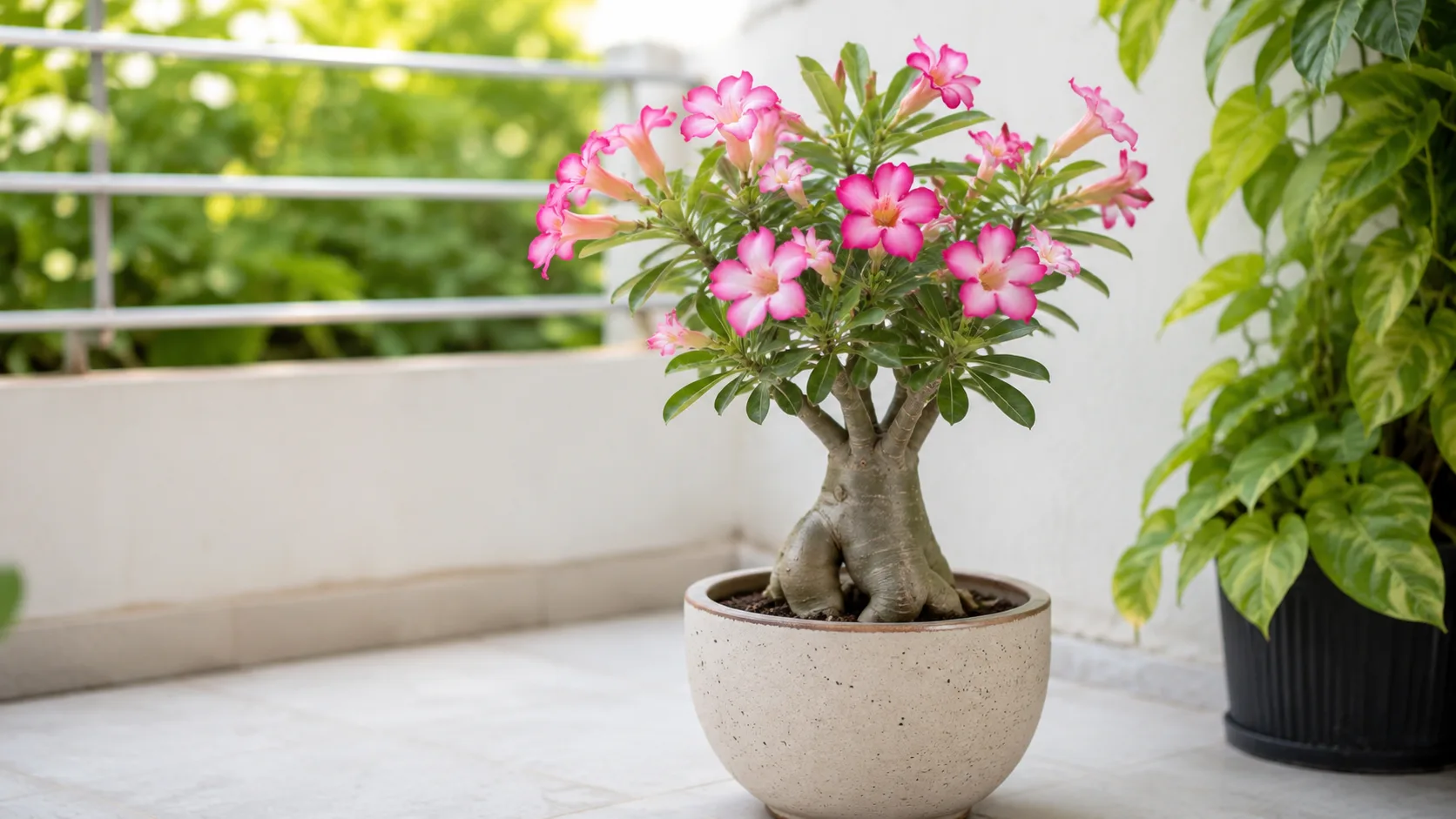
Adenium is native to Sub-Saharan Africa and the Arabian Peninsula, typically reaches 30–90 cm in containers; up to 3 m in natural habitat indoors, with slow to moderate growth. Adenium has a tree like growth habit and part of the Apocynaceae family. It is also known as Desert Rose, Sabi Star, Impala Lily, and Mock Azalea.
| Detail | Information |
|---|---|
| Also known as | Desert Rose, Sabi Star, Impala Lily, Mock Azalea |
| Native region | Sub-Saharan Africa and the Arabian Peninsula |
| Mature size | 30–90 cm in containers; up to 3 m in natural habitat |
| Growth rate | Slow to moderate |
| Growth habit | Tree Like |
| Scientific name | Adenium obesum |
| Family | Apocynaceae |
Adenium (Desert Rose) Care: Light, Water, Dormancy & Toxicity
What Is an Adenium Plant?
The adenium plant, usually sold as desert rose, is a caudiciform flowering succulent built for dry tropical climates, not for the low-light, evenly moist routine many houseplants tolerate. The species most growers encounter is Adenium obesum, a member of Apocynaceae (the dogbane family) with a swollen trunk-like base, glossy leaves, and trumpet-shaped flowers in pink, red, white, purple, and bicolor forms. It is native to arid regions of sub-Saharan Africa and the Arabian Peninsula, which explains the care logic in one sentence: strong light, warmth, sharp drainage, and long dry breaks between watering.
An adenium is not a pothos, peace lily, or calathea. Its caudex - the thickened base that stores water and energy - lets the plant survive drought that would stress softer tropicals, but that same adaptation makes wet, cool soil lethal. Before you ask how often to water, ask whether the plant is warm, bright, actively growing, and planted in a mix that dries fast. If any answer is no, fix conditions before adjusting the watering can.
In warm-climate outdoor setups and bright indoor windows, adenium can be forgiving. In dim rooms with dense potting soil and calendar watering, it becomes one of the easiest sculptural plants to rot. The first skill is reading the whole plant - especially caudex firmness - not chasing every yellow leaf.
Adenium vs Desert Rose and Common Names
Adenium is the botanical genus; desert rose is the trade name most often applied to Adenium obesum. You may also see impala lily, kudu lily, mock azalea, and Sabi star on labels. “Rose” suggests a true rose (Rosa), but adenium is unrelated. It sits in Apocynaceae alongside oleander and plumeria, which helps explain the milky sap and serious toxicity concerns.
Shop labels are not always precise. “Adenium” may mean A. obesum, regional forms such as Adenium arabicum or Adenium multiflorum, hybrids, seed-grown seedlings, or grafted named cultivars. For everyday care, most cultivated plants follow the same core rules: more sun, more warmth, more drainage, less water when growth slows.
Species, Hybrids, and Grafted vs Seed-Grown Plants
Flower color is only one variable. Some plants are selected for compact growth, some for caudex size, some for heavy flowering, and some for double or multicolor blooms. Grafted plants are common in retail because seed-grown adeniums do not always reproduce a parent’s exact flower. A named variety in bloom at purchase is often a scion grafted onto vigorous rootstock.
That matters at home. A grafted adenium may show two plant identities: the flowering top and the understock below the graft union. Shoots emerging below the union are rootstock suckers, not branches of your named variety, and they usually need removal. A seed-grown adenium often develops a more natural caudex over time, but flower color can be unpredictable. Neither path is automatically better; the right choice depends on whether you prioritize flower certainty, caudex character, or the experience of raising the plant from the start.
For related Adenium care, see Caterpillars on Adenium, Cold Damage on Adenium, Crown Rot on Adenium.
Why the Caudex Matters
The caudex is the plant’s survival system, not just a decorative swollen base. In habitat, adeniums store resources through cycles of rain and drought. In pots, that storage creates resilience - and a temptation to overwater. A fat caudex does not mean “water me now.” Often it means the plant already has reserves.
Firm caudex: usually healthy. It may feel slightly less plump after a long dry spell but should not be mushy, hollow, or foul-smelling.
Soft caudex: dehydration is possible, but in adenium softness more often signals root or stem rot, especially if the plant has been watered often, kept cool, or planted in dense soil.
Context decides the fix. Dry soil for weeks in warm weather plus mild wrinkling may recover after a careful soak. Frequent watering in cool weather plus softness is urgent - see our root rot guide before adding more water.
Many growers gradually expose the caudex when repotting for a bonsai-like look. Do this slowly on a healthy plant only. Raising too much root mass at once stresses feeder roots and can destabilize the pot. Lift slightly during repotting, remove old mix carefully, and expose only firm mature structure.
The caudex is a better diagnostic tool than leaves alone. Leaves yellow from age, season, pests, light changes, underwatering on Adenium, and overwatering. The caudex tells you whether the core plant is still strong. Firm base + some leaf drop is often manageable. Soft base + wet soil is an emergency.
Best Growing Conditions for Adenium
Adenium rewards discipline, not daily fussing. During warm active growth with strong light and fast drainage, it can take regular watering and moderate feeding. During cool dormancy, the same routine can rot it. Think in this order: light first, drainage second, watering third.
The plant grows indoors, on balconies, in greenhouses, and in warm gardens, but each setting changes risk. Indoors, insufficient light is the main failure mode. Outdoors, cold rain, monsoon moisture, sunburn after shade, and pests dominate. A practical rule: place the plant correctly before optimizing fertilizer or pruning.
Light Requirements
Adenium needs bright direct light to stay compact and flower well. UF/IFAS notes that plants need high light - six hours or more per day - to maintain flowering during summer. Outdoors, several hours of morning or full sun work where heat is not extreme enough to scorch newly moved plants. Indoors, use the brightest window available - often south- or west-facing in many climates. A room that feels bright to you may still be too dim for strong adenium growth.
The Royal Horticultural Society recommends full light under glass with shade from the hottest sun - intensity yes, careless exposure after shade no. A nursery plant grown under shade cloth should be acclimated over one to two weeks, not thrown into brutal afternoon sun on day one.
Light drives flowering more than fertilizer. Survival in bright indirect light is not the same as blooming. Weak light produces stretched stems, pale leaves, and a plant that looks alive but never performs. If your adenium has not flowered despite regular care, improve light before changing feed - see no flowers for the full diagnostic path.
Indoors, grow lights help in apartments, cloudy climates, or winter. Keep meaningful intensity without cooking leaves. Rotate the pot for balanced growth. Long internodes stretching toward the glass mean the plant wants stronger light.
Temperature and Dormancy
Adenium is a warm-climate plant. It dislikes cold soil, cold wet roots, and sudden low temperatures. University of Arizona Cooperative Extension notes that A. obesum may show cold damage below about 50°F (10°C) and recommends delaying spring watering until nighttime temperatures stay consistently above that threshold while new growth begins.
Use this decision tree instead of repeating generic dormancy warnings elsewhere in your routine:
| If you observe… | And soil is… | Action |
|---|---|---|
| Leafless plant, cool nights | Wet or cool-damp | Stop watering. Move to dry frost-free shelter. |
| Leafless plant, cool nights | Bone dry, caudex slightly wrinkled | Tiny drink only if nights are not cold-wet; otherwise wait for warmth. |
| Leafy plant, warm nights, active buds | Dry | Water deeply, drain fully, wait for dry-down. |
| Leafy plant, warm nights | Staying damp 5+ days | Fix drainage/light before next watering - rot risk. |
Dormancy is not always dramatic. Some plants drop most leaves; some keep a sparse canopy; some simply pause new growth. Triggers include cooler temperatures, shorter days, drought, or combined stress. During rest, roots are vulnerable in damp mix. A leafless adenium in cool weather is often resting, not dying - unless you keep it wet.
The dangerous combination is cool plus wet. Warm wet soil during active growth can be acceptable with fast drainage. Cool wet soil stops transpiration, slows roots, and favors rot. Many adeniums are lost in slow winter months when watering continues out of habit.
Indoor vs Outdoor Growing
Adenium can grow indoors, but it is rarely a low-light houseplant. It needs direct sun, a fast-draining pot, and careful watering. A sunny windowsill, sunroom, or grow-light setup can work; a desk across the room will not.
Outdoor growing is often easier in warm climates with rain protection. Outdoor light builds stronger stems, tighter growth, and better flowering. Manage weather: move pots under cover during prolonged rain, especially when nights are cool. In hot climates, black plastic pots and exposed roots can overheat; terracotta or light-colored containers help. Light afternoon shade during heat waves prevents scorch and bud drop.
A seasonal move works well for many growers: outdoors in bright warmth during the growing season, then a sheltered sunny frost-free spot when nights cool. Match care to season and you intervene less later.
Seasonal Care Calendar
Use this table as a framework, then adjust with caudex checks and pot weight - not autopilot dates.
| Season | Light | Watering | Feeding | Temperature / tasks |
|---|---|---|---|---|
| Spring wake (nights consistently above ~50°F) | Increase direct sun gradually after winter shelter | Resume deep watering as mix dries; do not soak on first warm day alone | Start half-strength liquid feed when new growth is obvious | Move outdoors after frost risk; inspect graft unions |
| Summer grow | Full sun once acclimated; watch scorch after shade | Every few days outdoors in heat if mix dries fast; less indoors | Half-strength monthly or per label during active growth | Peak flowering; watch pests on buds and tips |
| Fall slow | Maintain brightness; reduce sudden moves | Stretch interval as nights cool and growth slows | Taper feed by late fall | Bring containers in before cold rain; check drainage |
| Winter rest | Cool bright frost-free spot; light not critical for fully dormant plants | Minimal - occasional sip only if caudex shrivels severely and soil is dry | None during true dormancy | Protect from frost; never let roots freeze |
Grower note: In a bright indoor room kept above 65°F through winter, many adeniums retain leaves and need light watering every two to three weeks - not the near-zero schedule of a cool garage-dormant plant. The calendar is a starting point; caudex firmness and soil dryness override month names.
Soil, Pot, and Drainage
Soil is where adenium care succeeds or fails. The plant does not want rich, moisture-heavy compost. It wants structure that holds enough moisture for roots to drink, then releases excess water fast. Heavy mixes suffocate roots, especially in deep or oversized pots.
RHS recommends a peat-free loam-based compost with added sharp sand under glass. University of Arizona propagation guidance stresses well-drained mix because adenium roots should not stay wet continuously. Exact recipes vary by climate: dry hot regions can retain slightly more organic matter; humid or indoor setups should lean grittier.
Drainage holes are non-negotiable. Decorative cachepots without drainage are rot traps. Adenium roots need oxygen; waterlogged air spaces invite rot organisms.
Adenium is also sensitive to pot size. An oversized pot holds wet mix the root system cannot use. A snug pot with good drainage beats a large pot chosen for “future growth.” Repot when mix breaks down, roots circle heavily, or drainage fails - not to force speed.
Best Soil Mix for Adenium
A good mix drains quickly, resists compaction, and dries within a reasonable period after watering. A practical home blend: cactus/succulent mix amended with coarse sand, pumice, perlite, lava rock, or fine gravel. You still need some organic or loam-based material for nutrients and brief moisture retention; pure gravel is not the goal.
In humid climates, increase the mineral fraction. Indoors, err toward faster drainage because evaporation is weaker. If water takes many days to dry during warm active growth, the mix is probably too heavy or the pot too large. If water runs straight through and a firm-rooted plant shrivels quickly, the mix may be too lean.
Avoid fine beach sand, clay garden soil, and compost that stays wet. Performance beats ratios: after watering, does excess drain immediately? Does the mix become airy again? Does the caudex stay firm?
For a dedicated breakdown, see our adenium soil guide.
Choosing the Right Pot
Choose drainage, stability, and size matched to roots. Terracotta breathes and dries faster - helpful for overwaterers. Plastic holds moisture longer - workable in hot dry regions, riskier indoors. Ceramic is fine with holes and appropriate depth.
Shallow wide pots often suit caudex display and top-heavy plants. They dry faster, so hot-season attention increases. Do not bury the caudex deeply in moisture-retentive mix. When repotting, cover feeder roots but expose only firm mature caudex gradually over multiple repots.
Repot during warm active growth. After significant root trimming, wait a few days before watering so wounds callus. Resume with a full soak, then normal dry-down rhythm.
Watering Adenium Without Rot
There is no honest universal calendar. “Once a week” can rot a dormant winter plant and underwater an outdoor summer specimen. Watering depends on light, temperature, pot material, soil texture, root health, and growth phase.
Safest principle: water deeply when warm and the mix has dried, then let excess drain fully. Shallow daily sips keep the upper layer damp without building strong roots. A full soak followed by a dry interval matches natural drought cycles better.
Use plant and pot together. Lightweight pot, dry mix several centimeters down, active leaves, warm nights, and strong light suggest watering may be appropriate. Cool room, leafless plant, heavy damp pot, or cloudy stretch suggests waiting. Check deeper in large pots - surface dryness lies.
Overwatering is about duration of wetness, not volume poured. Lots of water through fast mix can be safe; a little water into dense soil can trap moisture around the caudex.
Full watering philosophy and mistake patterns live in our adenium watering guide.
Watering During Active Growth
During warm active growth with strong light, leaves, and buds, adenium uses more water than beginners expect. Chronic underwatering then causes shriveling, stalled growth, and bud drop. Drought-tolerant does not mean drought-loving during the growth season.
Practical method: soak until drainage runs free, then wait until mix is dry or nearly dry. Outdoors in heat that may mean every few days; indoors often far less. The correct interval is what your conditions produce.
Match feed to water. Fertilizing a dry or dormant plant stresses roots. Watering heavily without occasional flushing can build salts. Watch new growth - firm, compact, well-colored shoots mean the rhythm works.
Example scenarios (adjust with checks, not as rules):
| Setup | Rough active-season interval |
|---|---|
| Terracotta, 6+ hours sun, 85°F outdoors | Every 3–5 days when mix dries |
| Plastic pot, bright indoor south window, 72°F | Every 10–14 days when fully dry |
| Grow-light shelf, warm room, gritty mix | Every 7–10 days when dry |
Watering During Dormancy
Dormant adeniums need much less water. Leafless plants in cool weather should stay on the dry side - not always zero for months in very dry air, but conservative and occasional.
University of Arizona guidance: wake plants gradually in spring; delay heavy watering until nights stay above about 50°F and new growth appears. The classic mistake is soaking at the first warm afternoon, then hitting another cool week.
If a dormant plant stays warm, sunny, and leafy indoors, light watering every two to three weeks may be appropriate. If cool and leafless, nearly none. Caudex should remain mostly firm. Severe shriveling on dry soil may warrant a small drink - but not a full soak into cold mix.
Do not fertilize dormant plants. Resume feed when warmth and light return.
Fertilizer, Pruning, and Repotting
Fertilizer, pruning, and repotting refine a healthy plant; they rarely rescue one in poor light or soggy soil. Do not force flowers with bloom booster when light is weak - fix placement first.
Feeding for Growth and Flowers
Container adeniums benefit from feeding during active growth. University of Arizona Cooperative Extension suggests fertilizer low in nitrogen, moderate in phosphorus, and higher in potassium, applied at reduced strength during the growing season to support growth and flowering.
A balanced liquid feed at half label strength every four weeks during active growth is a practical starting point for home growers. Some prefer bloom formulas with relatively higher potassium. Feed only when the plant is actively growing, well watered, and in strong light. Stop when growth slows.
Excess nitrogen produces soft leafy growth at the expense of compact shape and flowers. Salt crust on soil, tip burn, or sudden stress after feeding suggest backing off. When in doubt, feed less.
Details and NPK nuance: adenium fertilizer guide.
Pruning for Shape and Graft Maintenance
Prune during warm active growth for branching and bonsai-like structure. Avoid heavy cuts just before or during dormancy. Milky sap appears at every cut - wear gloves; keep sap away from eyes, mouth, broken skin, children, and pets.
Graft maintenance: inspect the union when watering. Rootstock shoots below the graft usually have different leaf shape or flower color. Remove them early with sterile tools so the scion stays dominant. Allowed suckers can revert the plant visually to understock genetics.
Do not prune every branch on a stressed plant. Solve pests, rot, or recent repot shock first. Strategic removal beats drastic cutting.
After pruning, keep the plant warm, bright, and dry enough for cuts to callus. Do not mist wounds.
More shaping guidance: adenium pruning guide.
Repotting and Raising the Caudex
Repot when mix breaks down, roots circle heavily, drainage fails, or you need a root inspection - typically every two to three years for a healthy container plant, or sooner if mix stays wet too long. Warm active growth is safest.
Loosen old soil gently. Trim black mushy roots with sterilized tools. After major cuts, dry rest before watering. Raise the caudex slowly across repots, not in one dramatic exposure.
After repotting, bright but not brutal conditions for a short adjustment; resume full sun gradually; delay fertilizer until recovery signs appear.
Step-by-step timing: adenium repotting guide.
Flowering Problems and Plant Health
Adenium flowers when maturity, strong light, warmth, active growth, adequate nutrition, and root health align. Some seedlings bloom young; others need years. Grafted named varieties often flower earlier and more predictably than seed-grown plants.
Expect flushes, not year-round constant bloom. Chasing uninterrupted flowers leads to overfeeding and overwatering. Grow a strong plant that blooms when conditions support it.
When symptoms appear, ask four questions first: Direct light? Fast-drying soil? Warm nights? Firm caudex? Then inspect leaves, stems, roots, and pests.
Why Adenium Does Not Bloom
- Insufficient light - most common. Move gradually into stronger direct sun before changing fertilizer.
- Immaturity - seedlings need time; grafted plants often flower sooner.
- Feed mismatch - too much nitrogen pushes leaves; long-term container neglect reduces bloom energy. Moderate potassium-supporting feed during active growth only.
- Stress - relocation, heat spikes, pests, drought during bud formation, or wet soil swings cause bud drop. Keep care steady when buds appear.
Yellow Leaves, Soft Caudex, and Root Rot
Yellow leaves alone are not always bad. Old leaves age out; dormancy and light changes drop foliage. Firm caudex + some yellowing is often manageable.
Worry when yellow leaves pair with wet soil, soft caudex, black stems, or sour smell - that pattern points to rot. Stop watering, unpot if justified, trim mushy tissue, callus, and replant in dry fast mix. Severe cases may require cutting back to clean tissue; survival is not guaranteed. Prevention beats rescue every time.
Soft caudex from underwatering in hot dry weather often shows wrinkling without foul odor or black tissue. Confirm root condition before soaking a rotten plant.
Pests and Safe Treatment
Common pests include mealybugs, aphids, spider mites, and sometimes scale or thrips. NC State Extension lists aphids, armored scale, soft scale, and root mealybugs on Adenium obesum. Pests hide at shoot tips, leaf undersides, buds, graft unions, and tight joints.
Inspect before treating. Minor infestations: isolate, manual removal with alcohol on a swab (test first), or strong water spray if the plant can dry quickly. Insecticidal soap or horticultural oil can help - avoid hot sun after oil applications. Improve light and airflow; treat neighboring plants too.
Propagation and Buying Advice
Adenium multiplies by seed, cuttings, and grafting. University of Arizona Cooperative Extension notes that desirable varieties are commonly propagated by grafting, while cutting-grown plants typically develop a thick caudex more slowly than seed-grown plants - seed propagation encourages the strongest basal swell over time.
For full step-by-step protocols, see our adenium propagation guide. Overview-level essentials:
Seeds: Fresh seed germinates in days to weeks on well-drained medium at warm temperatures - commonly above 70°F (21°C) with bright indirect light and careful moisture. Hybrids do not breed true; flower color varies.
Cuttings: Soft tip cuttings root in warm humid conditions; mature woody segments callus and root in coarse mix with less enclosure. Rot follows wet cold mix.
Grafting: Preserves named flower types on vigorous rootstock; inspect unions and remove understock shoots.
Seeds, Cuttings, and Grafted Plants
| Method | Caudex development | Flower certainty | Skill | Time to meaningful bloom |
|---|---|---|---|---|
| Seed | Usually strongest swell | Unpredictable with hybrids | Moderate | Months to years |
| Cutting | Slower, thinner base early | Exact clone | Moderate | Faster than seed if wood is mature |
| Graft | Depends on rootstock | Scion flower preserved | High | Often fastest for named cultivars |
Brief seed steps: sow fresh seed on gritty moist medium; warmth above 70°F; bright indirect light; never waterlog. Brief cutting steps: take healthy stem; allow woody segments to callus briefly if mature; plant in fast-draining mix; warmth and bright indirect light; keep barely moist, not soggy.
What to Check When Buying
Choose firm caudex, clean graft union if grafted, no mushy spots or black stem lesions, no hidden pests. Few leaves in dormancy is normal; wet dense soil with soft base is not.
Match expectations: seedlings vary in flower; grafted plants in bloom offer more certainty; shipped plants may drop leaves - acclimate in bright shade before full sun and heavy watering.
Safety: Toxicity to Pets and People
All parts of Adenium obesum are treated as toxic if ingested. ASPCA lists desert rose as toxic to dogs, cats, and horses, with cardiac glycosides as the toxic principle and signs including vomiting, diarrhea, depression, irregular heartbeat, and death. The Merck Veterinary Manual describes cardiac glycosides inhibiting the Na+/K+ ATPase pump, affecting heart rhythm.
Pets: keep plants out of reach; contact a veterinarian promptly if chewing occurs - do not wait for severe symptoms.
People: sap can irritate skin and eyes; wear gloves when pruning or repotting; wash hands and tools after contact. Keep pruned material, seeds, and fallen leaves away from children. Bitter taste limits ingestion, but sap exposure during care is the practical home risk.
Beauty is not the issue; unmanaged access is. Choose elevated shelves, fenced outdoor beds, or pet-safe alternatives for floor-level placements.
Key Takeaways
Adenium care becomes manageable when you treat it as a seasonal, light-hungry caudex plant, not a generic leafy houseplant. Three rules carry most of the weight:
- Read the caudex before the leaves. Firm base + seasonal leaf drop is often normal rest. Soft base + wet cool soil is rot - act on drainage and watering, not fertilizer.
- Respect the 50°F logic. Delay spring soaks until nights stay warm and growth returns; cut winter water sharply; never combine cold roots with damp mix.
- Buy and propagate with intent. Seed for caudex character, graft for flower certainty, cuttings to clone - and remove rootstock suckers on grafted plants before they take over.
Keep direct light, gritty drainage, and seasonal restraint in place, and adenium can be one of the most rewarding container plants you grow: compact in sun, dramatic with age, and capable of flowers that look far more delicate than the plant truly is. Handle sap and toxicity seriously, link out to topic guides when one section needs depth, and let the calendar plus caudex checks - not habit - decide when the watering can comes out.
When to use this page vs other Adenium guides
- Adenium overview - Canonical hub for this species - care topics and problems branch from here.
- Adenium problems - Symptom-first path when you already know something is wrong.
Related Adenium guides
How to care for Adenium?
How much light does Adenium need?
full sun or very strong direct light, ideally 6+ hours in warm active growth
- full sun or very strong direct light - full sun or very strong direct light, ideally 6+ hours in warm active growth.
- ideally 6+ hours in warm active growth - full sun or very strong direct light, ideally 6+ hours in warm active growth.
When should you water Adenium?
Water deeply only after the mix dries through; keep much drier during cool dormancy.
- Push finger 5–7 cm deep - water only when completely dry - Water deeply only after the mix dries through; keep much drier during cool dormancy.
- also observe if caudex (trunk) feels firm
- Drain excess water - Water deeply only after the mix dries through; keep much drier during cool dormancy.
What soil works best for Adenium?
Loose, gritty, sharply draining succulent mix with plenty of mineral material.
- 30% potting mix - Loose, gritty, sharply draining succulent mix with plenty of mineral material.
- 40% coarse sand or perlite - Light white granules that keep soil airy and help prevent compaction.
- 30% fine gravel or pumice - Volcanic rock that improves drainage and keeps roots from sitting in wet soil.
Grower notes for Adenium
What matters most with Adenium
Adenium stores water in leaves, stems, roots, or a swollen base, so overcare is usually more dangerous than short dry spells. Strong light and drainage are the safety net. In practice, the care checkpoint is simple: full sun or very strong direct light, ideally 6+ hours in warm active growth. Pair that with loose, gritty, sharply draining succulent mix with plenty of mineral material, and avoid changing water, pot size, and placement all at once.
Best placement in a real home
Adenium belongs where full sun or very strong direct light, ideally 6+ hours in warm active growth is realistic for most of the day, not only where the pot looks good. Water deeply only after the mix dries through; keep much drier during cool dormancy. If the pot stays wet longer than expected, move the plant into better light or reassess the mix before watering again. Humidity target: Low to moderate household humidity with strong airflow. Temperature comfort zone: 24°C to 35°C (75°F to 95°F) during active growth.
Before you buy this plant
Choose Adenium with firm new growth, clean leaf undersides, and soil that does not smell sour or feel compacted. Be cautious if you see root-rot, sticky residue, collapsed crowns, or a pot that is wet in poor light. Cosmetic old-leaf damage is less worrying than weak roots or active pests.
First month after bringing it home
Do not repot Adenium on day one unless the mix is failing or pests are obvious. Quarantine it, learn how fast the pot dries, and keep care boring while it adjusts. Watch especially for root-rot, yellow-leaves, and slow-growth. If problems appear, correct the condition first rather than stacking fertilizer, repotting, and pruning together.
Safety note for Adenium
Adenium is not a plant to keep within reach of pets or children. The database flags it for cats, dogs, and humans. Use gloves if sap or plant tissue is irritating, and pick a pet-safe alternative for floor pots or low shelves.
How to tell Adenium is settling in
Also sold as Desert Rose, Sabi Star, and Impala Lily, this plant should be judged by stable new growth rather than label names alone. If you plan to multiply it later, common methods include Seeds, Callused stem cuttings, and Grafting. Repot only when you see roots densely filling pot and caudex significantly outgrowing pot. If yellow-leaves shows up early, inspect light, watering, and roots before assuming the plant is permanently weak.
Is it pet safe?
Adenium is not pet safe. Keep it out of reach of cats, dogs, horses, and children, and contact a veterinarian or poison-control service if ingestion is suspected.
ASPCA lists Desert Rose (Adenium obesum) as toxic to cats, dogs, and horses. Toxic principles include cardiac glycosides, and reported clinical signs include vomiting, diarrhea, anorexia, depression, irregular heartbeat, and death. Keep the plant away from pets and children, and wear gloves when pruning because the milky sap can irritate skin.
Watering Adenium
For Adenium, push finger 5–7 cm deep - water only when completely dry; also observe if caudex (trunk) feels firm and water every 5–7 days in hot summer; every 14–21 days in cooler months; zero in winter dormancy. Water normally in warm active growth, then reduce sharply during cool winter rest. Resume gradually when new leaves appear.
| Detail | Information |
|---|---|
| How often | Every 5–7 days in hot summer; every 14–21 days in cooler months; zero in winter dormancy |
| How to check | Push finger 5–7 cm deep - water only when completely dry; also observe if caudex (trunk) feels firm |
| Seasonal changes | Water normally in warm active growth, then reduce sharply during cool winter rest. Resume gradually when new leaves appear. |
Signs of overwatering
- soft mushy caudex
- root rot
- stem blackening
- caudex rot - often fatal
Signs of underwatering
- caudex slightly wrinkled - acceptable; leaf drop in dormancy - normal
Soil & potting for Adenium
Use a mix of 30% potting mix, 40% coarse sand or perlite, 30% fine gravel or pumice for Adenium. Exceptional drainage is non-negotiable - water must pass through within seconds. Target soil pH around 6.0–7.5. Repot every 2–3 years; adenium likes being slightly pot-bound, ideally in spring (March–April) just as new growth begins.
| Detail | Information |
|---|---|
| Recommended mix | 30% potting mix, 40% coarse sand or perlite, 30% fine gravel or pumice |
| Drainage | Exceptional drainage is non-negotiable - water must pass through within seconds |
| Soil pH | 6.0–7.5 |
| Repotting frequency | Every 2–3 years; adenium likes being slightly pot-bound |
| Best season to repot | Spring (March–April) just as new growth begins |
Signs it needs repotting
- roots densely filling pot
- caudex significantly outgrowing pot
Humidity & temperature for Adenium
Adenium prefers low to moderate household humidity with strong airflow, though normal home humidity is usually fine. Keep temperatures around 24°C to 35°C (75°F to 95°F) during active growth.
| Detail | Information |
|---|---|
| Humidity | Low to moderate household humidity with strong airflow - normal home humidity is fine. |
| Ideal temperature | 24°C to 35°C (75°F to 95°F) during active growth |
Fertilizer & pruning for Adenium
Common problems on Adenium
Likely cause: Ants farming honeydew from aphid or mealybug infestations on tender Adenium shoots and buds.
Quick fix: Treat the underlying sap-sucking pests first; wipe honeydew and monitor stems until ants leave.
Full fix guide →Aphids
MediumLikely cause: Soft-bodied aphids cluster on new Adenium growth and flower buds, weakening shoots.
Quick fix: Spray stems and leaf undersides with insecticidal soap or neem oil; repeat weekly until clear.
Full fix guide →Black Spots
MediumLikely cause: Anthracnose (Colletotrichum) in humid/wet conditions causes yellowing then black spots and leaf drop on desert rose.
Quick fix: Move out of rain/high humidity, bottom-water only, remove spotted leaves, and improve airflow.
Full fix guide →Brown Tips
MediumLikely cause: Dry-down stress, excess salts, or fertilizer burn on leaf margins—common when watering or feeding is out of sync.
Quick fix: Check soil dryness and caudex firmness; flush salts if needed and resume soak-and-dry watering.
Full fix guide →Bud Drop
LowLikely cause: Flower buds abort when light is weak, soil stays wet, temperatures swing, or the plant was recently moved/repotted.
Quick fix: Stabilize placement in full sun, water only when dry, and inspect buds for aphids or thrips.
Full fix guide →Caterpillars
MediumLikely cause: Oleander moth larvae chew holes and strip leaves; common where Adenium is grafted onto oleander understock.
Quick fix: Hand-pick caterpillars and apply Bt at dusk on feeding sites; repeat every 10 days if needed.
Full fix guide →Cold Damage
HighLikely cause: Temperatures below ~50°F (10°C) cause blackened tips, leaf drop, and soft cold-stressed tissue on desert rose.
Quick fix: Move to a warm bright spot above 55°F, stop watering until firm, and prune only mushy tissue later.
Full fix guide →Crown Rot
HighLikely cause: Wet soil during cool or dormant periods rots the swollen caudex, often progressing from roots upward.
Quick fix: Stop watering, unpot, cut away all soft black caudex tissue, dry 2–3 days, then repot in gritty mix.
Full fix guide →Curling Leaves
MediumLikely cause: Leaves curl inward from water stress, aphid feeding, or heat after a sudden environment change.
Quick fix: Check soil moisture and caudex firmness; treat pests if present and stabilize light and temperature.
Full fix guide →Damping Off
HighLikely cause: Seedlings topple at the soil line when trays stay wet and lack airflow after germination.
Quick fix: Remove collapsed seedlings, improve ventilation, let mix dry, and use fast-draining seed-starting medium.
Full fix guide →Draft Stress
MediumLikely cause: Cold or dry drafts near windows and vents shock Adenium, causing leaf drop outside normal dormancy.
Quick fix: Move to a stable warm bright location away from AC, heaters, and drafty doors.
Full fix guide →Drooping Leaves
MediumLikely cause: Limp foliage usually signals root stress—either rot from wet soil or drought stress on a firm caudex.
Quick fix: Feel the caudex and check soil depth; adjust watering and inspect roots if the base is soft.
Full fix guide →Fertilizer Burn
MediumLikely cause: Too much fertilizer during weak light or dormancy builds salts that burn leaf margins and stress roots.
Quick fix: Stop feeding, flush with water if drainage is good, and resume half-strength feed only in warm active growth.
Full fix guide →Fungus Gnats
LowLikely cause: Gnats indicate soil staying too wet—especially dangerous during dormancy when roots are easily damaged.
Quick fix: Let soil dry completely, use yellow traps, and drench with BTI if larvae persist.
Full fix guide →High Humidity
MediumLikely cause: Humid stagnant air keeps leaves wet and soil slow-drying, triggering fungal leaf spot and rot.
Quick fix: Shelter from rain, improve airflow, bottom-water, and keep plants in full sun with dry foliage.
Full fix guide →Holes in Leaves
MediumLikely cause: Chewing insects—especially oleander caterpillars—eat holes through Adenium leaves and new growth.
Quick fix: Inspect leaf undersides at dawn, hand-pick larvae, and apply Bt to active feeding areas.
Full fix guide →Leaf Drop
MediumLikely cause: Leaves drop in cool dormancy, or from overwatering, cold drafts, and sudden environment changes.
Quick fix: If caudex is firm and season is cool, reduce water; if soft or soil is wet, check for rot.
Full fix guide →Leaf Spot Disease
MediumLikely cause: Fungal leaf spot from wet foliage and poor ventilation causes circular brown/black lesions and defoliation.
Quick fix: Remove spotted leaves, keep foliage dry, improve airflow, and avoid overhead watering.
Full fix guide →Leggy Growth
MediumLikely cause: Low light causes etiolation—long thin stems leaning toward the brightest window with sparse leaves.
Quick fix: Move to the sunniest spot or add grow lights; prune leggy stems back in early spring.
Full fix guide →Mealybugs
MediumLikely cause: Mealybugs hide in leaf axils and caudex crevices, sucking sap and excreting honeydew.
Quick fix: Dab clusters with rubbing alcohol or spray insecticidal soap into crevices; repeat weekly.
Full fix guide →Mold on Soil
LowLikely cause: Persistent moisture on the soil surface grows mold—an early sign the pot is staying too wet.
Quick fix: Scrape moldy top layer, reduce watering, improve airflow, and let the mix dry fully between drinks.
Full fix guide →Mosaic Virus
HighLikely cause: Viral infection causes leaf mottling and broken flower color; spread via sap and unsanitary tools.
Quick fix: Isolate the plant, sterilize tools, and destroy severely infected specimens to protect the collection.
Full fix guide →No Drainage Hole
HighLikely cause: Water pools in sealed pots, suffocating roots and rotting the caudex even with careful watering.
Quick fix: Repot immediately into a container with multiple drainage holes and fast-draining succulent mix.
Full fix guide →No Flowers
MediumLikely cause: Failure to bloom when light is below ~6 hours direct sun, dormancy watering is too high, or feed is too nitrogen-heavy.
Quick fix: Give full direct sun, dry the soil between waterings, and use low-nitrogen bloom fertilizer in warm months.
Full fix guide →Not Enough Light
MediumLikely cause: Insufficient direct sun causes stretched stems, pale leaves, and absent or weak flowering.
Quick fix: Move to the brightest south window or outdoors gradually; supplement with grow lights if needed.
Full fix guide →Overwatering
HighLikely cause: Wet soil suffocates desert-rose roots, causing yellow leaves, soft caudex, and fatal rot in cool weather.
Quick fix: Stop watering, confirm mix is dry 5–7 cm down, and inspect roots if the caudex feels soft.
Full fix guide →Poor Drainage
HighLikely cause: Heavy or water-retentive mix and blocked drainage keep roots wet, triggering rot within days.
Quick fix: Repot into gritty succulent mix with perlite/pumice and never let the pot sit in a full saucer.
Full fix guide →Powdery Mildew
MediumLikely cause: Humid stagnant conditions allow Oidiopsis/Leveillula mildew on crowded leaves and stems.
Quick fix: Increase airflow, keep foliage dry, remove affected leaves, and apply sulfur or neem if needed.
Full fix guide →Repotting Stress
MediumLikely cause: Root disturbance during repotting temporarily limits water uptake, causing wilt and leaf loss.
Quick fix: Repot only in spring, avoid watering for several days, and keep in bright stable warmth.
Full fix guide →Root Rot
HighLikely cause: Overwatering—especially during winter dormancy—rots roots and caudex until stems blacken and collapse.
Quick fix: Stop watering, unpot, trim all mushy roots/caudex tissue, dry 2–3 days, repot in gritty mix.
Full fix guide →Scale Insects
MediumLikely cause: Armored scale attaches to stems and leaves, sucking sap and causing yellowing and leaf drop.
Quick fix: Scrape visible scale, apply horticultural oil to stems, and repeat treatment every 10 days.
Full fix guide →Slow Growth
LowLikely cause: Insufficient sun, cool weather, recent dormancy, or root stress slows new leaves and caudex swelling.
Quick fix: Move to full direct sun, resume spring watering/feeding after dormancy, and check caudex firmness.
Full fix guide →Spider Mites
MediumLikely cause: Hot dry indoor air favors spider mites causing stippled yellow leaves and fine webbing on Adenium.
Quick fix: Rinse foliage, increase humidity briefly, and apply insecticidal soap or neem every 5–7 days.
Full fix guide →Likely cause: Sap-sucking pests excrete honeydew that coats leaves and can lead to sooty mold.
Quick fix: Identify and treat the pest, wipe sticky leaves, and monitor for returning insects.
Full fix guide →Likely cause: Sudden intense sun on unacclimated plants burns leaf edges and can trigger defoliation.
Quick fix: Move to bright indirect light, remove dead leaves, and re-acclimate to direct sun over 1–2 weeks.
Full fix guide →Thrips
MediumLikely cause: Thrips rasp growing tips and buds, leaving silvery scars that deform new leaves and flowers.
Quick fix: Shake stems over white paper to confirm, use blue sticky traps, and treat with spinosad or insecticidal soap.
Full fix guide →Underwatering
MediumLikely cause: Extended dry periods in active growth dehydrate the caudex and cause curling, browning, and leaf loss.
Quick fix: Water deeply when soil is dry throughout, then return to soak-and-dry intervals.
Full fix guide →Wilting
MediumLikely cause: Wilting stems and leaves occur with rotting wet roots or with drought on an otherwise firm caudex.
Quick fix: Check caudex firmness and soil moisture at depth before watering again.
Full fix guide →Wrong Soil Mix
HighLikely cause: Standard potting mix or moisture-retentive soil keeps Adenium roots wet and initiates rot.
Quick fix: Repot into gritty succulent mix with perlite, sand, or pumice and excellent drainage.
Full fix guide →Yellow Leaves
MediumLikely cause: Yellow leaves signal cool dormancy, overwatering/root stress, or anthracnose—not always disease.
Quick fix: If caudex is firm and season is cool, reduce water; if soil is wet, inspect roots immediately.
Full fix guide →Low Humidity
MediumLikely cause: Adenium evolved for arid climates and tolerates normal indoor humidity without a humidifier. Crisp leaf edges usually mean underwatering, salt burn, or sun scorch-not dry air. First step: feel the cau
Quick fix: See plant-specific guide for step-by-step fixes.
Full fix guide →Brown Leaves
MediumLikely cause: Common brown leaves pattern on Adenium under indoor care stress.
Quick fix: Inspect roots, watering, light, and pests; adjust one variable and monitor new growth.
Full fix guide →Pale Leaves
MediumLikely cause: Common pale leaves pattern on Adenium under indoor care stress.
Quick fix: Inspect roots, watering, light, and pests; adjust one variable and monitor new growth.
Full fix guide →Distorted Leaves
MediumLikely cause: Common distorted leaves pattern on Adenium under indoor care stress.
Quick fix: Inspect roots, watering, light, and pests; adjust one variable and monitor new growth.
Full fix guide →Whiteflies
MediumLikely cause: Common whiteflies pattern on Adenium under indoor care stress.
Quick fix: Inspect roots, watering, light, and pests; adjust one variable and monitor new growth.
Full fix guide →Leaf Miners
MediumLikely cause: Common leaf miners pattern on Adenium under indoor care stress.
Quick fix: Inspect roots, watering, light, and pests; adjust one variable and monitor new growth.
Full fix guide →Nitrogen Deficiency
MediumLikely cause: Common nitrogen deficiency pattern on Adenium under indoor care stress.
Quick fix: Inspect roots, watering, light, and pests; adjust one variable and monitor new growth.
Full fix guide →Iron Deficiency
MediumLikely cause: Common iron deficiency pattern on Adenium under indoor care stress.
Quick fix: Inspect roots, watering, light, and pests; adjust one variable and monitor new growth.
Full fix guide →Magnesium Deficiency
MediumLikely cause: Common magnesium deficiency pattern on Adenium under indoor care stress.
Quick fix: Inspect roots, watering, light, and pests; adjust one variable and monitor new growth.
Full fix guide →Potassium Deficiency
MediumLikely cause: Common potassium deficiency pattern on Adenium under indoor care stress.
Quick fix: Inspect roots, watering, light, and pests; adjust one variable and monitor new growth.
Full fix guide →Calcium Deficiency
MediumLikely cause: Common calcium deficiency pattern on Adenium under indoor care stress.
Quick fix: Inspect roots, watering, light, and pests; adjust one variable and monitor new growth.
Full fix guide →