Mosaic Virus on Adenium: Causes, Checks & Fixes
Quick answer
True mosaic virus on Adenium shows irregular light-and-dark green mottling on new leaves, often with broken flower color or distortion, and there is no home cure. First step: isolate the plant away from your collection, stop pruning or grafting from it, and compare whether mottling worsens on successive new leaves before deciding to discard.
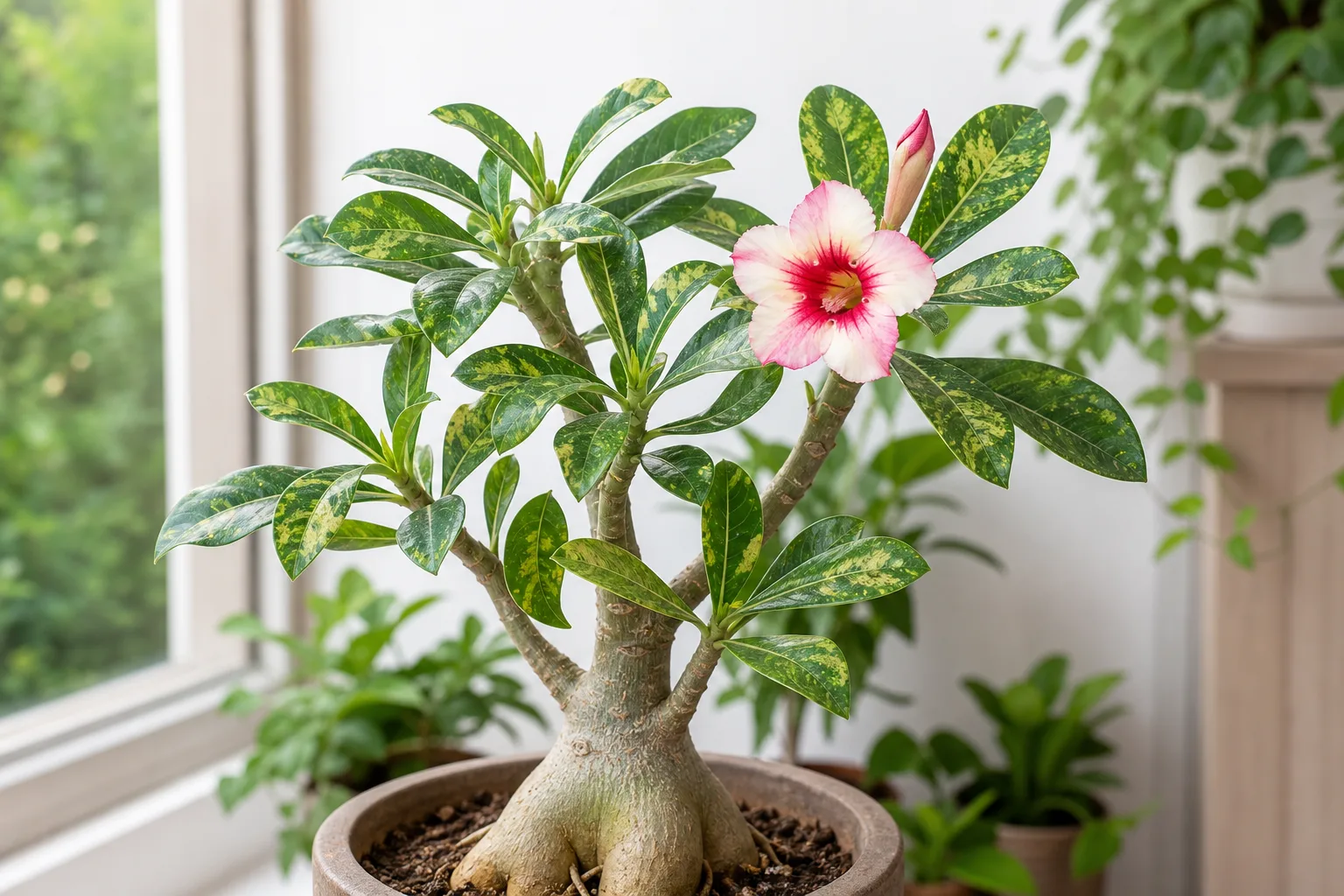
Mosaic Virus on Adenium: Causes, Checks & Fixes
This guide covers mosaic virus on Adenium. See also the general Mosaic Virus guide, watering, and light pages for this plant.
Mosaic Virus on Adenium: Causes, Checks & Fixes
Quick answer
Mosaic virus on Adenium (Adenium obesum, desert rose) is uncommon in careful home collections but serious when confirmed: irregular light-and-dark green mottling on new leaves, sometimes with broken or streaky flower color and distorted growth. There is no home cure. First step: isolate the plant away from other adeniums and apocynaceous plants, stop pruning or propagating from it, and watch three to four flushes of new leaves before deciding to discard.
Many suspected cases are natural leaf veining, sun scorch, or aphid stress - not virus. Some adenium cultivars show pronounced white veins that can look variegated until you compare new growth over time. Accurate confirmation keeps healthy desert roses out of the trash and stops sap-spread to the rest of your collection.
What mosaic virus looks like on Adenium
On desert rose, viral mosaic usually appears as patchy yellow-green or light-and-dark green islands on younger leaves first. The pattern is irregular - not the neat symmetry of a stable cultivar trait. Over several weeks, successive new leaves often look more mottled than the last, even when watering and light are correct.
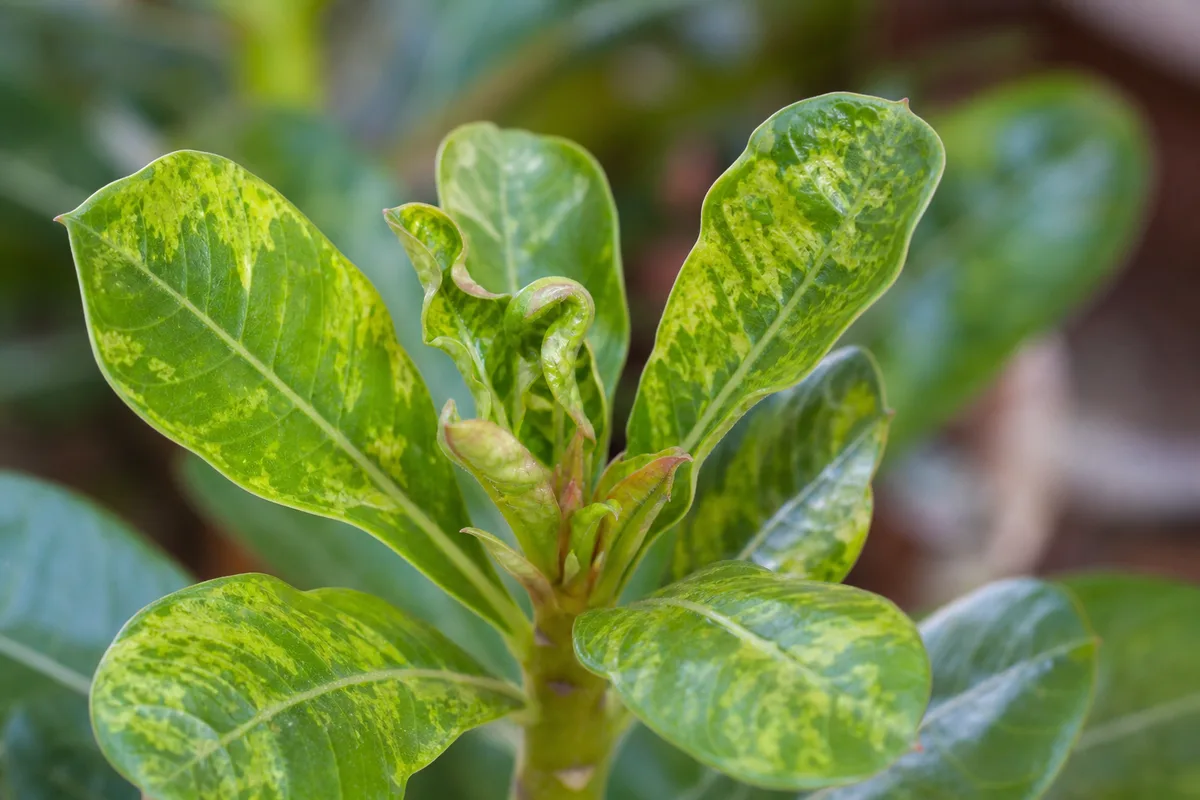
Irregular yellow-green mosaic patches on adenium leaves (not neat cultivar veining) with younger growth most affected - compare with healthy glossy green desert rose foliage on the same plant.
Flowers may show color break: streaks, blotches, or uneven shading on petals that do not match the cultivar’s normal bloom. Stems and the caudex typically stay firm; mushy tissue points to rot, not virus. Grafted plants may show mottling only on the scion while the rootstock looks clean - or vice versa if both were handled with the same contaminated blade.
Potexviruses such as Adenium obesum virus X are reported mainly as leaf mottling on desert rose. Cucumber mosaic virus produces similar mosaic and mottling, often more visible on younger foliage. Either way, the diagnostic clue is progressive worsening on new growth, not a static pattern on every leaf.
Why Adenium gets mosaic virus
Desert rose is widely propagated by grafting, cuttings, and tissue culture, especially among Southeast Asian nursery stock. Viruses ride along in sap-contaminated tools, infected scion wood, and shared pruning blades. Potexviruses spread mechanically through wounded tissue - incidental contact, trimming, and clonal propagation - not through a dedicated insect vector. Cucumber mosaic virus adds aphid transmission: aphids can acquire the virus in seconds and pass it to the next plant they feed on.
Imported batches and retail nursery lines have tested positive for both AobVX and CMV in quarantine and regulatory surveys. That does not mean every mottled adenium is virused, but it explains why new purchases and grafting projects carry higher risk than a long-established plant that has produced clean leaves for years.
Stress from overwatering on Adenium, weak light, or cold does not cause true mosaic virus, but it can make sun scorch, nutrient edges, and pest damage harder to read. There is also no fertilizer or fungicide fix for confirmed virus - months of feeding while sharing tools only spreads infection.
How to confirm the cause
Confirm in this order:
- New leaf progression - Photograph the tip every week for four weeks. Worsening irregular mottling on each flush supports virus; a stable repeating pattern supports cultivar veining.
- Flower check - Open blooms with streaky or broken color on a plant that previously bloomed solid strengthen virus suspicion.
- Caudex and soil - Feel the swollen base. Firm caudex with foliar mottling only fits virus; soft blackening fits rot.
- Pest sweep - Look for aphids on buds and new growth. Clear pests with soap or a hard rinse, then re-evaluate after two weeks. CMV-related mottling will not disappear when aphids leave; pest damage often improves.
- Tool and propagation history - Mottling that appeared after grafting, taking cuttings, or pruning several adeniums in one session raises virus likelihood.
- Collection comparison - Similar mottling on plants pruned with the same shears is a strong spread signal.
- Lab certainty - Home growers rarely virus-test. For valuable breeding stock, professional indexing is the only definitive confirmation.
When in doubt on an inexpensive plant you do not plan to propagate, treat as virus for isolation rather than continuing to graft or share cuttings.
First fix for Adenium
Isolate the plant in a separate room, shelf, or outdoor zone away from other adeniums, oleander, and plumeria relatives. Do not prune, graft, or take cuttings until you have watched several new leaf flushes.
Improve baseline care so lookalikes reveal themselves: full direct sun during active growth, gritty fast-draining mix, and dry-down watering only when the pot is light and the mix is dry several centimeters down. If mottling keeps worsening on clean new leaves despite good culture, discard the plant - bag stems and leaves for trash, not compost near other succulents. Sterilize every tool that touched the plant before working on healthy stock.
Step-by-step management
- Move the suspect desert rose away from the main collection immediately.
- Label dedicated gloves and tools; keep them with the isolated plant.
- Photograph newest leaves weekly to document whether mottling spreads.
- Remove only fully dead leaves if you are temporarily keeping a mild case - do not prune living mottled tissue into open sap on shared tools without sterilizing between cuts.
- If discarding, wear gloves because adenium sap is toxic; bag all tissue securely.
- Disinfect pots, saucers, and bench surfaces before reuse.
- If you keep a backup specimen, propagate only after six to eight weeks of clean new growth and use sterile tools - accepting that latent infection is still possible without lab testing.
Recovery timeline
True mosaic virus does not recover - infected cells remain infected. Isolated adeniums may survive months with increasing leaf mottling and fewer normal blooms. Six to eight weeks of clean, undistorted new growth is the main home-level signal that you misdiagnosed veining, scorch, or pest stress.
Sun scorch on unacclimated plants often shows crispy margins within days of a sudden move to harsh sun, not progressive mosaic islands. Aphid-related distortion often improves within one to two weeks after pests are gone. Environmental patterns shift faster than viral mottling.
Causes to rule out
Mosaic lookalikes on desert rose include:
- Natural white veining - Some adeniums show pronounced pale veins on glossy leaves; the pattern repeats consistently on every new leaf and does not intensify.
- Sun scorch - Brown or tan crispy edges after sudden intense sun; not patchy interveinal mottling.
- Cold yellowing - Uniform yellow leaves and drop below about 50°F (10°C); not irregular green islands.
- Aphid or thrips damage - Curled tips, silvery scars, or visible insects; mottling that fades after pest control.
- Fertilizer burn - Brown leaf margins from salt buildup; even damage, not mosaic patches.
- Fungal leaf spot - Circular brown lesions with defined edges; not interveinal mottling.
What not to do
Do not graft mottled scions onto clean rootstock hoping the understock will cure them. Do not apply repeated fertilizer or fungicide sprays to “green up” viral leaves. Do not return an isolated plant to a shared bench after one improved leaf. Do not compost infected tissue where sap could contact other plants. Avoid using the same pruning blade on multiple adeniums without sterilizing between plants.
How to prevent mosaic virus next time
Buy from reputable sources with uniform, undistorted foliage. Quarantine new desert roses four to six weeks before placing them near grafting stock or mature specimens. Sterilize pruners between every plant when trimming or taking cuttings - alcohol, bleach solution, or horticultural sanitizer per label. Control aphids on new growth during warm months.
Because so much commercial adenium production uses grafting and mass propagation, treat every new import as suspect until it proves clean through several flushes of normal leaves and flowers. Keep a dedicated set of tools for high-value stock.
Adenium care cross-check
Suspected virus diagnosis requires stable desert rose culture first: Adenium light guide, fast drainage, and dry-down watering during active growth, with much less water in cool dormancy. Most “virus” scares trace to veining confusion, scorch after a move outdoors, or aphids - only progressive new-leaf mottling after care correction and pest clearance warrants discard.
When to worry
Worry about spread to your collection, not instant caudex collapse. Discard and disinfect when mottling clearly worsens on successive leaves despite good sun, drainage, and pest control. Worry immediately if multiple plants show new mottling after shared pruning or grafting. Adenium is toxic to pets and people - bag discarded tissue securely if animals might access trash, and wear gloves when cutting sap-heavy stems.
Conclusion
Mosaic virus on Adenium is uncured, sap-spread, and tied to grafting, cuttings, dirty tools, and sometimes aphids carrying CMV. Isolate, improve sun and drainage, control pests, and watch new leaves for worsening irregular mottling. Rule out natural veining, scorch, and insects before discarding - but never propagate from suspect stock. Prevention is quarantine, sterile tools, clean nursery sources, and aphid control on tender spring growth.
When to use this page vs other Adenium guides
- Adenium watering guide - Use for routine moisture checks before assuming mosaic virus is the main issue.
- Adenium problems hub - Browse all 40 common issues on this species.