Black Spots on Adenium: Causes, Checks & Fixes
Quick answer
On desert rose, black spots with yellow halos that spread and drop leaves are usually anthracnose (Colletotrichum) triggered by wet foliage and stagnant humidity. First step: move the plant out of rain and high humidity so leaves stay dry, then feel the caudex-firm tissue points to leaf fungus; soft tissue means rot.
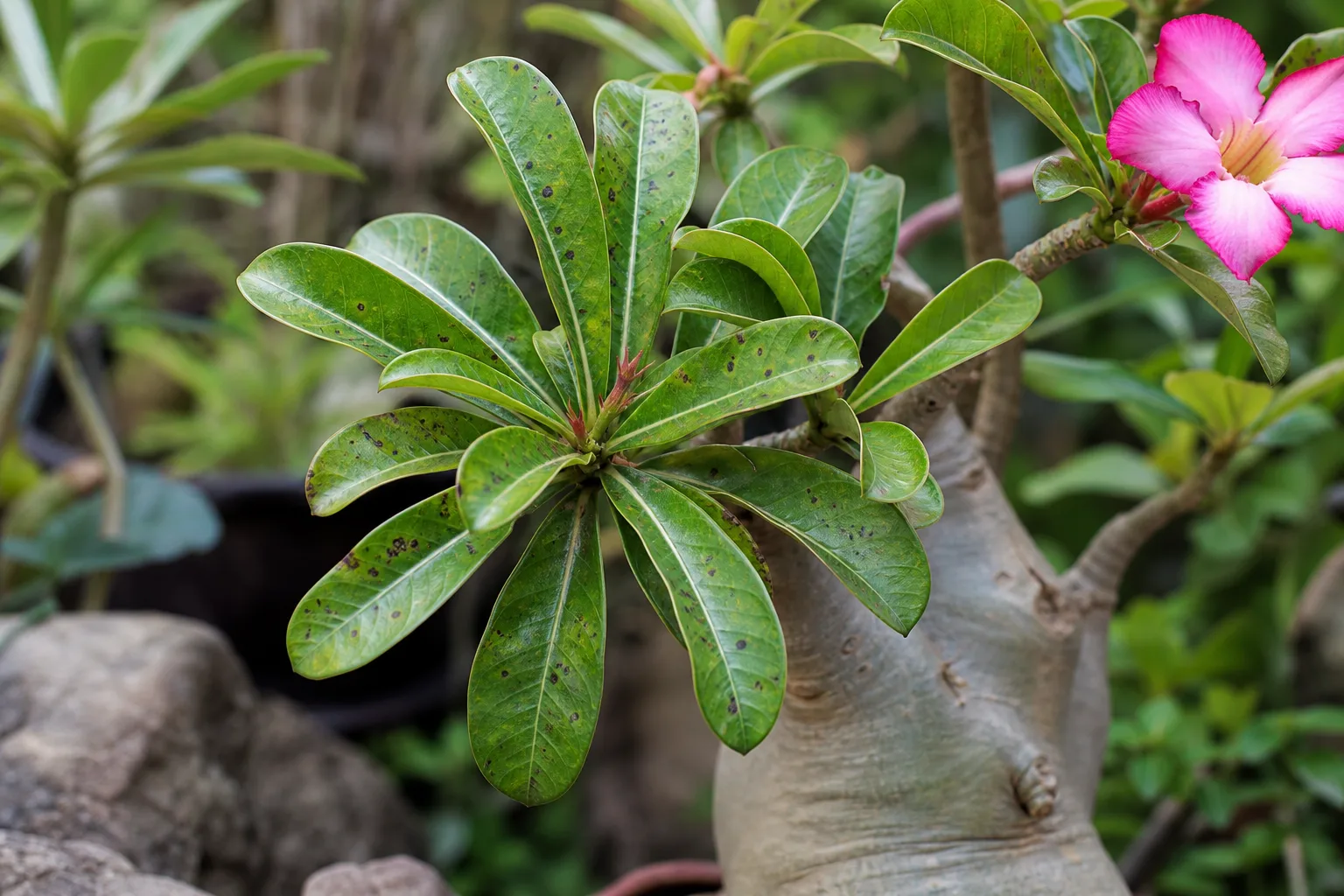
Black Spots on Adenium: Causes, Checks & Fixes
This guide covers black spots on Adenium. See also the general Black Spots guide, watering, and light pages for this plant.
Black Spots on Adenium: Causes, Checks & Fixes
Quick answer
Black spots on Adenium obesum (Adenium overview) are most often anthracnose-a fungal leaf spot caused by Colletotrichum species that thrives when leaves stay wet in humid air. UF/IFAS documents this pattern on desert rose: yellowing foliage with necrotic lesions that darken to brown or black blotches, enlarge, merge, and cause leaves to drop. This is not normal dormancy leaf loss; it usually follows overhead watering, rain exposure, or a move to a humid, poorly ventilated room.
First step: move the plant somewhere leaves can stay dry-out of rain, away from misting, and out of stagnant humid corners. Press the caudex while you move it: firm, solid tissue supports a leaf-fungus diagnosis; soft or wrinkled base tissue means switch to root rot or overwatering checks before you treat leaves. In most humid, wet-foliage home setups, prolonged leaf wetness-not drought-is what triggers black spots.
This page is the canonical guide for anthracnose and wet-weather leaf spots on desert rose. Related fungi such as Cercospora follow the same dry-leaf fix; insect chewers and rot look different and are covered below.
What black spots look like on Adenium
On desert rose, anthracnose starts as irregular yellow patches on otherwise glossy green leaves. The yellow tissue soon develops brown-to-black spots or blotches, sometimes with faint concentric rings. Spots often begin at leaf tips or margins and spread inward. As infection advances, individual lesions merge into larger dead patches, and the leaf yellows fully before dropping.
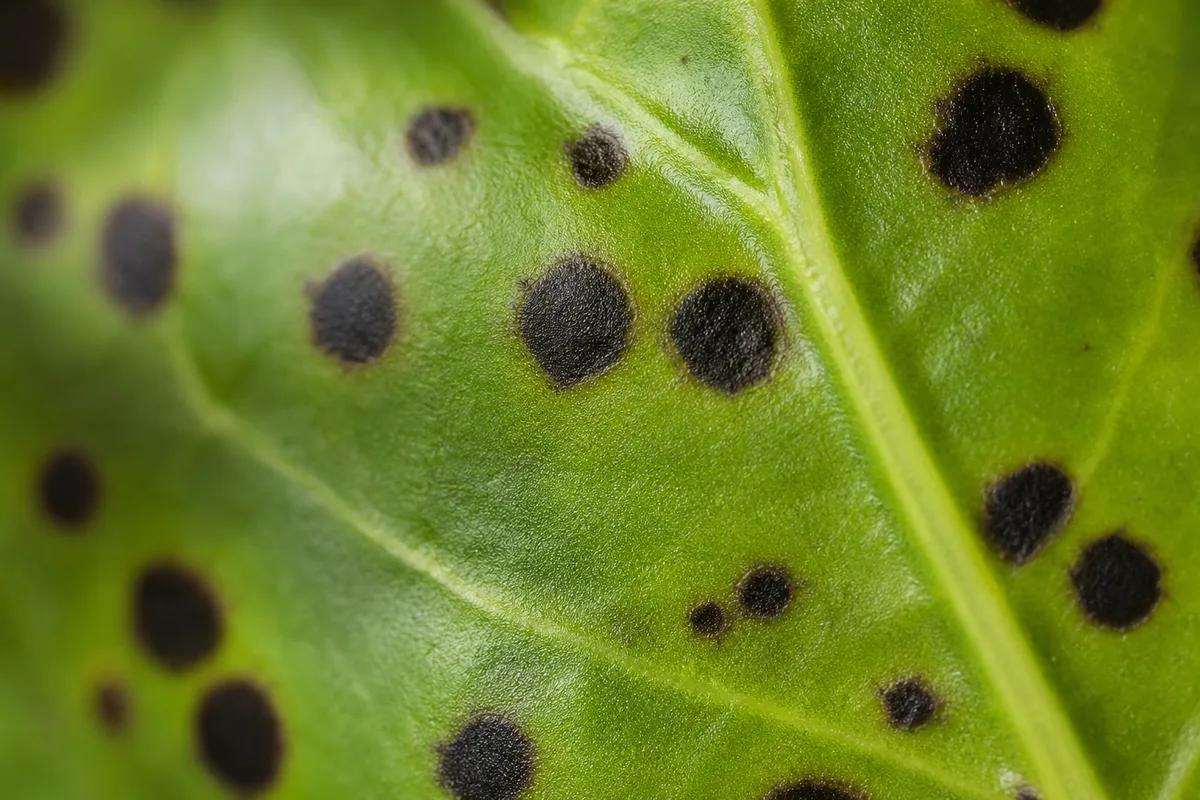
Black Spots symptoms on Adenium - compare with healthy tissue on the same plant.
A few details help separate this from other Adenium problems:
- Pattern: scattered spots with yellow halos on multiple leaves, often lower or inner leaves first where airflow is weakest.
- Texture: spots are dry and papery, not water-soaked or mushy (mushy black patches suggest bacterial issues or advanced rot).
- Stem involvement: in mild cases, spots stay on leaves; spreading black lesions on stems signal escalation toward crown rot.
- Caudex: should remain firm during pure leaf anthracnose. A soft, wrinkled, or darkening caudex points to overwatering or rot instead.
Adenium leaves are thick and succulent compared to many houseplants, so spots can look like dark oil blotches before the whole leaf yellows. Heavy defoliation during warm active growth-with a still-firm caudex-is a strong anthracnose signal.
Why Adenium gets black spots
Desert rose is a drought-adapted succulent tree from sub-Saharan Africa. It stores water in its caudex and leaves and expects dry air, sharp drainage, and full sun. Anthracnose fungi are common in the landscape and often live on plant surfaces without causing disease until moisture and humidity shift the balance.
Several Adenium-specific factors make black spots likely:
Wet foliage. Colletotrichum spores spread by water splash from rain or irrigation. When leaf surfaces stay wet for four or more hours after evening watering, heavy dew, or misting-spores germinate and penetrate leaf tissue. Adenium is not built for tropical foliage-wetting routines.
High humidity and poor airflow. Grouped pots, greenhouse corners, and indoor rooms with stagnant air keep leaves from drying. Gulf Coast and Florida growers often see anthracnose flare after a week of rain when outdoor pots sit unsheltered-spots appear on lower leaves first, then climb the canopy unless plants move under a porch overhang or ventilated cold frame with the lid cracked.
Overhead watering habits. Watering from above wets the leaf crown and axils where desert rose holds moisture longer than thin-leaved plants. Bottom-watering or saucer fills keep the pathogen’s main requirement-wet leaves-off the table.
Stress without rot. Overwatering that keeps soil soggy can weaken Adenium and invite fungi, but black leaf spots can appear even when the caudex is still firm. The fungus exploits leaf tissue first; caudex rot is a separate, more dangerous track that sometimes shares the same wet conditions.
Seasonal overlap. Anthracnose often appears during warm, humid months when Adenium is actively growing and has full leaf cover-the same period when growers water most. Cool dormancy leaf drop is uniform and seasonal; anthracnose drop is patchy and tied to spotted leaves.
How to confirm the cause
Work through these checks before treating. The goal is to confirm fungal leaf spot-not rot, sunburn, cold damage, or pests.
- Leaf history. Did spots appear after rain, misting, relocation to a humid room, or overhead watering? Timing that matches wet foliage supports anthracnose.
- Spot appearance. Yellow halos around enlarging black lesions fit Colletotrichum. Crispy brown edges without halos suggest sun scorch. Uniform yellow-then-drop without spots fits dormancy or chill.
- Caudex feel. Press the swollen base gently. Firm and solid: continue with leaf-focused diagnosis. Soft, mushy, or malodorous: stop and assess root or caudex rot.
- Soil moisture. Stick a finger 5–7 cm into the mix. Soggy soil plus spots may mean overlapping issues; very dry soil with spots still points to humidity on leaves, not drought.
- Undersides and stems. Look for webbing (mites), cottony clusters (mealybugs), bright orange caterpillars with black tufts (oleander caterpillar), or ragged chewed holes. None of these produce classic yellow-halo black spots.
- Spread speed. New spots on fresh leaves over a week confirm active disease. Static old spots on a few bottom leaves after a corrected environment may be leftover damage.
If most checks align with wet foliage and yellow-halo lesions on a firm caudex, anthracnose is the working diagnosis. Uncertainty between leaf spot and early rot favors drying the plant out completely and rechecking the caudex in three days before any fungicide.
The first fix to try
Move the plant to a dry, bright location where leaves will not get wet.
That single step addresses the condition anthracnose needs to keep spreading. Specifically:
- Pull outdoor pots under cover before rain, or move them to a sunny porch with overhang.
- Stop misting and overhead watering immediately.
- Increase spacing or run a fan on low nearby to move air across leaves (not directly blasting the caudex).
- Water at the soil surface or via saucer so no splash hits foliage.
Wait two to three days after the move before removing spotted leaves or considering fungicide. Cultural correction-dry leaves, bright air, no splash-is the foundation; chemicals only protect tissue that has not yet infected.
Step-by-step recovery
Once the plant is in a dry, airy, bright spot, proceed in order:
Remove heavily spotted leaves. Cut or snap off leaves that are more than half black or yellow. Bag and discard them-do not compost. Sterilize scissors between cuts if you move to healthy tissue.
Pet and skin safety: wear gloves when handling cut stems. Adenium sap is irritating, and the plant is toxic to pets. Keep clippings away from dogs and cats; wash hands after pruning.
Adjust watering. Water only when the mix is dry throughout the root zone. During active summer growth, that might be every five to seven days; in cool rest, much less or none. Never water on a schedule while fighting leaf spot.
Bottom-water or use a narrow spout directed at soil only. Morning watering gives any incidental splash time to dry.
Monitor new growth weekly. The next flush of leaves should emerge without spots. If clean leaves appear within two to three weeks, cultural correction was enough.
Escalate to fungicide only if spots keep appearing on new leaves after two weeks of dry culture. Protective fungicides guard healthy tissue; they do not heal blackened areas already present. UF/IFAS lists copper sprays (copper diammonia diacetate or copper octanoate) and chlorothalonil among protective options for ornamental anthracnose-always read the label, apply at the shorter interval during humid rainy periods, and spread applications wider when weather dries. Spray in early morning or late afternoon so leaves dry before harsh sun hits; midday copper or chlorothalonil on succulent desert rose leaves can cause phytotoxic burn. Test one leaf first and wait 48 hours before treating the whole plant. Do not fertilize a stressed plant to “boost recovery.”
Do not repot on day one unless soil is waterlogged and smelling sour. Adenium repotting guide adds stress and can splash spores. Fix dryness first; repot in spring with gritty mix only if drainage is clearly failing.
Recovery timeline
| Phase | What to expect |
|---|---|
| Days 1–3 | No new wetting; existing spots may darken as tissue dies. Leaf drop may continue from already-infected leaves. |
| Week 1–2 | Shedding slows. Caudex stays firm. No new spots on the newest leaves is the first positive sign. |
| Week 2–3 | Clean new growth at branch tips. Plant may look sparse until fresh leaves fill in. If every new leaf still spots after three weeks of dry culture, escalate to labeled fungicide or isolate the plant from your collection. |
| Month 2+ | Normal summer growth rhythm if light and dry-down watering hold. Old scarred leaves may persist on lower branches until you prune them. |
Anthracnose rarely kills a mature desert rose with a sound caudex. Failure looks like continued spotting on every new leaf despite dry culture, or a softening base-switch focus to rot rescue if that happens.
Lookalike symptoms
| Symptom pattern | Likely cause | Key differentiator |
|---|---|---|
| Yellow halos, enlarging black blotches, firm caudex | Anthracnose (Colletotrichum) | Follows wet foliage; spreads leaf to leaf |
| Brown circular spots, same wet trigger, firm caudex | Cercospora or related leaf-spot fungi | Same dry-leaf treatment; exact fungus rarely matters at home |
| Crispy tan tips/margins, no halos | Sun scorch | After sudden move to harsh midday sun |
| Uniform yellow-then-drop, cool weather | Dormancy or chill | No expanding lesions; firm caudex, dry soil |
| Yellow leaves, soft caudex, sour soil | Root or caudex rot | Base tissue fails before isolated dry spots |
| Ragged holes, orange caterpillars, skeletonized patches | Oleander caterpillar | Insect feeding, not fungal halos |
| Tiny yellow dots, fine webbing | Spider mites | Stippling, not enlarging black blotches |
Cercospora and other leaf spots also cause brown lesions on desert rose in wet conditions. Treatment overlaps completely with anthracnose: dry leaves, remove infected foliage, improve airflow. Home growers rarely need lab identification-the moisture fix is the same.
Oleander caterpillar (Syntomeida epilais) feeds on oleander and related Apocynaceae hosts including desert rose, especially in Florida and the Gulf Coast. Bright orange larvae with black hair tufts chew ragged holes or skeletonize leaves-you will see the insects or their droppings, not yellow-halo fungal circles. Manual removal or Bacillus thuringiensis (Bt) on chewed areas targets caterpillars, not fungicide.
Sun scorch browns leaf tips and margins to a dry, crispy tan-not black with yellow halos. It follows a sudden move to harsh midday sun without acclimation. Caudex stays firm; spots do not spread leaf to leaf over days.
Cold damage yellows and drops leaves uniformly when temperatures fall below about 10°C (50°F). Blackening may appear on tender tips after frost, but the pattern is weather-linked, not splash-linked.
Root or caudex rot yellows leaves and can cause drop, but the defining sign is a soft caudex, sour soil, and sometimes stem blackening from the base up-not isolated dry spots with halos on an otherwise firm plant.
Spider mite stippling shows as tiny yellow dots, not enlarging black blotches. Fine webbing on undersides confirms mites.
Mistakes to avoid
- Misting or showering the plant to “clean” leaves-this extends wetness and spreads spores.
- Watering more because leaves dropped-defoliation from fungus is not thirst; wet soil makes rot more likely.
- Immediate fungicide without drying the environment-chemicals protect new tissue but cannot substitute for dry culture on desert rose.
- Spraying fungicide in full midday sun-succulent leaves can burn; test one leaf in shade first.
- Stacking repot, prune, feed, and spray on one day-pick one intervention, watch the response, then add the next if needed.
- Composting infected leaves-spores survive and reinfect.
- Treating dormancy leaf loss as disease-winter rest drops leaves evenly without black lesions; reduce water and wait for spring.
How to prevent black spots next time
Prevention on Adenium is mostly environmental alignment with its native dry-climate biology:
- Grow in full sun-six or more hours of direct light during active growth keeps tissue vigorous and leaves dry quickly.
- Use gritty, fast-draining mix with plenty of mineral grit; avoid peat-heavy bags that hold moisture at the crown.
- Bottom-water or soil-level water only; skip misting entirely.
- Shelter from rain during humid seasons if you grow outdoors in the Southeast or tropics-porch overhang, eaves, or a ventilated cold frame beats leaving pots open to week-long downpours.
- Space pots so air moves between plants; do not cram desert roses in a humid greenhouse bench without ventilation.
- Quarantine new plants for two weeks and inspect leaves before mixing collections.
- Winter rest: withhold water during cool dormancy so cold, damp soil does not compound any lingering spores on old leaves.
For full species context and baseline care, see the Adenium overview and watering guide.
When to worry
Treat black spots as urgent if:
- The caudex softens or smells unpleasant-shift to rot protocol, not leaf-spot care.
- Stems develop spreading black lesions or dieback above the caudex-see crown rot.
- Every new leaf spots within days despite two weeks of dry, bright culture-escalate to labeled fungicide or discard severely infected stock to protect others.
- The plant loses most of its foliage during peak growth and shows no clean replacement leaves after a month.
Anthracnose alone on a firm desert rose is manageable and common in humid climates. The combination of wet leaves and wet soil is what turns a cosmetic leaf issue into a caudex emergency-watch the base as closely as you watch the spots.
When to use this page vs other Adenium guides
- Adenium watering guide - Use for routine moisture checks before assuming black spots is the main issue.
- Adenium problems hub - Browse all 40 common issues on this species.
- Overwatering on Adenium - Different entry point when symptoms overlap with black spots.
- Mold on Soil on Adenium - Different entry point when symptoms overlap with black spots.
- Leaf Drop on Adenium - Different entry point when symptoms overlap with black spots.