Sunburn & Scorched Leaves on Adenium: Causes, Checks & Fixes
Quick answer
Sunburn on Adenium usually follows a sudden jump to harsh direct sun-especially after winter indoors or shade. First step: move the pot to bright filtered light and leave it there until scorch stops spreading.
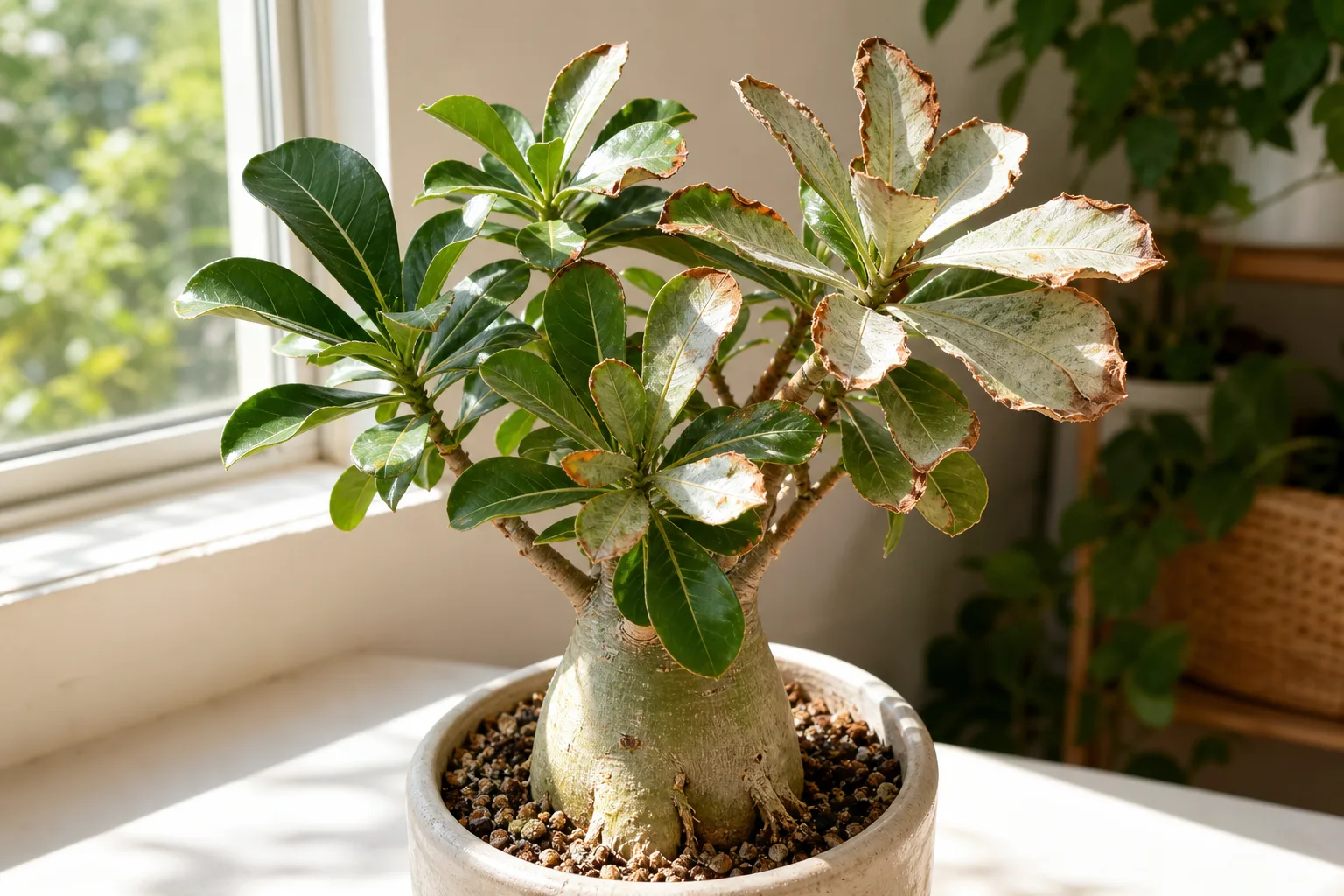
Sunburn & Scorched Leaves on Adenium: Causes, Checks & Fixes
This guide covers sunburn / scorched leaves on Adenium. See also the general Sunburn / Scorched Leaves guide, watering, and light pages for this plant.
Sunburn & Scorched Leaves on Adenium: Causes, Checks & Fixes
Quick answer
Adenium overview is built for full sun, but Adenium obesum still sunburns when exposure jumps too fast-excessive direct light turns leaves pale and brown on many houseplants, including succulents moved without acclimation. The classic trigger is moving a plant from a dim room, winter shelf, or nursery shade straight into afternoon sun. Leaves turn pale, papery, or brown on the side facing the light; some may curl and drop while the caudex stays firm.
First fix: move the pot to bright filtered light or morning sun only-somewhere with strong brightness but no harsh midday rays. Leave it there until you see no new scorch for several days. Do not water heavily, repot, or fertilize while leaves are still crisping.
What sunburn looks like on Adenium
Sun scorch on Desert Rose has a directional pattern. Damage concentrates on the leaf surfaces that took the hardest hit:
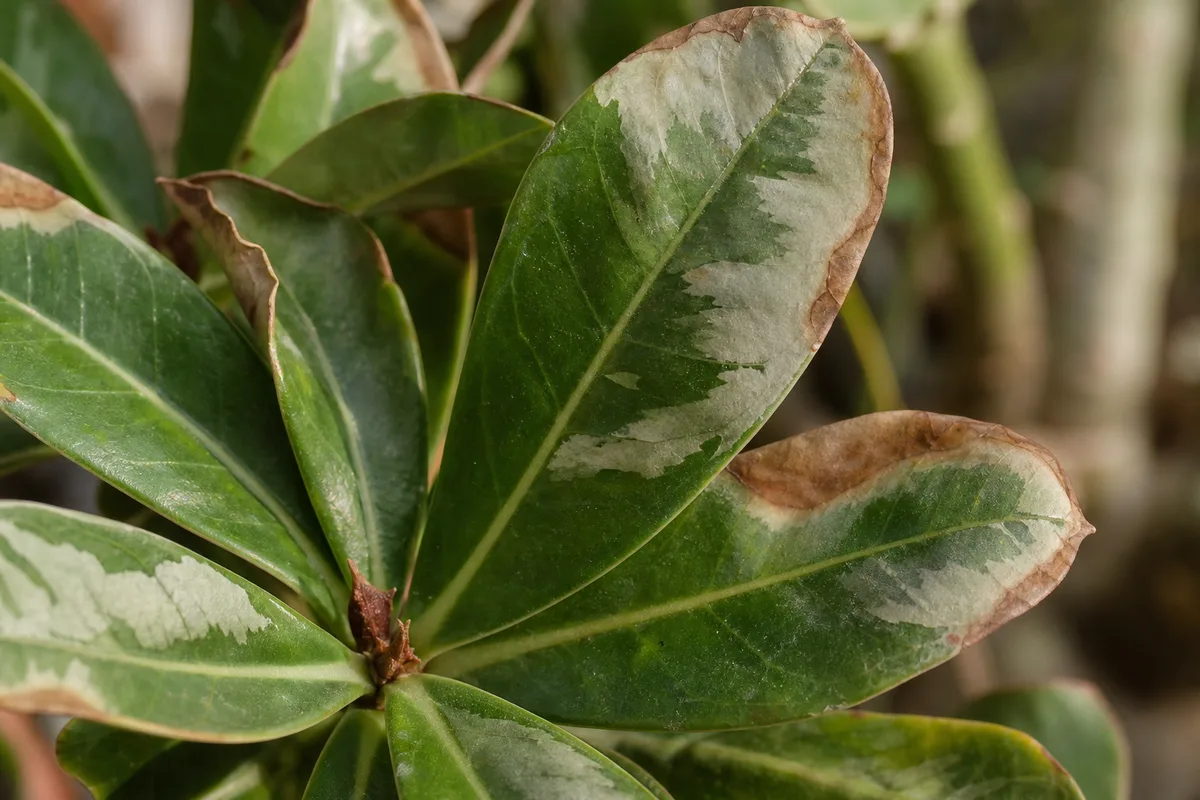
Bleached silvery patches and crispy brown margins on sun-exposed Desert Rose (Adenium) leaves - damage stays directional on the light-facing surface while shaded tissue stays greener.
- Bleached or silvery patches on the upper leaf surface, often on the south- or west-facing side of the plant
- Crispy brown margins and tips that feel dry and papery, not soft or mushy
- Sudden leaf drop after a move outdoors or against a hot window-often the oldest leaves first
- Curling or wilting that looks dramatic but comes with dry soil and a firm caudex, not a soft one
On grafted plants, the scion leaves may burn before the understock adjusts. Seedlings and newly rooted cuttings are especially vulnerable because their leaves are thin and have not hardened off to UV.
Sunburn rarely starts at the soil line. If stems or the caudex turn black and soft, suspect rot or cold injury instead.
Why Adenium gets sunburn despite loving sun
Adenium obesum is native to semi-arid sub-Saharan Africa and the Arabian Peninsula and needs six or more hours of bright sunlight daily to stay compact and flower. That requirement creates a paradox for home growers: the plant must have sun, but only after its leaves have adjusted to the intensity.
Common Adenium-specific triggers include:
- Spring move outdoors after winter dormancy indoors, when new leaves are tender
- Nursery-to-patio transplant where the plant was under shade cloth and you placed it in open sun the same day
- Window escalation from an east window to unfiltered south glass in summer
- Post-watering sun exposure when wet leaves magnify heat on a hot afternoon
- Reflective surfaces such as white walls, pool decks, or metal shelving that bounce extra light onto one side of the pot
Indoor Adenium that was kept back from the glass for months develops soft, etiolated foliage. That tissue burns quickly when you finally push the pot into full sun to “fix” leggy growth.
How to confirm sunburn is the cause
Work through these checks before treating anything else:
- Timeline - Did scorch appear within 24 to 72 hours of a light change, outdoor move, or window swap? Sunburn timing is fast.
- Caudex feel - Press the swollen base with a gloved finger. Firm and solid points to light stress. Soft or squishy means rot or overwatering on Adenium.
- Soil moisture - Stick a finger 5 to 7 cm deep. Dry or lightly dry soil with scorched leaves fits sunburn; Adenium prefers to allow soils to dry between waterings. Wet, cool soil with yellowing leaves does not.
- Leaf pattern - Bleaching on exposed surfaces only, with shaded leaves still green, strongly suggests scorch.
- Pest check - Flip leaves and inspect for stippling, webbing, or holes. Spider mites and caterpillars cause different damage patterns.
If every check matches sunburn and the caudex is firm, you can skip fungicides and root surgery. The fix is light management.
The first fix: shade immediately
Move the pot to a location with bright indirect light or gentle morning sun-a covered porch, east-facing stoop, or 1 to 2 metres back from a south window behind sheer curtain. This single step stops active burning.
Keep the plant there for at least 5 to 7 days. Watch for:
- No new bleached spots appearing
- Existing crispy leaves drying but not spreading to adjacent tissue
- Caudex remaining firm
Only after scorch stabilizes should you begin re-acclimating to stronger light.
Re-acclimating Desert Rose to full sun
Adenium still needs direct sun long term. After the burn stops, increase exposure gradually over 10 to 14 days:
- Days 1–3: Morning sun only (roughly 2 to 3 hours before noon) or bright dappled shade all day
- Days 4–7: Add late-morning sun; total direct exposure about 4 hours
- Days 8–10: Extend into early afternoon if temperatures stay below about 35°C (95°F)
- Days 11–14: Move to the final full-sun spot if no new scorch appears
Rotate the pot a quarter turn every few days so all sides harden evenly. In desert climates with extreme afternoon heat, permanent partial shade during peak hours is acceptable-the plant will still bloom with strong morning sun.
Skip fertilizer until new leaves open cleanly green.
Lookalike symptoms on Adenium
Several problems mimic scorched leaves. Separating them prevents the wrong fix:
| What you see | Likely cause | Key difference |
|---|---|---|
| Bleached patches after a light move | Sunburn | Fast onset, exposed side only, firm caudex |
| Uniform brown tips on many leaves | underwatering on Adenium or salt burn | Dry soil throughout, caudex may wrinkle |
| Blackened soft stem tips after a cold night | Cold damage | Follows a chill below ~10°C (50°F)-UF/IFAS notes leaf yellowing and drop below 55°F-not a light change |
| Circular brown spots with yellow halos | Fungal leaf spot | Spreads in humid, wet conditions; spots are scattered |
| Ragged holes with frass | Caterpillars | Physical chewing, not bleaching |
Mistakes to avoid
- Moving straight back into full afternoon sun once one leaf looks better-partial recovery is not acclimation
- Heavy watering because leaves look wilted; a firm caudex with dry soil does not need a soak during light recovery
- Fertilizing scorched plants to “push new growth”-salts stress roots already working to replace leaves
- Misting burned leaves in hot sun, which can worsen tissue damage
- Pruning the caudex or main stems when only foliage burned; the storage organ is usually fine
Wear gloves when removing dead leaves. Desert Rose sap is irritating and the plant is toxic to cats and dogs if ingested.
Recovery timeline and what improvement looks like
Scorched leaf tissue does not revert to green. Judge success by the plant’s base and new growth:
- Days 1–7: Scorch spread stops; no new bleaching
- Weeks 2–4: Tiny leaf buds appear at stem tips in warm weather
- Month 2+: New leaves open fully green and thicker; flowering may resume next cycle if sun is adequate
A firm caudex throughout is the best sign the plant will recover cosmetically. If the base softens while you are shading the plant, unpot and inspect for rot-sunburn alone should not mush the caudex.
How to prevent sunburn next time
- Acclimate every spring when moving Adenium outdoors after winter rest
- Harden off nursery purchases in bright shade for a week before full sun
- Use morning sun as the entry point in hot climates; add afternoon exposure only after leaves toughen
- Avoid watering foliage before peak sun hours
- Increase light indoors gradually when correcting leggy growth-add a grow light or move closer by inches per week, not feet per day
Once acclimated, keep the plant in the brightest spot you can offer during active growth. That is what Desert Rose needs for caudex swelling and blooms.
When to worry
Sunburn is usually cosmetic if caught early. Escalate care if:
- The caudex softens or smells sour-rot may have started from a separate watering issue
- Stems blacken from the base upward, not just leaf margins
- All leaves drop and no buds appear after 4 to 6 weeks in warm, stable light
- Scorch returns after full re-acclimation-check for reflected heat or hot glass contact
For a firm caudex and stable scorch, patience and gradual light are enough. Adenium replaces leaves faster than many succulents once conditions match its desert habits.
When to use this page vs other Adenium guides
- Adenium watering guide - Use for routine moisture checks before assuming sunburn / scorched leaves is the main issue.
- Adenium problems hub - Browse all 40 common issues on this species.
- Brown Tips on Adenium - Different entry point when symptoms overlap with sunburn / scorched leaves.
- Curling Leaves on Adenium - Different entry point when symptoms overlap with sunburn / scorched leaves.