Underwatered Desert Rose: Wrinkled Caudex & Soak-and-Dry Fix
Quick answer
Underwatering on Adenium shows up in active growth as a firm but wrinkled caudex, curling or crispy leaves, and bone-dry gritty mix-not a soft mushy base. First step: water deeply until runoff drains, then wait until the mix is dry 5–7 cm down before the next drink.
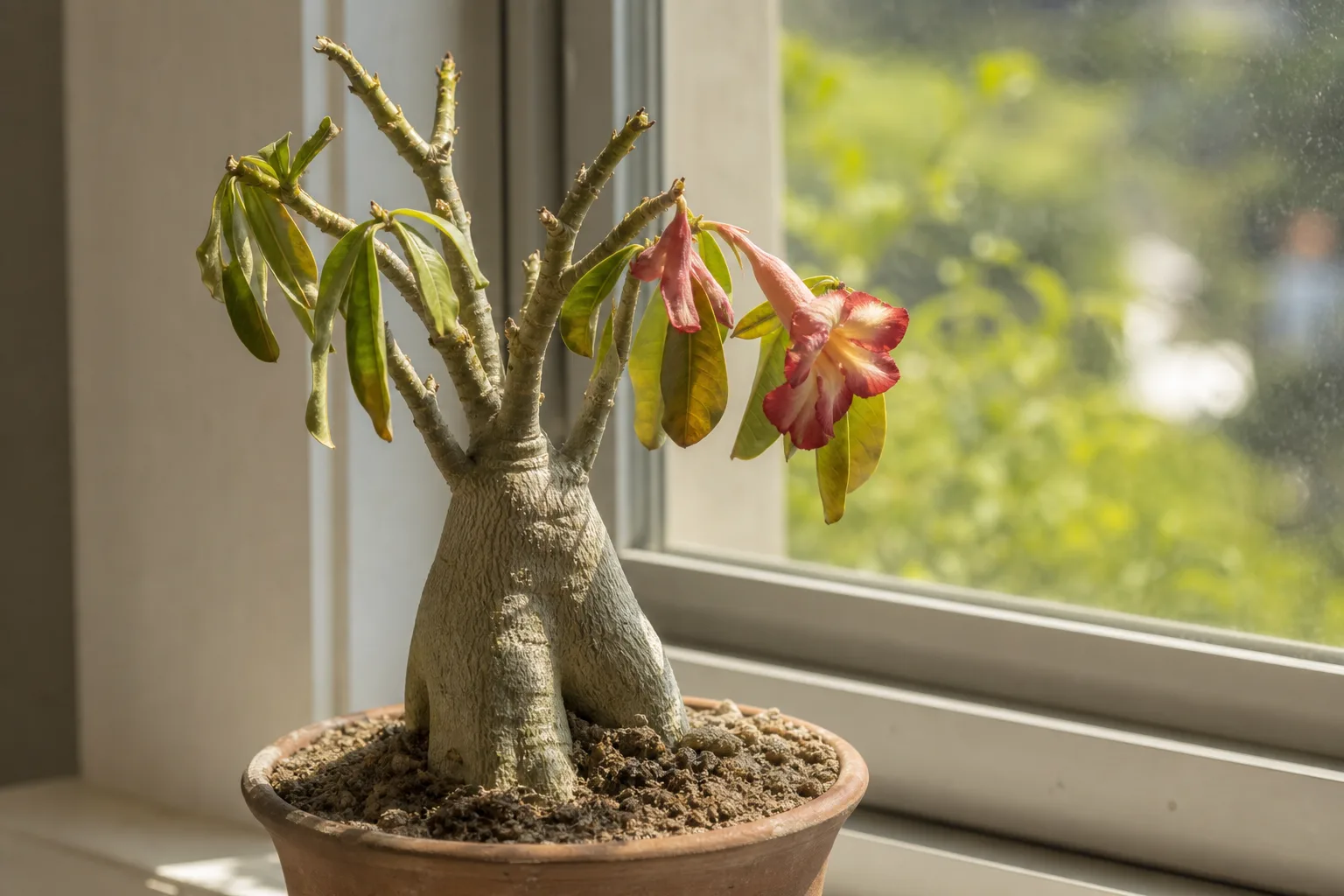
Underwatering on Adenium: Causes, Checks & Fixes
This guide covers underwatering on Adenium. See also the general Underwatering guide, watering, and light pages for this plant.
Underwatering on Adenium: Causes, Checks & Fixes
Quick answer
Underwatering on Adenium obesum (Adenium overview) is too little water during active growth, not the brief dry spells this plant tolerates in winter rest. The caudex stores moisture like a reservoir; when that supply runs low in hot sun, leaves curl, margins crisp, and the swollen base wrinkles while staying firm-a very different feel from the soft mush of rot.
First step: water deeply until excess runs from the drain holes, then stop. Do not feed, repot, or mist the same day. Once the mix is fully saturated, resume soak-and-dry-water again only when the soil is dry 5–7 cm deep and the pot feels light.
| What you find | What it usually means | Read next |
|---|---|---|
| Firm + wrinkled caudex, dusty dry mix, warm growth | Underwatering-reservoir depleted | Stay on this page; deep soak below |
| Soft caudex on wet or cool-damp mix | Root rot or crown decay | Root rot on Adenium - stop watering and unpot |
| Firm caudex, dry soil, leafless in cool months | Normal winter dormancy | Adenium watering guide - withhold unless caudex clearly deflates |
| Wrinkled caudex on wet mix for days | Root uptake failure-not simple thirst | Inspect roots; may overlap with overwatering damage |
For baseline culture-gritty mix, Adenium light guide, seasonal rhythm-see the Adenium overview, soil guide, and watering guide.
Adenium is drought tolerant, but it is not a cactus you can ignore all summer. In full sun and gritty mix, an actively growing Desert Rose can dry out fast. Underwatering is usually safer and easier to fix than overwatering-as long as you confirm the caudex is firm, not rotting.
What underwatering looks like on Adenium
Desert Rose signals thirst through the caudex first, then the leaves. Learn that order and you avoid treating drought like disease.
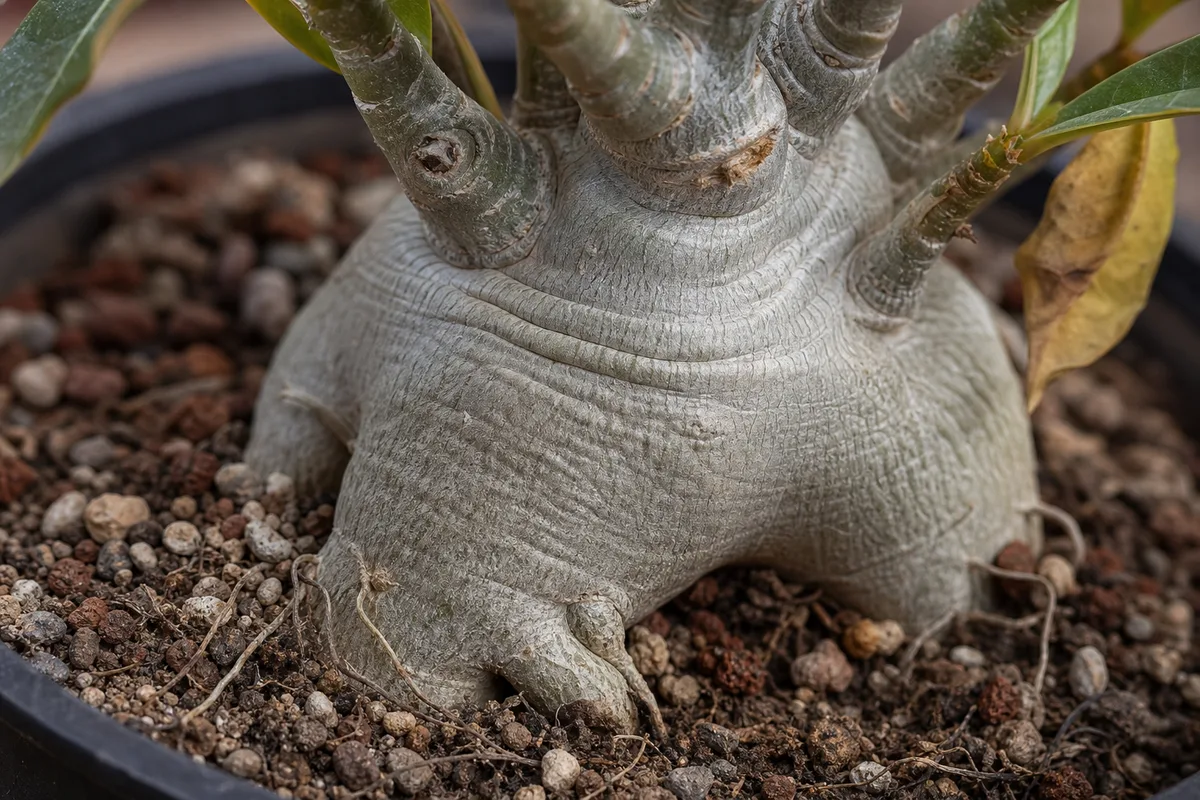
Underwatering symptoms on Adenium - compare with healthy tissue on the same plant.
Caudex (swollen base):
- Wrinkled, slightly deflated skin on an otherwise firm trunk-the classic underwatering sign
- Loss of the smooth, plump look as internal reserves are used
- Caudex may feel hard and dry when pressed, not squishy
Leaves and stems:
- Inward curling or limp droop on dry mix (not on wet soil)
- Crispy brown edges or tips, especially on older leaves first
- Thin, dull foliage that does not perk up overnight
- Premature leaf drop on Adenium during warm months-not the seasonal drop of cool dormancy
- Bud abort when flower buds shrivel on bone-dry mix in summer
Soil and pot:
- Mix dusty dry 5–7 cm down; surface may be pale and pulled slightly from the pot wall
- Pot feels very light when lifted
- Water may run straight through on the first pass if mix went hydrophobic from long dryness
What underwatering does not look like:
- Soft, squishy, darkening caudex on wet soil-that is overwatering or rot
- Uniform yellow leaves with sour-smelling mix
- Black stem tips after a cold night-that is chill injury, not thirst
A slightly wrinkled caudex in winter with dry soil and no active growth is often normal dormancy, not a call for a heavy soak.
Why Adenium gets underwatering
Adenium obesum is native to semi-arid Africa and the Arabian Peninsula with a swollen caudex to survive dry seasons. It handles drought better than constant wet-but active growth in full sun burns through stored water faster than many owners expect, especially when care habits are tuned for “succulent = rarely water.”
Common causes on Desert Rose:
Fear of rot after overwatering - One bad rot event leads to underwatering every other week in summer. The caudex shrinks while the owner waits for a calendar date instead of reading the plant.
Season mismatch - Watering like it is still dormancy when new leaves and heat returned in spring. The plant is transpiring heavily in direct sun but getting winter-level drinks.
Gritty mix + small pot + hot terrace - Fast-draining succulent mix in full outdoor sun can go from wet to bone-dry in two or three days during heat waves. That is correct soil behavior-it demands faster checks, not less water forever.
Hydrophobic dry-out - Peat or organic matter that stayed dry too long repels water; the surface looks briefly damp while the root ball stays dry inside.
Indoor winter vent-drying - Heat vents and low humidity speed drying on sunny windowsills even in cool months. A firm, slightly wrinkled caudex in late winter may need one light drink, not the zero-water rule used for fully dormant outdoor specimens.
The pattern is almost always: firm caudex + dry depth + warm active growth + increasing wrinkles.
Wrinkled caudex on wet mix: uptake failure
This edge case trips owners who only know “wrinkled = thirsty.” When the mix is wet 5–7 cm down but the caudex still wrinkles, roots may not be absorbing water-often after past root rot, recent repot shock, or severe root pruning.
How to tell thirst from uptake failure:
| Signal | Simple underwatering | Uptake failure |
|---|---|---|
| Soil at depth | Dusty dry | Cool-damp or wet for days |
| Caudex feel | Firm, hard-wrinkled | Firm-wrinkled or softening |
| After one deep soak | Plumps within 3–7 days | No change; may worsen if rot present |
| Root check | White firm tips | Brown mushy sections |
Do not keep soaking wet mix hoping wrinkles disappear-that invites rot. Unpot, rinse roots, trim mush back to firm tissue, air-dry two to three days, and repot into gritty mix per the soil guide. If the caudex softens, follow the root rot workflow immediately.
How to confirm the cause
Work through checks in order so you do not soak a rotting plant or ignore true drought.
- Season and growth stage - Are new leaves or flower buds active? Warm months increase water need. Cool dormancy with leaf drop and dry soil may be normal rest.
- Caudex feel - Press the base with dry fingers. Firm + wrinkled = thirst. Soft + mushy = stop and inspect for rot before adding more water.
- Soil at depth - Finger or skewer 5–7 cm down. Dusty and cool-dry confirms underwatering. Clammy or wet at depth rules simple thirst out-see uptake failure above.
- Pot weight - Lift the container. Very light versus your memory of a well-watered pot supports dryness.
- Drain smell and stem color - Sour odor, blackening base, or wet stems on soggy mix points to rot, not underwatering.
- Response test - After one deep soak on confirmed dry mix, leaves should show some recovery within 24–48 hours if roots are intact. No change on wet soil means look elsewhere.
Confirmed diagnosis: Dry mix throughout, firm wrinkled caudex, active growth season, limp or crispy leaves, light pot.
First fix for Adenium
Water deeply once, slowly, until water runs freely from the bottom and the mix is evenly moist-not a quick splash on the surface.
- Use room-temperature water; avoid ice-cold tap shock on heat-stressed roots.
- If water channels through dry grit, water in two or three passes ten minutes apart, or bottom-water the pot for 30–45 minutes, then let it drain completely.
- Empty the saucer so the caudex is not sitting in runoff.
That single thorough soak is the entire first fix. Do not fertilize, repot, prune heavily, or move the plant to harsh new sun the same day.
After draining, wait and watch: the caudex should begin to smooth within several days in warm growth. Resume normal soak-and-dry per the watering guide-allow soils to dry between waterings; for many home pots in summer, check every few days and water when dry 5–7 cm down; in cool dormancy, often weeks between drinks or none until the caudex clearly shrivels.
Step-by-step recovery
- Confirm firm caudex and dry depth-not wet rot.
- Deep soak until runoff; repeat staged watering if mix repelled the first pass.
- Drain fully and return to bright sun or strong light-Adenium recovers faster with the light it already acclimated to.
- Wait 5–7 days before the next full drink unless heat and dryness return quickly; judge by soil depth and caudex plumpness, not guilt.
- Trim only fully crisp, dead leaves if they bother you-optional; living tissue stays as-is.
- Repot only if mix is collapsed, root-bound in a tiny pot drying in hours, or hydrophobic after repeated failed soaks-otherwise one fix at a time.
Recovery timeline
Mild dehydration (slight caudex wrinkles, few crispy tips): often 24–72 hours to visible leaf turgor after one good soak; caudex plumps over 3–7 days.
Moderate stress (heavy wrinkling, many dropped leaves, weeks of neglect in summer): 1–2 weeks of corrected soak-and-dry before new tip growth looks normal.
Worsening signs after you watered on already wet mix: soft caudex, spreading black stem, sour smell-shift to root rot protocol, not more water.
Cosmetic brown leaf edges do not green up; success means firm caudex, stable soil cycle, and clean new leaves at the branch tips.
Lookalike symptoms
| What you see | Often confused with | How to tell apart |
|---|---|---|
| Wrinkled firm caudex | Root rot | Rot: soft base, wet mix, sour smell. Thirst: dry depth, light pot, firm tissue. |
| Crispy leaf tips | Sun scorch | Scorch: sudden harsh sun move; soil may still be moist. Thirst: prolonged dryness. |
| Leaf drop + dry soil | Winter dormancy | Dormancy: cool season, firm caudex, UF/IFAS winter rest. Thirst: warm active growth. |
| Wilt on wet mix | Overwatering | Overwatering: damaged roots cannot drink; see overwatering. |
| Stippling + webbing | Spider mites | Mites: fine dots on undersides; treat pests after confirming. |
What not to do
Do not panic-soak daily after one dry spell-saturated grit with no dry-down invites rot. Do not mist leaves instead of soaking roots; Desert Rose needs moisture in the mix, not humidity on foliage. Do not fertilize a drought-stressed plant before hydration stabilizes-salts on dry roots burn. Do not assume every soft caudex needs water; soft on wet soil means rot. Do not keep Adenium in dense peat-heavy mix thinking extra water fixes crisp leaves-see the soil guide and fix drainage first. Do not ignore a wrinkled caudex all summer because “succulents prefer dry”-active Adenium in full sun needs a real dry-down cycle, not permanent drought.
How to prevent underwatering on Adenium
Prevention is reading the pot and caudex, not memorizing a single weekday schedule.
- Gritty succulent mix with perlite, sand, or pumice so water drains fast but can be replaced on a rhythm you can observe.
- Full direct sun in warm months so growth and flowering stay strong-and so you check pots often when they dry quickly.
- Soak-and-dry habit from the watering guide: water thoroughly, then wait until dry 5–7 cm down; in hot outdoor summer that may be every few days, in cool indoor months every two to three weeks, in dormancy minimal or none until the caudex wrinkles.
- Lift the pot weekly during growth; weight change beats a calendar.
- Staged watering after vacations or neglect-plan a deep soak, not a daily trickle that never reaches the root ball.
- Right pot size-extremely small pots dry in hours in heat; slightly pot-bound is fine, but a root ball that dries twice daily needs either more volume or more frequent checks.
Healthy Desert Rose care pairs sharp drainage with generous drinks when dry-the same pairing that prevents both underwatering and rot.
When to use this page vs other Adenium guides
- Adenium watering guide - Use for routine moisture checks before assuming underwatering is the main issue.
- Adenium problems hub - Browse all 40 common issues on this species.
- Wilting on Adenium - Different entry point when symptoms overlap with underwatering.
- Brown Tips on Adenium - Different entry point when symptoms overlap with underwatering.
- Yellow Leaves on Adenium - Different entry point when symptoms overlap with underwatering.