Adenium Light Needs: Best Window, Sun & Warning Signs
Adenium Light Needs: Best Window, Sun & Warning Signs
Adenium Light Needs: Best Window, Sun & Warning Signs
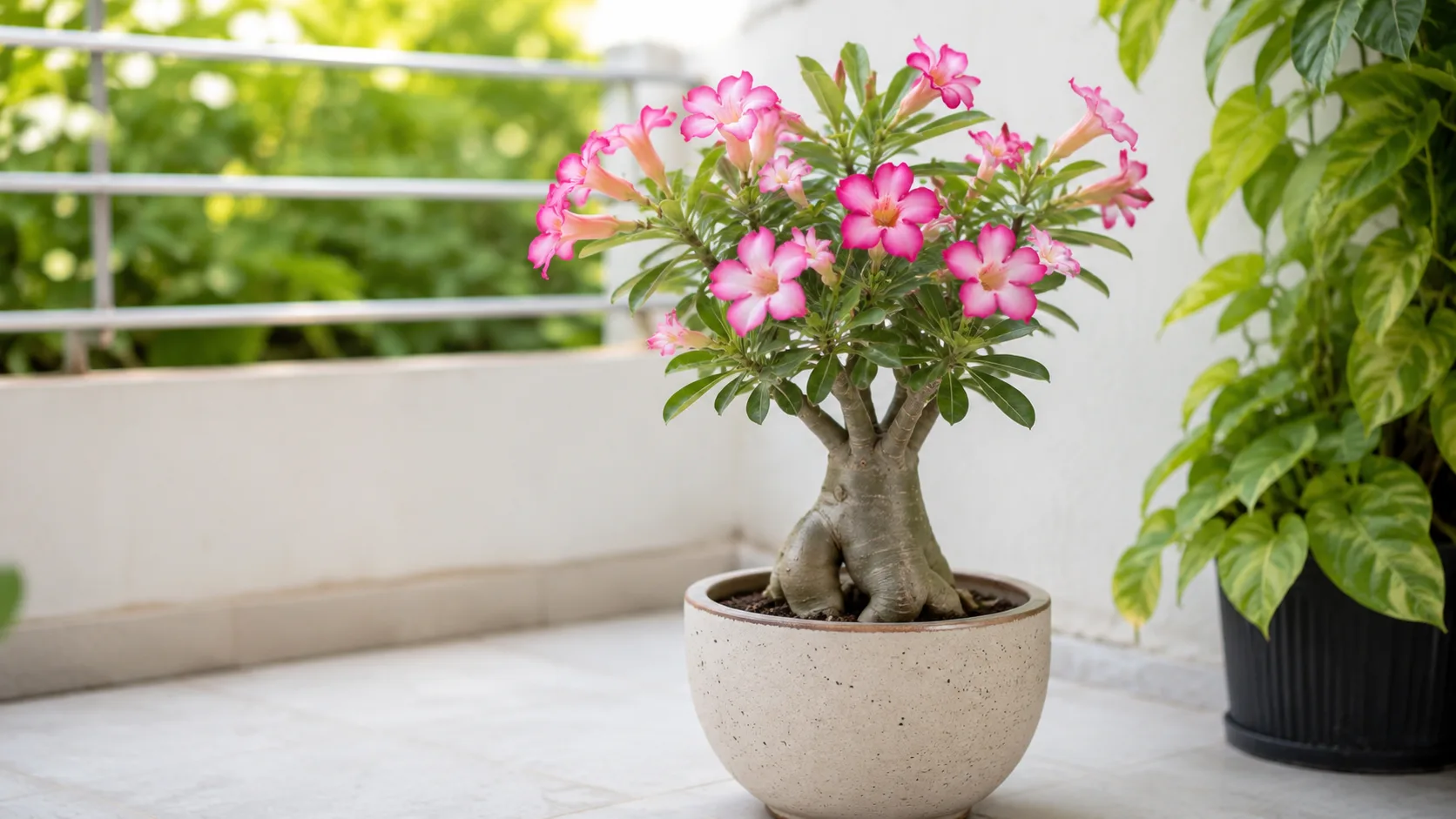
Adenium obesum - the Adenium overview - did not evolve for the middle of a living room. This Apocynaceae succulent stores water in a swollen caudex and thick stems, then spends that energy on trumpet-shaped summer flowers when conditions match its native open scrub across sub-Saharan Africa and the Arabian Peninsula. Indoors, the mistake is almost always the same: judging by how bright the room feels instead of how many hours of direct sun actually hit the leaves. A dim corner can look “fine” for months while the plant stretches, refuses to bloom, and sits in soil that dries too slowly for a desert-adapted root system.
The practical goal is simpler than the marketing photos suggest. Place Adenium where new growth stays compact and correctly colored, the caudex firms up during warm months, and flower buds form when temperatures cooperate. Light controls all three. It also controls how fast the pot dries - a brighter plant drinks faster, while a dim plant in the same watering routine is a rot waiting to happen. For the full species profile, see the Adenium overview; for diagnosis when stretch has already started, see not enough light on Adenium.
Why Adenium Is Not a “Bright Room” Plant
Houseplant advice often collapses “tolerates indoor culture” into “happy anywhere with ambient brightness.” Adenium exposes why that shortcut fails. NC State Extension’s Plant Toolbox classifies cultural light as full sun - six or more hours of direct sunlight per day - not bright indirect, not “near a window somewhere in the room.” Missouri Botanical Garden lists full sun as the outdoor norm for this species. The Royal Horticultural Society recommends growing under glass in full light with shade from the hottest sun - intensity first, heat management second.
That biology matters because Adenium uses light to build caudex tissue, shorten internodes, and trigger flowering. A plant three feet from a south window may live in a bright room and still etiolate - stems lean, gaps between leaves widen, and buds abort. The newest leaf pair tells the truth; old sun-grown foliage on the same branch can mask a recent light drop for weeks.
One more placement note: Adenium is highly toxic to pets and children if ingested, with cardiac glycosides in sap and all tissues (ASPCA). Sunny windowsills are prime real estate for light - keep pots out of reach of cats, dogs, and curious toddlers even when the window is perfect horticulturally.
How Much Light Adenium Actually Needs
The 6-Hour Minimum and the Flowering Link
UF/IFAS EP474 is explicit: Adenium must be stationed in high light, six hours or more per day, to maintain flowering during summer, and will not flower under low light conditions. UF/IFAS Gardening Solutions repeats the same threshold for profuse bloom - six or more hours of bright light daily during the growing season.
That number refers to direct or very strong sun on the leaf surface, not reflected brightness across the room. Count hours when sunbeams fall on foliage, not when the wall looks lit. In warm active growth - roughly when night temperatures stay above about 15–18°C (60–65°F) and new leaves are opening - treat six hours as a floor, not a ceiling. Many healthy container plants receive eight or more hours on a south patio or unobstructed south/west sill.
If flowers are your goal, light outranks fertilizer. Feeding a stretching plant in a dim corner produces soft growth, not blooms. Fix placement first; resume weak feeding only after new tips look normal.
Active Growth vs Dormancy Light Expectations
Adenium has a cool-season rest. UF/IFAS EP474 notes leaf drop and reduced growth when temperatures fall; NC State advises bringing plants indoors when outside temperatures reach 55°F (13°C) and decreasing water while dormant.
During dormancy, the plant still benefits from the brightest window you have, but expectations shift. Leaf drop with a firm caudex and dry soil is often normal winter rest - not proof of catastrophic low light. Do not panic-move a resting plant into harsh afternoon sun to “help” it. Do keep it out of the darkest interior rooms; etiolation during dormancy still weakens structure, and wet soil in a dim winter corner is dangerous.
When new leaves return in spring, ramp light aggressively again. That is when stretch and failed flowering show up if the window is insufficient.
How Window Glass Changes Desert Sun Indoors
Outdoor desert sun can exceed what double-pane glass delivers to a sill, but indoor placement introduces different problems: lower total daily duration in winter, UV filtering through glass, and heat buildup against the pane in summer. A south window in December may barely clear the six-hour direct threshold; the same sill in June can scorch leaves that touch hot glass.
Think in plant-facing intensity, not room aesthetics. A hand held between plant and window should cast a sharp shadow on a clear day for much of the active-growing season. Faint or absent shadow means you are below full-sun territory regardless of how “sunny” the room feels.
Best Window Placement Indoors
Window Direction Scorecard (Northern Hemisphere)
Compass direction is a starting map. Overhangs, trees, tinted glass, sheers, and pot distance all shift the real numbers. Still, for Northern Hemisphere growers choosing among household windows:
| Direction | Typical indoor light | Suitability for Adenium |
|---|---|---|
| South-facing | Strong direct sun most of the day; hottest in summer | Best default for flowering and compact growth; pull back from hot glass or filter peak summer afternoon |
| West-facing | Intense direct sun afternoon–evening | Very good for bloom; watch summer heat and scorch on unacclimated plants |
| East-facing | Gentle direct morning sun, then bright ambient | Good - easier acclimation, may need supplemental hours for heaviest flowering |
| North-facing | Mostly indirect; often insufficient direct hours | Poor long-term - survival or stretch without grow lights; do not treat as a primary placement |
This scorecard aligns with NC State full-sun classification and the window priority used in our not enough light diagnosis page: south or west first, east as a gentler alternative, north only with artificial supplementation.
A north window is not “bright exposure” for Adenium in horticultural terms. It may keep a plant alive for a season, but leggy stems, absent flowers, and slow caudex development are predictable outcomes.
Distance From Glass, Rotation, and Seasonal Shifts
Light intensity drops sharply with distance. Keep the pot within about 30 cm (12 inches) of the glass when possible - on the sill or a low stand directly beside it. In summer, if leaves press against overheated pane, move back a few inches or add a sheer curtain during peak hours.
Rotate the pot a quarter turn every few days so branches do not permanently lean toward one vector. Adenium does not self-correct once stems set a lean.
Re-evaluate placement in late winter. Lower sun angle and shorter days reduce energy at the same window. Stretch that appears in February often clears with no care change except patience until spring sun returns - or with grow lights if the window never reaches six direct hours.
Direct Sun, Scorch, and Acclimation
Adenium wants intensity, but leaves formed in shade cannot handle sudden desert-grade exposure. University of Arizona Cooperative Extension emphasizes gradual adjustment when moving succulents to stronger light - the same principle applies when shifting from a nursery shade house to your sunniest sill or patio.
Safe Hardening Schedule (7–14 Days)
Use this sequence when moving from dim indoor culture to full outdoor sun or an unfiltered south/west window:
- Days 1–3: Morning sun only (roughly 7–10 a.m.) or bright indirect at the target window; 2–3 hours.
- Days 4–6: Add late-morning hours; watch for bleaching on the sun-facing side.
- Days 7–10: Extend toward midday if temperatures stay moderate; skip blistering heat waves.
- Days 11–14: Full exposure at the intended summer home if leaves stay firm and new growth is compact.
If you see bleached patches, crisp edges, or sudden leaf collapse, pull back one step and wait for new growth before advancing again. Old scorched tissue does not heal green.
Sun Stress Color vs Sunburn on Adenium Leaves
Some Adenium hybrids blush red on sun-facing tissue - a reversible stress pigment response similar to other succulents. Even reddish or bronze tint with firm leaves often means the plant is adapting to brighter light. Dry, papery, bleached white patches on the exposed side mean sunburn - permanent on that tissue. Sunburn is a placement or acclimation error, not proof that Adenium “hates sun.”
In extreme summer heat, RHS guidance to provide shade from the hottest sun matters. Research on container production in central Florida found highest flower counts under about 30% shade (maximum PAR near 1,255 µmol·m⁻²·s⁻¹) compared with heavier shade (HortScience, 2014). Translation for home growers: afternoon protection during heat waves can preserve leaves without abandoning full-sun culture the rest of the day.
Low Light: Limits, Symptoms, and Rot Risk
Low light is a poor long-term setup. Adenium may persist for months on stored caudex reserves, but vigor, flowering, and compact form all decline. Typical signals during warm active growth:
- Etiolated stems - internodes longer than a finger width, branches leaning hard toward glass.
- Small, pale new leaves - contrast with older, darker foliage on the same branch.
- Missing or aborted flowers - despite warm temperatures and dry soil.
- Slow caudex swelling - the plant is not photosynthesizing enough to store energy.
The hidden risk is wet soil in dim corners. Evaporation slows when light drops. Adenium roots in soggy mix during cool weather invite rot even when the plant “looks fine” on top. If the pot stays wet and the caudex softens, light may be only part of the problem - but moving to a brighter spot and cutting water is still the first pairing fix. See the Adenium watering guide for dry-down checks tied to placement.
Do not increase fertilizer to fix stretch. Increase light first.
Grow Lights When Windows Fail
When no window delivers six hours of useful direct light - common in north rooms, basement apartments, and short winter days - supplemental lighting is not optional for a thriving Desert Rose.
Spectrum, Hours, Distance, and Intensity Targets
Maryland Extension notes that inadequate light causes leggy stretch and that duration matters when supplementing natural light. Practical indoor targets for Adenium:
- Fixture: Full-spectrum horticultural LED (roughly 5,000–6,500 K color temperature), not warm household bulbs alone.
- Photoperiod: 12–14 hours daily on a timer during active growth; shorten if the plant is in cool dormancy but do not leave it in 24-hour light.
- Distance: 15–30 cm (6–12 inches) above the highest leaves - close enough for intensity, far enough to avoid leaf heat burn.
- Intensity: Aim for bright succulent windowsill equivalence at the canopy. Exact PPFD varies by fixture; if new growth stays compact and green, intensity is sufficient. If stems still stretch with 14 hours of lamp time, raise intensity (closer fixture or stronger panel), not just duration.
Run lights consistently. Random on/off schedules confuse photoperiod-sensitive flowering cycles.
Moving Adenium Outdoors (and Back Indoors)
Outdoor summer sun is often the fastest way to reset a leggy indoor Adenium - after frost risk passes and after acclimation. NC State recommends bringing plants inside when temperatures fall to 55°F (13°C). In most temperate climates, that means patio season from late spring through early fall, then a bright indoor winter home.
Outdoors: Start with morning sun, build to full patio exposure over 7–14 days, and use afternoon shade only during extreme heat. Elevate pots on feet so drainage stays sharp.
Back indoors: Move before cold nights, not after damage. Scout for pests on leaves and caudex crevices. Place directly in the brightest window - do not intermediate through a dim room “to rest.” Reduce watering as growth slows; light should remain as strong as your home allows.
Warning Signs Cheat Sheet
Use this quick read after any placement change. Judge by newest growth after 7–14 days, not old scars.
Too little light (warm active growth):
- Long gaps between new leaf pairs; stems flop or lean.
- Pale, undersized new foliage; no summer flowers.
- Soil stays wet unusually long; fungus gnats or surface mold appear.
Too much sun or too-fast acclimation:
- Bleached, papery, or crisp patches on sun-facing leaves.
- Sudden leaf drop or collapse within days of a big move.
- Blackened tissue on caudex or stems (may overlap with cold damage - check temperature).
Wrong season (often dormancy, not light failure):
- Leaf drop with firm caudex and cool weather after you already cut water.
- No new growth despite good summer light - may simply be winter rest; do not force feed.
For step-by-step recovery when stretch is advanced, use the not enough light fix path.
Practical Checks: New Growth, Watering, and First Month
- New-growth test: The newest leaf or shoot should be firm, appropriately colored, and close-spaced to the last pair. Old etiolated stems will not shrink; only new tips prove the placement works.
- Watering link: Brighter placement dries soil faster - check dryness 5–7 cm deep before each drink. Dim placement requires longer dry-down; see watering guidance.
- First month at home: Do not repot, hard-prune, and relocate light on the same week. Quarantine new plants, make one light change, then read tip growth for 10–14 days before stacking other interventions.
- Nursery stock check: Shade-grown retail plants often etiolate within weeks of purchase. Prefer compact, sun-hardened specimens with firm caudex and short internodes. Leggy inventory needs the same acclimation schedule as a dim windowsill plant moving outdoors.
Related Adenium Care
Light sits upstream of almost every other Adenium problem. When placement is wrong, watering, feeding, and flowering all look broken.
- Adenium overview - species basics, toxicity, and seasonal rhythm.
- Not enough light - diagnosis and recovery when stretch is already visible.
- Adenium watering - dry-down checks that must track light changes.
- Sunburn on Adenium - when acclimation failed and leaves crisped.
Conclusion
Adenium is a full-sun succulent flowering tree in miniature, not a foliage plant that happens to have a thick trunk. Give it six or more hours of direct light during warm active growth, prioritize south or west windows indoors, and treat north exposure as grow-light territory. Acclimate shade-grown plants over 7–14 days, protect from the hottest afternoon rays during heat waves, and read new growth - not room brightness - as your scorecard. When windows fail, run a full-spectrum LED 12–14 hours daily 15–30 cm above the canopy. Pair every light increase with a watering rethink, keep toxic plants off reachable sills, and link stretch or bloom failure back to placement before you reach for fertilizer. Get the window right and Desert Rose care becomes predictable; miss it and every other knob turns the wrong way.
When to use this page vs other Adenium guides
- Adenium overview - Start here for whole-plant context before deep-diving this topic.
- Adenium problems hub - Jump to symptom-specific fix guides when this care topic does not resolve the issue.
- Not Enough Light on Adenium - Escalate here when light adjustments are not enough.
- Leggy Growth on Adenium - Escalate here when light adjustments are not enough.
- Sunburn / Scorched Leaves on Adenium - Escalate here when light adjustments are not enough.