Desert Rose Powdery Mildew: Caudex-Safe Checks & Fixes
Quick answer
White talc-like dust on Adenium leaf tops in humid, stagnant air is usually powdery mildew-not rot. First step: press the caudex (firm = foliar problem), then move the pot to brighter airflow and remove the most coated leaves with clean scissors.
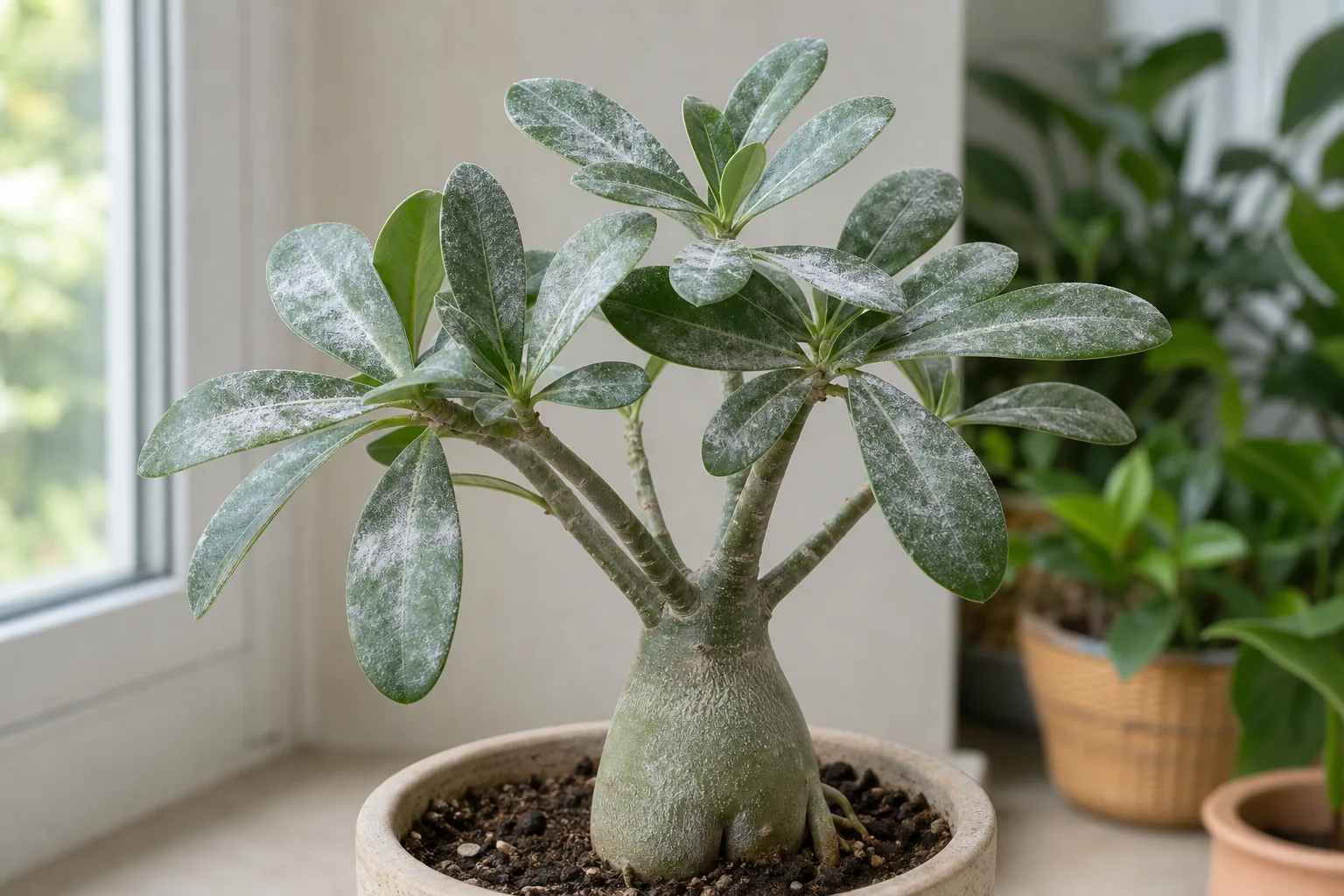
Powdery Mildew on Adenium: Causes, Checks & Fixes
This guide covers powdery mildew on Adenium. See also the general Powdery Mildew guide, watering, and light pages for this plant.
Powdery Mildew on Adenium: Causes, Checks & Fixes
Quick answer
White talc-like dust on Adenium obesum (Desert Rose) leaf tops usually means powdery mildew in humid, stagnant air-not the root collapse that terrifies desert rose growers.
First step: press the caudex. Firm tissue with dusty foliage points to a foliar fungus fix. Soft tissue with yellow leaves means inspect roots for rot before you remove leaves or spray anything.
Then move the pot to the brightest, airiest spot you can offer and cut off the most heavily coated leaves with clean scissors. For baseline culture that keeps leaves dry, see the Adenium care overview, light guide, and watering guide.
Why desert rose gets powdery mildew
Adenium obesum stores water in its caudex and thick stems. It needs full sun and well-drained soil and tolerates drought far better than moisture sitting on its leaves. Powdery mildew fungi thrive when warm days are followed by cool, humid nights-the microclimate on a crowded plant shelf, in a steamy bathroom, or under a sealed propagation dome.
The disease is less common on desert rose than on soft-leaved houseplants, but growers report white powdery coatings when plants stay indoors with insufficient airflow, watered from above, or grouped tightly on drip trays. Powdery mildew species colonize upper leaf surfaces and young stems, interfering with photosynthesis and causing leaves to curl, distort, or drop prematurely.
Indoor winter culture is a frequent trigger. Adenium rests during cool months with reduced watering, yet leaves may still sit in humid stagnant air near heating vents or glass. Outdoor pots moved under eaves for rain protection sometimes land in a shaded, still corner where foliage never dries. Overhead misting to “help” a desert rose in dry winter air often backfires by keeping leaves damp for hours-on this plant, dry leaves in full sun are the default defense, not extra humidity.
What powdery mildew looks like on Adenium
Early signs are small white or grayish patches on the upper surface of leaves, often starting on lower or inner leaves where airflow is weakest. The coating looks like flour or talcum powder and can be wiped off with a finger. Patches enlarge and merge until whole leaves look dusted. Young stems and flower buds may also carry the powder.
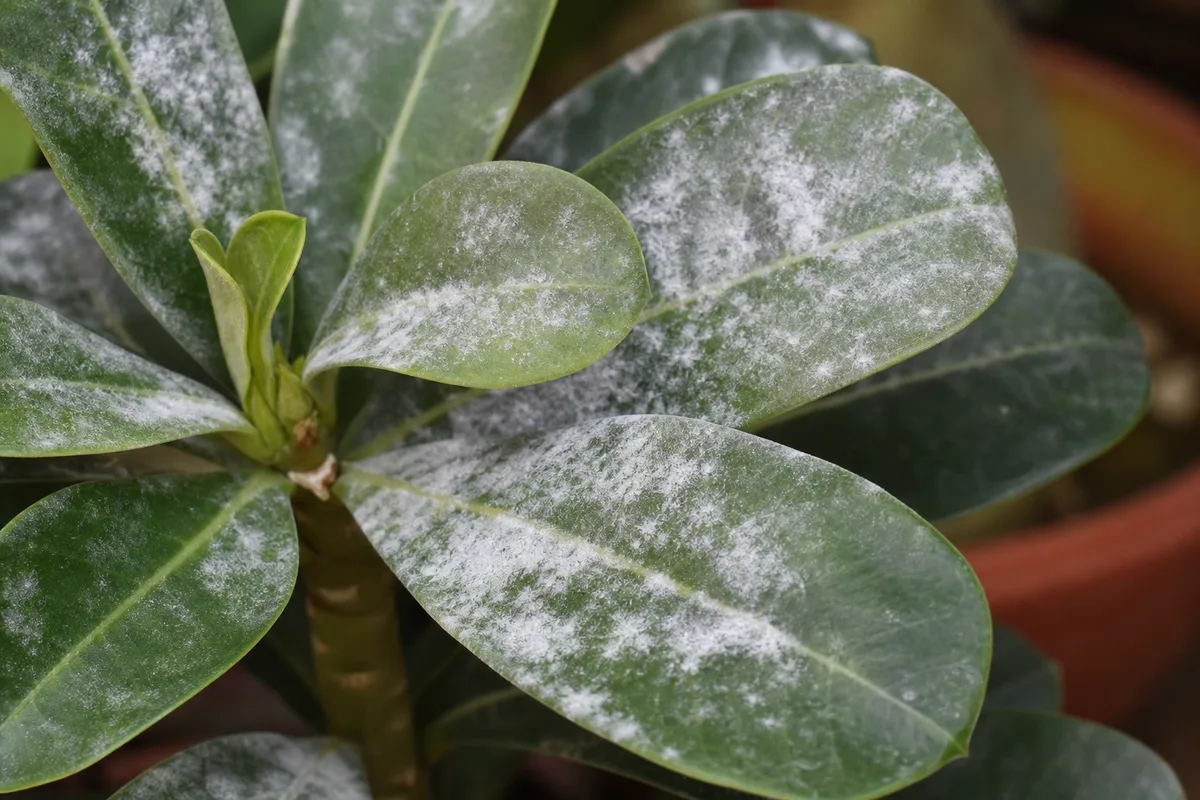
White talc-like powder coating the upper surface of desert rose leaves - patches enlarge and merge until foliage looks dusted, unlike separate cottony mealybug clumps.
Affected leaves may curl, look stunted, or yellow before dropping. The swollen caudex should remain firm throughout-soft, mushy base tissue points to rot, not mildew alone.
Unlike leaf spot disease, there are no brown or black circular lesions with yellow halos. Unlike mealybugs, the white material is a uniform surface dust-not separate cottony clumps hiding in leaf axils or caudex crevices. Unlike sun scorch, damage is powdery and patchy rather than crispy brown margins on the sun-exposed side. Unlike normal winter dormancy, yellowing comes with white coating during warm active growth, not a clean seasonal leaf drop on dry soil with a firm caudex.
For other pale-mark causes that are not necessarily fungus, see the white spots symptom guide-this page focuses on confirmed environmental powdery mildew on desert rose foliage.
How to confirm mildew vs. lookalikes
Work through these checks before reaching for fungicide:
- Wipe test - Powdery mildew rubs off as a dusty smear on your finger. Mealybug wax comes off in small waxy threads; scale leaves a hard bump.
- Location on the plant - Mildew coats leaf tops and young stems broadly. Mealybugs cluster in protected joints and stem bases.
- Recent humidity pattern - Did warm days follow cool humid nights, or did you mist, overhead-water, or move the plant to a closed terrarium? Spreading white dust after those events strongly suggests mildew.
- Airflow audit - Crowded shelves, saucers holding standing water, and pots pressed against walls keep foliage damp longer than desert rose prefers.
- Caudex firmness - Press the base. Firm tissue with powdered leaves supports foliar mildew. Soft caudex with yellow leaves means inspect roots for rot before treating foliage.
- Growth stage - During active summer growth, mildew on new tips is more concerning than a few dusty old leaves on a dormant plant that is already dropping foliage naturally.
If multiple plants in the same humid zone show matching white dust after a wet or stagnant period, environmental fungus is the likely cause rather than a one-off nutrient issue.
Symptom lookalike comparison
| What you see | Pattern | Caudex | First check |
|---|---|---|---|
| Powdery mildew | Uniform white dust on leaf tops; rubs off as powder | Firm | Airflow + sun; remove worst leaves |
| Mealybugs | Cottony clumps in axils and caudex folds; sticky honeydew | Usually firm | Alcohol dab; see mealybugs guide |
| Leaf spot | Brown/black circles with yellow halos | Firm unless rot co-infection | See leaf spot guide |
| Sun scorch | Crispy brown on sun-exposed edges; no talc dust | Firm | Gradual sun acclimation |
| Root/crown rot | Yellow leaves; may have some white mold on soil, not leaf dust | Soft or squishy | Root rot workflow first |
| Winter dormancy | Clean leaf drop on dry soil below ~55°F | Firm | Resume care in spring; no fungicide on bare caudex |
First fix: sun, airflow, and leaf removal
Move the pot to the brightest, airiest spot you can provide-outdoor full sun after gradual acclimation is ideal during warm months. Space it away from neighboring plants and run a small fan on low indoors if the room stays humid.
This single environmental correction dries foliage and slows spore spread before any chemical step. After repositioning, remove the most heavily coated leaves with clean, sharp scissors. Bag them and discard in the trash; do not compost indoors.
Wait five to seven days and inspect new growth. If white dust appears on fresh leaves despite dry foliage and good airflow, escalate to labeled fungicides (see below). Fungicides do not restore already powdered tissue-they protect clean new growth.
Do not repot, fertilize, or heavily prune stems the same day you adjust placement and remove leaves. Stack one correction at a time so you can read the plant’s response.
When to escalate to sulfur, oil, or bicarbonate
UC IPM recommends sulfur products as preventives applied before infection spreads; they are less effective once coating is heavy. For mild to moderate active infections caught early, horticultural oil or plant-based oils such as neem oil can work as eradicants-cover all leaf surfaces per label directions and repeat at 7- to 10-day intervals as new leaves expand.
On desert rose, timing matters as much as product choice:
- Sulfur - Apply in morning or evening when air temperature stays below 90°F. Sulfur can burn foliage in heat and must not follow or precede oil within two weeks.
- Horticultural or neem oil - Never spray in midday full sun on a heat-stressed caudex plant. Apply at dusk when temperatures are below 90°F, the plant is not drought-stressed, and you have not used sulfur recently. Patch-test one leaf for 48 hours-succulent leaves burn easily under oil plus sun.
- Potassium bicarbonate - Products such as those labeled for powdery mildew can eradicate early infections but UC IPM warns bicarbonates can injure already-infected tissue; avoid on advanced coating or heat-stressed outdoor plants.
If spread continues on new growth after one properly timed application, a second treatment per label interval is reasonable. Chronic outbreaks on multiple collection plants may warrant contacting your local cooperative extension office for regional fungicide guidance.
Step-by-step recovery
- Isolate the affected desert rose from other plants until active spread stops.
- Move to full sun with free air movement around the canopy.
- Remove heavily coated leaves and any distorted buds that fail to open.
- Switch permanently to base watering-never wet the foliage.
- Empty saucers after each drink so humidity does not rise from standing water.
- Sterilize scissors with rubbing alcohol between cuts and between plants.
- If spread continues on new growth after one week of cultural correction, apply labeled sulfur or horticultural oil once at the correct time of day, then repeat only per label interval.
- Hold fertilizer until new leaves emerge clean for two weeks.
Recovery timeline
New powder formation should halt within one to two weeks once leaves stay dry and airflow improves. Clean new leaves emerging two to three weeks later confirm recovery. Old powdered foliage that was not removed will not green up again-expect some bare branches until fresh growth fills in.
Defoliation during active summer growth looks alarming but is usually reversible when the caudex stays firm. Plants in winter dormancy may drop leaves anyway; wait until spring warmth and resumed watering before judging whether mildew persists on new foliage.
What not to do
Do not mist desert rose to raise humidity when white dust is present-moisture feeds the fungus. Do not overhead-water from a shower or hose. Do not leave removed powdered leaves on the soil surface where splash can spread spores. Do not apply nitrogen fertilizer to a defoliating plant; stressed Adenium does not need feeding until new growth is stable.
Do not treat with sulfur during the hottest midday hours or within two weeks of an oil spray. Wear gloves when cutting stems and leaves. Desert rose sap is toxic and can irritate skin. If a pet chews leaves or stems, contact ASPCA Animal Poison Control (888-426-4435) or your veterinarian-do not wait for symptoms.
How to prevent powdery mildew on Adenium
Match care to the plant’s arid origins. Grow in loose, sandy or gravelly, well-drained mix with drainage holes. Water deeply at the soil line only when the mix is dry several centimeters down; empty saucers promptly. Give full direct sun-the same light that supports flowering also dries leaves quickly and keeps the canopy less hospitable to mildew.
Trim dense leaf clusters to open the canopy. Avoid humid stagnant corners, closed terrariums, and crowded plant shelves unless you monitor daily. Quarantine new desert roses for two weeks before placing them near your collection.
Reduce watering sharply during cool winter rest when leaves drop naturally. Wet soil and humid stagnant air together during dormancy invite both foliar fungus on any remaining leaves and caudex rot.
When to worry
Treat as urgent if the caudex softens, stem tissue blackens near lesions, buds abort repeatedly during peak bloom season, or defoliation accelerates weekly during warm growth. Those signs suggest advanced stress or co-infection with rot-not a cosmetic powder issue alone.
Slow, stable white dust on a few lower leaves with a firm base is lower urgency. Correct airflow and watering technique first and reassess before chemical treatment.
Before you treat foliage, confirm the caudex is firm. A soft base changes the entire workflow-foliar fungicide will not fix wet roots, and removing leaves on a rotting plant wastes recovery time.
When to use this page vs other Adenium guides
- Adenium watering guide - Use for routine moisture checks before assuming powdery mildew is the main issue.
- Adenium problems hub - Browse all 40 common issues on this species.
- Leaf Drop on Adenium - Different entry point when symptoms overlap with powdery mildew.