Damping Off on Adenium Seedlings: Causes, Checks & Fixes
Quick answer
When half your desert rose seed tray topples overnight with pinched brown stems at the soil line, that is damping off-not caudex rot on a mature plant. Pull every collapsed seedling immediately, let the surface mix dry, and vent the dome before you bottom-water survivors again.
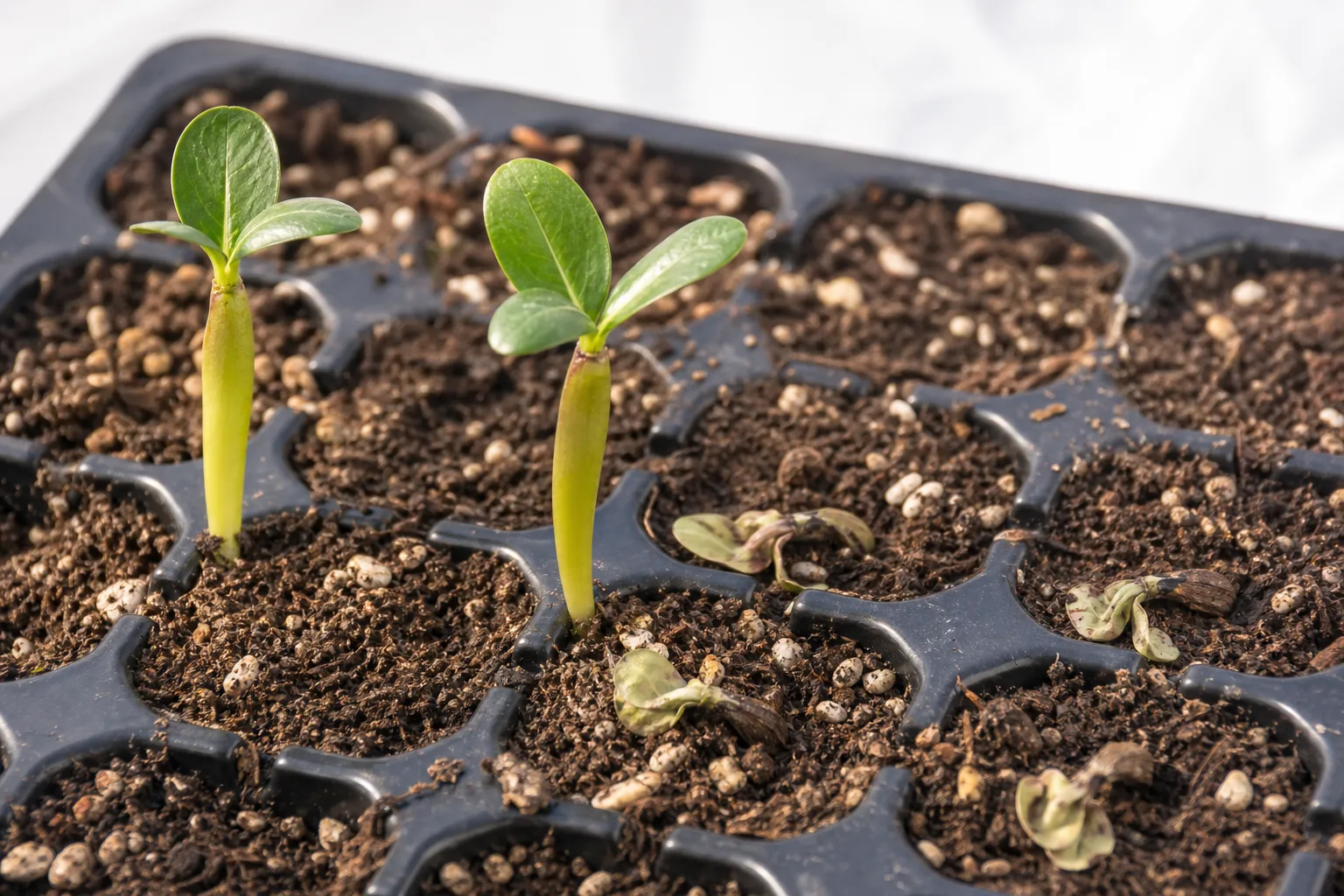
Damping Off on Adenium: Causes, Checks & Fixes
This guide covers damping off on Adenium. See also the general Damping Off guide, watering, and light pages for this plant.
Damping Off on Adenium: Causes, Checks & Fixes
Quick answer
You sowed Adenium overview seed five days ago on a heat mat, sealed the dome, and woke up to three cotyledon loops lying flat with a water-soaked pinch where each stem meets the mix. That overnight collapse is damping off on Adenium seedlings-fungal rot at the soil line from a wet, stagnant tray-not root rot on a mature caudex plant in a large pot.
The fungi behind it-commonly Pythium and Rhizoctonia-thrive when standard peat-heavy seed mix stays soggy under a closed dome. First fix: pull out and discard every collapsed seedling immediately, then let the remaining tray surface dry before you bottom-water again.
Why Adenium seedlings get damping off
Desert rose seeds germinate fast when soil is warm and moist-often within a week on a heat mat-but Adenium obesum needs sharp drainage and well-drained potting compost, not waterlogged organic media. Many growers start seeds in generic seed-starting mix that holds moisture for days. That works for leafy vegetables; on Adenium it keeps tender stem bases wet long enough for soil fungi to attack.
Peat-heavy flats create a specific trap for desert rose: seeds need warmth and surface moisture to sprout, yet soils that stay too wet produce rots on this succulent. Cotyledon-stage stems are thin and fleshy-they lack the woody caudex tissue that protects mature plants. Fast germination under heat means domes often stay sealed past the point when airflow becomes critical.
Common failure chain for Adenium trays:
- Fresh seeds sprout under a sealed dome on peat mix
- Bottom heat is absent or uneven, so outer cells run cool while center cells stay wet
- Overhead misting or daily top-watering keeps the surface saturated
- Seedlings crowd a flat with no fan moving air between cells
Pythium favors cool, wet conditions; Rhizoctonia often causes the classic topple at the soil line after emergence. Reused trays, dirty tools, or splashed water from an infected cell spread spores to healthy neighbors. Adenium seedlings grow quickly compared with many succulents, but they still need moisture without saturation during their first weeks-the margin between moist and soggy is narrow in peat.
For the next sowing, a gritty inorganic-heavy mix breaks that peat trap: aim for roughly 50–70% perlite, pumice, or coarse sand blended into sterile soilless base so water drains in seconds, not days.
What damping off looks like on Adenium
Healthy sprouts look fine one day; overnight the stem kinks at the surface and the whole seedling flops flat. Key signs:
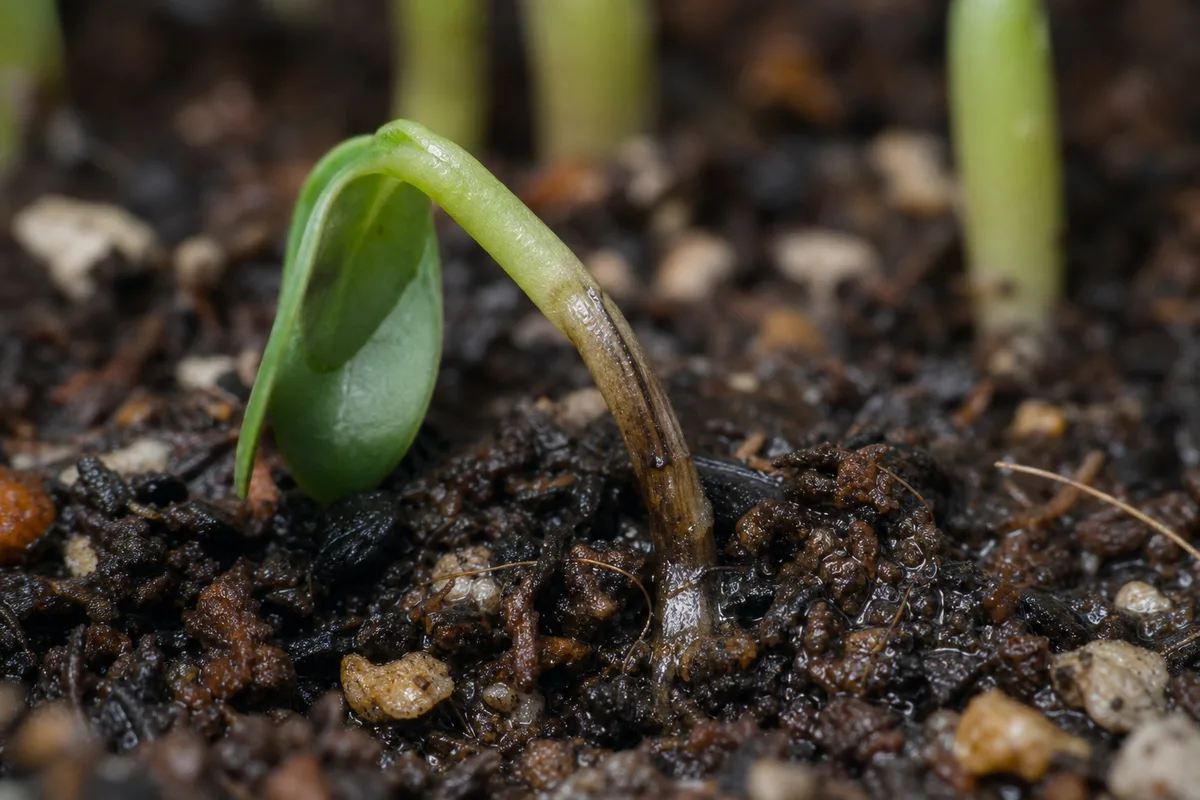
Damping Off symptoms on Adenium - compare with healthy tissue on the same plant.
- Pinch at the soil line - stem looks pinched, brown, black, or water-soaked; tissue above may stay green briefly
- Sudden collapse - not a slow wilt over a week; often overnight or within a day
- Patchy pattern - several seedlings in one tray, sometimes clustered, while others still stand
- Optional fuzzy growth - white, pink, or gray mold at the base in humid flats
Diagnostic sketch (soil line = ---):
DAMPING OFF                    LEGGY FLOP (not fungal)
     |  green cotyledons              |  pale stretched stem
     |                               |
  ---X---  dark pinched ring      ---|---  firm dry tissue
     |                               |
   mushy base                      mix surface
Gently pin the base between finger and thumb. Damping off shows a dark pinched ring and mushy tissue. Leggy light-starved seedlings fall from weak elongated stems, but the soil-line tissue stays firm and dry.
Leggy, pale seedlings stretching toward a dim window may also fall over, but the base stays firm and dry-that is weak light, not fungal damping off. Mature Adenium with a soft caudex and yellow leaves in a large pot is root rot from overwatering, not this seedling disease.
How to confirm the cause
Work through these checks before treating the whole tray with fungicide:
- Age of plant - damping off only affects germinating seeds and very young seedlings, usually before the first true leaves harden off
- Stem base - gently touch the soil line; damping off tissue is mushy or thread-thin, not firm and green
- Tray moisture - mix wet an inch down, condensation inside a dome, or algae on the surface supports a fungal diagnosis
- Temperature - soil below roughly 70°F slows Adenium germination and favors Pythium in cool, wet media
- Spread pattern - multiple collapsed cells in one flat points to damping off; one dry cell with a shriveled seedling points to underwatering on Adenium
If seeds never emerged at all, pre-emergence rot from the same fungi may be the issue-poor stand, empty cells, and mold on the surface without visible sprouts.
Damping off vs. lookalikes on desert rose
| Pattern | Stem at soil line | Mix moisture | Spread | First move |
|---|---|---|---|---|
| Damping off | Pinched, brown/black, mushy | Wet; dome condensation | Several cells at once | Discard collapsed; dry and vent tray |
| Leggy flop | Firm, dry; long pale stem | Often dry on surface | Usually one weak sprout | Add light and warmth |
| Underwatering | Firm but shriveled top | Dry; mix pulls from cell walls | Isolated dry cells | Bottom-water once |
| Mature caudex rot | Soft swollen base on adult plant | Wet potting mix | Whole potted plant | See root rot guide |
| Physical damage | Clean snap, not rotting ring | Any | Single disturbed cell | No fungicide; stabilize tray |
First fix for Adenium seedlings
Remove every collapsed seedling now-stem, roots, and the surrounding pinch of mix-and throw them in the trash, not the compost pile. There is no reliable cure once damping off has started; survivors are usually weak, and infected tissue keeps inoculating the tray.
After removal:
- Stop overhead misting; let the surface dry until it lightens in color
- Vent the dome or remove it entirely if most seeds have sprouted-Adenium often germinates within about a week under warmth, so domes sealed longer than a few days post-sprout trap humidity
- Run a small fan nearby so air moves across the flat without blasting seedlings
- Bottom-water only when the top layer is dry, using room-temperature water
Do not fertilize stressed seedlings, repot healthy ones the same hour, and do not drench fungicide on the entire tray unless you have confirmed active spread and read the label for ornamentals. One correction first-dryer conditions and sanitation-beats stacking treatments.
Step-by-step recovery for remaining seedlings
If upright seedlings still have firm stems at the base:
- Isolate the tray away from other seed flats and mature Adenium
- Thin crowded cells so leaves are not touching-better airflow between plants
- Move to warmth and light - a heat mat holding soil near 80°F and bright light after the first true leaves appear matches desert rose germination needs
- Bottom-water on a schedule - at warm soil temperatures, many growers bottom-water every 3–5 days only when the surface is dry; set the tray in shallow water until the surface moistens, then lift it out
- Watch for 3–5 days - new upright growth and firm stem bases mean you stabilized conditions; any new pinching means discard those cells too
Seedlings that stay small, hard, and stunted at the soil line after infection may linger but rarely become vigorous adult plants. Starting a fresh batch with sterile mix is often faster than nursing compromised survivors-see the Adenium propagation guide for a clean restart.
Recovery timeline
| Stage | What to expect |
|---|---|
| Day 0 | Remove collapsed seedlings; surface begins drying |
| Days 1–3 | Spread should stop if mix dries and airflow improves |
| Days 4–7 | Healthy neighbors produce new leaf pairs if warmth and light are adequate |
| Weeks 2–4 | Surviving seedlings can move toward normal desert rose care-still avoid soggy mix |
| First winter | Small seedlings remain delicate; keep warm, bright, and slightly drier than summer trays |
Collapsed seedlings do not grow back. Judge success by whether unaffected cells keep standing and produce new leaves, not by reviving fallen sprouts.
What not to do
Do not leave collapsed seedlings in the tray to see if they recover-they will not, and they infect neighbors. Do not keep a sealed humidity dome on sprouted Adenium for days; remove plastic covers after about half the seeds have germinated. Do not use garden soil or reuse mix from a collapsed flat without sterilizing containers. Do not start seeds in heavy peat alone without perlite, pumice, or coarse sand-desert rose needs the wet-dry cycle gritty media provides. Wear gloves when handling cut seedlings; Adenium sap is toxic and irritates skin-NC State notes contact dermatitis from milky latex on all plant parts.
When sterilizing trays indoors, use a 1:10 bleach rinse after soapy washing, rinse well, and air-dry before reuse-never mix bleach with other cleaners in an enclosed space.
How to prevent damping off next time
Start clean. Use sterile soilless mix-not garden soil-and wash trays with soapy water, then a 1:10 bleach rinse. For Adenium, blend in extra perlite, pumice, or coarse sand so water drains in seconds, not days.
Warm the soil. Germinate on a heat mat targeting roughly 80°F; cold soil slows Adenium and invites Pythium. UC IPM recommends heat mats when ambient soil runs cool, and Penn State Extension suggests 70–75°F bottom heat for general seedling flats-desert rose growers often run slightly warmer for faster sprout.
Control moisture. Bottom-water when the surface dries. Vent domes daily after sprouting, then remove them within a few days on fast-germinating desert rose. Space seeds so airflow reaches every cell.
Sanitize between batches. Fungi spread on tools, hose ends, and reused flats-scrub and rinse containers between sowings.
Accept losses early. Discarding one bad cell the moment it pinches protects the rest of a desert rose batch better than waiting for half the tray to fall.
When fungicide might help
Environmental correction-dryer mix, airflow, dome removal, sanitation-is the first and usually sufficient response on home Adenium trays. Penn State Extension notes that fungicides on seedlings can inhibit root formation and should be avoided when possible.
If collapse keeps spreading despite dry, airy conditions on a valuable batch:
- Treat only after confirming damping off, not underwatering or light flop
- Use a product labeled for ornamental seedlings or greenhouse damping-off and follow label rates exactly-never exceed concentration on tender cotyledons
- Test on a small portion of the tray first if the label allows; some chemicals stress young roots
- Seed treatments exist for commercial growers; home sowers gain more from sterile mix and heat than from post-collapse drenches
Fungicide does not resurrect collapsed seedlings. It is a containment tool for neighbors while you fix the wet, stagnant conditions that caused the problem.
When to use this page vs other Adenium guides
- Adenium watering guide - Use for routine moisture checks before assuming damping off is the main issue.
- Adenium problems hub - Browse all 40 common issues on this species.
Related Adenium guides
- Adenium overview
- Adenium watering
- Adenium light
- Adenium soil
- Adenium problems
- Ants on Plant on Adenium
- Aphids on Adenium
- Black Spots on Adenium
Related tool
Use the Plant Problem Diagnosis Tool to narrow causes for damping off on this plant before changing multiple variables at once.