Spider Mites on Adenium: Causes, Checks & Fixes
Quick answer
Spider mites on Adenium show as pale stippling and fine webbing, often in hot dry indoor air. First step: isolate the plant and rinse leaf undersides with a strong stream of water to knock off mites before any spray.
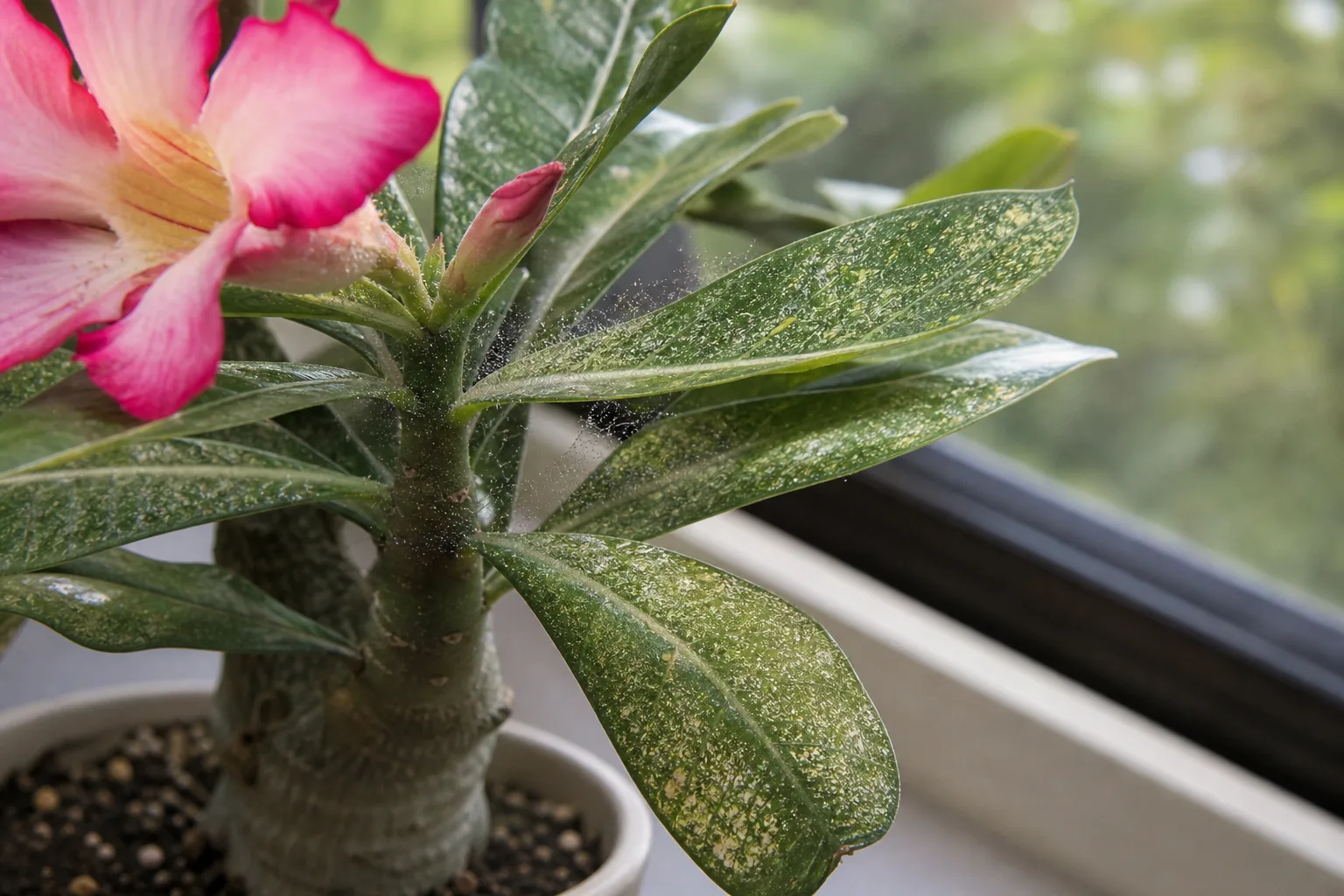
Spider Mites on Adenium: Causes, Checks & Fixes
This guide covers spider mites on Adenium. See also the general Spider Mites guide, watering, and light pages for this plant.
Spider Mites on Adenium: Causes, Checks & Fixes
Quick answer
Your Desert Rose has fine webbing and pale dots on the leaves, but you have not watered in weeks-is it rot or bugs? Press the caudex: firm tissue with stippling and silk at stem joints points to spider mites; soft tissue on wet mix means root rot first.
Adenium obesum stores water in its caudex and wants full sun with gritty, fast-draining mix. Mite damage mimics leaf stress, but do not respond by watering more-wet soil during cool months kills desert rose faster than dry canopy air.
First step: isolate the plant and rinse every leaf underside with a firm stream of lukewarm water for several minutes. That physical knockdown confirms active mites and buys time before you choose soap or oil sprays.
What spider mites look like on Adenium
Spider mites are barely visible dots-often red, green, or amber-clustered on leaf undersides and young stem tissue. On Desert Rose their feeding leaves a distinctive pattern:
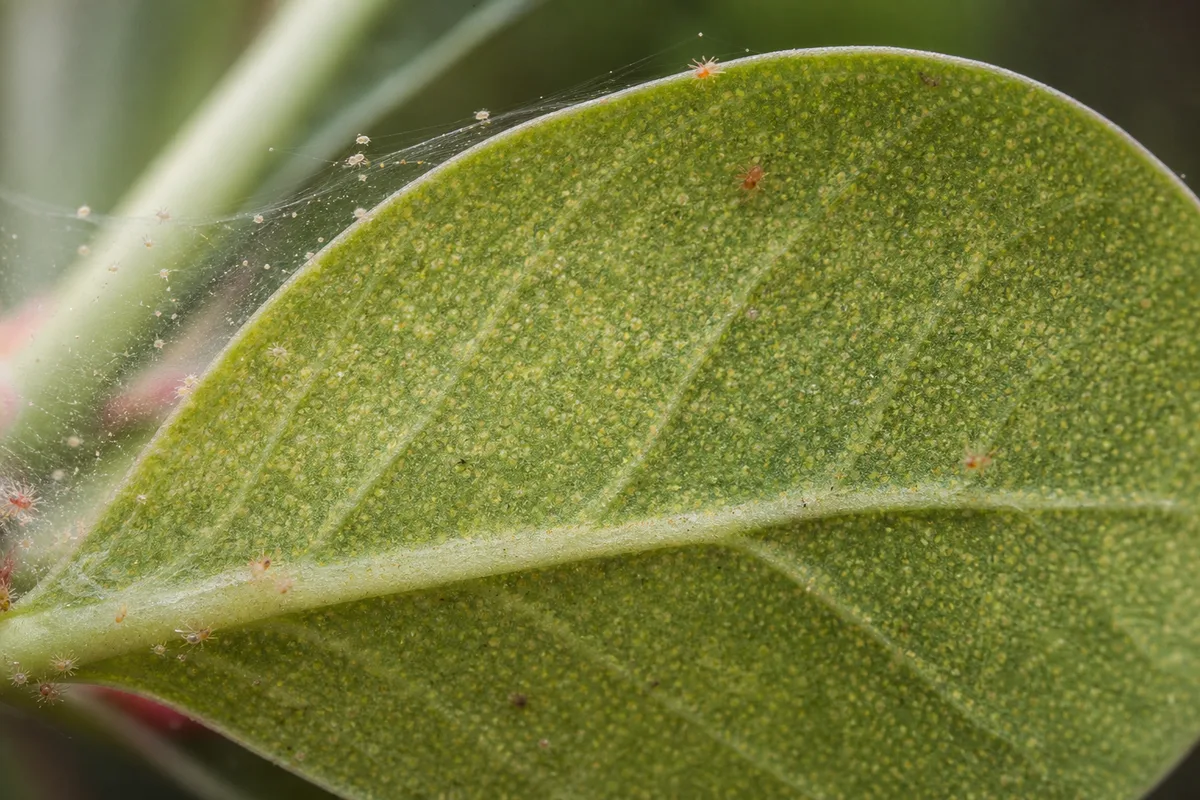
Spider Mites symptoms on Adenium - compare with healthy tissue on the same plant.
- Stippling: thousands of tiny yellow or white dots where individual leaf cells were drained
- Dull or bronzed leaves that still feel papery, not mushy
- Fine webbing between leaves, at the caudex crown, or along thin branches
- Slow tip growth during warm months when the plant should be pushing new leaves
Adenium leaves are thick and succulent compared with thin-leaved houseplants like pothos or ficus, so early stippling can stay subtle for weeks-you may notice dull bronzing before you see individual dots. By the time webbing is obvious, the colony has usually been present for some time. During winter dormancy, when Adenium drops most foliage, mites shift to stems and any remaining leaves-bark may look grayish or dusty rather than its normal green or burgundy tone.
Unlike caterpillar damage, you will not see ragged holes. Unlike mealybugs, there are no white cottony clusters-though both pests can appear on the same stressed plant.
Why desert rose gets spider mites (dry air vs. dry roots)
Adenium evolved for sun and heat, and spider mites thrive in overlapping conditions: warm air, low humidity, and dust on leaf surfaces. The conflict is environmental, not contradictory-your desert rose wants dry roots and bright light, while mites exploit the dry canopy above the pot.
Winter indoor microclimate. A common setup-south window for light plus forced-air heat running-creates exactly what spider mites favor indoors: warm, dusty foliage with very low humidity while soil stays appropriately dry. Soil dryness is correct Adenium care; canopy dryness is mite habitat.
Crowded collections. Mites crawl short distances and ride on tools, hands, or breeze between pots on a sunny shelf.
Dusty leaves. Full-sun Adenium accumulates dust that blocks inspection and gives mites cover.
Stressed plants. Extended drought during active growth, sudden light reduction, or recent Adenium repotting guide weaken new tissue-mites colonize tips first.
UF/IFAS lists mites among pests on Adenium obesum, alongside aphids and mealybugs. The plant is not immune just because it is succulent.
Confirm mites vs. rot, dormancy, sun scorch, thrips, and fungal spot
Work through these checks before spraying anything:
- White-paper tap test. Hold a suspect leaf over white paper and flick the underside. Moving specks confirm live mites.
- Magnifier scan. Inspect newest leaves and stem joints at 10× magnification. Look for dots plus silk threads.
- Caudex feel. Press the swollen base. Firm tissue with stippled leaves points to mites. Soft tissue with yellow wilting leaves suggests rot-different emergency.
- Soil moisture. Push a finger 5–7 cm deep. Bone-dry mix with a firm caudex is normal Adenium rhythm, not proof of mites. Wet mix with stippling still means mites, but fix drainage before heavy foliar rinsing indoors.
- Location audit. Note heaters, AC vents, and whether neighboring plants show stippling too.
Symptom lookalike comparison
| What you see | Likely cause | Key check |
|---|---|---|
| Stippling + webbing + firm caudex | Spider mites | Moving specks on white-paper tap test |
| Bare branches, firm caudex, no silk | Winter dormancy | Cool season; no undersurface mites on stems |
| Uniform wilt, dry pot, no dots | Underwatering | No webbing; weight light; see watering guide |
| Crispy brown leaf margins after sun move | Sun scorch | Margins only-not evenly spaced dots across leaf face |
| Silvery scars, distorted new growth | Thrips | Rasping scars; less classic webbing |
| Circular brown lesions | Fungal leaf spot | Wet foliage history; not mite stippling |
| White cottony clusters in caudex folds | Mealybugs | Wax in crevices; alcohol turns pests orange-gray |
| Soft caudex, wet soil, sour smell | Root rot | Base yields under gentle pressure |
Confirmed diagnosis - stippling with undersurface activity or webbing on a firm caudex. Suspected - uniform yellow leaf drop and bare branches in cool months with no silk may be normal dormancy; recheck stems with a lens before treating.
First fix: isolate, rinse, and treat safely
Isolate and rinse. Move the Adenium away from other plants. In a sink, shower, or outdoors in mild weather, spray every leaf underside and stem with a strong lukewarm stream for several minutes. Rotate the pot so water reaches axils where webbing hides.
This single step:
- Removes a large fraction of adults and eggs through physical washing
- Confirms you are treating the right problem
- Avoids stacking pesticides on day one
Let the plant drain and dry in bright indirect light for the rest of the day. Do not water the pot just because leaves look stressed-wait for your normal dry-down interval per the Adenium watering guide.
Dawn/dusk spray timing for full-sun plants
Schedule any soap or oil for early morning or late evening so wet leaves dry before intense direct sun hits outdoor specimens. Clemson Extension cautions against applying soap above 90°F or when plants are heat-stressed-Adenium in afternoon summer sun burns easily if residue lingers on glossy foliage.
Insecticidal soap and horticultural oil on succulents
If stippling persists or webbing remains after the rinse, apply insecticidal soap or horticultural oil labeled for mites. Coat all leaf surfaces, especially undersides, until the solution barely drips.
For labeled ready-to-use products, follow package intervals. If mixing concentrate, Clemson Extension suggests a 1 to 2% soap solution (about 2½ to 5 tablespoons per gallon of water) and repeating every four to seven days. Mite eggs hatch in cycles; one spray rarely clears an outbreak.
Oil phytotoxicity note: Horticultural oils can injure plants when temperatures exceed about 80°F or humidity stays high-residue that evaporates slowly increases burn risk. Patch-test oil on one lower leaf or a small stem section 24 hours before full treatment. Adenium’s glossy, thick leaves are less glaucous than powdery echeveria, but outdoor desert roses in peak summer still need cool-hour applications.
Between sprays: Optionally raise ambient humidity around the plant with a pebble tray or brief room misting-not the soil surface. Spider mites reproduce faster in dry air, but caudex rot comes from wet mix, so never trade root moisture for foliar humidity. See the low humidity guide for canopy-vs-root distinction.
Prune only if needed. Remove a heavily webbed leaf or two and bag it. Wear gloves-Adenium sap is toxic and irritates skin. Do not strip the plant bare unless most leaves are already lost.
Step-by-step recovery and timeline
- Isolate and rinse all leaf undersides and stems thoroughly.
- Re-inspect with white-paper tap test 24–48 hours later.
- If mites persist, apply insecticidal soap or horticultural oil at dawn or dusk; coat undersides until runoff.
- Repeat every five to seven days for at least three cycles to catch newly hatched mites.
- Inspect neighboring pots weekly; treat early stippling on adjacent plants.
- Judge success by clean new tip leaves, not by repaired old stippled tissue.
Days 1–3: Webbing loosens after the first rinse; live mite activity should drop on re-inspection.
Week 1–2: Stippling stops spreading to new leaves if treatment coverage was thorough.
Weeks 2–4: After three timed spray cycles, new tip leaves should emerge without fresh dots. Old damaged leaves stay stippled permanently-that is normal; drained cells do not refill.
Dormant plants: Recovery may wait until spring flush even after mites are gone. A firm caudex through winter means the plant is still viable-keep inspecting bare stems monthly.
Mistakes to avoid
Watering more when leaves look sick. Mite-stippled Adenium still needs dry-down watering. Wet soil in cool weather invites [caudex rot](https://www.missouribotanicalgarden.org/gardens-gardening/your-garden/help-for-the-home-gardener/advice-tips-resources/insects-pests-and-problems/environmental/[overwatering on Adenium](/plants/adenium/overwatering/))-a bigger killer than mites.
One-and-done spraying. A single soap application leaves eggs to hatch. Plan three cycles minimum.
Treating only leaf tops. Mites live underneath. Incomplete coverage guarantees return.
Spraying in midday sun. Soaps and oils on wet leaves in hot direct sun can burn Adenium foliage. Treat at dawn or dusk.
Raising humidity by watering the pot. Pebble trays and room humidifiers target air, not roots.
Ignoring dormant stems. Mites on leafless winter plants still drain stem tissue-inspect with a magnifier monthly.
How to prevent spider mites on Adenium
Match prevention to how Desert Rose actually lives in your home:
- Quarantine new purchases for two weeks; rinse and inspect undersides before shelf placement.
- Rinse foliage monthly during active growth-the same physical control that works in treatment.
- Keep dust off sun-facing leaves so you spot stippling early.
- Maintain airflow around the caudex without overpotting into slow-drying mix.
- Weekly winter checks with a magnifier on stems when the plant is indoors and heat is running.
- Avoid crowding multiple succulents so mites cannot walk between pots.
Strong culture helps: full sun, correct dry-down rhythm, and a firm caudex make new growth less inviting-but dry winter air still requires inspection, not humidifiers on the soil. Baseline care lives on the Adenium care hub.
When to escalate - miticides, extension help, and pet safety
Treat as urgent when:
- Webbing spans multiple branches and returns within days of rinsing
- The last leaves on a dormant plant are stippled and falling
- New spring growth emerges already dotted despite two treatments
- Mites appear on several plants in the same room
Lower urgency when stippling is on one branch, the caudex is firm, and the first rinse removes visible mites. Monitor for a week before adding sprays.
If stippling spreads through three full soap or oil rounds, contact your local extension office for identification confirmation. General broad-spectrum insecticides often miss mites; labeled miticides with active ingredients such as abamectin or bifenthrin may be discussed by professionals for stubborn greenhouse or nursery outbreaks-always follow label directions for ornamentals and rotate modes of action to limit resistance. Insecticidal soaps are among the safer contact options on ornamentals when applied in cool hours.
Spider mites rarely kill a mature Adenium with a healthy caudex if caught before severe defoliation-but they can weaken the plant enough that rot fungi exploit later overwatering. Fix pests first; keep the root zone disciplined.
Pet ingestion: If a cat or dog chewed stems, leaves, or soap-treated tissue, contact your veterinarian or ASPCA Poison Control at (888) 426-4435 immediately-Desert Rose contains cardiac glycosides that can cause vomiting, irregular heartbeat, and worse.
Before you water again
Stippling and webbing on a firm caudex means rinse mites first-not another drink. Soft caudex on wet mix means rot protocol, not pest spray. That single check keeps most desert rose owners from making the problem worse while they treat the right cause.
Related problems: Mealybugs · Aphids · Low humidity · Root rot · Adenium overview
When to use this page vs other Adenium guides
- Adenium watering guide - Use for routine moisture checks before assuming spider mites is the main issue.
- Adenium problems hub - Browse all 40 common issues on this species.
- Curling Leaves on Adenium - Different entry point when symptoms overlap with spider mites.
- Leaf Drop on Adenium - Different entry point when symptoms overlap with spider mites.
- Slow Growth on Adenium - Different entry point when symptoms overlap with spider mites.