Slow Growth on Adenium: Causes, Checks & Fixes
Quick answer
Slow growth on Adenium is often normal in cool dormancy-but during warm active growth, weak sun, root stress, or recent repot shock are the usual brakes. First step: confirm the season and caudex firmness, then move the plant to full direct sun if temperatures are warm and the base is firm.
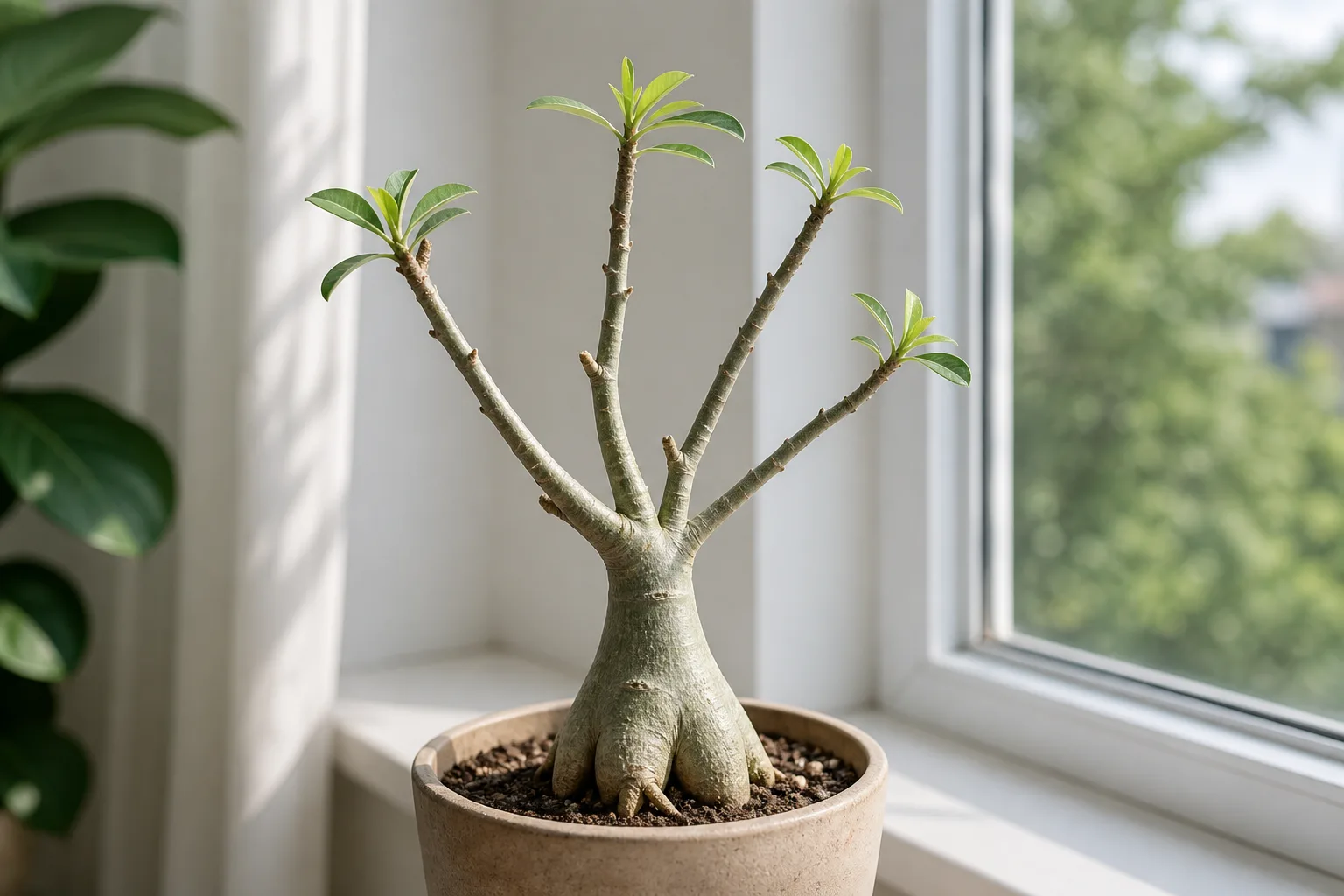
Slow Growth on Adenium: Causes, Checks & Fixes
This guide covers slow growth on Adenium. See also the general Slow Growth guide, watering, and light pages for this plant.
Slow Growth on Adenium: Causes, Checks & Fixes
Quick answer
Slow growth on Adenium (Adenium obesum), also called Adenium overview, is not always a problem. This is a naturally slow caudex plant that may pause for months during cool dormancy. Concern starts when warm active growth returns and you still see no new leaves, no stem extension, and no gradual caudex swelling for weeks.
First step: confirm the season and feel the caudex (swollen base). If temperatures are warm, the caudex is firm, and the plant sits in fewer than six hours of direct sun, move it to your sunniest stable spot before you change watering, fertilizer, or pot size.
Adenium builds its sculptural caudex slowly by design. During active growth it should still push new glossy leaves at branch tips every few weeks and thicken the base over a season. Static stems with pale foliage in a dim room, or a firm caudex that never wakes after spring warmth, point to fixable cultural limits-not a dead plant.
What slow growth looks like on Adenium
On Desert Rose, “slow” means different things than on fast-growing tropicals like pothos. Judge new leaf frequency, caudex change, and season together.
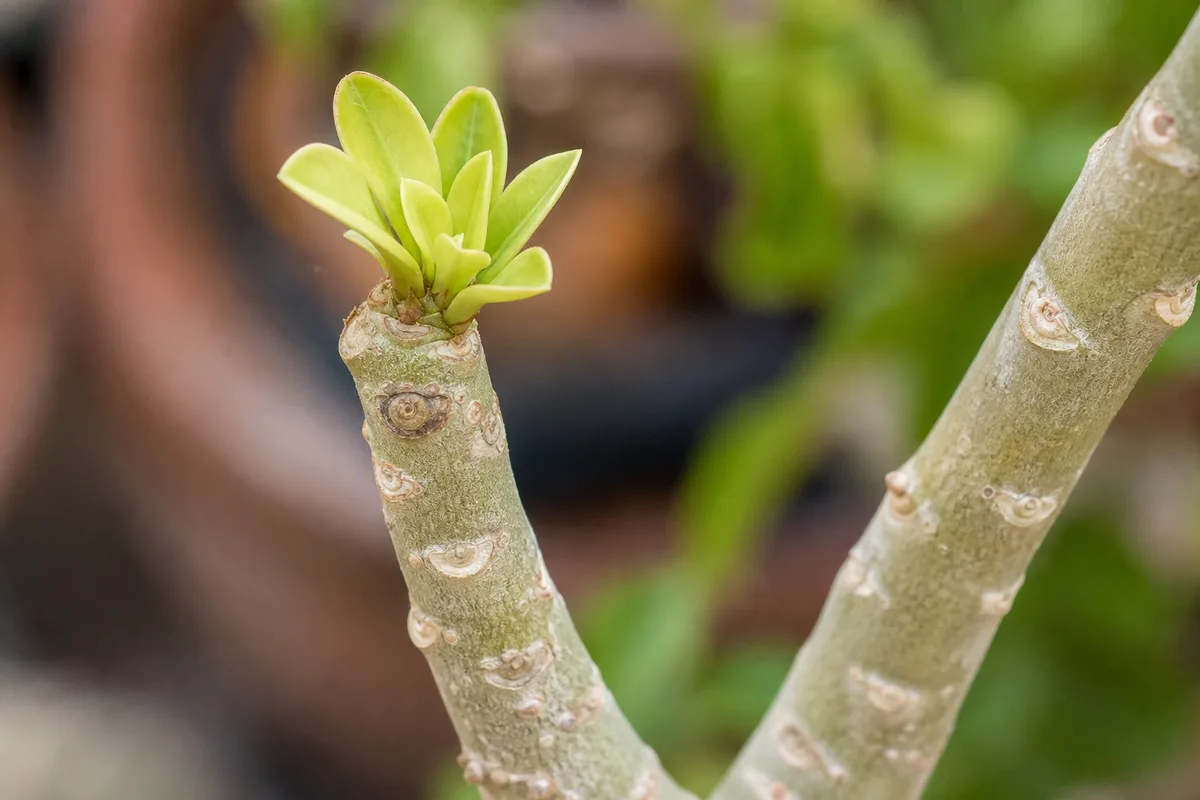
Small pale leaves clustered only at the stem tip with bare lower branches and no visible internode progress - compare with the firm caudex and season before assuming the plant is failing.
Typical slow-growth patterns:
- No new leaves for weeks during warm summer or spring, while the caudex stays firm but does not swell
- Small, pale new leaves at stem tips-often the first sign of weak light before stems stretch
- Stems that look frozen in place-no fresh branch tips, no flower buds, no visible internode progress over a month of warm weather
- Caudex that neither swells nor wrinkles-the plant looks parked, not actively building or clearly resting
- Growth that resumes only at the very top while lower branches stay bare-common after a rough dormancy or repot
Normal slow periods you should not panic over:
- Cool winter dormancy-leaves drop, watering stops, and the plant may look bare for three to four months while the caudex stays hard
- First two to four weeks after spring wake-up-new leaf tips appear before the caudex visibly thickens
- Two to three weeks after Adenium repotting guide-root disturbance pauses top growth even when care is correct
- Young seed-grown plants-the best caudex usually develops from seed-grown plants, often over several warm seasons before vigorous blooming
Compare with a firm versus soft caudex every time. Slow growth with a soft, yielding base and wet soil is root stress-not patience. Slow growth with a firm, slightly wrinkled base and dry mix is drought holding growth back.
Why Adenium gets slow growth
Desert Rose evolved as a drought-adapted succulent tree from Tropical Africa and the Arabian Peninsula. It stores water in its caudex and grows in bursts when heat and light are strong-not steadily year-round like many foliage houseplants.
Insufficient direct sun (most common in active growth)
Adenium needs bright sunlight for six hours or more per day to flower and grow vigorously, and will not flower under low light conditions. Under low light, the plant survives but stalls new leaf and caudex development, often while stems slowly stretch toward the brightest window. Indoor placements that look bright to you may still fall short of the direct sun this species uses to fuel caudex swelling.
Cool weather and natural dormancy
When temperatures dip below about 55°F, Adenium slows sharply. Chill can yellow and drop leaves. Through cold winter months, withhold water and let the plant rest for 3–4 months-no new growth is expected. Growth resumes when spring warmth returns and you gradually restore watering and feeding.
Root stress from wet soil
overwatering on Adenium-especially in cool weather or dense peat-heavy mix-damages roots before the caudex goes fully soft. Too much water can lead to root rot and early root stress limits water and nutrient uptake, so growth stalls even though leaves have not yellowed yet. Wet soil with a firm caudex today can become a soft caudex tomorrow if watering continues.
Drought during active growth
A firm but wrinkled caudex with bone-dry mix also stops new leaves. Adenium tolerates dry spells, but extended drought in hot summer prevents the tissue building that thickens the base. Growth pauses until the plant rehydrates.
Recent repotting or relocation
Root disturbance, a new window, or a move indoors for winter temporarily limits uptake. Desert Rose often sits visually static for two to three weeks after repotting while roots settle-normal if the caudex stays firm.
Sap-sucking pests
Low-level aphid, mealybug, or spider mite infestations drain vigor from new shoots without obvious collapse. Growth slows on tender tips while older leaves look unchanged.
What usually is not the cause
Adenium does not need high humidity to grow-dry household air is fine. Fertilizer rarely fixes slow growth when light is weak or roots are stressed. Severe root binding is uncommon as a growth limiter because Desert Rose tolerates-and often prefers-being slightly pot-bound.
How to confirm the cause
Work through this order before repotting, feeding, or watering heavily:
- Season and temperature - Is it cool dormant months, or warm active growth above roughly 75°F (24°C)? Bare branches in winter with a firm caudex are often normal rest.
- Caudex firmness - Press the swollen base. Firm and hard supports patience or a light fix. Soft, squishy, or darkening means stop watering and inspect roots.
- Direct sun hours - Count hours of direct sun on the plant, not just bright ambient room light. Fewer than six hours during warm months strongly points to light as the bottleneck.
- Soil moisture at depth - Probe 5–7 cm deep. Chronic wet mix with stalled growth suggests root stress. Very dry mix with a wrinkled firm caudex suggests drought.
- Pot weight and drainage - A heavy pot that never dries, or a saucer holding water, slows growth by keeping roots oxygen-starved.
- Recent changes - Repot, move, or indoor transition within the last month explains a short pause.
- New growth inspection - Check stem tips and leaf undersides for aphids, mealybugs, stippling, or webbing.
- Plant age - Seedlings and young plants grow slowly by nature; a two-year-old desert rose may simply need more time and stronger sun.
If warm weather, wet soil, and a soft caudex appear together, treat as root rot risk before assuming the plant needs more fertilizer or a larger pot.
First fix for Adenium
If temperatures are warm and the caudex is firm, move the plant to full direct sun-six or more hours daily-before you change water, feed, or repot.
- Dim indoor spot during warm months: shift to the sunniest south or west window, or outdoors in morning-to-midday sun after a one-to-two-week acclimation.
- Just exiting dormancy: resume light watering only when new leaf tips show; place in maximum sun as warmth stabilizes.
- Wet mix with stalled growth but firm caudex: move to sun and airflow first, then let the mix dry through before the next drink-do not add water to force growth.
- Dry mix with wrinkled firm caudex: one deep watering after the sun move, then return to soak-and-dry intervals.
Do not stack repotting, pruning, fertilizer, and pesticide on the same day. Adenium responds best to one correction, then a two-to-four-week watch on new tip growth and caudex firmness.
Step-by-step recovery
Once the first fix matches what you confirmed:
- Hold placement stable - Pick the sunniest spot and leave the pot there through the next growth flush. Repeated moves abort new shoots.
- Match watering to season - Soak-and-dry during warm active growth; minimal water in cool rest. Empty saucers after every watering.
- Add feed only after growth restarts - Half-strength balanced liquid fertilizer every two to three weeks during summer active growth, not during dormancy or on a stressed root zone.
- Treat pests if confirmed - Rinse new growth, then insecticidal soap at label intervals until tips stay clean for two weeks.
- Repot only when mix fails - Heavy peat, no drainage holes, or black mushy roots need gritty succulent mix and trimmed rot-not a larger pot on day one for mild slowness alone.
- Track caudex, not just leaves - Photograph the base monthly during warm season; gradual thickening confirms progress even when leaf count changes slowly.
Recovery timeline
Low-light correction in warm weather often produces the first new leaves within two to four weeks; caudex swelling becomes visible over one full growing season, not days.
Post-dormancy wake-up may take three to six weeks after stable spring warmth and resumed watering before active tip growth looks normal.
Repotting pause usually breaks within two to three weeks if the caudex stays firm and sun is strong.
Early root stress from overwatering can take several weeks of dry-down; advanced soft caudex rot may never fully restore lost tissue.
Drought-related stall often turns around within one to two weeks after a single deep watering on a firm wrinkled base.
Signs you are on track: new glossy leaves at stem tips, caudex firmness maintained or gradual thickening, and flower buds forming during summer-not just unchanged bare branches.
Lookalike symptoms
Slow growth on Adenium overlaps with other problems:
- Leggy growth on Adenium - Long thin stems reaching toward light mean the plant is growing, just badly; true slow growth means little new tissue anywhere.
- No flowers - Weak sun stops blooms before it stops all leaf production; both share a light fix.
- Wilting or drooping - Limp leaves with wet soil and soft caudex is rot, not slow growth. Firm caudex with dry soil is drought.
- Yellow leaves on Adenium - Chill and dormancy yellow before drop; overwatering yellows with soft tissue. Slow growth can coexist but the caudex feel separates causes.
- Stunted new shoots - Pest damage and virus mottling deform tips; inspect closely if leaves emerge small and twisted, not merely sparse.
Always pair growth rate with season, sun hours, and caudex condition-reading stems alone misleads on Desert Rose.
What not to do
Do not fertilize heavily to “force” growth on a plant in weak light or wet soil-salt buildup stresses roots further. Do not repot into a much larger pot hoping for a growth spurt; excess wet soil around sparse roots invites rot. Do not increase watering on a bare dormant plant in cool months. Do not expect summer growth rates in winter rest. Do not judge progress daily; track new leaves over weeks.
Wear gloves when pruning-the milky sap is irritating, and the plant is toxic to pets if ingested.
How to prevent slow growth next time
Match care to Adenium’s rhythm: full direct sun during warm active growth, loose, sandy or gravelly, well-drained soil, and dry-down watering between drinks, with sharply reduced moisture in cool dormancy. Resume watering and light feeding only when spring warmth returns and new leaf tips show. Acclimate outdoor sun moves over one to two weeks. Quarantine new plants and inspect stem tips weekly during summer.
Accept that caudex development is inherently gradual-allow soils to dry between waterings and consistent sun matter more than chasing rapid size with excess feed or water.
When to use this page vs other Adenium guides
- Adenium watering guide - Use for routine moisture checks before assuming slow growth is the main issue.
- Adenium problems hub - Browse all 40 common issues on this species.
- Not Enough Light on Adenium - Different entry point when symptoms overlap with slow growth.
- Leggy Growth on Adenium - Different entry point when symptoms overlap with slow growth.
- Yellow Leaves on Adenium - Different entry point when symptoms overlap with slow growth.