Fertilizer Burn on Adenium: Causes, Checks & Fixes
Quick answer
Fertilizer burn on Adenium most often follows feeding during winter leaf drop or weak light-when the caudex is resting and cannot use nutrients. Stop all fertilizer, flush twice if drainage is excellent, and resume half-strength feed only after warm active growth returns.
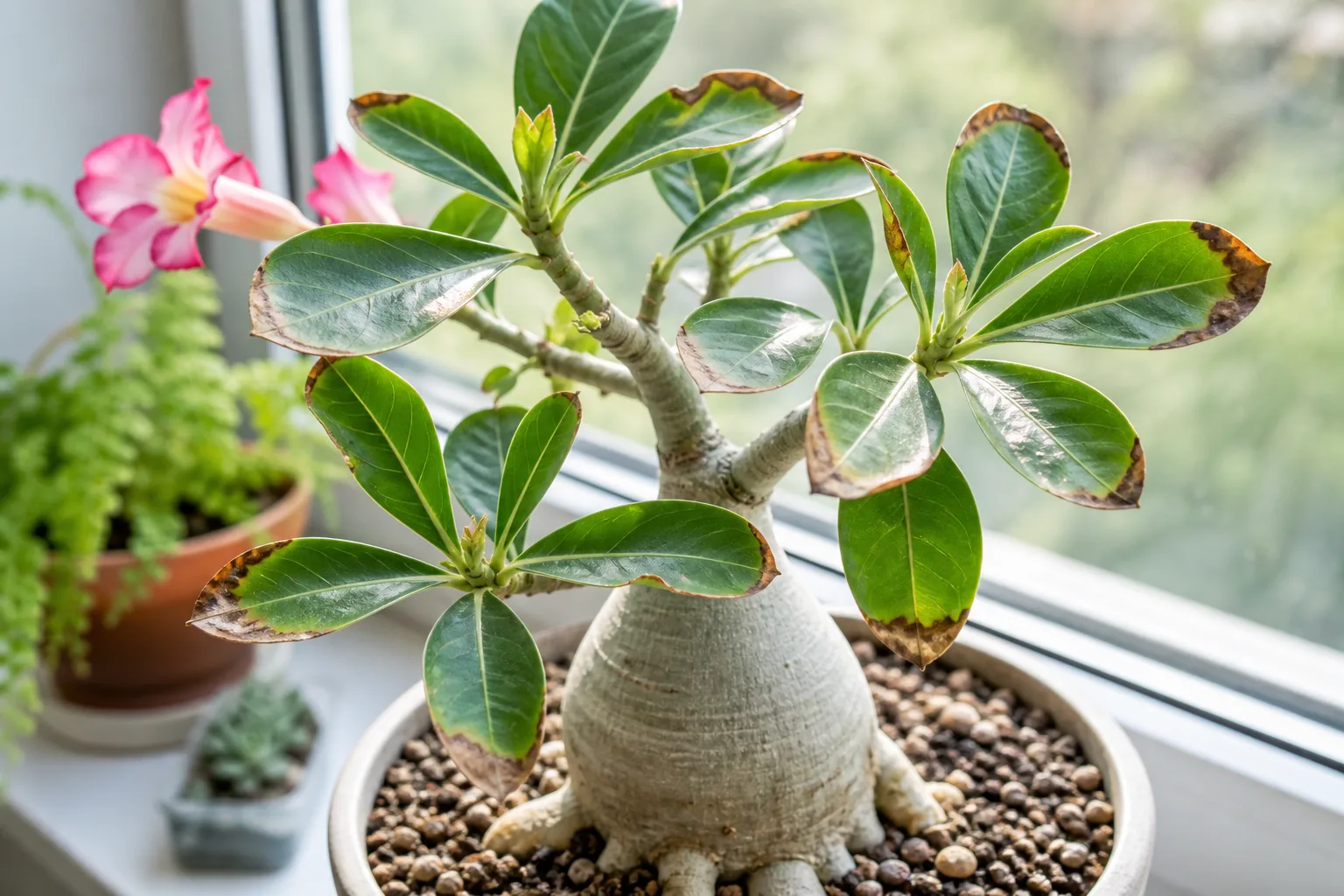
Fertilizer Burn on Adenium: Causes, Checks & Fixes
This guide covers fertilizer burn on Adenium. See also the general Fertilizer Burn guide, watering, and light pages for this plant.
Fertilizer Burn on Adenium: Causes, Checks & Fixes
Quick answer
The most common Adenium fertilizer-burn mistake is feeding during winter leaf drop-when UF/IFAS notes the plant should rest three to four months with water withheld and all leaves and flowers dropped as part of its natural cycle. A grower sees a leafless caudex, assumes the plant is hungry, and applies liquid feed. Salts accumulate in the root zone because dormant roots cannot absorb them. Weeks later, when warmth returns, margins crisp on new or remaining leaves and white crust may appear on the soil surface.
This page covers post-feed salt injury-brown margins tied to a recent fertilizer application. For multi-cause brown tips (dry-down, tap water, sun), use the brown tips on Adenium guide. For baseline feeding schedules and NPK choice, see the Adenium fertilizer guide.
First fix: stop all fertilizer immediately. If the caudex is firm and the pot drains freely, flush the soil with plain room-temperature water until roughly three pot volumes run through, empty the saucer, wait one week, and repeat once. Do not feed again for at least four to six weeks-or until warm active growth resumes with clean new leaves.
Why desert rose is easy to over-fertilize
Adenium obesum (desert rose) evolved across arid Africa and Arabia as a drought-adapted succulent tree that stores water in a swollen caudex. That reservoir lets the plant survive long dry seasons, but it also means the root system processes nutrients slowly compared with fast-growing tropical foliage plants. Container culture in peat-heavy or oversized pots traps fertilizer residue near the caudex even when you water carefully.
Three Adenium-specific traps drive most home cases:
Feeding during dormancy. When night temperatures fall and days shorten, desert rose drops leaves and enters a rest period lasting roughly three to four months. UF/IFAS EP474 explicitly calls for withholding water and letting the plant rest during cold winter months-feeding during this window is the single most common burn trigger because metabolism is near zero.
Feeding in weak light. Adenium needs six or more hours of bright sunlight daily to maintain flowering and active nutrient uptake. A shaded windowsill plant fed on a summer schedule cannot use the salts you add; they concentrate in the root zone.
Full-strength or stacked doses. Excess soluble salts burn leaf tips and margins, damage fine root hairs, and can cause wilting even when soil feels moist. Slow-release granules placed too close to the caudex, or repeated liquid feeds without flushing between applications, compound the problem on thick succulent leaves where injury concentrates at edges.
Feeding frequency - weekly extension guidance vs. conservative home default
UF/IFAS EP474 recommends a low dose of liquid fertilizer weekly during the summer growing season at manufacturer label dilution-written for outdoor Florida specimens in high light. The Adenium fertilizer guide uses a more conservative home default: half-strength liquid every 3–4 weeks during active growth, with a monthly plain-water flush. Both approaches are valid when light, pot size, and drainage match the feeding intensity. Burn usually follows off-season feeding, full label strength indoors, or skipping flushes-not the exact week count alone.
Feeding during leaf drop - when rest timing varies
Winter rest is triggered by cool nights and shorter days, not the calendar alone. Outdoor desert roses in USDA zones 10B–12 may rest later than a windowsill plant in a heated northern room. Indoor specimens near radiators may never fully drop leaves yet still slow growth enough that weekly summer feeding becomes too much.
Rule of thumb: if the plant is leafless or nearly leafless and you have reduced watering, treat it as dormant and skip all fertilizer until new leaves emerge in warm weather. A few winter flowers on a cool plant do not justify feeding-blooms on a resting caudex still run on stored reserves, not fresh nitrogen.
What fertilizer burn looks like on Adenium
On desert rose, salt burn is margin-focused and tied to recent feeding:
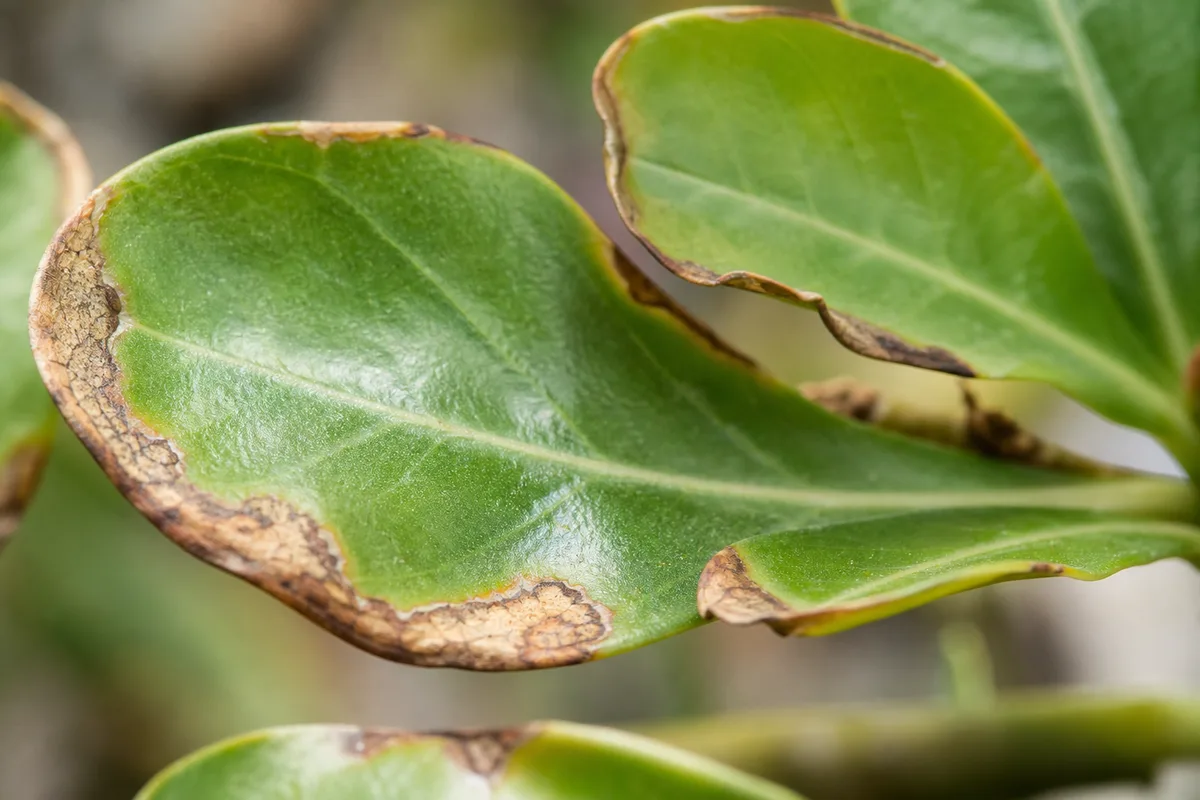
Fertilizer Burn symptoms on Adenium - compare with healthy tissue on the same plant.
- Dry brown, tan, or papery tips and thin margins while the mid-leaf stays green and stiff
- Damage on several leaves within one to two weeks of feeding, often older outer leaves first
- White or crusty residue on soil surface, pot rim, or saucer
- Sudden leaf drop or wilt shortly after a feed, with the caudex still firm in mild cases
- Reduced or absent flowering after heavy nitrogen feeds during summer
This differs from root rot from overwatering, where the caudex goes soft, stems blacken at the base, and soil may smell sour. It also differs from sun scorch, which bleaches or browns the window-facing side of leaves after a sudden move into harsh sun rather than isolated tip necrosis across multiple leaves.
Fertilizer burn vs. brown tips, sun scorch, rot, and drought
Use this table when symptoms overlap-brown margins appear on several Adenium problem pages:
| Sign | Fertilizer burn (this page) | Brown tips (multi-cause) | Sun scorch | Root rot / overwatering | Underwatering |
|---|---|---|---|---|---|
| Best trigger clue | Fed within last 1–2 weeks | Any time; dry-down or salts | After sudden sun move | Wet soil, heavy watering | Long dry spell in heat |
| Caudex feel | Firm | Firm or slightly wrinkled | Firm | Soft, yielding | Firm, slightly wrinkled |
| Soil surface | White crust common | Crust possible (tap + feed) | Dry, no crust | Wet, may smell sour | Dusty dry throughout |
| Leaf pattern | Tips/margins on multiple leaves | Tips only; variable | Window-facing side | Yellowing, drop, base mush | Tips; oldest first |
| First fix | Stop feed + flush | Caudex + soil probe first | Shade + acclimate | Stop water; inspect roots | Soak when dry |
For the full brown-tip decision path, see brown tips on Adenium. For sun acclimation, see sunburn on Adenium. For soft caudex emergencies, see root rot on Adenium.
How to confirm fertilizer burn
Work through checks in an order that matches Adenium biology:
- Fertilizer history - Did you feed during winter dormancy, use full-strength product, or apply more often than your light level supports?
- Season and light - Is the plant resting with few leaves in cool months, or growing in less than six hours of direct sun?
- Soil crust - Is white mineral residue visible on the surface or inner pot wall?
- Timing - Did margins brown within days to two weeks of your last feed?
- Caudex feel - Is the swollen base firm (salt stress likely) or soft and yielding (rot likely)?
- New growth - Are youngest leaves at stem tips still clean after you stop feeding?
If only one tip browned after physical damage or a single missed watering, watch one month before flushing. Pattern across multiple leaves plus recent feeding strongly favors fertilizer burn or salt buildup.
Lookalike symptoms to rule out
Underwatering causes a slightly wrinkled but firm caudex, light pot weight, and dusty dry soil throughout-not white crust after feeding. Dormancy leaf drop in cool weather is normal when the caudex stays firm and you have not fertilized. Sun scorch develops after abrupt exposure to intense sun without acclimation. Root rot produces mushy caudex tissue and sour smell-firm bases with crusty soil point to salts instead.
First fix - stop feeding and flush safely
Stop all fertilizer immediately. Do not apply another dose to “help the plant recover”-salts worsen burn on a stressed succulent.
If the pot has drainage holes and gritty mix and the caudex is firm, flush the soil with plain room-temperature water: run water slowly through for three to five minutes until roughly three times the pot volume has drained, empty the saucer so salty water is not reabsorbed, wait one week, then repeat once. Hold off on repotting, moving outdoors, and heavy pruning on the same day-you need to see whether burn stops spreading after salts leach out.
Do not flush a plant in dense waterlogged soil without checking caudex firmness first. If the base is soft, inspect for root rot before adding more water.
Step-by-step recovery
After stopping feed and completing the initial double flush:
- Trim - Cut only necrotic margin tissue with clean scissors. Wear gloves because Adenium sap is irritating and the plant is toxic to cats and dogs if ingested; keep trimmed debris away from pets.
- Pause feeding - Skip fertilizer for at least four to six weeks, longer through winter rest. Resume at half strength only once new leaves appear and night temperatures stay above about 75°F (24°C).
- Water before future feeds - Lightly moisten soil before applying diluted fertilizer so salts do not concentrate on dry roots.
- Move to stronger light - Give full sun with dry-down watering so the plant can use nutrients you eventually reintroduce.
- Repot only if crust persists - If white buildup returns after two flushes, repot into fresh gritty succulent mix without added fertilizer for two months.
Make one correction at a time. Do not stack systemic pesticide, caudex trimming, and repotting into a larger pot on the same weekend.
Bloom vs. foliage nitrogen after recovery
Heavy nitrogen during active growth pushes soft vegetative shoots at the expense of trumpet-shaped blooms desert rose is grown for. After burn recovery, favor low-nitrogen, higher-phosphorus-and-potassium formulas at half strength-ratios such as 5-10-10 or diluted balanced feed-rather than bloom-boosting doses stacked on already stressed roots. Resume feeding only when the plant shows continuous new growth in full sun; a resting or leaf-dropping specimen does not need nitrogen regardless of formula.
Recovery timeline
Existing brown margins will not revert to green. Mild burn on a few outer leaves often stabilizes within two to four weeks after flushing and stopping feed. Judge full recovery by clean new leaves emerging over four to eight weeks once warm active growth resumes in spring-not by old margins turning green again.
If tip burn continues on fresh center growth despite no feeding and two flushes, inspect the caudex for rot or mealybugs in leaf axils-rarer but more serious. Severe salt damage may require repotting into entirely fresh mix.
What not to do
Do not feed during winter dormancy when Adenium naturally drops leaves. Do not increase watering because margins look dry-soggy soil causes caudex rot faster than cosmetic tip damage threatens the plant. Do not use full-strength fertilizer or pile slow-release granules on the soil surface near the caudex.
Avoid fertilizing a dry or stressed plant. Do not assume desert rose needs the same monthly feeding schedule as leafy tropicals. Do not reuse flush water or let the pot sit in a saucer full of salty runoff. Do not confuse seasonal dormancy leaf drop with fertilizer injury unless you recently fed.
How to prevent fertilizer burn next season
Treat desert rose as a sun-loving succulent that feeds lightly only in warm months. Apply half-strength liquid fertilizer at most every 3–4 weeks during active summer growth-or weekly at quarter strength only if the plant sits in six or more hours of direct sun and drains fast. Skip entirely during winter rest.
Use loose, gritty, well-drained mix in a pot with drainage holes so salts flush out with normal watering. Leach the pot every four to six months if you feed regularly-pour a large volume of plain water through and empty the saucer. Water lightly before applying fertilizer. For full NPK guidance, seasonal calendar, and mistake avoidance, use the Adenium fertilizer guide.
When to worry
Fertilizer burn alone is medium severity on desert rose when the caudex stays firm. Escalate if:
- The caudex softens or darkens at the base
- Stems blacken and collapse at soil level
- Soil smells sour despite flushing
- The plant wilts while soil stays wet
- White crust returns within days after two thorough flushes
Those patterns suggest root rot or combined salt and waterlogging damage-not cosmetic margins alone. Unpot and inspect roots if multiple leaves fail at once.
Related Adenium guides
- Adenium overview - species context, light, and seasonal rhythm
- Adenium fertilizer guide - when, how much, and which NPK to use
- Brown tips on Adenium - multi-cause margin browning when feeding was not the trigger
- Root rot on Adenium - soft caudex and wet-soil emergencies
- Sunburn on Adenium - acclimation after harsh sun exposure
- Adenium watering - dry-down rhythm that pairs with light feeding
Related tool
Use the Plant Problem Diagnosis Tool to narrow causes for fertilizer burn on this plant before changing multiple variables at once.