Oleander Caterpillars on Desert Rose: ID & Treatment
Quick answer
Oleander caterpillars-bright orange larvae with black tufts-are the main chewers on desert rose in warm climates where oleander grows outdoors. First step: inspect new shoots at dawn, hand-pick larvae while wearing gloves, and drop them in soapy water before they strip the sparse foliage.
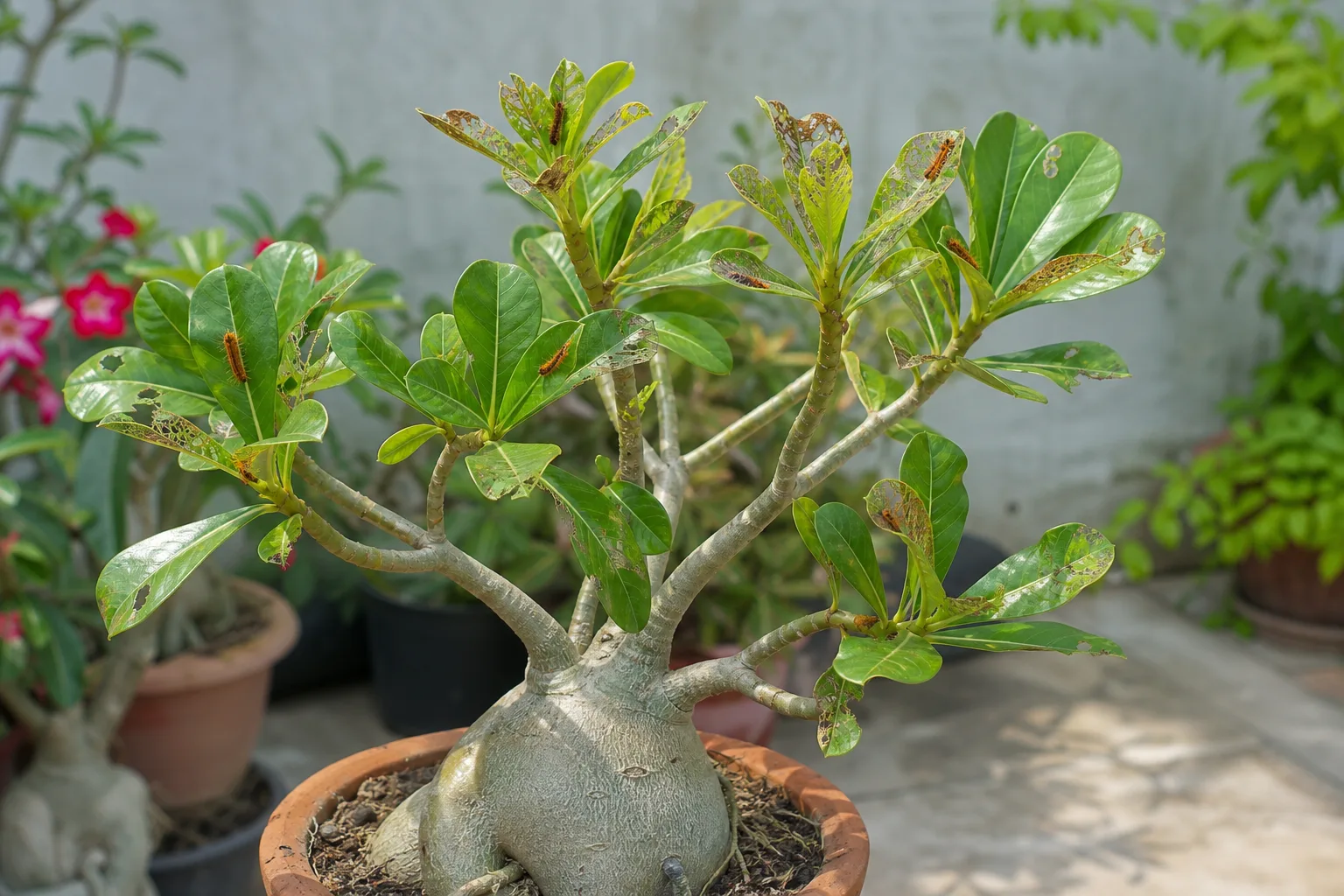
Oleander Caterpillars on Desert Rose (Adenium): ID & Treatment
This guide covers caterpillars on Adenium. See also the general Caterpillars guide, watering, and light pages for this plant.
Oleander Caterpillars on Desert Rose (Adenium): ID & Treatment
Quick answer
You checked your desert rose yesterday and the newest shoots looked fine. This morning, tender branch tips are brown, skeletonized, or full of holes-and because Adenium obesum often carries only one flush of leaves per branch, the damage looks catastrophic on a plant with a modest canopy.
In warm southern climates, the usual culprit is the oleander caterpillar (Syntomeida epilais): bright orange larvae with black hair tufts that target plants in the dogbane family, including desert rose.
First step: inspect the newest shoots at dawn, when larvae feed openly on leaf undersides. Hand-pick every caterpillar while wearing gloves, drop them in soapy water, and bag any pale egg clusters stuck to the bottom of leaves. That single pass often stops a small outbreak before the sparse canopy is gone.
What oleander caterpillars look like on desert rose
Desert rose keeps far fewer leaves than leafy houseplants, so caterpillar damage shows up fast. Learn the life stages so you treat the right pest-not sun scorch, fungal spots, or sap feeders.
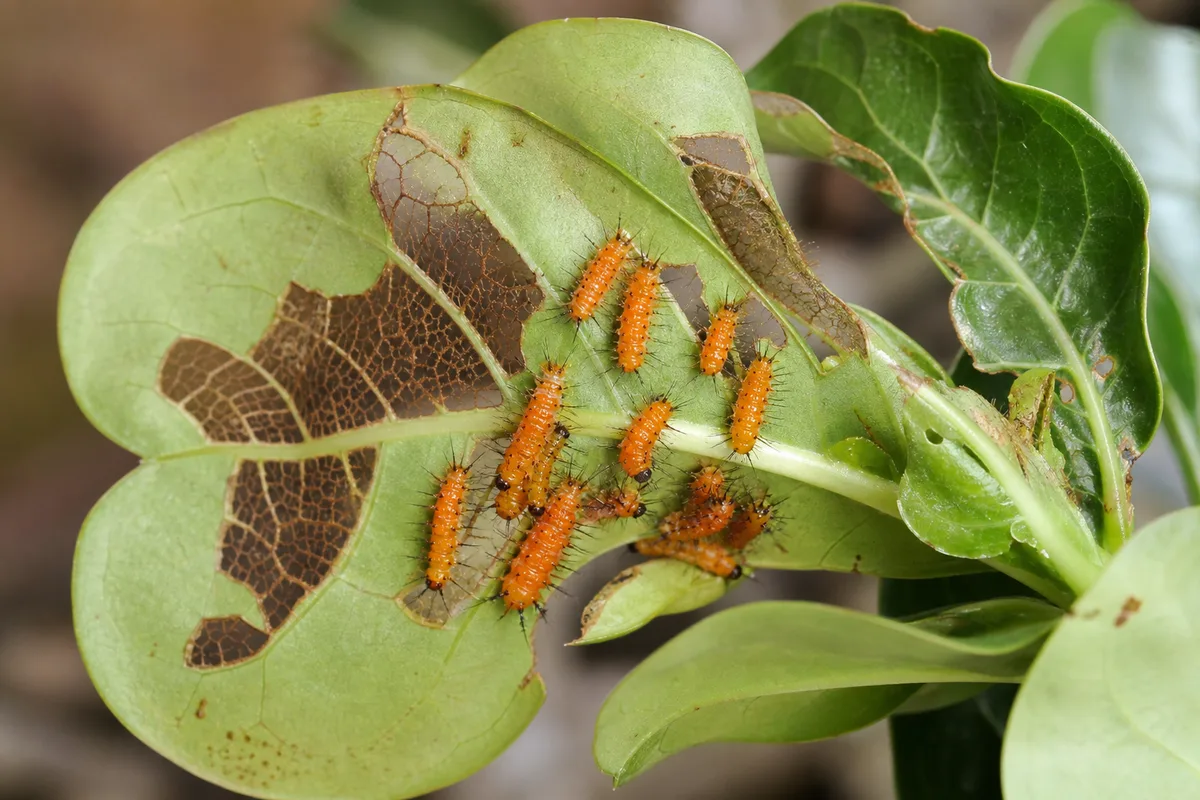
Bright orange oleander caterpillars with black hair tufts feeding gregariously on a desert rose leaf underside - skeletonized brown tissue between green veins where larvae have chewed through.
Egg clusters on leaf undersides
Moths lay pale yellow eggs in groups on the undersides of fresh leaves, often at branch tips. Eggs are easy to miss until they hatch; wiping or pruning a cluster removes an entire generation before chewing starts.
Gregarious young larvae on new growth
Young oleander caterpillars feed gregariously on the undersides of fresh leaves. They skeletonize tissue between the veins, turning shoots dull brown while veins stay green. Flip the leaf and you will usually find a cluster of small orange larvae only a few millimeters long.
Advanced defoliation on sparse branches
After several molts, larvae split up and eat entire leaves, leaving ragged holes or bare stems. Because Adenium often carries just one leaf flush per branch at a time, a heavy infestation can make the plant look nearly naked within days. The swollen caudex and woody stems stay intact-the damage is foliar, not structural.
Adult polka-dot wasp moth
The adult is a day-flying moth sometimes called the polka-dot wasp moth: iridescent blue-green wings with white spots and an orange-tipped abdomen. Seeing these moths hovering around your desert rose in daylight is a warning that egg laying may follow.
Pupae on pots, walls, and fence posts
Mature larvae leave the plant to spin brown pupae wrapped in a thin silk-and-hair cocoon. They often attach to walls and eaves near the host, including pot rims, trellises, and fence posts. Missing pupae guarantees another generation on your desert rose.
Why desert rose gets oleander caterpillars
This is not random chewing. The pest is tied to desert rose biology and where you grow the plant.
Apocynaceae family link to oleander
Adenium obesum belongs to Apocynaceae-the same plant family as oleander (Nerium oleander). Oleander caterpillars evolved to feed on those toxic, milky-sapped relatives, and desert rose chemistry does not deter them.
Florida, Gulf Coast, and oleander-landscape exposure
Because desert rose shares family ties with oleander, it is susceptible to oleander caterpillar feeding. The pest is common in Florida and southern Georgia and anywhere oleander grows outdoors. In South Florida and the Keys, moths are active year-round; farther north, cold winters kill northern populations and moths recolonize each spring-plan weekly shoot checks from late spring through fall on outdoor patio plants. If your desert rose summers outside in those regions-or sits near oleander hedges-exposure risk is high. Moths can move between Apocynaceae hosts in the same yard.
Grafted desert rose on oleander rootstock
Many commercial Adenium are grafted onto oleander or Adenium seedling rootstock for faster growth and a uniform caudex. The graft does not attract caterpillars by itself, but the scion foliage is equally acceptable food. Plants from southern nurseries and landscapes where oleander is common are often already in moth flight paths when you bring them home-so grafted patio specimens in oleander-heavy neighborhoods may see outbreaks sooner than a seed-grown plant kept strictly indoors, even though both scions are vulnerable once eggs land.
Outdoor summer placement and winter bring-in
Desert rose thrives in Adenium light guide and warm weather, so owners often move pots outdoors for summer. That supports growth but opens the door to regional pests that rarely appear on strictly indoor collections. A plant that was pest-free indoors can return with egg clusters you did not notice.
Indoor and northern collections - low risk, different chewers
If you grow desert rose year-round indoors above USDA hardiness zones 10–11 with no patio time, oleander caterpillar is uncommon. Chewed leaves in that setup more often trace to mechanical damage, pets, or hitchhiker pests on new plants. Outdoor summer culture in the Southeast and Gulf Coast is where this moth is a predictable seasonal issue.
Confirm before you treat
Before spraying anything, run through a short checklist so you do not treat the wrong problem.
- Find live larvae or eggs. Chewed leaves alone could be old damage. Active orange caterpillars or pale yellow egg clusters on leaf undersides confirm an ongoing infestation.
- Check the feeding pattern. Caterpillars produce irregular holes and missing leaf sections with visible frass (droppings) on leaves or beneath the plant. Damage progresses shoot by shoot from the tips inward.
- Rule out lookalikes. Sun scorch creates crisp brown edges without frass or larvae. Fungal leaf spots show circular tan-to-black lesions, not chewing-see leaf spot disease on Adenium when spots dominate. Aphids and mealybugs leave sticky honeydew but not large missing leaf sections.
- Assess caudex firmness. Press the base gently. A firm caudex means the plant is still healthy enough to recover from foliar loss. Soft, darkening tissue points to rot-a separate emergency; read overwatering on Adenium before you focus only on pests.
If you confirm oleander caterpillars, note whether larvae are still small and clustered (easiest stage) or large and solitary (needs faster action).
The first fix to try
Hand removal is the safest first response for desert rose. UF/IFAS recommends snipping infested foliage with larvae attached, bagging it, and freezing for 24 hours-or hand-picking larger larvae into soapy water. This avoids broad-spectrum sprays on a plant whose leaves you want to keep.
Wear gloves throughout. Adenium sap contains cardiac glycosides and irritates skin; oleander foliage sap is similarly toxic, and you will be handling chewed tissue close to your hands. Keep pets away from pruned material and soapy water buckets.
Work at dawn or dusk when larvae feed openly. Start at the highest new shoots and move down. Check the pot rim, trellis, and nearby walls for pupal cocoons-brown pupae wrapped in silk and hairs. Remove and destroy those so moths cannot emerge and re-lay eggs.
Make this one correction before reaching for insecticides. Watch the plant for five to seven days. If new holes appear, move to the secondary steps below.
If hand-picking is not enough
When larvae are too numerous, hidden on tall outdoor specimens, or returning after a first pass, escalate in this order rather than stacking treatments the same day.
Apply Bacillus thuringiensis (Bt kurstaki)
Bt is a microbial insecticide that kills only lepidopteran larvae and leaves most beneficial insects unharmed when used as directed. Spray both sides of leaves in late afternoon or on a cloudy evening when larvae are actively eating-Bt must be ingested to work, and UV light breaks it down quickly in direct sun. Repeat every seven to ten days until you see no new damage, because later hatchlings will not be affected by the first application alone.
On desert rose in peak summer sun, avoid midday spraying even with Bt. Stressed glossy leaves recover more slowly from wet foliage sitting in harsh light; late-day application matches extension timing for caterpillar biopesticides.
Spinosad when Bt is not enough
If small larvae keep hatching after repeated Bt passes, spinosad is a broader biopesticide extension guides list for caterpillar control. It works faster than Bt but is toxic to bees and many beneficials while the spray is still wet-apply at dusk, target infested shoots only, and read the label for ornamental shrubs. Use it as a step-up, not a first spray on a plant that still has sparse foliage to protect.
Prune heavily damaged shoots
If a branch tip is stripped and brown, prune it back to healthy tissue with a clean blade. Sterilize tools between cuts if sap is visible. Pruning is secondary to larval removal; cutting without killing caterpillars leaves survivors on lower leaves.
Support regrowth
Once larvae are gone, place the plant in strong direct sun and resume normal soak-and-dry watering for the season per the Adenium watering guide. Do not fertilize immediately after defoliation-wait until you see new leaf buds opening in warm active growth.
Recovery timeline and what to expect
Cosmetic hole damage on existing leaves is permanent. Recovery shows up as fresh leaves emerging from branch tips. Under warm, bright conditions during active summer growth, desert rose often pushes new leaves from branch tips within a few weeks once larvae are gone, though timing depends on season and how completely the plant was stripped.
Flowering and caudex stakes: A single defoliation rarely stops blooming if the caudex stays firm. Repeated defoliation year after year can make the plant more susceptible to other pests and drain energy that would otherwise swell the caudex and fuel flower buds-chronic yearly outbreaks are when flowering stalls and the base stops gaining size even though the plant survives.
Signs you are on track:
- No new chewed edges appearing for a week or more
- Firm caudex and stable stem color
- New leaf buds swelling at branch tips
Signs the problem is worsening or the plant is stressed beyond pest damage:
- Continued leaf loss despite treatment (check for missed pupae nearby)
- Softening caudex or blackening stem base (rot-stop watering and inspect roots)
- No new buds after six weeks in warm weather (possible repeated defoliation stress)
Lookalike symptoms
| What you see | Likely cause | How to tell apart |
|---|---|---|
| Irregular holes with frass and orange larvae | Oleander caterpillar | Live insects on leaf undersides |
| Crisp brown leaf margins, no droppings | Sun scorch | Follows sudden move to harsh sun; see sunburn on Adenium |
| Circular tan lesions turning black | Fungal leaf spot / anthracnose | Spots, not holes; humid conditions |
| Sticky leaves, tiny soft insects | Aphids or mealybugs | Honeydew sheen; no large chewed sections |
| Silvery scarring on buds | Thrips | No caterpillars; rasping damage on new growth |
Mistakes to avoid
Do not blast desert rose with a heavy systemic insecticide as a first response. Adenium leaves are sparse-you need every healthy one for photosynthesis and flowering. Broad chemicals stress the plant and may harm pollinators when the desert rose is outdoors.
Do not increase watering because the plant looks bare. Leaf loss from caterpillars is not a drought signal. Water only when the gritty mix is dry through the top several centimeters, as you would during normal active growth.
Do not handle larvae or pruned foliage bare-handed. Caterpillar hairs are not urticating, but Adenium sap still irritates skin. Keep dogs and cats away from chewed leaves and pruning debris-desert rose is toxic to pets if ingested.
Do not spray cardiac-glycoside-rich sap-covered foliage without gloves, even for products labeled safe on ornamentals. Wipe tools and wash hands after pruning wet shoots.
Do not ignore pupae on nearby surfaces. Moths often pupate on walls, fence posts, or pot sides near the host plant. Leaving cocoons guarantees another generation on your desert rose.
How to prevent the next generation
Weekly inspection of new shoots during warm months catches egg clusters before larvae spread. Outdoors, scan the undersides of the topmost leaves-moths prefer young tissue for egg laying.
If oleander hedges grow nearby, monitor those plants too; shared moth populations move between Apocynaceae hosts. When bringing desert rose indoors for winter, inspect thoroughly so pupae or eggs do not ride inside.
Quarantine new Adenium purchases for two weeks before placing them beside established plants. Nursery stock from southern growers sometimes arrives with early-stage egg masses you can wipe off before an outbreak starts.
Align baseline care with the Adenium care hub-full sun, gritty mix, and dry-down watering-so recovery flushes stay vigorous after any pest setback.
When to worry - and when to call extension
Oleander caterpillars rarely kill desert rose outright-UF/IFAS notes that even total defoliation does not kill oleander, and the same generally holds for Adenium with a healthy caudex. Worry when defoliation repeats every year and the plant stops flowering or the caudex stops swelling, because chronic leaf loss drains energy reserves.
Treat outbreaks as urgent during active summer growth when the plant relies on its leaves for food production and bud formation. During winter dormancy, Adenium may already be leafless by nature-focus on preventing pupae survival rather than saving leaves that would drop anyway.
If the caudex softens or stems blacken during an infestation, suspect concurrent rot from overwatering a now-stressed plant. Address root conditions on the overwatering guide separately; caterpillar treatment alone will not fix a wet caudex.
For repeated annual defoliation on outdoor specimens in Florida or Gulf Coast yards, contact your county extension office with photos of larvae, damage, and nearby oleander-local flight timing and neighbor hedge management often matter more than another round of the same spray.
When to use this page vs other Adenium guides
- Adenium watering guide - Use for routine moisture checks before assuming caterpillars is the main issue.
- Adenium problems hub - Browse all 40 common issues on this species.