Prayer Plant Care Guide: Maranta leuconeura Indoors
Maranta leuconeura
Prayer Plant needs bright indirect light, consistently moist soil (filtered water), 50%+ humidity, and temperatures above 15 °C. Non-toxic to pets.
Prayer Plant Care Guide: Maranta leuconeura Indoors
Start with wateringThe most common care mistake for Maranta LeuconeuraWatering guide →Maranta Leuconeura care essentials
Light
medium indirect light, low indirect light
Water
Every 5–7 days - keep soil consistently moist at 2 cm depth. Use filtered or overnight tap water to avoid fluoride brown tips. Do not allow to dry out.
Soil
60 % potting compost + 20 % perlite + 20 % coco coir. Moisture-retaining and well-draining. pH 5.5–7.0.
Humidity
High humidity (60%+); more tolerant than Calathea but still prefers humid conditions
Temperature
18°C to 27°C (65–80°F)
Fertilizer
Feed lightly during active growth. Use monthly in spring and summer at half strength..
About Maranta Leuconeura
Maranta Leuconeura has a upright growth habit.
| Detail | Information |
|---|---|
| Growth habit | Upright |
| Scientific name | Maranta leuconeura |
Prayer Plant Care Guide: Maranta leuconeura Indoors
Walk into a room with a healthy Maranta leuconeura at dusk and you will see something most houseplants never do: the leaves lift and fold upward as if the plant is folding its hands in prayer. That nightly movement is the reason for the common name prayer plant, and it is also your best early warning system for whether the environment is working. This guide covers what the plant actually is, why the leaves move, how to keep the foliage crisp and patterned indoors, and why the ASPCA lists it as non-toxic to cats and dogs - with the practical caveats pet owners still need.
The goal is straightforward: by the end you should know how to place a prayer plant for stable light and humidity, water it without rotting the rhizomes or crisping the edges, read the signs when leaf movement slows or stops, propagate it by division or cuttings, and tell it apart from the Calathea cousins it is often confused with at the garden center.
What Maranta leuconeura Actually Is (Not Calathea)
Maranta leuconeura is an evergreen, rhizomatous tropical perennial in the Marantaceae family - the same family as arrowroot - and it is native to Brazil, where it grows on the humid forest floor beneath taller canopy. The Missouri Botanical Garden Plant Finder describes it as a low-growing plant that typically reaches 12–15 inches tall and as wide, spreading horizontally by rhizomes rather than climbing. Indoors it behaves like a compact foliage plant with a creeping habit, excellent in shallow pots, wide bowls, and hanging baskets where the patterned leaves can be seen from above and below.
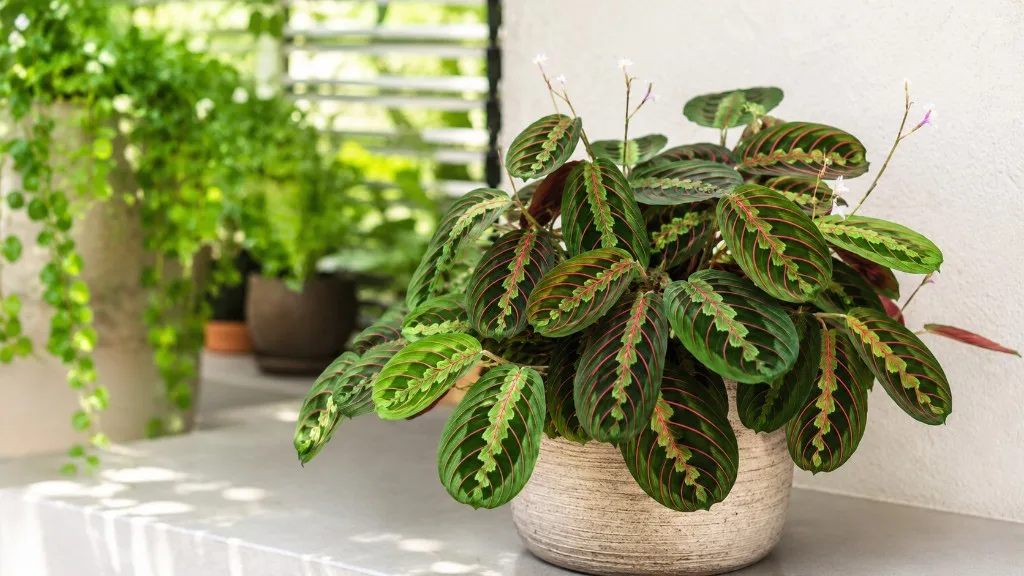
What makes the species commercially valuable is the foliage, not the flowers. Leaves are oblong-elliptic with bold patterning - often a herringbone of red veins, pale central variegation, and undersides that run gray-green to purple-red depending on cultivar. The North Carolina Extension Gardener Plant Toolbox notes that flowers are small and insignificant on typical houseplants, appearing as white, two-lipped blooms on short spikes in ideal conditions but rarely mattering to indoor growers. If your plant flowers, that usually means light, humidity, and moisture are already in a good range.
The naming confusion is worth clearing up early because it affects both care expectations and pet safety research. “Prayer plant” is used in shops for Maranta, Calathea, Stromanthe, and Ctenanthe - all Marantaceae relatives with similar patterned leaves and, in many cases, some form of leaf movement. Maranta leuconeura is the classic prayer plant of the genus Maranta; Calathea species are separate botanically and often need even stricter humidity. When you search care advice or toxicity databases, use the scientific name on the tag. The ASPCA prayer-plant entry covers the common-name group and lists the plant as non-toxic to cats, dogs, and horses, but trade labels are not always precise about genus.
The Daily Leaf Fold: Nyctinasty Explained
The prayer plant’s signature behavior is nyctinasty - a nastic leaf movement that is not aimed at a directional stimulus like light (that would be a tropism) but at a daily rhythm. By day, leaves lie roughly parallel to the soil, maximizing light capture on the patterned upper surface. After dark, they rise and fold vertically, exposing less surface area and showing the contrasting undersides. The North Carolina Extension entry describes leaves held parallel to the ground by day and moving to a perpendicular “prayer” position at night.
This is fast movement by plant standards - driven by reversible changes in turgor pressure in specialized joints called pulvini at the base of the leaf stalk, not by new growth. Research on nyctinasty in related species shows motor cells in the pulvinus swell or shrink as ion concentrations shift, and the rhythm persists even under constant artificial light because an endogenous circadian clock keeps time. You do not need to memorize the cell biology to grow the plant well, but understanding the mechanism explains two practical facts: movement can lag when the plant is stressed, and a healthy plant should show a visible daily cycle when light transitions are natural.
Pulvini, Circadian Rhythm, and When Movement Stops
A prayer plant that stops folding at night is telling you something about the environment before brown tips or yellow leaves appear. The most common indoor cause is too much continuous light - a lamp left on late, or a spot near a hallway light that never fully darkens. The plant needs a believable day/night signal. Move it where evenings are genuinely dim for several hours, and movement usually returns within a few days if nothing else is wrong.
Stress from chronic underwatering, cold drafts, or very low humidity can also reduce pulvinus function. Leaves may stay partially open, feel limp, or roll at the edges. Check moisture in the top 2 cm of mix, confirm the room is above 60°F (15°C), and raise humidity toward 60% before assuming disease. Conversely, do not panic if movement is subtle on cloudy winter days; weaker light slows the whole rhythm. Watch the newest leaves - if they unfurl cleanly and the plant folds at least partially overnight, the core system is intact.
Cultivars Worth Knowing
Most nursery prayer plants are selections of M. leuconeura with different vein colors and central markings. Three patterns dominate trade:
Maranta leuconeura var. kerchoveana - often sold as “green prayer plant” or rabbit tracks - has medium green leaves with dark splotches along the midrib that look like small footprints. It is slightly more forgiving in average humidity than the red-veined forms, though it still is not a desert plant.
Maranta leuconeura ‘Erythroneura’ - the red-veined or herringbone prayer plant - shows strong red lateral veins on dark green, with a pale green central stripe. This is the Instagram-famous pattern most people picture. It shows fluoride and low-humidity damage quickly on those thin leaf margins.
Maranta leuconeura var. leuconeura - sometimes called black prayer plant in commerce - has silvery-green centers, green margins, and red-brown veins on a darker field. Pattern contrast fades in too much direct sun or very low light.
Care is essentially the same across cultivars; differences are mostly cosmetic sensitivity. Red-veined forms telegraph water-quality and humidity problems earliest. If you have choice at purchase, pick the plant whose newest leaf is fully opened, undamaged, and brightly patterned - that tells you more about your future success than an older leaf count.
Light Requirements Indoors
In Brazil the species lives in dappled understory light - bright enough to maintain variegation, never harsh enough to bleach pigments. Indoors, aim for bright, indirect or diffused light for most of the day. The Missouri Botanical Garden recommends bright indoor light without strong direct sun, and NC State lists tolerance for low to medium light with the caveat that color fades and growth slows when light is weak.
A practical placement is 3–6 feet from an east-facing window, or behind a sheer curtain on south- or west-facing glass. Morning sun for an hour is usually fine; midday direct sun bleaches the fishbone pattern, scorches margins, and collapses the contrast that makes the plant worth keeping. Low light survival is possible - Maranta is genuinely more tolerant than many Calathea - but stems stretch, new leaves emerge smaller, and the plant becomes easier to overwater because it uses moisture slowly.
Rotate the pot a quarter turn weekly so rhizomes do not all crawl toward one window. If you must use artificial light, a full-spectrum LED 12–14 inches above the foliage for 12–14 hours daily can substitute for a poor window, provided nights are dark enough for nyctinasty. Watch new growth: compact nodes and vivid patterning mean light is adequate; long petioles and pale centers mean move it closer to the source.
Watering for Even Moisture
Prayer plants are moisture-loving but not swamp-loving. They hate drying to dust, yet soggy rhizomes rot quickly in cool, dim conditions. The working rule from LeafyPixels plant data and extension guidance aligns: keep soil consistently moist in the top 2 cm during active growth, watering when the upper inch begins to feel dry to the touch - often every 5–7 days in warm months, longer in winter when growth slows.
Water thoroughly until a little runs from drainage holes, then empty the saucer within 30 minutes. Never let the pot sit in standing water. The University of Illinois Extension prayer plant page adds an easy-to-miss warning: do not allow water to stand on the crowns, because stems rot readily when water pools where leaves meet the rhizome. Water the soil surface directly, not from overhead, especially on cold mornings.
In winter, Illinois Extension suggests allowing the soil to dry slightly more between waterings while still avoiding full drought. That means the top inch may go dry, but the root ball should not turn brick-hard. Leaves curling tightly during the day, crispy tips, and stalled folding at night often mean underwatering or humidity too low, not necessarily “needs more sun.”
Fluoride, Chlorine, and Tap Water Fixes
NC State and Missouri Botanical Garden both flag fluoride sensitivity - brown tips and leaf edge burn on an otherwise healthy plant often trace to tap water, not “underwatering” in the usual sense. Municipal water with fluoride, chlorine, or high dissolved salts builds up in the mix and margins burn first on thin-leaved cultivars.
Fixes, in order of reliability: use filtered, distilled, or rainwater; leave tap water in an open container overnight to off-gas some chlorine (this helps chlorine more than fluoride); flush the pot monthly with plain water until runoff runs clear; repot into fresh mix if salt crust rings the pot. If only tips are brown but new leaves are clean after a water change, you found the culprit. Trim old tips with sterile scissors for appearance; new growth is the scoreboard.
Humidity Targets and Temperature Limits
Prayer plants are tropical humidity plants. NC State is blunt: the species is intolerant of low humidity. Most successful indoor targets sit at 50% relative humidity minimum, with 60% or higher producing the cleanest edges and fastest rhizome growth. Maranta is often described as more forgiving than Calathea, but “more forgiving” still does not mean a dry forced-air winter without help.
Raise humidity the ways that actually move the needle: a small humidifier near the plant (best), a pebble tray with the pot above the water line (good supplement), or grouping with other plants (modest bump). Misting leaves gives a minutes-long spike and can encourage fungal spotting on crowded foliage - skip the spray bottle as your primary strategy.
Temperature comfort tracks normal indoor living: 65–80°F (18–27°C) is ideal. Missouri Botanical Garden warns against temperatures below 60°F (15°C) and frost entirely. Cold window sills, air-conditioning vents pointed at the pot, and winter draft gaps cause overnight leaf curl, blackened edges, and rhizome stall. If the plant sits on a windowsill, move it 6–12 inches back when outdoor nights drop below freezing outside the glass.
Soil Mix and Container Drainage
Use a moisture-retentive, well-draining mix - not straight garden soil, not pure peat without structure. A proven recipe matching LeafyPixels data: 60% potting compost, 20% perlite, 20% coco coir, targeting pH 5.5–7.0. The compost holds steady moisture; perlite and coir keep oxygen at the rhizome surface. Prayer plants prefer slightly acidic, lime-free conditions, which pairs with the filtered-water recommendation - hard, alkaline tap water stresses roots over time.
Pots need drainage holes and a width suited to horizontal spread. Shallow, wide containers fit the creeping habit better than deep narrow ones that hold unused wet soil below the rhizome zone. Terracotta dries faster - helpful if you tend to overwater; plastic retains moisture - better if you underwater in bright light. Go up one pot size at Maranta Leuconeura repotting guide, not three. An oversized pot stays wet in the center while the surface looks fine, the classic setup for root rot on Maranta Leuconeura masked as “mysterious yellowing.”
Fertilizing Without Leaf Burn
Prayer plants are moderate feeders, not hungry monsters. Feed monthly in spring and summer at half strength with a balanced liquid fertilizer when the plant is actively growing and soil is already moist. NC State notes leaves burn with over-fertilization as well as fluorides - salt damage mimics low humidity tip burn, so diagnose before doubling feed.
Skip fertilizer on stressed plants, immediately after repotting, and through late fall and winter unless you grow under strong lights with visible new leaves. Always water first, then fertilize so nutrients distribute without concentrating at dry root zones. If pattern color washes out despite good light, pale new growth may indicate mild nutrient lack, but fix water and light before escalating to full-strength feeds.
Repotting Rhizomatous Prayer Plants
Repot every 1–2 years, or when roots and rhizomes circle the surface, water runs straight through, or growth stalls in spring despite good care. The best window is early spring as new shoots appear. Slide the plant out, tease outer mix gently, and move to a container one size larger with fresh mix.
Because prayer plants spread by rhizomes, you may see horizontal runners with new leaf points - that is normal. Bury rhizomes 1–2 cm below the surface, not deep like a bulb. After repotting, keep humidity high, light bright but indirect, and watering slightly cautious for two weeks while cut rhizome surfaces callus. Illinois Extension’s crown-rot warning matters most here: avoid overhead watering until the plant settles.
Propagation by Division and Cuttings
Two home methods work reliably: division at repotting and stem cuttings.
For division, unpot a healthy plant with multiple crowns. Pull or cut rhizome sections so each piece has at least one growing point and several roots. Pot sections separately at the same depth, water lightly, bag or dome humidity for the first week if your home is dry, then acclimate. NC State lists rhizomatous division as the standard propagation route.
For stem cuttings, cut just below a node on a healthy stem, place in water or moist coco coir, and keep warm and humid. Roots often form in 2–4 weeks in water changed every few days. Transfer to mix when roots are 2–3 cm long, and keep the young plant sealed or domed for a week to limit transpiration stress. Do not propagate from plants with active spider mites, rot, or mosaic-like mottling you cannot explain - problems clone forward.
ASPCA Pet Safety
For cat and dog households, prayer plant is one of the safer decorative foliage choices. The ASPCA Toxic and Non-Toxic Plants list for prayer plant classifies it as non-toxic to dogs, cats, and horses, with non-toxic principles - meaning no known systemic poison in the plant tissue as classified by their database. That matches LeafyPixels toxicity research for Maranta leuconeura specifically.
Non-toxic is not an invitation to let pets treat the pot as salad. Veterinary guidance widely notes that any plant material can cause vomiting or mild gastrointestinal upset if eaten in quantity, simply from fiber irritation. The risk profile is fundamentally different from true toxic houseplants with calcium oxalates or insoluble crystals - but you still prefer intact leaves to chewed stubs.
After a Pet Nibbles a Leaf
If a cat or dog takes a small bite, monitor for vomiting or lethargy beyond a single episode. Most owners see nothing serious with Maranta. If symptoms persist, you are unsure of plant identity, or the pet ate a large volume, call your veterinarian and ASPCA Animal Poison Control at 888-426-4435 with the scientific name handy. Prevent repeat nibbling by elevating the plant, offering cat grass, or using a physical barrier - not because the plant is deadly, but because damaged foliage ruins the display and chronic chewing stresses the rhizome.
Rabbit, horse, and reptile owners should treat species-specific safety as unverified unless a vet confirms - ASPCA cat/dog non-toxic status does not automatically extend to every herbivore.
Troubleshooting Brown Tips, Yellow Leaves, and Pests
Most prayer plant problems reduce to a short diagnostic chain: soil moisture → humidity → light → water quality → pests. Fix the environment before pruning heavily or repotting repeatedly.
Brown leaf tips and margins usually mean low humidity, fluoride or salt burn, or chronic underwatering. Raise humidity first, switch water source, flush salts, then trim dead tips. Yellow leaves with wet mix and soft stems suggest overwatering on Maranta Leuconeura or root rot - unpot, trim black mushy rhizomes, repot dry-ish into fresh mix, and withhold water until the plant steadies. Yellow lower leaves alone on an otherwise firm plant may be normal senescence; remove them. Pale, washed-out new leaves in bright direct sun mean too much light; in dim corners mean too little.
Curling during the day pairs with dry air or drought - the plant reduces exposed surface. Spider mites love stressed, dry prayer plants; look for stippling and fine webbing under leaves, shower the plant, then treat with insecticidal soap on a test leaf first. Mealybugs hide at nodes; dab with isopropyl alcohol and follow with soap repeats weekly until clear.
NC State notes no serious pest or disease problems when conditions are right - which really means conditions prevent the pests that exploit weak plants.
Prayer Plant vs Calathea
Both are Marantaceae with patterned leaves and reputations for fussiness, but they are not interchangeable.
Maranta leuconeura spreads low on rhizomes, shows the clearest nyctinasty in the genus trade, and tolerates low to medium light better than many Calathea. It still needs humidity, but recovery from a missed watering is often faster when rhizomes remain firm.
Calathea species typically grow more upright on shorter stems, many lack the dramatic nightly fold people expect from the name “prayer plant,” and they often decline faster in dry air - brown edges appearing within days of a humidity crash. Calathea toxicity varies by species; never assume the same ASPCA entry covers a plant labeled only “peacock plant.”
If you succeed with Maranta and want another patterned foliage challenge, Calathea is the next step up in humidity demand. If Maranta struggles in your dry winter home, a Calathea will not magically be easier - fix humidity infrastructure first.
Best Placement in a Real Home
Think bright bathroom, kitchen counter away from the stove, or a living room shelf 5 feet from an east window - places with stable warmth and occasional humidity spikes. Avoid top-of-fridge heat, single-pane winter sills, and HVAC blasting directly on leaves. Hanging baskets work if humidity is adequate; heat rises and upper air is often drier, so ceiling vents near baskets are a common mistake.
Because the plant is pet-safe for cats and dogs, it fits rooms where toxic trailing plants cannot - but low creeping pots are still cat toys. Elevated stands protect both pet stomachs and leaf tips. For nyctinasty viewing, place where you naturally pass at dusk - the movement is the plant’s best feature and your earliest diagnostic tool.
Choosing a Healthy Plant and the First Month Home
At purchase, choose firm new leaves, clean undersides without webbing, and mix that smells like soil not vinegar. Avoid pots with collapsed stems, widespread crispy tips, or soggy surface algae. Pattern intensity on the youngest leaf predicts how the plant will look in your home more than mature lower leaves with old cosmetic damage.
Quarantine new plants two weeks from your collection, inspect under leaves with light, and do not repot day one unless roots are rotting or pests are obvious. The first month is for learning how fast your pot dries at your light - adjust watering from touch, not from a social media schedule. Change one variable at a time: if you move it for light, do not simultaneously repot and fertilize.
Watch for brown-tips, yellow-leaves, and root-rot early. If yellowing appears, check moisture and roots before assuming permanent failure. Prayer plants bounce back from rhizomes when core tissue stays firm - one of the reasons division propagation works so well.
Conclusion
Maranta leuconeura rewards growers who treat it like a Brazilian forest-floor plant, not a generic succulent or a set-and-forget pothos. Give it bright, indirect light, evenly moist soil with good drainage, 60%+ humidity, warm stable temperatures above 60°F, and filtered or low-salt water, and the herringbone leaves stay vivid while nyctinasty keeps time each evening. The ASPCA listing as non-toxic to cats and dogs makes it a rare patterned foliage plant that fits many pet-aware homes - still best kept from enthusiastic chewers.
When tips brown, leaves stop folding, or yellow spreads, walk the same checklist: moisture at the rhizome, humidity at the leaf margin, light on the newest growth, salts in the water, then pests. Fix the condition, then trim. Master that order and the prayer plant becomes one of the most watchable houseplants you can grow - a plant that moves on schedule when your care is working.
When to use this page vs other Maranta Leuconeura guides
- Maranta Leuconeura overview - Canonical hub for this species - care topics and problems branch from here.
- Maranta Leuconeura problems - Symptom-first path when you already know something is wrong.
Related Maranta Leuconeura guides
How to care for Maranta Leuconeura?
How much light does Maranta Leuconeura need?
medium indirect light, low indirect light
- medium indirect light, low indirect light - medium indirect light, low indirect light.
When should you water Maranta Leuconeura?
Every 5–7 days - keep soil consistently moist at 2 cm depth. Use filtered or overnight tap water to avoid fluoride brown tips. Do not allow to dry out.
- Check top 2 inches - Every 5–7 days - keep soil consistently moist at 2 cm depth.
- Drain excess water - Use filtered or overnight tap water to avoid fluoride brown tips.
What soil works best for Maranta Leuconeura?
60 % potting compost + 20 % perlite + 20 % coco coir. Moisture-retaining and well-draining. pH 5.5–7.0.
- Well-draining mix - Moisture-retaining and well-draining.
Grower notes for Maranta Leuconeura
What matters most with Maranta Leuconeura
Maranta Leuconeura is part of the fussy foliage group where leaf movement, crisping, and humidity stress can look dramatic before the plant is truly lost. Judge the newest rolled leaves and root moisture before reacting to every old edge mark. In practice, the care checkpoint is simple: medium indirect light, low indirect light. Pair that with 60 % potting compost + 20 % perlite + 20 % coco coir. Moisture-retaining and well-draining; pH 5.5–7.0, and avoid changing water, pot size, and placement all at once.
Best placement in a real home
Maranta Leuconeura belongs where medium indirect light, low indirect light is realistic for most of the day, not only where the pot looks good. Every 5–7 days - keep soil consistently moist at 2 cm depth. Use filtered or overnight tap water to avoid fluoride brown tips. Do not allow to dry out. If the pot stays wet longer than expected, move the plant into better light or reassess the mix before watering again. Humidity target: High humidity (60%+); more tolerant than Calathea but still prefers humid conditions.. Temperature comfort zone: 18°C to 27°C (65–80°F).
Before you buy this plant
Choose Maranta Leuconeura with firm new growth, clean leaf undersides, and soil that does not smell sour or feel compacted. Be cautious if you see brown-tips, sticky residue, collapsed crowns, or a pot that is wet in poor light. Cosmetic old-leaf damage is less worrying than weak roots or active pests.
First month after bringing it home
Do not repot Maranta Leuconeura on day one unless the mix is failing or pests are obvious. Quarantine it, learn how fast the pot dries, and keep care boring while it adjusts. Watch especially for brown-tips, yellow-leaves, and root-rot. If problems appear, correct the condition first rather than stacking fertilizer, repotting, and pruning together.
Safety note for Maranta Leuconeura
Maranta Leuconeura is not a plant to keep within reach of pets or children. Treat it as an inaccessible display plant. Use gloves if sap or plant tissue is irritating, and pick a pet-safe alternative for floor pots or low shelves.
How to tell Maranta Leuconeura is settling in
If you plan to multiply it later, common methods include Stem cuttings and Division. If yellow-leaves shows up early, inspect light, watering, and roots before assuming the plant is permanently weak.
Is it pet safe?
Maranta Leuconeura is generally considered pet safe.
Watering Maranta Leuconeura
Every 5–7 days - keep soil consistently moist at 2 cm depth. Use filtered or overnight tap water to avoid fluoride brown tips. Do not allow to dry out.
Soil & potting for Maranta Leuconeura
60 % potting compost + 20 % perlite + 20 % coco coir. Moisture-retaining and well-draining. pH 5.5–7.0.
Humidity & temperature for Maranta Leuconeura
Maranta Leuconeura prefers high humidity (60%+); more tolerant than Calathea but still prefers humid conditions, though normal home humidity is usually fine. Keep temperatures around 18°C to 27°C (65–80°F).
| Detail | Information |
|---|---|
| Humidity | High humidity (60%+); more tolerant than Calathea but still prefers humid conditions - normal home humidity is fine. |
| Ideal temperature | 18°C to 27°C (65–80°F) |
Fertilizer & pruning for Maranta Leuconeura
Use feed lightly during active growth. Use monthly in spring and summer at half strength.. for Maranta Leuconeura.
| Detail | Information |
|---|---|
| Fertilizer type | Feed lightly during active growth. Use monthly in spring and summer at half strength.. |
Common problems on Maranta Leuconeura
Likely cause: Jul 24, 2023 · Ants are one of the most common pests that can infest indoor plants , including the vibrant and beautiful Red Prayer Plant (Maranta leuconeura ). Not only can ants be a nuisance, but they can also cause damage to the plant by
Quick fix: Confirm diagnosis on your Maranta Leuconeura, then address the most likely care or pest factor described in current extension guidance.
Full fix guide →Brown Tips
MediumLikely cause: Low humidity or fluoride in tap water
Quick fix: Increase humidity to 55%+; use filtered water
Full fix guide →Aphids
MediumLikely cause: Jul 9, 2023 · Aphids are small, soft-bodied insects that suck the sap from plants, causing stunted growth and distorted leaves. They reproduce rapidly and can quickly infest a Red Maranta plant if not treated promptly.
Quick fix: Confirm diagnosis on your Maranta Leuconeura, then address the most likely care or pest factor described in current extension guidance.
Full fix guide →Bud Drop
LowLikely cause: Flowers drop off if not pollinated, and stalk dies if it contains no pollinated flowers. Numerous cultivars have been produced.
Quick fix: Confirm diagnosis on your Maranta Leuconeura, then address the most likely care or pest factor described in current extension guidance.
Full fix guide →Caterpillars
MediumLikely cause: Jul 10, 2023 · Caterpillars can be a common pest that affects various types of plants, including the Maranta Prayer Plant (Maranta leuconeura ). These small, voracious eaters can quickly cause damage to your plants if left unchecked.
Quick fix: Confirm diagnosis on your Maranta Leuconeura, then address the most likely care or pest factor described in current extension guidance.
Full fix guide →Crispy Leaves
MediumLikely cause: Have you ever walked up to your beautiful Prayer Plant (Maranta leuconeura ), eagerly waiting to see its leaves perform their stunning nightly folding dance, only to notice dry, crispy brown edges?
Quick fix: Confirm diagnosis on your Maranta Leuconeura, then address the most likely care or pest factor described in current extension guidance.
Full fix guide →Curling Leaves
MediumLikely cause: Aug 15, 2025 · To counteract water loss, leaves curl , reducing their surface area to conserve moisture. This helps the plant adapt, but prolonged dry air can result in crispy leaf margins. Marantas prefer bright, indirect light and are sen
Quick fix: Confirm diagnosis on your Maranta Leuconeura, then address the most likely care or pest factor described in current extension guidance.
Full fix guide →Distorted Leaves
MediumLikely cause: Aug 15, 2025 · Uncover the causes behind your Maranta’ s curling leaves . Get practical solutions to diagnose and fix common prayer plant care issues for thriving growth.
Quick fix: Confirm diagnosis on your Maranta Leuconeura, then address the most likely care or pest factor described in current extension guidance.
Full fix guide →Dry Hydrophobic Soil
MediumLikely cause: Keep the soil consistently moist and avoid overwatering to prevent rotting, drooping, yellowing and loss of the plant. Decrease watering in fall and winter since growth is minimal at this time. Do not allow the soil to dry out completely to
Quick fix: Confirm diagnosis on your Maranta Leuconeura, then address the most likely care or pest factor described in current extension guidance.
Full fix guide →Exposed Roots
MediumLikely cause: Dec 4, 2025 · Proper drainage is paramount because the fine root structure of the Maranta is highly susceptible to fungal diseases. Healthy roots should appear firm and light-colored.
Quick fix: Confirm diagnosis on your Maranta Leuconeura, then address the most likely care or pest factor described in current extension guidance.
Full fix guide →Fertilizer Burn
MediumLikely cause: Aug 4, 2023 · Fertilizers can cause leaf burns if left on the leaves for an extended period. If any fertilizer accidentally gets on the leaves, gently wipe it off with a damp cloth. For optimal growth, Red Maranta should be fertilized every
Quick fix: Confirm diagnosis on your Maranta Leuconeura, then address the most likely care or pest factor described in current extension guidance.
Full fix guide →Draft Stress
MediumLikely cause: Mar 3, 2024 · Avoid exposing to cold drafts or sudden temperature fluctuations, as this can cause stress and damage to the plant. They thrive in high humidity environments, mimicking their native tropical habitat.
Quick fix: Confirm diagnosis on your Maranta Leuconeura, then address the most likely care or pest factor described in current extension guidance.
Full fix guide →Iron Deficiency
MediumLikely cause: Jul 17, 2023 · A nutrient deficiency can also manifest as yellow leaves in a red Maranta plant. The most common nutrient deficiencies that lead to yellowing leaves are nitrogen, iron , and magnesium deficiencies.
Quick fix: Confirm diagnosis on your Maranta Leuconeura, then address the most likely care or pest factor described in current extension guidance.
Full fix guide →Leaf Miners
MediumLikely cause: Nov 18, 2020 · Prune your prayer plant by cutting just above leaf nodes using a pair of sterilized garden scissors. Pruning two or three times a year (best times are in fall and spring) helps to encourage bushy growth.
Quick fix: Confirm diagnosis on your Maranta Leuconeura, then address the most likely care or pest factor described in current extension guidance.
Full fix guide →Flowers Turning Brown
MediumLikely cause: Maranta Plants prosper in a humidity of 60-80%. Too low humidity will result in brown leaf tips and edges. To increase humidity, group the plants together, set the pot on a wet pebble tray or use a cool mist humidifier. Do not mist the leav
Quick fix: Confirm diagnosis on your Maranta Leuconeura, then address the most likely care or pest factor described in current extension guidance.
Full fix guide →Holes in Leaves
MediumLikely cause: Maranta are native to tropical Central and South America and the West Indies. Maranta are named for Bartolomeo Maranta , an Italian physician and botanist of the 16thcentury. See full list on homeplantsguide.com Maranta are low-growing plan
Quick fix: Confirm diagnosis on your Maranta Leuconeura, then address the most likely care or pest factor described in current extension guidance.
Full fix guide →Leaf Spot Disease
MediumLikely cause: Jul 1, 2023 · To combat leaf spot in your Maranta Prayer Plant, remove and destroy any infected leaves immediately. Avoid overhead watering, as wet foliage promotes disease development.
Quick fix: Confirm diagnosis on your Maranta Leuconeura, then address the most likely care or pest factor described in current extension guidance.
Full fix guide →Mealybugs
MediumLikely cause: Jul 10, 2023 · The Prayer Plant, scientifically known as Maranta leuconeura , is a popular houseplant for its beautiful foliage and easy care requirements. However, like any other plant, it can fall victim to various pests, including mealyb
Quick fix: Confirm diagnosis on your Maranta Leuconeura, then address the most likely care or pest factor described in current extension guidance.
Full fix guide →Low Humidity
LowLikely cause: Maranta Plants prosper in a humidity of 60-80% . Too low humidity will result in brown leaf tips and edges. To increase humidity, group the plants together, set the pot on a wet pebble tray or use a cool mist humidifier. Do not mist the lea
Quick fix: Confirm diagnosis on your Maranta Leuconeura, then address the most likely care or pest factor described in current extension guidance.
Full fix guide →Magnesium Deficiency
MediumLikely cause: Jul 9, 2023 · A nutrient deficiency can also cause yellowing leaves in Maranta Prayer Plants. Specifically, a lack of essential nutrients like nitrogen, iron, or magnesium can lead to chlorosis, a condition where the leaves lose their green
Quick fix: Confirm diagnosis on your Maranta Leuconeura, then address the most likely care or pest factor described in current extension guidance.
Full fix guide →Not Enough Light
MediumLikely cause: Jan 6, 2026 · Learn how to care for your Maranta leuconeura with our guide on light requirements, watering, humidity, and more. Perfect for indoor plant enthusiasts.
Quick fix: Confirm diagnosis on your Maranta Leuconeura, then address the most likely care or pest factor described in current extension guidance.
Full fix guide →Overwatering
HighLikely cause: Prayer plants are attractive houseplants that do not like overwatering . Learn the signs of an overwatered prayer plant and how to save it.
Quick fix: Confirm diagnosis on your Maranta Leuconeura, then address the most likely care or pest factor described in current extension guidance.
Full fix guide →Plant Leaning
MediumLikely cause: Maranta leuconeura , widely known as the prayer plant due to its daily sunlight-dependent movements (which are said to resemble hands "in-prayer"), is a species of flowering plant in the family Marantaceae native to the Brazilian tropical f
Quick fix: Confirm diagnosis on your Maranta Leuconeura, then address the most likely care or pest factor described in current extension guidance.
Full fix guide →Root Rot
MediumLikely cause: Persistently soggy soil
Quick fix: Ensure drainage; reduce watering frequency
Full fix guide →Rust Disease
MediumLikely cause: Jul 17, 2023 · Root rot is a serious disease that affects the roots of plants, including the Maranta Red plant. It is caused by overwatering or poorly draining soil, which creates an environment conducive to fungal growth.
Quick fix: Confirm diagnosis on your Maranta Leuconeura, then address the most likely care or pest factor described in current extension guidance.
Full fix guide →Slow Growth
LowLikely cause: Insufficient light or low temperatures
Quick fix: Move to brighter spot; ensure 18 °C+ consistently
Full fix guide →Repotting Stress
MediumLikely cause: Nov 16, 2025 · The most favorable time to repot a Maranta leuconeura is during the late winter or early spring , just before its active growing season begins. Repotting during this period allows the plant to quickly recover from the stress
Quick fix: Confirm diagnosis on your Maranta Leuconeura, then address the most likely care or pest factor described in current extension guidance.
Full fix guide →Seedlings Falling Over
MediumLikely cause: Jul 14, 2023 · If your Maranta Prayer Plant is falling over , it’s essential to identify the underlying cause to restore its health and vigor. Evaluate your plant’s lighting conditions, watering routine, humidity levels, nutrient supply, an
Quick fix: Confirm diagnosis on your Maranta Leuconeura, then address the most likely care or pest factor described in current extension guidance.
Full fix guide →Spider Mites
MediumLikely cause: Jul 6, 2023 · Spider mites are tiny pests that can cause significant damage to indoor plants, including the popular rattlesnake prayer plant (Maranta leuconeura). These pests are not actual spiders but rather members of the arachnid family.
Quick fix: Confirm diagnosis on your Maranta Leuconeura, then address the most likely care or pest factor described in current extension guidance.
Full fix guide →Seeds Not Germinating
MediumLikely cause: Sep 22, 2025 · The prayer plant (Maranta leuconeura ) is a low-growing tropical plant native to South America. Learn how to grow this unique and popular houseplant. View all Sep 4, 2022 · Place the seeds on the surface of the soil, spacing
Quick fix: Follow extension or botanical guidance for Maranta Leuconeura seeds not germinating; adjust care before applying broad treatments.
Full fix guide →Thin Stems
MediumLikely cause: Jul 3, 2023 · The stems of Maranta Red plants are relatively short and grow close to the ground. They are typically thin and covered with small, scale-like leaves called cataphylls. These cataphylls protect the delicate growing points of th
Quick fix: Confirm diagnosis on your Maranta Leuconeura, then address the most likely care or pest factor described in current extension guidance.
Full fix guide →Transparent Leaves
MediumLikely cause: Download the Maranta Leuconeura leaves , vibrant green foliage, ornamental plant, cut out transparent 58988848 royalty free PNG from Vecteezy for your project and explore over a million other illustrations, icons and clipart graphics!
Quick fix: Confirm diagnosis on your Maranta Leuconeura, then address the most likely care or pest factor described in current extension guidance.
Full fix guide →Transplant Shock
MediumLikely cause: Nov 19, 2025 · During transplant shock , the Maranta leuconeura is busy tending its roots and faces greater exposure to environmental issues, pests, and diseases. Signs of transplant shock include yellow, wilting, or curled-up leaves.
Quick fix: Confirm diagnosis on your Maranta Leuconeura, then address the most likely care or pest factor described in current extension guidance.
Full fix guide →Weak Stems
MediumLikely cause: Present a bright, indirect location, avoiding prolonged exposure to the sun, especially in the summer. A setting that's either too bright or dark will cause the variegations (foliar patterns) to weaken . Maintain evenly moist soil, allowing
Quick fix: Confirm diagnosis on your Maranta Leuconeura, then address the most likely care or pest factor described in current extension guidance.
Full fix guide →White Spots
MediumLikely cause: Jul 1, 2023 · These small, white insects form cotton-like clusters on the plant’s stems and undersides of leaves. They suck sap from the plant, causing stunted growth, yellowing leaves, and a sticky residue known as honeydew.
Quick fix: Confirm diagnosis on your Maranta Leuconeura, then address the most likely care or pest factor described in current extension guidance.
Full fix guide →Wrong Soil Mix
MediumLikely cause: Your maranta has soil requirements? Don't panic — Maranta leuconeura has fine, shallow root systems adapted for rapid water uptake in…. Here's exactly how to fix it.
Quick fix: Confirm diagnosis on your Maranta Leuconeura, then address the most likely care or pest factor described in current extension guidance.
Full fix guide →Wilting
MediumLikely cause: Jul 1, 2023 · Symptoms of root rot include yellowing or wilting leaves, stunted growth, and a foul odor coming from the soil. To treat root rot in your Maranta Prayer Plant, first assess the extent of the damage.
Quick fix: Confirm diagnosis on your Maranta Leuconeura, then address the most likely care or pest factor described in current extension guidance.
Full fix guide →Wind Damage
MediumLikely cause: The plant’s leaves will begin to suffer damage if the ambient temperature drops below 55° degrees Fahrenheit or goes above 80° degrees Fahrenheit. Good air circulation is beneficial, but Maranta leuconeura must stay away from drafts.
Quick fix: Confirm diagnosis on your Maranta Leuconeura, then address the most likely care or pest factor described in current extension guidance.
Full fix guide →Yellow Leaves
MediumLikely cause: Overwatering or cold temperatures
Quick fix: Allow top 2 cm to dry; keep above 18 °C
Full fix guide →Thrips
MediumLikely cause: Jan 8, 2026 · Maranta leuconeura—the prayer plant—is uniquely vulnerable to Thrips palmi and Frankliniella occidentalis. Unlike spider mites or scale, thrips feed by rasping epidermal cells and injecting saliva, triggering irreversible cell
Quick fix: Confirm diagnosis on your Maranta Leuconeura, then address the most likely care or pest factor described in current extension guidance.
Full fix guide →Drooping Leaves
MediumLikely cause: Drooping on prayer plant often means normal daytime relaxation-not a crisis. Abnormal droop stays limp 24 hours and pairs with dry mix, wet sour mix, or cold below 18°C. First step: check tonight's le
Quick fix: See plant-specific guide for step-by-step fixes.
Full fix guide →Fungus Gnats
MediumLikely cause: Fungus gnats on Maranta leuconeura mean the soil surface stays wet too long-common when growers keep prayer plant mix moist at depth but never let the top 2 cm dry. First step: pause watering until th
Quick fix: See plant-specific guide for step-by-step fixes.
Full fix guide →Leggy Growth
MediumLikely cause: Leggy growth on Maranta leuconeura means long internodes and stretched stems reaching for light-not the species' normal low clump habit. First step: move the pot within one to three feet of an east wi
Quick fix: See plant-specific guide for step-by-step fixes.
Full fix guide →Mold on Soil
MediumLikely cause: Fluffy white or gray fuzz on prayer plant soil means the top layer has stayed damp-often from fear of crisp tips and frequent shallow watering. First step: pause watering and let the top 2 cm dry comp
Quick fix: See plant-specific guide for step-by-step fixes.
Full fix guide →Underwatering
MediumLikely cause: Underwatering on prayer plant shows as limp leaves, crispy tips, and dry mix at 2 cm depth-Maranta leuconeura should not dry out completely. First step: water thoroughly until a little drains, or bott
Quick fix: See plant-specific guide for step-by-step fixes.
Full fix guide →