Low Humidity on Maranta Leuconeura: Causes, Checks & Fixes
Quick answer
When Maranta leuconeura edges crisp while soil at 2 cm stays moist and nightly leaf folding weakens, dry air-not thirst-is the likely cause. First step: read a hygrometer at leaf height and run a humidifier beside the plant until RH holds 55–60% before you add water or repot.
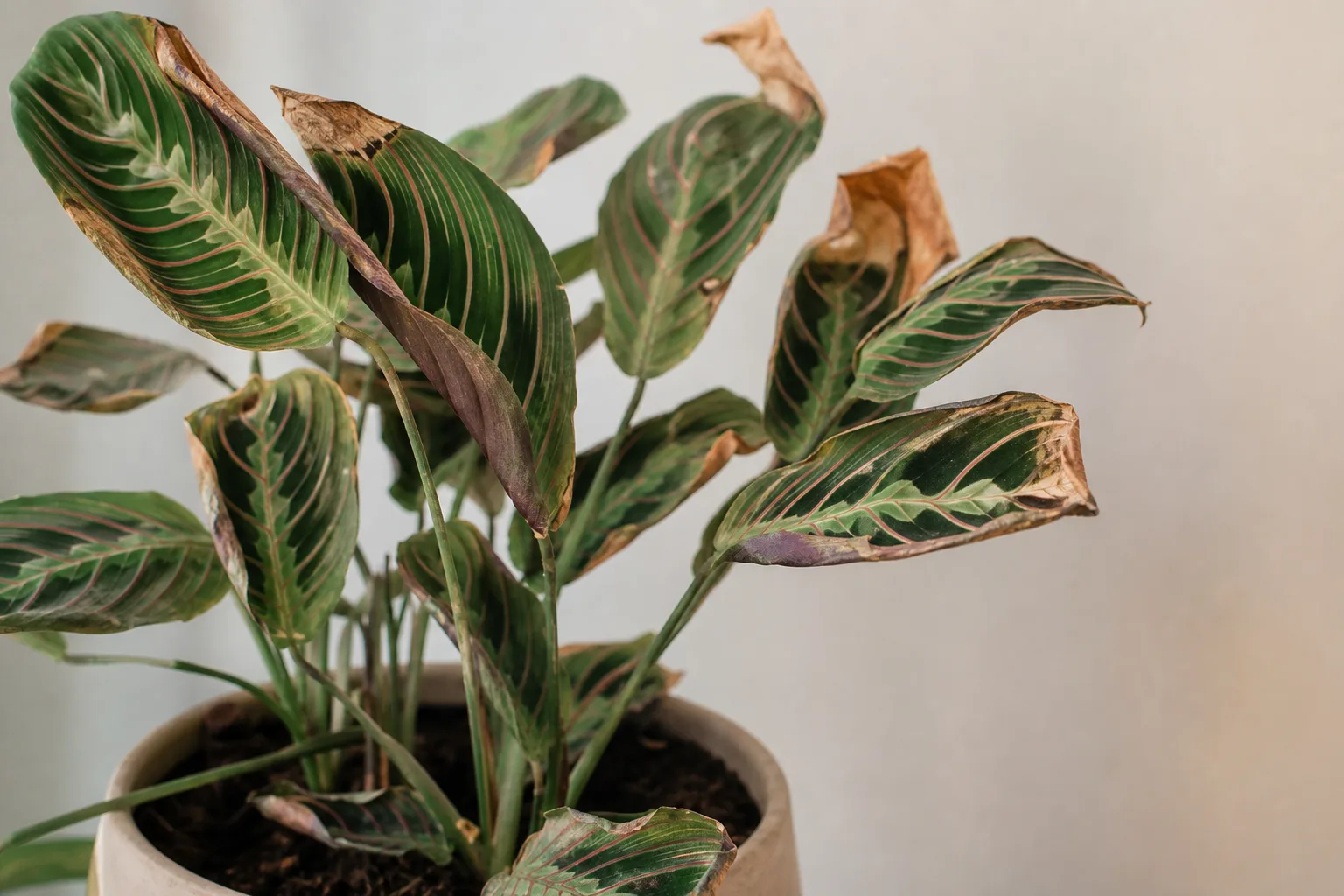
Low Humidity on Maranta Leuconeura: Causes, Checks & Fixes
This guide covers low humidity on Maranta Leuconeura. See also the general Low Humidity guide, watering, and light pages for this plant.
Low Humidity on Maranta Leuconeura: Causes, Checks & Fixes
Quick answer
Use this page when your prayer plant’s patterned leaves show crisp brown margins, faded variegation, or weaker nightly folding-but the top 2 cm of mix feels evenly moist and roots stay firm. That combination means raise humidity, not water more.
Maranta leuconeura evolved in humid tropical understories where air stays warm and moist year-round. Indoors, winter heating often pulls relative humidity below 30%, and dry air strips moisture from thin, patterned leaves faster than shallow rhizomatous roots can replace it-even when the potting mix is wet enough. The RHS prayer plant profile recommends maintaining high humidity at all times for this species.
First step: place a cool-mist or ultrasonic humidifier within 1–2 metres of the plant and aim for 55–60% RH at leaf height. Move the pot away from heating vents and cold window glass before you increase watering or repot. Dry air is an environmental fix-not a reason to soak the soil.
Low humidity vs. crispy leaves vs. brown tips - which guide to use
Prayer plant margin damage routes to three different pages depending on what you confirmed:
| Your pattern | Best guide | Why |
|---|---|---|
| Moist soil at 2 cm + crisp margins + weaker night folding + RH below 45% | This page | Air is too dry; roots are not the bottleneck |
| Crispy, papery leaves + dry soil throughout + light pot | Crispy leaves | Multi-cause moisture loss-underwatering, sun, or humidity |
| Brown tips only + stable humidity above 55% + possible white crust on soil | Brown tips | Fluoride, salts, or water quality stacked on dry air |
| Limp wilting + wet soil + sour smell | Overwatering or root rot | Crown failure-not humidity alone |
When in doubt, check a hygrometer at leaf height and soil moisture at 2 cm before choosing a fix. Adding water to moist mix because leaves look dry is the most common Maranta mistake in heated apartments.
What low humidity looks like on Maranta Leuconeura
Humidity stress on prayer plants usually starts at the leaf margins, not the center. On a healthy plant, leaves fold upright after dark; low humidity often weakens that movement before roots fail.
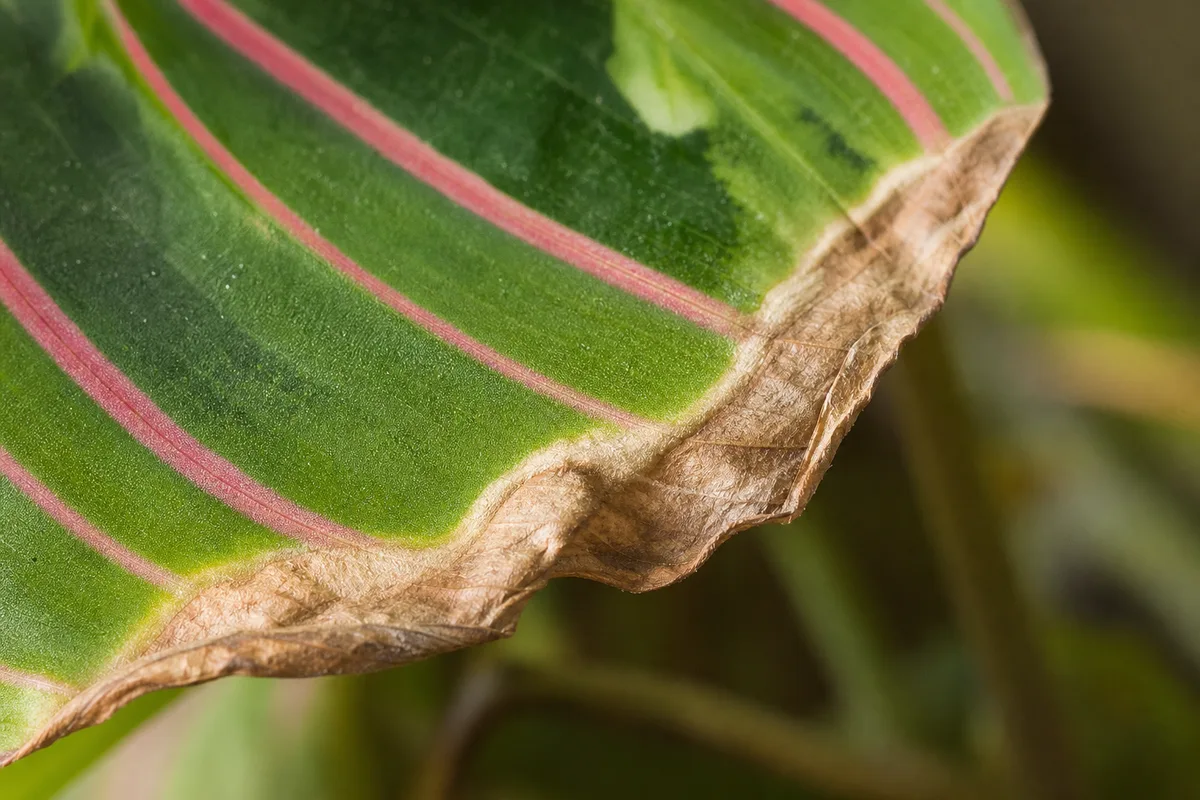
Low Humidity symptoms on Maranta Leuconeura - compare with healthy tissue on the same plant.
Early signs:
- Dry, papery brown tips or edges while the herringbone center stays green
- Leaves curling slightly inward to reduce exposed surface area
- New leaves opening smaller or with tan margins already present
- Variegation looking dull or washed out compared with older growth
- Nightly folding becoming less dramatic-leaves stay flatter after lights out
Progressed stress:
- Brown margins spreading inward on multiple leaves at once
- Leaf movement slowing-leaves droop instead of rising vertically at dusk
- Fine stippling or webbing on undersides as spider mites exploit dry conditions
- Slowed new growth during an otherwise warm, bright season
The damage often clusters on leaves nearest a heating vent, radiator, or drafty window. Because Maranta spreads horizontally from rhizomes, outer leaves on the trailing side of a hanging basket may crisp first while inner growth still looks fine-a clue that localized dry air, not root failure, is the trigger. Red-veined cultivars such as ‘Erythroneura’ tend to show edge burn on new growth before green cultivars like ‘Kerchoviana’.
What to compare visually: Hold a damaged leaf beside a healthy older leaf from the same plant. Humidity damage shows uniform margin tan on several leaves at once with moist soil visible in the photo frame; underwatering pairs crisp edges with visibly dry, shrunken mix pulling from the pot wall.
Why prayer plant struggles in dry air
Maranta leuconeura is a low-growing tropical perennial with broad, thin leaves built for shaded, humid forest floors-not heated living rooms. NC State lists the species as intolerant of low humidity. Its leaves transpire steadily through stomata; when ambient humidity drops, water exits faster than roots can supply it, even if the potting mix feels adequately moist.
Several traits make this species more sensitive than tougher houseplants like pothos, though Maranta is generally more forgiving than close relatives such as Calathea:
- Leaf structure - Large surface area and no waxy cuticle mean rapid moisture loss in dry air.
- Shallow rhizomes - Roots sit near the soil surface and cannot deep-draw water to compensate for heavy transpiration.
- Nyctinastic movement - The daily fold-and-rise cycle depends on healthy turgor pressure in pulvini at the leaf base; chronic dryness weakens that response before roots show damage.
- Winter indoor climate - Forced-air heating can drop room humidity below 30% while owners keep the same watering rhythm, masking the real problem.
Placement mistakes compound the issue. Hot air blasting from a floor vent desiccates foliage in hours. Cold window glass in winter creates a microclimate where leaves touch chilled pane and lose moisture on both sides. Running AC in summer without nearby humidity support produces the same edge-crisping pattern. A desk near a monitor or radiator can dry the upper air in a hanging basket faster than a humidifier on the floor reaches leaf height.
How to confirm low humidity is the cause
Work through these checks before changing watering, fertilizer, or soil:
- Hygrometer reading - Place a digital hygrometer at leaf height for 24 hours. Readings consistently below 45% near the plant support low humidity; above 55% suggests another cause.
- Soil moisture at 2 cm - Stick a finger into the top 2 cm of mix per Illinois Extension watering guidance. Evenly moist soil plus crispy edges points to air stress. Bone-dry soil suggests underwatering. Wet, heavy soil with yellowing leaves suggests overwatering.
- Pot weight and roots - Lift the pot. A moderate weight with firm, pale roots rules out root rot. Sour smell or mushy roots mean waterlogged mix-not humidity alone.
- Timing and location - Did symptoms appear after turning on heat, moving the plant near a window, or placing it under a new AC vent? Seasonal timing strongly favors environmental dryness; see draft stress if cold blasts are involved.
- New growth and leaf movement - Check whether newest leaves still roll up at dusk. Humidity-stressed plants often keep some movement early; advanced root problems flatten leaves entirely.
- Pest check - Inspect undersides with a hand lens. Spider mite stippling plus dry air means fix humidity and treat pests together.
If humidity near the plant stays above 55%, soil moisture is appropriate, and edges still crisp, look next at fluoride or mineral tip burn from tap water-a separate issue covered in brown tips.
First fix for Maranta Leuconeura
Run a humidifier within 1–2 metres of the plant until RH at leaf height holds 55–60% for several days.
Humidifier setup and placement
Choose a cool-mist or ultrasonic unit sized for the room; a small bedside humidifier often suffices for one plant corner. The RHS advises maintaining high humidity at all times for prayer plants-occasional misting alone does not meet that bar.
- Distance - Position the output 1–2 metres from foliage so mist does not pool on crowns overnight. Aim airflow toward leaf height, not the floor; hanging baskets near ceiling vents need the humidifier raised or redirected because upper air is often driest.
- Target - Hold a hygrometer at the same height as the top leaves, not at desk level. RH at the humidifier display can read 10–15 points higher than at the plant.
- Runtime - Run daily during heating season rather than misting occasionally-brief misting raises humidity only for minutes and can leave dense foliage wet overnight, which invites fungal problems on prayer plant leaves.
- Bathroom option - Kitchens and bathrooms hold higher baseline humidity, but only relocate if the spot delivers bright filtered light without cold glass contact. A dim bathroom fails faster from low light than dry air; a bright east-facing bath with a small humidifier often works better than either alone.
While the humidifier runs:
- Move the pot off the windowsill or at least 30 cm away from cold glass and heat vents.
- Keep your normal moist-but-not-soggy watering rhythm per the watering guide; do not pour extra water to “replace” lost air moisture.
- Group the Maranta with other tropicals if space allows-the shared transpiration creates a slightly damper microclimate. Illinois Extension notes that grouping plants improves humidity immediately around them, though it rarely replaces a humidifier in a furnace-heated room.
Pebble trays and grouping limits
A pebble tray under the pot can add a few percentage points of RH near the soil surface. In a home that drops to 20–30% RH in winter, trays alone rarely sustain 55–60% at leaf height-pair them with a humidifier for reliable results. Never let pots sit directly in standing water; trays should keep roots above the water line.
Check the hygrometer after 48–72 hours. Stable humidity is the signal to proceed; if edges keep spreading despite 60% RH, inspect for mites or switch to filtered water before trying secondary fixes.
Step-by-step recovery
Once humidity is stable, support recovery in this order:
- Hold fertilizer - Skip feeding until new leaves open cleanly for two to three weeks. Fertilizer on drought-stressed foliage can burn margins further.
- Scout for spider mites - If stippling appears, rinse undersides with lukewarm water in the morning and repeat weekly while humidity stays high. Treat confirmed infestations per the spider mites guide before leaves dry out again.
- Trim selectively - Snip fully brown tips or edges with clean scissors, following the natural leaf contour. Leave partially green tissue intact; it still photosynthesizes.
- Switch to filtered water if tips persist - Maranta is sensitive to fluoride and salts in tap water, which compound edge burn when air is dry. Filtered, distilled, or overnight-settled tap water reduces that layer of damage.
- Adjust placement for the season - In summer, keep the plant out of direct AC streams. In winter, rotate the pot weekly so no single side faces the coldest glass.
Avoid Maranta Leuconeura repotting guide during active humidity recovery unless roots are clearly failing. Prayer plants dislike simultaneous root disturbance and environmental stress.
Recovery timeline and what improvement looks like
Humidity fixes work gradually. Expect:
- 3–7 days - Edge browning stops spreading; leaves feel less papery.
- 2–4 weeks - New leaves emerge with cleaner margins; nightly folding may strengthen.
- 1–2 months - Several fresh leaves replace the worst damaged ones on actively growing plants.
Old brown tissue will not green up again-judge success by new growth, not repaired edges. If no clean new leaves appear after four weeks at 55–60% RH with correct watering, reassess light (too dim slows recovery) and root health.
Signs the problem is worsening:
- Crown or stem bases softening while soil stays wet
- Multiple leaves yellowing from the base up
- Mite webbing spreading despite humidifier use
- New leaves emerging already mostly brown
Those patterns mean escalate beyond humidity-check for root rot, cold damage, or heavy pest load. Start with the wilting guide when stems collapse.
Lookalike symptoms to rule out
| What you see | More likely cause | Quick differentiator | Best guide |
|---|---|---|---|
| Crispy tips, moist soil, firm roots | Low humidity | Dry room air, winter timing, hygrometer below 45% | This page |
| Crispy tips, light pot, dry soil | Underwatering | Soil pulls from pot sides; wilts before edges crisp | Underwatering |
| Yellow leaves, soggy soil, sour smell | Overwatering / root rot | Mushy roots; limp stems despite wet mix | Overwatering |
| Tip burn only, stable humidity | Fluoride / salt in tap water | Persists after humidifier; often uniform on older leaves | Brown tips |
| Silver stippling, fine webbing | Spider mites | Pests visible on undersides; worsens in dry air | Spider mites |
| Bleached patches on upper leaves | Direct sun scorch | Damage on sun-facing side, not just margins | Crispy leaves |
| Crisping after vent or window move | Draft / microclimate | One-sided damage near cold glass or heat blast | Draft stress |
Low humidity and underwatering often overlap in dry homes-confirm both hygrometer reading and soil moisture before picking a fix.
Mistakes to avoid
- Overwatering to compensate for dry air - Soggy rhizomes rot quickly; prayer plants need moist mix, not saturated crowns.
- Relying on misting alone - Brief spritzes do not sustain the 55–60% RH Maranta needs through a heating season.
- Placing pebble trays as the only solution - Trays help slightly near the pot but rarely lift whole-room winter air enough on their own; pair with a humidifier in dry climates.
- Repotting or fertilizing immediately - Extra stress stacks when the plant is already losing turgor to dry air.
- Ignoring spider mites - Dry conditions invite mites; fixing humidity alone may not clear an established colony.
- Sitting on a cold windowsill - Chilled glass plus dry heat creates a worse microclimate than either alone.
- Humidifier on the floor under a hanging basket - Leaf height may stay below 40% RH even when the floor reads 60%.
Maranta care cross-check
Low humidity rarely exists in isolation. Confirm these basics stay steady while you humidify:
- Light - Bright indirect light per the light guide; no direct sun that heats and dries leaves.
- Temperature - 18–27°C (65–80°F); avoid cold drafts below 15°C.
- Water - Keep top 2 cm evenly moist during growth per watering guidance; allow slight drying in winter only if growth slows.
- Water quality - Filtered or settled water reduces tip burn stacked on humidity stress.
- Airflow - Gentle circulation is fine; avoid constant hot or cold blasts.
- Overview - Cultivar notes, nyctinasty basics, and seasonal rhythm in the prayer plant care guide.
Maranta leuconeura tolerates slightly lower humidity than Calathea but still belongs in the “tropical foliage” group-not with succulents or other dry-air specialists.
How to prevent low humidity next time
- Start humidifying before edges crisp - When heating season begins, run the humidifier proactively rather than reacting to brown tips.
- Track RH weekly - A cheap hygrometer removes guesswork; aim for 55–60% at plant height.
- Group tropicals - Clustering prayer plants with ferns or philodendrons shares transpired moisture.
- Choose bathroom or kitchen placement carefully - Only if bright enough and away from cold glass; see light requirements.
- Redirect vents - Deflect heat and AC away from plant shelves and hanging baskets.
- Weekly underside checks in winter - Catch mites early when indoor air is driest.
About this guide
This guide was written by sai-ananth and reviewed by the LeafyPixels Review Board against botanical references including the University of Illinois Extension prayer plant page, Illinois Extension houseplant humidity guidance, Missouri Botanical Garden PlantFinder entry for M. leuconeura, NC State Extension Plant Toolbox, Royal Horticultural Society Maranta leuconeura details, and LeafyPixels watering, crispy leaves, brown tips, spider mites, wilting, and draft stress guides. Humidifier distance heuristics and pebble-tray limitation notes are editorial diagnostics synthesized from extension humidity guidance and prayer plant growth habit-not a single published lab trial.
Conclusion
Low humidity on Maranta leuconeura is fixable when you treat dry air as the cause-not thirsty roots. Moist soil plus crisp margins means humidify, not water more. Run a humidifier at leaf height, protect the plant from vent and window drafts, and judge recovery by new leaves rolling up cleanly at night.
Routing reminder: dry soil throughout → underwatering or crispy leaves; tips only with stable RH → brown tips; limp stems with wet mix → wilting or overwatering. Full species context lives in the prayer plant overview.
When to use this page vs other Maranta Leuconeura guides
- Maranta Leuconeura watering guide - Use for routine moisture checks before assuming low humidity is the main issue.
- Maranta Leuconeura problems hub - Browse all 40 common issues on this species.
- Brown Tips on Maranta Leuconeura - Different entry point when symptoms overlap with low humidity.
- Curling Leaves on Maranta Leuconeura - Different entry point when symptoms overlap with low humidity.