Crispy Leaves on Maranta Leuconeura: Causes, Checks & Fixes
Quick answer
Crispy Maranta leuconeura leaves usually mean the plant lost moisture faster than roots replaced it-dry soil, dry winter air, or direct sun are the top triggers. First step: feel the top 2 cm of mix and check a hygrometer; water thoroughly if dry, or run a humidifier if soil is moist but RH is below 45%.
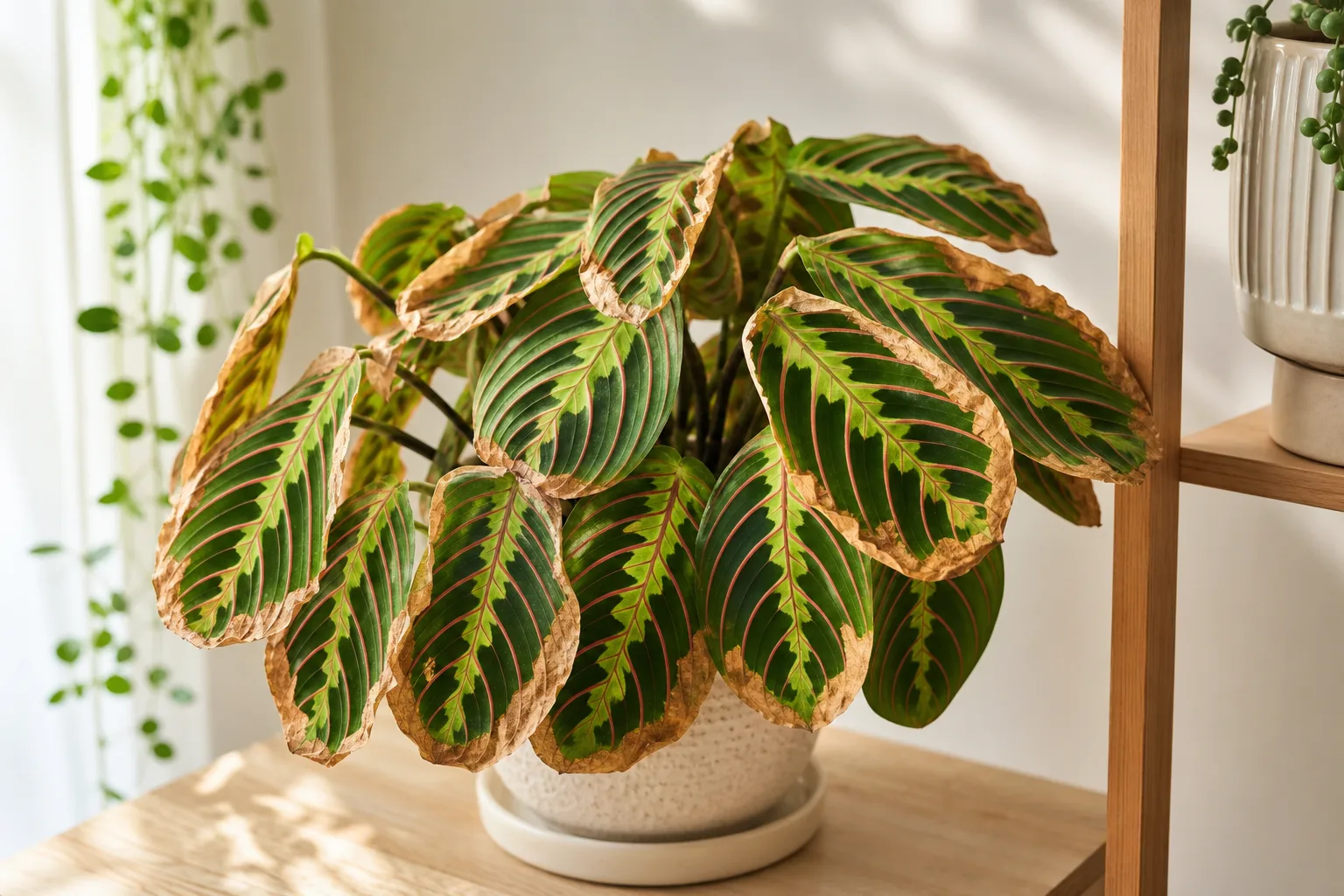
Crispy Leaves on Maranta Leuconeura: Causes, Checks & Fixes
This guide covers crispy leaves on Maranta Leuconeura. See also the general Crispy Leaves guide, watering, and light pages for this plant.
Crispy Leaves on Maranta Leuconeura: Causes, Checks & Fixes
Quick answer
Crispy leaves on Maranta leuconeura mean leaf tissue dried out faster than the shallow rhizome roots could resupply it. Prayer plants carry broad, thin, patterned foliage built for humid tropical understories-not the dry air, direct sun, or bone-dry potting mix common in heated homes. Damage often starts as papery brown margins, then spreads until whole sections feel brittle and may crumble when touched.
First step: push your finger into the top 2 cm of mix and read a hygrometer at leaf height. If the soil is dry and the pot feels light, water thoroughly until a little drains and empty the saucer. If the mix is evenly moist but room humidity reads below 45%, place a humidifier beside the plant before you change watering, fertilizer, or soil.
What crispy leaves look like on Maranta Leuconeura
Crisping on prayer plants is a texture change-not just color. Healthy Maranta leaves feel supple and fold upright at night; stressed leaves feel dry, stiff, or crackly along the edges and sometimes across the blade.
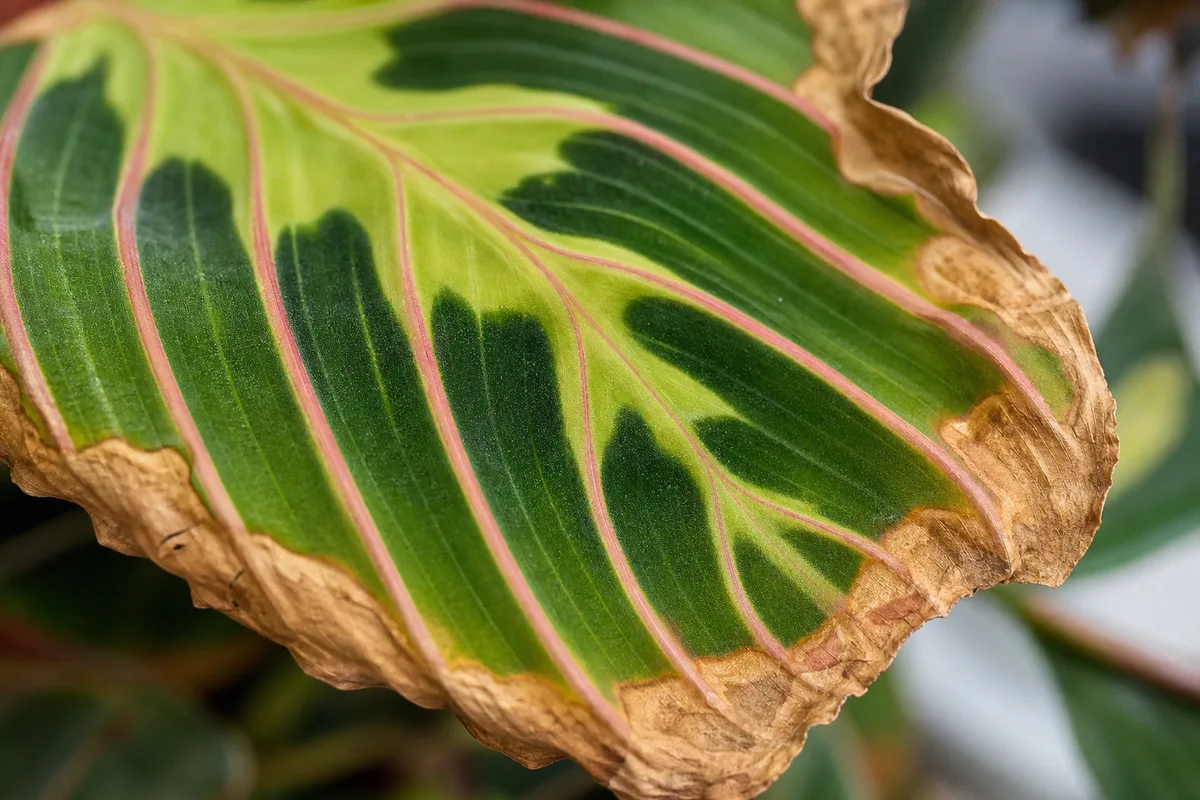
Crispy Leaves symptoms on Maranta Leuconeura - compare with healthy tissue on the same plant.
Early signs:
- Dry, papery brown tips or margins while the herringbone center still looks green
- Leaves curling inward to reduce exposed surface area
- Slight dullness in variegation compared with older growth
- Nightly folding becoming less dramatic before full flattening
Progressed damage:
- Large sections of leaf turning tan and brittle, not just the edge
- Leaves that crunch or break when bent instead of flexing
- New leaves opening small or already crisp at the margins
- Outer trailing leaves crisping first while inner growth still looks soft-a clue to localized dry air or sun on one side of a basket
Crisping from underwatering often pairs with limp stems and mix that has pulled away from the pot sides. Crisping from low humidity usually arrives with moist soil and firm roots. Sun scorch shows bleached or washed-out patches on the side facing the window, not uniform margin burn on every leaf.
Why prayer plant leaves go crispy
Maranta leuconeura is a low-growing tropical perennial with rhizomatous stems and thin leaves that transpire steadily. When moisture exits faster than roots absorb it, the most exposed tissue desiccates first-typically margins, then larger areas if stress continues.
The main drivers on Maranta Leuconeura overview:
- Underwatering or hydrophobic soil - Prayer plants want evenly moist mix during active growth. Letting the pot dry completely-or having peat repel water after drought-cuts root uptake and crisps leaves from the bottom up.
- Low indoor humidity - Winter heating can drop room RH well below what tropical foliage expects. Dry air pulls water from leaf edges even when soil feels adequate.
- Direct sun or heat blasts - Too much sun bleaches patterns and bakes leaf tissue. Hot air from vents or radiators desiccates foliage in hours.
- Tap water minerals - Fluoride and salt buildup burn margins; stacked with dry air, edges go fully crispy rather than lightly tan.
- Spider mites - Occasional spider mites thrive in dry conditions and rasp leaf cells, leaving stippled patches that feel dry and papery.
Maranta tolerates slightly lower humidity than close relatives like Calathea, but it still belongs in the tropical foliage group-not with drought-hardy succulents.
How to confirm the cause
Work through these checks before Maranta Leuconeura repotting guide, fertilizing, or heavy pruning:
- Soil moisture at 2 cm - Dry, dusty mix throughout plus a light pot confirms underwatering. Evenly moist mix with crispy edges points to air humidity or water quality. Wet, heavy soil with yellowing leaves suggests overwatering on Maranta Leuconeura-not the same as crisp dryness.
- Hygrometer reading - Hold a digital meter at leaf height for 24 hours. Below 45% strongly supports low humidity; above 55% shifts focus to Maranta Leuconeura watering guide, sun, or salts.
- Pot weight and roots - Lift the container. Moderate weight with firm, pale roots rules out advanced root rot on Maranta Leuconeura. Sour smell or mushy roots mean waterlogged mix.
- Light and placement - Did the plant move to a brighter sill, sit beside a new heater, or touch cold window glass? One-sided bleached crisping implicates sun or microclimate, not roots alone.
- Leaf movement - Humidity- or drought-stressed plants often keep partial nightly folding early. Completely flat, limp leaves with wet soil suggest root failure.
- Pest check - Inspect undersides with a hand lens. Fine stippling plus webbing means treat mites while fixing humidity.
If humidity stays above 55%, soil moisture is steady, and leaves still crisp, switch next to filtered water to rule out fluoride tip burn that can feel fully brittle on margins.
First fix for Maranta Leuconeura
Match the fix to what you confirmed at the soil surface and hygrometer-do not stack every treatment at once.
- Dry soil, light pot: Water thoroughly until a little runs from the drainage holes, then empty the saucer. If mix repelled water and ran straight through, bottom-water for 20–30 minutes so the root ball rehydrates.
- Moist soil, RH below 45%: Run a cool-mist or ultrasonic humidifier within 1–2 metres of the plant until RH at leaf height holds 55–60% for several days. Move the pot off the windowsill and away from heating vents while the humidifier runs.
Hold fertilizer and skip repotting until new leaves open without brittle edges. Extra stress on a dehydrated prayer plant often worsens crisping rather than speeding recovery.
Step-by-step recovery
Once the primary moisture or humidity issue is addressed:
- Stabilize watering rhythm - Keep the top 2 cm evenly moist during growth; allow only slight drying in winter if growth slows. Never let the entire pot go bone dry.
- Switch to filtered or settled water if margins stay brittle - Low-fluoride water reduces edge burn stacked on dry air.
- Scout and rinse for spider mites - If stippling appears, rinse undersides with lukewarm water in the morning weekly while humidity stays high.
- Trim selectively - Snip fully brown, brittle sections with clean scissors, following the natural leaf contour. Leave partially green tissue-it still photosynthesizes.
- Adjust seasonal placement - In summer, keep the plant out of direct AC streams. In winter, rotate weekly so no single side faces the coldest glass.
Avoid misting as your only humidity strategy; brief spritzes lift RH for minutes and can leave dense foliage wet overnight.
Recovery timeline and what improvement looks like
Environmental fixes work gradually on Maranta:
- 2–5 days - Crisping stops spreading; leaves feel less papery.
- 2–4 weeks - New leaves emerge with cleaner margins; nightly folding may strengthen.
- 1–2 months - Several fresh leaves replace the worst damaged ones on actively growing plants.
Old brown tissue will not green up-judge success by new growth, not repaired edges. If no clean new leaves appear after four weeks with correct moisture and 55–60% RH, reassess light (too dim slows recovery) and root health.
Signs the problem is worsening:
- Crown or stem bases softening while soil stays wet
- Multiple leaves yellowing from the base up
- Mite webbing spreading despite humidifier use
- New leaves emerging mostly brown and brittle
Those patterns mean escalate beyond simple dryness-check for root rot, cold damage, or heavy pest load.
Lookalike symptoms to rule out
| What you see | More likely cause | Quick differentiator |
|---|---|---|
| Crispy margins, moist soil, firm roots | Low humidity | Dry room air, winter timing, hygrometer below 45% |
| Crispy leaves, light pot, dry soil throughout | Underwatering | Mix pulls from pot sides; wilts before widespread crisping |
| Soft yellow leaves, soggy soil, sour smell | Overwatering / root rot | Mushy roots; limp stems despite wet mix |
| Bleached patches on sun-facing side | Direct sun scorch | Damage localized to brightest exposure |
| Silver stippling, fine webbing | Spider mites | Pests on undersides; worsens in dry air |
| Uniform tip burn, stable humidity | Fluoride / salt in tap water | Persists after humidifier; often on older leaves |
Low humidity and underwatering often overlap in dry homes-confirm both hygrometer reading and soil moisture before picking a fix.
Mistakes to avoid
- Overwatering because leaves look dry - Soggy rhizomes rot quickly; prayer plants need moist mix, not saturated crowns.
- Relying on misting alone - Brief spritzes do not sustain the humidity Maranta needs through a heating season.
- Repotting or fertilizing immediately - Root disturbance and salts stack stress when leaves are already losing turgor.
- Ignoring spider mites - Dry conditions invite mites; fixing humidity alone may not clear an established colony.
- Leaving the pot on a cold windowsill - Chilled glass plus dry heat creates a worse microclimate than either alone.
- Trimming every leaf before fixing the cause - Remove only fully dead tissue until conditions stabilize.
Maranta care cross-check
Crispy leaves rarely exist in isolation. Confirm these basics stay steady while you recover:
- Light - Maranta Leuconeura light guide; no direct sun that heats and dries leaves.
- Temperature - 18–27°C (65–80°F); avoid cold drafts below 15°C.
- Water - Keep top 2 cm evenly moist during growth; use filtered or settled water if margins burn easily.
- Humidity - Target 55–60% RH at plant height in dry months.
- Airflow - Gentle circulation is fine; avoid constant hot or cold blasts.
How to prevent crispy leaves next time
- Start humidifying before edges crisp - When heating season begins, run the humidifier proactively.
- Track RH weekly - A cheap hygrometer removes guesswork.
- Water on soil feel, not leaf appearance - Check the top 2 cm before every major watering.
- Group tropicals - Clustering prayer plants with other humidity lovers shares transpired moisture.
- Redirect vents - Deflect heat and AC away from plant shelves.
- Weekly underside checks in winter - Catch mites early when indoor air is driest.
Conclusion
Crispy leaves on Maranta leuconeura are a moisture-balance warning-the plant lost water from thin foliage faster than its shallow roots could replace it. Confirm whether dry soil or dry air is driving the damage, fix that one condition first, and judge recovery by new leaves rolling up cleanly at night. Old brittle tissue will not turn green again, but steady humidity, filtered water, and consistent moist-not soggy-soil keep the next generation of patterned foliage supple.
When to use this page vs other Maranta Leuconeura guides
- Maranta Leuconeura watering guide - Use for routine moisture checks before assuming crispy leaves is the main issue.
- Maranta Leuconeura problems hub - Browse all 40 common issues on this species.
- Brown Tips on Maranta Leuconeura - Different entry point when symptoms overlap with crispy leaves.
- Curling Leaves on Maranta Leuconeura - Different entry point when symptoms overlap with crispy leaves.