Yellow Leaves on Maranta Leuconeura: Causes, Checks & Fixes
Quick answer
On Maranta leuconeura, yellow leaves usually come from roots staying too wet, cool drafts, dry air, or mineral-heavy water. First action: stop calendar watering and wait until the top inch is lightly dry before watering again, while keeping the plant warm and draft-free.
Yellow Leaves on Maranta Leuconeura: Causes, Checks & Fixes
This guide covers yellow leaves on Maranta Leuconeura. See also the general Yellow Leaves guide, watering, and light pages for this plant.
Yellow Leaves on Maranta Leuconeura: Causes, Checks & Fixes
Quick answer
Yellow leaves on Maranta usually start with water imbalance first, then temperature, humidity, and water quality. Prayer plant prefers evenly moist mix, Maranta Leuconeura light guide, warm conditions, and higher humidity, but it declines quickly if roots stay oxygen-starved in wet media Illinois Extension, Missouri Botanical Garden.
First fix: pause watering until the top inch feels lightly dry, then water thoroughly and let excess drain. At the same time, keep temperatures above 60°F and remove cold drafts Missouri Botanical Garden.
What yellow leaves look like on Maranta leuconeura
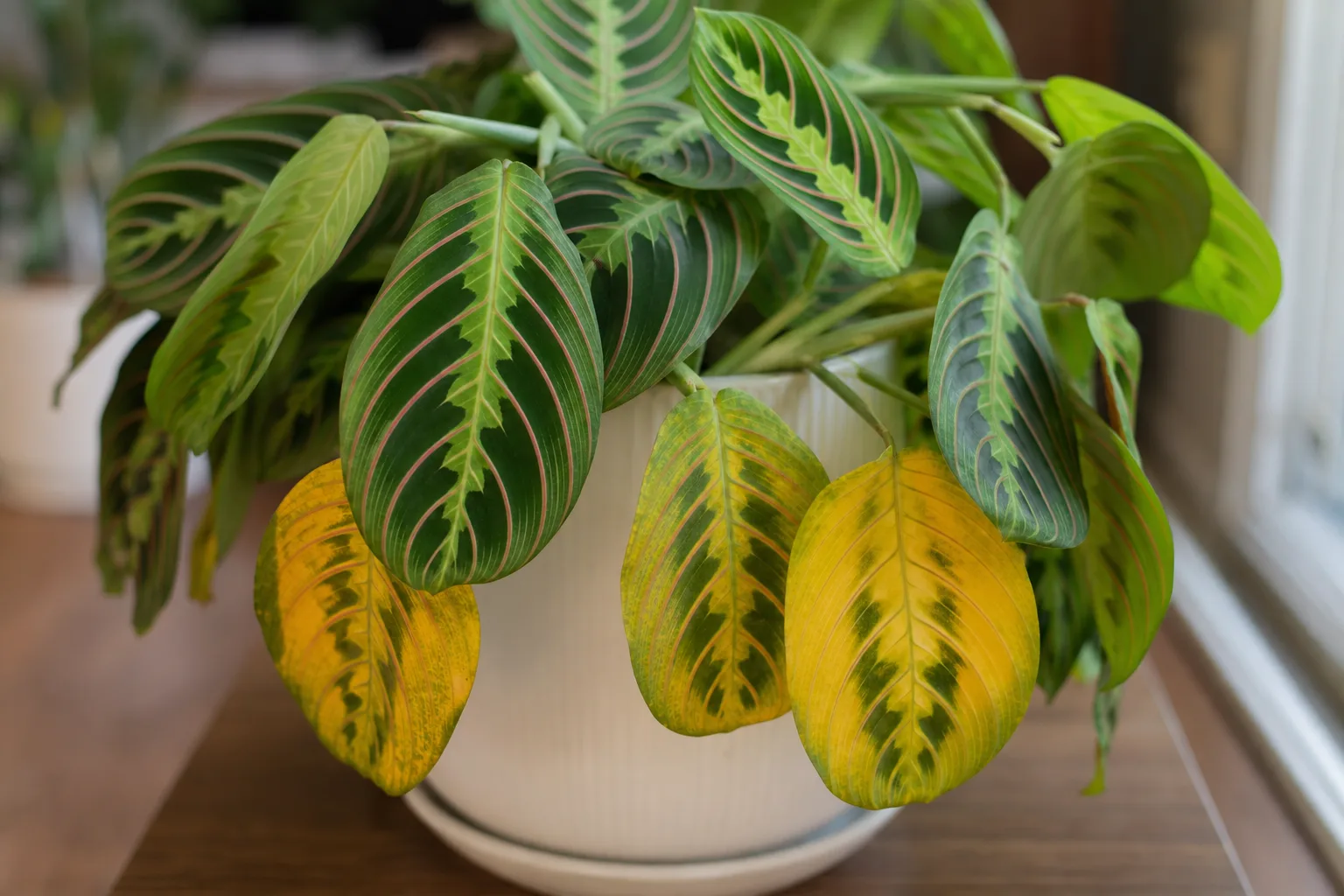
On this species, yellowing often begins on older interior leaves when moisture stays high too long around the roots. If stress continues, yellowing can spread to newer leaves and petioles may lose firmness. Maranta leaves normally rise at night and flatten by day; reduced movement often appears during environmental or root stress NC State Extension Plant Toolbox.
If only one lower leaf yellows occasionally and the plant keeps pushing healthy patterned growth, that is often natural turnover rather than a full care failure.
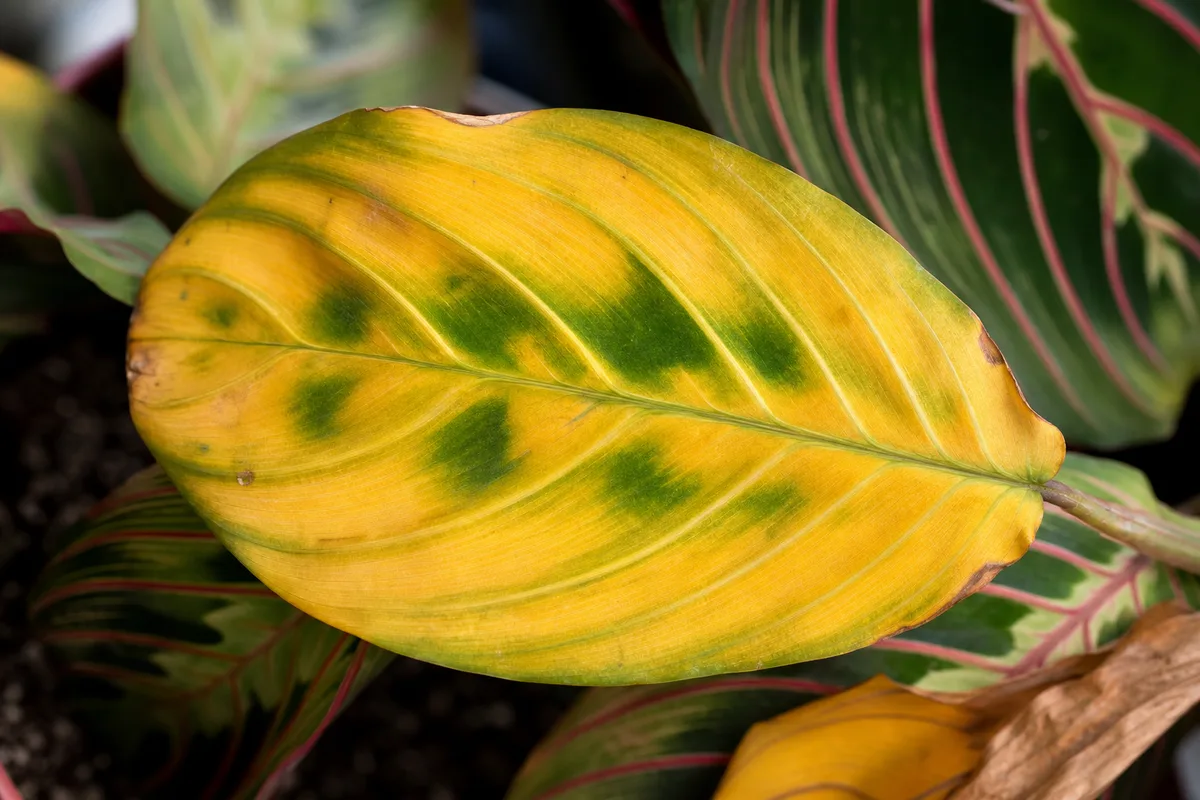
Yellow Leaves symptoms on Maranta Leuconeura - compare with healthy tissue on the same plant.
Most likely causes (ranked for this plant)
| Cause | What you usually see | Quick confirmation |
|---|---|---|
| overwatering on Maranta Leuconeura / poor drainage | Lower leaves yellow, mix stays wet, pot feels heavy | Wet mix after 4-6 days, sour smell, mushy roots |
| Low humidity | Faded yellow-green leaves, later edge crisping | RH often under 50-55%, worse in heating season NYBG |
| Cold stress | Sudden yellowing after cool nights or draft exposure | Plant near cold glass/AC or frequent temperature swings Missouri Botanical Garden |
| Tap-water mineral/fluoride stress | Slow yellowing with tip burn or dull foliage | History of hard/treated tap water use NYBG |
| root rot on Maranta Leuconeura progression | Yellowing plus limp stems and crown softness | Dark, soft roots; rotting smell |
| Pests (especially spider mites or thrips) | Patchy stippling, not uniform yellow wash | Speckling/webbing or silvery scars on undersides Missouri Botanical Garden |
How to confirm the cause before treating
- Check soil depth and pot weight first. If the top inch is still damp and the pot remains heavy several days after watering, overwatering is the lead suspect.
- Check temperature and draft exposure. Maranta is frost-intolerant and prefers temperatures that do not dip below 60°F Missouri Botanical Garden.
- Measure humidity in the plant zone. Prayer plant care performs best in warm, humid conditions; dryness often worsens yellowing and edge damage Illinois Extension, NYBG.
- Inspect roots if symptoms spread. Healthy roots are firm and pale; rotting roots are dark and mushy.
- Flip leaves and inspect undersides. Stippled yellow patches suggest mites or thrips more than root stress.
- Compare old vs. new growth. One old leaf yellowing is often normal; yellowing of newer leaves points to active stress.
The first fix to try
Pause watering until the top inch dries slightly, then resume thorough watering with full drainage.
This one change addresses the most common Maranta failure mode: roots that stay wet too long and lose oxygen. Keep the pot warm and draft-free while watching for stabilization over the next 7-10 days.
If sour odor, soft crown tissue, or collapsing leaves continue despite this dry-down correction, escalate to root inspection and a repot into an airy mix. Do not fertilize while yellowing is still spreading.
Step-by-step recovery (after the first fix)
If the mix stayed too wet
- Remove standing water from saucers.
- Trim clearly mushy roots only.
- Repot into a container with drainage, only one size up.
- Return to bright, indirect light and stable warmth.
If humidity is low
Raise humidity into roughly the 50-60% range with a humidifier or stable humid microclimate NYBG. Low humidity increases stress load and can make the same watering pattern feel harsher on Maranta.
If water quality is a suspect
Switch to filtered, distilled, or rainwater for several weeks and flush old salts from the mix. NYBG guidance for prayer plant specifically advises avoiding hard water NYBG.
Recovery timeline and what improvement looks like
Mild yellowing from a single watering mistake may stabilize in 1-2 weeks. Root-stress cases usually need 3-6 weeks before the plant looks consistently better.
Judge recovery by new leaves and stopped spread, not by old yellow tissue returning to green. Existing yellow leaves often remain cosmetically damaged.
Lookalikes and causes to rule out
- Natural aging: one lower leaf at a time, plant otherwise vigorous.
- Underwatering: dry, light pot plus crisp curl before full yellowing.
- Not enough light: on Maranta Leuconeura smaller weak growth and longer internodes; see
/plants/maranta-leuconeura/plant-problems/not-enough-light/. - Low humidity as primary trigger: paling before major tip burn; see
/plants/maranta-leuconeura/plant-problems/low-humidity/. - Water-quality stress: gradual decline with recurring tip damage; see
/plants/maranta-leuconeura/plant-problems/brown-tips/. - Spider mites / thrips: fine stippling and webbing or silvery scarring; see
/plants/maranta-leuconeura/plant-problems/thrips/.
What not to do
- Do not add fertilizer as a first response to yellowing.
- Do not repot into a much larger pot “to help roots.”
- Do not keep watering on schedule if the mix is still wet.
- Do not assume all yellowing is humidity alone; confirm root and temperature status first.
How to prevent yellow leaves next time
Use a repeatable care system instead of reactive fixes:
- Follow a moisture-check watering rhythm (not calendar watering); related guide:
/plants/maranta-leuconeura/watering/. - Keep temperatures above 60°F and avoid cold window drafts Missouri Botanical Garden.
- Maintain moderate-to-high humidity; related guide:
/plants/maranta-leuconeura/plant-problems/low-humidity/. - Use lower-mineral water where possible; related guide:
/plants/maranta-leuconeura/plant-problems/brown-tips/. - If wet symptoms repeat, review
/plants/maranta-leuconeura/plant-problems/overwatering/and/plants/maranta-leuconeura/plant-problems/root-rot/.
For full species context, see /plants/maranta-leuconeura/.
When to worry
Urgent signs are crown softening, foul soil odor, fast multi-leaf collapse, and no healthy new growth after two to three weeks of corrected care. Those signs suggest active root decline rather than mild environmental stress.
When to use this page vs other Maranta Leuconeura guides
- Maranta Leuconeura watering guide - Use for routine moisture checks before assuming yellow leaves is the main issue.
- Maranta Leuconeura problems hub - Browse all 40 common issues on this species.
- Overwatering on Maranta Leuconeura - Different entry point when symptoms overlap with yellow leaves.
- Not Enough Light on Maranta Leuconeura - Different entry point when symptoms overlap with yellow leaves.
- Root Rot on Maranta Leuconeura - Different entry point when symptoms overlap with yellow leaves.