Magnesium Deficiency on Maranta Leuconeura: Causes, Checks
Quick answer
Magnesium deficiency on prayer plant shows as yellow patches between green veins on older leaves while new growth stays bright. First step: confirm soil is moist-not-soggy and roots are firm, then apply one diluted Epsom salt drench during active growth-not full-strength fertilizer on a stressed plant.
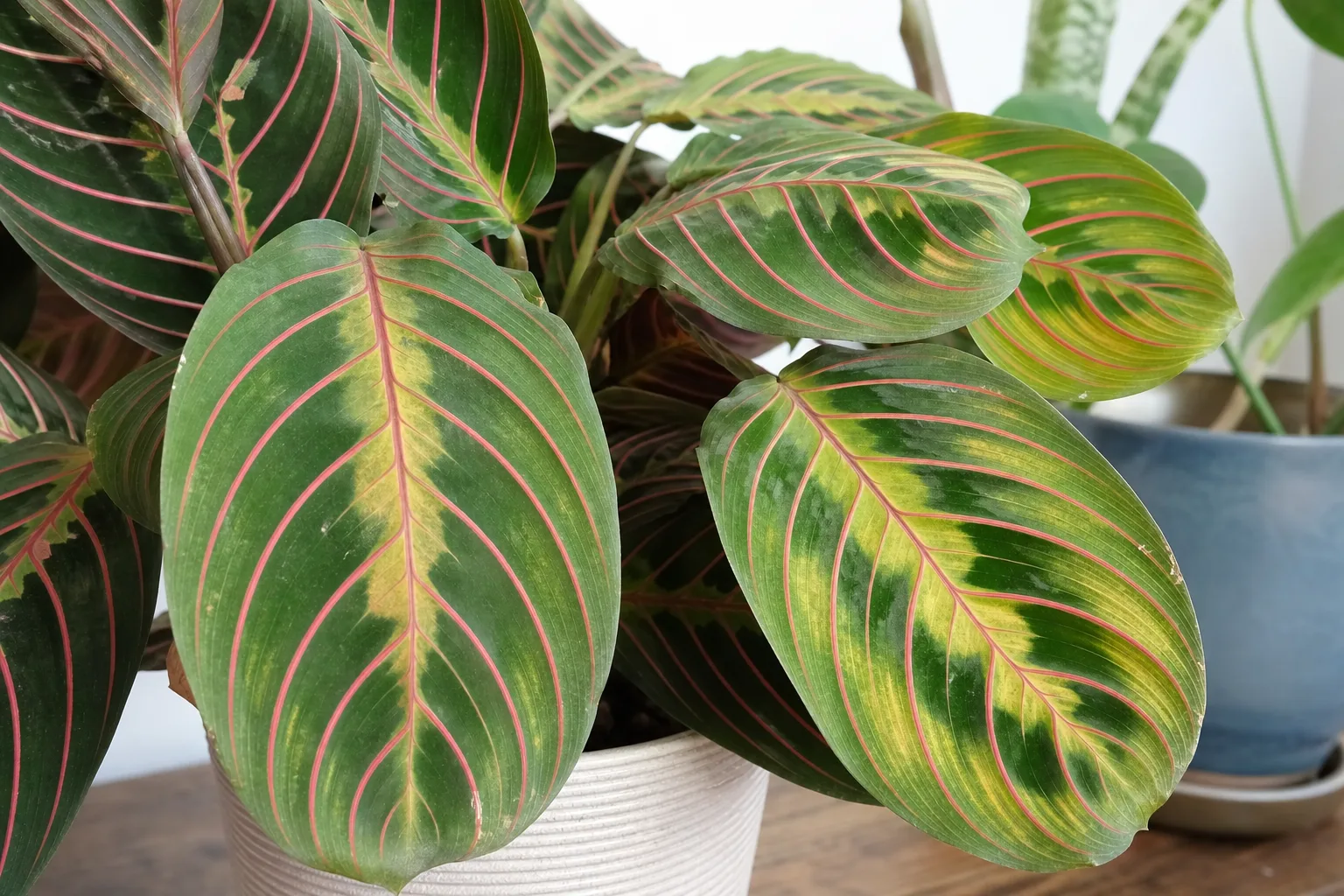
Magnesium Deficiency on Maranta Leuconeura: Causes, Checks & Fixes
This guide covers magnesium deficiency on Maranta Leuconeura. See also the general Magnesium Deficiency guide, watering, and light pages for this plant.
Magnesium Deficiency on Maranta Leuconeura: Causes, Checks & Fixes
Quick answer
Magnesium deficiency on Maranta leuconeura shows up as yellow patches between the green veins on older leaves, while newer prayer-plant foliage often stays patterned and bright. Magnesium is mobile inside the plant, so the species pulls it from lower leaves to support new growth-exactly the pattern you see on a clump-forming prayer plant with striking white or red vein markings.
First step: confirm the plant is not overwatered and roots are firm, then apply one diluted Epsom salt drench (about one teaspoon per gallon of water) to moist soil during active growth. Do not stack full-strength fertilizer, Maranta Leuconeura repotting guide, and pruning on the same day. Magnesium fixes work only when roots can absorb nutrients.
What magnesium deficiency looks like on Maranta Leuconeura
On prayer plants, the patterned leaf surface makes interveinal chlorosis easy to spot once you know what to compare.
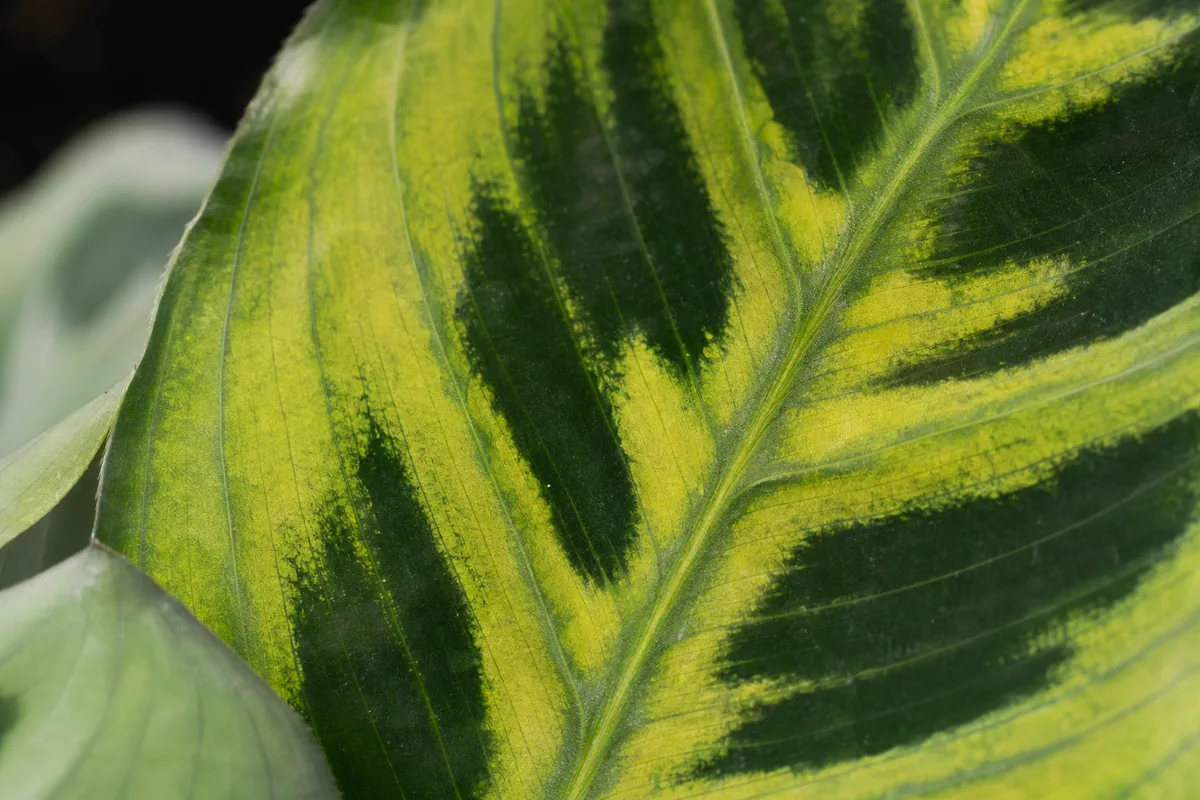
Magnesium Deficiency symptoms on Maranta Leuconeura - compare with healthy tissue on the same plant.
Typical pattern:
- Yellow or pale green between the white or colored veins, while veins stay darker green
- Symptoms start on lower, older leaves closest to the soil and spread upward only if the gap persists
- New leaves at the center or tips of each stem still open with normal variegation early on
- Affected areas may feel thin or papery but are not crispy unless a separate humidity issue exists
- Nightly leaf folding often continues at first because turgor is still adequate
What it does not look like:
- Uniform yellow entire leaves with wet, heavy soil (overwatering on Maranta Leuconeura or root stress)
- Yellowing only on the newest small leaves with green veins on older foliage (iron deficiency pattern)
- Brown dry tips alone without yellow tissue between veins (fluoride, low humidity, or salt burn)
- Stippled yellow dots with fine webbing (spider mites)
Because Maranta spreads from shallow rhizomes, the oldest leaves at the outer edge of the clump yellow first. One basal leaf fading after years can be normal senescence; magnesium deficiency affects several older leaves at once during the growing season.
Why prayer plant develops magnesium deficiency
Maranta leuconeura is a steady grower in warm, humid conditions. It uses nutrients continuously from spring through early fall when it pushes new patterned leaves and extends its rhizome. Several factors drain magnesium from container-grown prayer plants faster than owners expect:
- Leaching with watering - Magnesium leaches from the soil at each watering and washes out of potting mix each time you water to keep soil evenly moist, which Maranta requires.
- Long time in the same soil - After two or more years, peat-based mix loses available minerals even if you water correctly.
- Skipped feeding - Owners who pause all fertilizer to avoid burn may never replace magnesium that left with drainage water.
- Winter growth under lights - Supplemental light can keep a prayer plant growing while fertilizer stays paused, accelerating deficiency on older leaves.
- Competition from other nutrients - Heavy potassium or calcium without balanced magnesium can limit uptake in some mixes, though this is less common indoors than simple depletion.
Prayer plants prefer slightly acid soil (pH 5.5–7.0). Extreme pH drift is rare in fresh indoor mix but can lock up nutrients in very old, compacted containers.
How to confirm magnesium deficiency
Work through these checks in order before treating:
- Leaf age and pattern - Is yellowing strictly between veins on multiple older leaves, with veins still green? That pattern fits magnesium. Whole-leaf yellow on wet soil does not.
- New growth - Are the newest rolled leaves still well patterned? Magnesium deficiency spares young tissue until the problem is advanced.
- Soil moisture and roots - Stick a finger 2 cm into the mix. Evenly moist, lightweight soil with firm pale roots supports a nutrient fix. Sour smell or mushy roots mean stop and address rot first.
- Feeding history - Has the plant received no fertilizer for a full growing season, or lived in the same pot more than two years? Both increase likelihood.
- Season and light - Active growth in Maranta Leuconeura light guide during spring or summer makes deficiency plausible. Deep winter dormancy with no new leaves makes nutrient stress less likely as the sole cause.
- Lookalike sweep - Confirm no pest stippling, no cold draft below 18 °C, and no white salt crust on the soil surface from prior overfeeding.
If every check points to magnesium and roots are healthy, proceed with a targeted supplement-not a full feeding overhaul yet.
The first fix to try
Apply one Epsom salt drench at one teaspoon per gallon of water to already-moist soil, then wait two to three weeks.
Use plain Epsom salt (magnesium sulfate). Water the prayer plant lightly the day before if the surface is dry, then pour the room-temperature solution through the mix until a little drains from the bottom. Empty the saucer. This replaces magnesium without the salt load of a full synthetic feed.
Do not foliar-spray in direct sun or on leaves with open wounds. Do not repeat the drench within the same month unless extension guidance for your product says otherwise.
Step-by-step recovery
After the first Epsom drench, support recovery in this order:
- Resume light balanced feeding - Once new growth looks stable, use balanced liquid fertilizer at half label strength monthly through early fall. Hold feed entirely in late autumn and winter when growth slows.
- Maintain moisture rhythm - Keep soil consistently moist at 2 cm depth without waterlogging crowns. Dry roots cannot pick up magnesium you just added.
- Monitor the next two leaf cycles - Watch the next two sets of leaves that unfurl from each stem. Clean patterning between veins confirms the fix.
- Trim only dead tissue - Remove fully brown or collapsed older leaves at the base after the plant stabilizes. Yellow tissue rarely re-greens.
- Repot if soil is exhausted - If the pot has not been refreshed in three or more years, schedule repotting into fresh, well-draining mix the following spring-not the same week as the first drench.
Avoid doubling Epsom salt doses hoping for faster results. Excess magnesium can interfere with calcium uptake and stress shallow Maranta roots.
Recovery timeline
Mild interveinal chlorosis on a few lower leaves often stabilizes within two to three weeks after one proper drench and corrected feeding. The next unfurling leaf is the earliest reliable sign.
Older chlorotic leaves may stay yellow permanently even when the plant is healthy again. Expect four to eight weeks before you can judge full recovery across the clump. If new leaves open yellow between veins, repeat the diagnostic path-roots, pH, or iron may now be the limiting factor.
Lookalike symptoms on prayer plant
| What you see | Likely cause | Quick differentiator |
|---|---|---|
| Yellow between veins, old leaves first | Magnesium deficiency | Veins stay green; new leaves normal early |
| Yellow new leaves, green old leaves | Iron deficiency | Pattern reversed from magnesium |
| Even yellow leaves, wet soil, limp stems | Overwatering / root rot on Maranta Leuconeura | Soil stays soggy; crown may soften |
| Brown tips only, no yellow between veins | Low humidity or fluoride | Margins crisp; center green |
| Pale overall, weak leggy stems | Low light | No interveinal pattern; soil normal |
Mistakes to avoid
- Feeding a waterlogged plant - Fertilizer or Epsom salt on rotting roots worsens damage.
- Full-strength fertilizer after spotting yellow - Prayer plants burn easily; half strength monthly is enough during growth.
- Treating in deep winter dormancy - Without active growth, roots take up little magnesium; wait until new leaves appear.
- Assuming all yellow leaves need Epsom salt on Maranta Leuconeura - Overwatering is more common on Maranta; always check moisture first.
- Repeated weekly Epsom doses - One drench plus balanced feed is safer than continuous magnesium loading.
How to prevent magnesium deficiency next time
Integrate magnesium maintenance into normal prayer-plant care rather than waiting for yellow leaves:
- Feed with diluted balanced fertilizer monthly from spring through early fall when the plant is actively producing leaves.
- Give a twice-yearly Epsom salt drench at the dilution above if the plant stays in the same container year-round.
- Flush the pot with plain water occasionally to prevent salt buildup from synthetic feeds.
- Repot into fresh mix every two to three years so baseline minerals return.
- Keep bright indirect light and temperatures above 18 °C so growth and nutrient uptake stay aligned.
When to worry
Magnesium deficiency alone rarely kills a prayer plant, but combined stress can. Seek a different diagnosis if stems collapse at the soil line, roots are black and mushy, or yellowing races to every leaf within days. Those signs point to crown rot, severe overwatering, or virus-not a nutrient gap fixable with Epsom salt.
If interveinal chlorosis persists through two leaf cycles despite correct drench and feeding, consider sending a photo to a local extension office or testing whether iron-not magnesium-is limiting new growth.
Conclusion
Magnesium deficiency on Maranta leuconeura announces itself on older patterned leaves as yellow tissue between still-green veins. Confirm healthy roots and moist-but-drained soil, apply one diluted Epsom salt drench during active growth, then resume light balanced feeding. Judge success on the next prayer-plant leaves-not on old yellow tissue recovering its color.
When to use this page vs other Maranta Leuconeura guides
- Maranta Leuconeura watering guide - Use for routine moisture checks before assuming magnesium deficiency is the main issue.
- Maranta Leuconeura problems hub - Browse all 40 common issues on this species.
- Yellow Leaves on Maranta Leuconeura - Different entry point when symptoms overlap with magnesium deficiency.
- Brown Tips on Maranta Leuconeura - Different entry point when symptoms overlap with magnesium deficiency.