Maranta leuconeura (Prayer Plant) Fertilizer: When, How
Maranta leuconeura (Prayer Plant) Fertilizer: When, How, and Mistakes
Maranta leuconeura (Prayer Plant) Fertilizer: When, How, and Mistakes
Maranta leuconeura fertilizer decisions start with something no pothos page can copy: the nightly leaf fold. Maranta leuconeura - the classic prayer plant - is a low, rhizome-spreading tropical from Brazil’s humid forest floor, famous for nyctinasty, the daily rise and fold of leaves driven by pulvini at each petiole base. When evenings are dark and the plant is healthy, leaves move from flat by day to vertical at night. That rhythm is your first growth gauge. Active folding plus clean new leaves means metabolism is running; stalled movement with crispy margins often means pause feeding and fix water or humidity before adding more nitrogen.
Prayer plants are moderate feeders, not hungry foliage crops. They use nutrients to push patterned leaves along creeping rhizomes, but thin leaf tissue and shallow fibrous roots cannot buffer salt the way a large outdoor bed can. The practical default for most indoor growers: balanced liquid fertilizer at half the label strength, once a month from mid-spring through early fall, applied only onto moist soil, with a monthly plain-water flush to leach soluble salts. Pause entirely in late autumn and winter unless you grow under strong supplemental lights with visible new growth. Overfeeding causes brown tips, white crust on the soil, and leaf drop that mimics low humidity - so diagnose before you double the dose.
This guide covers N-P-K choices, a worked dilution example, seasonal timing, nyctinasty as a pause signal, fluoride and fertilizer salt interaction, recovery after burn, and how feeding connects to watering, light, and soil on the same plant.
Why Prayer Plants Need Light, Consistent Feeding - Not Heavy Doses
Marantaceae houseplants evolved on nutrient-cycling forest floors where organic matter arrives in thin layers, not in concentrated bursts. M. leuconeura spreads horizontally by rhizome, stays compact - typically 12–15 inches tall and as wide per Missouri Botanical Garden - and replaces leaves steadily during warm months rather than surging like a summer vegetable. That biology favors small, regular nutrient inputs over label-strength doses every two weeks.
The Royal Horticultural Society lists prayer plants as plants to feed monthly during the growing season. University of Maryland Extension guidance for indoor plants recommends half-strength dilution and warns that fertilizer on dry soil burns roots as salts concentrate at the root surface. Those two sources reconcile cleanly: monthly rhythm from RHS, conservative concentration from extension. If your plant sits in a small pot, dim light, or hard tap water, stretching to every six to eight weeks at half strength is safer than forcing a strict monthly calendar - watch new leaves, not the date.
Heavy feeding does not speed nyctinasty or deepen herringbone patterning. It raises soluble salts in a closed pot where evaporation leaves minerals behind. NC State Extension notes prayer plant leaves burn with over-fertilization as well as with high fluorides - tip damage from salts looks like humidity burn or tap-water injury, which is why prayer plant fertilizer guides must address water quality and feeding together, not as separate footnotes.
How Fertilizer Supports Rhizome Spread and New Leaf Color
Nutrients fuel three visible outcomes on a healthy prayer plant: new leaves unfurling along rhizome tips, side shoots filling in after division or pruning, and stable pattern contrast on the upper leaf surface. Nitrogen supports leaf expansion; phosphorus and potassium support root function and overall vigor; micronutrients on a complete label - iron, magnesium, manganese - matter when new growth emerges pale despite good light and moisture.
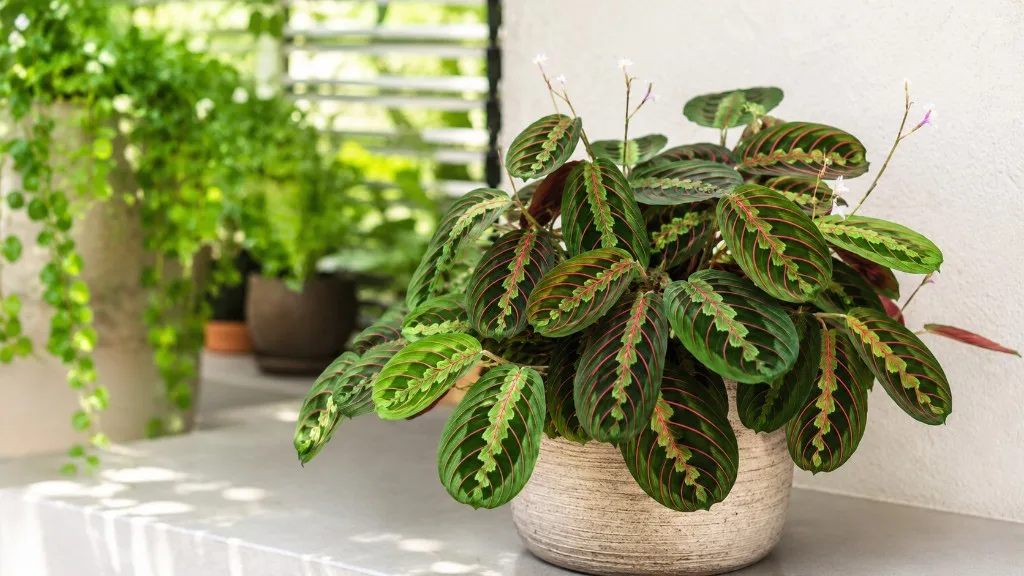
Patterned cultivars are the scoreboard. On Maranta leuconeura ‘Erythroneura’ (red herringbone), you want sharp red lateral veins on dark green with a pale central stripe. On var. kerchoveana (rabbit tracks), dark splotches along the midrib should stay crisp against medium green. When feeding is right, newest leaves match the cultivar’s catalog look; older lower leaves naturally age out. When feeding is wrong - or when fluoride and salts stack - margins brown first on the thinnest tissue while the plant may still fold at night, which confuses many growers into adding more fertilizer.
Rhizome spread slows in depleted mix. After 12–18 months in the same pot, even careful watering leaches nutrients. Light monthly feeding during active growth replaces what the plant exports into foliage. Fresh repotting into enriched mix supplies a buffer - hold fertilizer four to six weeks after repotting so damaged roots heal, a standard extension precaution for container houseplants.
Cultivar Differences: Red-Vein vs. Rabbit Tracks
All M. leuconeura cultivars share the same feeding framework; differences are speed of visible damage, not different N-P-K needs. Red-veined forms (‘Erythroneura’, var. leuconeura with strong vein contrast) show tip burn and pattern washout earliest because margins are thin and pigments are sensitive to salt and fluoride stress. Rabbit tracks (var. kerchoveana) tolerates average humidity lapses slightly better but is not immune - white crust on soil and sudden wilt after feeding still mean flush and pause.
If one cultivar in your collection burns while another does not, compare pot size, water source, and light before buying a separate fertilizer. The weaker plant is usually in a smaller pot, drier air, or harder water - not missing a “red-plant formula.”
Best Fertilizer Type and N-P-K for Prayer Plants
The best prayer plant fertilizer for most homes is a complete, water-soluble, balanced houseplant formula with moderate nitrogen. Look for equal N-P-K numbers such as 10-10-10 or 20-20-20 on the label. Equal ratios keep feeding simple when your goal is foliage and rhizome health, not flowers - prayer plant blooms are small and rare indoors per NC State, so phosphorus-heavy “bloom boosters” add salt without benefit.
Avoid very high-nitrogen alone; excess nitrogen can push soft, pale growth and reduce the sharp contrast that makes patterned leaves worth keeping. Organic liquids - diluted fish emulsion or seaweed - work if you already use them, but synthetic balanced liquids offer predictable dosing in small pots. Skip fertilizer-pesticide combination products for routine care; prayer plant leaves are poor targets for foliar feeding because salts spot patterned tissue and pooled droplets encourage fungal issues on crowded foliage.
Liquid vs. Slow-Release: What Works Indoors
| Form | Pros for prayer plant | Cons / cautions |
|---|---|---|
| Liquid balanced (10-10-10, 20-20-20) | Precise half-strength dosing; easy to skip a month; pairs with monthly salt flush | Requires measuring; easy to over-concentrate if rushed |
| Slow-release granules | Less frequent application in large floor containers | Unpredictable release in small pots; stacks with liquid feeds; hard to flush salts quickly |
| Organic liquids | Gentle if heavily diluted | Odor indoors; variable N release; still builds salts if overused |
| Foliar sprays | None recommended routinely | Leaf spotting, salt burn on patterned foliage |
Default choice: liquid at half strength monthly during active growth. If you repotted with slow-release mixed into the soil, skip liquid for two to three months and watch for salt crust before resuming.
Half-Strength Rule and Worked Dilution Example
If you remember one rule, make it half the label’s houseplant rate - never full strength on a container M. leuconeura unless you leach salts monthly and know your water is soft.
Houseplant labels assume a range of species and pot sizes. Prayer plants sit in the moderate, salt-sensitive group: more hungry than a snake plant, far less tolerant than a outdoor tomato of concentrated feed. Cutting the label rate in half is the safest default cited by University of Maryland Extension for indoor foliage plants.
Worked example: Your bottle says 1 teaspoon per gallon of water for houseplants.
- Half strength: ½ teaspoon per gallon - standard monthly dose during active growth.
- Quarter strength: ¼ teaspoon per gallon - use if you feed every three weeks in bright light, after repotting recovery, or if you previously saw tip burn.
Mix in a watering can with a narrow spout. Stir. Apply slowly to the soil surface, not the leaf crown. If the label gives per liter instead of gallon, halve that volume the same way. Measuring spoon beats eyeballing - prayer plant pots are small enough that a double scoop matters.
For a 6-inch pot, you typically need enough solution to moisten the root zone without flooding the crown; discard saucer water within 30 minutes. If no water drains, your mix may be too dense - see our soil guide before increasing feed.
Seasonal Schedule: Spring Through Winter
Timing follows metabolism, not guilt. Feed when the plant produces new leaves and folds nightly; stop when growth stalls in short days and cooler rooms. Missouri Botanical Garden recommends fertilizing monthly during the growing season and to substantially reduce fertilizer from autumn to late winter - language that maps to a full pause for most temperate indoor homes without grow lights.
Start feeding when spring growth appears: new rolled leaves at rhizome tips, stronger nightly folding, pot weight increasing as roots take water. Taper in early fall if new leaves slow. Pause from late autumn through early spring when nights are long and room temperatures drop - unused nutrients become soluble salts while roots absorb water slowly.
Grow-light exception: If you run full-spectrum LEDs 12–14 hours daily and the plant keeps pushing new leaves through winter, you may feed every six to eight weeks at half strength - still conservative. If nyctinasty weakens or tips brown, stop feeding and flush; winter growth under lights is optional, not mandatory.
Month-by-Month Feeding Calendar
| Month (Northern Hemisphere) | Growth phase | Feeding guidance |
|---|---|---|
| March–April | Wake-up, new shoots | Start half-strength liquid if active growth visible; monthly or every 6–8 weeks |
| May–August | Peak foliage | Monthly half-strength default; flush salts monthly with plain water |
| September | Slowing | Final monthly feed or stretch to 6 weeks if growth continues |
| October | Wind-down | Taper; skip if no new leaves |
| November–February | Low growth indoors | No fertilizer for typical rooms; optional 6–8 week half-strength under strong grow lights only |
| After repotting | Root recovery | Wait 4–6 weeks before resuming |
| After overfeed flush | Salt recovery | Pause 4–6 weeks; resume at quarter to half strength |
The table is a framework. A prayer plant in a bright, humid bathroom may use nutrients faster than one in a dry office - let new leaf quality and salt crust override the calendar.
Step-by-Step: Pre-Moisten, Dilute, Apply, and Flush
Safe feeding is mostly order of operations. Brand matters less than moist soil, season, and salt management.
- Check season and plant. Confirm active growth - new leaves and visible nyctinasty. If winter dormancy or stress, stop.
- Inspect for salt crust or tip burn. White residue on soil or brown margins mean flush, do not feed.
- Water with plain water if the top inch is dry. Bring the root zone to even moisture before fertilizer. Never pour nutrients onto dry soil.
- Mix fertilizer at half strength in room-temperature water - filtered or rainwater if you fight fluoride tips.
- Apply evenly across the soil surface, avoiding the crown where stems meet rhizome. Keep solution off patterned leaves.
- Let a little drain, then empty the saucer within 30 minutes.
- Once monthly, follow a feed week with a plain-water flush - water until runoff runs clear - to leach accumulated salts per University of Maryland Extension soluble salt guidance.
Morning feeding after the plant has hydrated is fine; the moist-soil rule matters more than the clock. Mark the date so an enthusiastic week does not become a double dose.
When Nyctinasty Slows: Pause Feeding
Nyctinasty is not decoration - it is a metabolic signal. Healthy prayer plants fold leaves upward after dark. When pulvinus function weakens, leaves stay flat or droop overnight, often before widespread yellowing. Common causes: continuous light from a lamp, chronic underwatering, cold drafts, very low humidity, or root stress from soggy mix. Any of these mean hold fertilizer until the environment stabilizes.
Feeding a stressed plant pushes salts into roots that are already struggling to move water. Illinois Extension emphasizes consistent moisture without crown rot - fertilizer cannot fix rhizome damage from alternating drought and flood. Resume half-strength monthly feeds only when new leaves unfurl cleanly and nightly folding returns for several days. Think of nyctinasty resumption as your green light, not the first sunny afternoon in March.
Water Quality, Fluoride, and Salt Buildup
Prayer plants are fluoride-sensitive. NC State lists leaf burn from high fluorides alongside over-fertilization. Municipal tap water carries fluoride that does not evaporate when water sits overnight; chlorine off-gassing helps chlorine but not fluoride. Each watering and feeding leaves minerals behind as water evaporates from the pot. Fertilizer salts add a second load on top of water minerals - tip burn may be fluoride, fertilizer, or both.
Fix order: Switch to filtered, distilled, or rainwater for routine watering and feeding; flush monthly with plain water until runoff is clear; repot into fresh mix if a white ring cakes the pot walls. If new leaves stay clean after a water change but old tips stay brown, you found the culprit - trim old damage for appearance only.
Before increasing fertilizer on a plant with brown tips, read our brown tips guide and rule out humidity below 50–60% and inconsistent moisture. Fertilizer burn often arrives with white crust and sudden leaf drop after a recent feed; fluoride damage builds more slowly across months of tap water.
Signs Your Feeding Routine Is Working
Success on M. leuconeura is visible on new growth, not older leaves.
- New leaves unfurl at full size for the season with cultivar-correct patterning.
- Nightly folding stays obvious when evenings are dark.
- Rhizome tips produce leaves every few weeks in summer without long bare gaps.
- Soil surface stays free of heavy white crust; pot does not smell sour.
- Stems stay firm at the crown; no sudden wilt after feeding.
Pale new growth with good light and moisture may mean mild hunger after a year in the same mix - increase from every eight weeks to monthly at half strength, not full strength. Washed-out pattern in bright sun is often too much light, not too little fertilizer.
Over-Fertilizing: Symptoms, Flush, and Recovery
Over-fertilizing is one of the most common prayer plant mistakes because the plant stays green briefly while roots accumulate damage. Symptoms include brown leaf tips and margins, white or yellowish crust on the soil surface, sudden leaf drop despite moist soil, and wilting that looks like underwatering right after a feed. University of Maryland Extension links high soluble salts to marginal necrosis on sensitive indoor foliage - prayer plant leaves show damage fast.
Recovery protocol:
- Stop all fertilizer immediately.
- Flush the pot with plain water three to four times over an hour, letting excess drain fully each time.
- Pause feeding 4–6 weeks while watching new growth.
- Resume at quarter to half strength on the first feed after recovery.
- Trim only fully dead leaf tissue; burned margins on living leaves will not green up.
Badly damaged roots may require repotting into fresh mix - coordinate with our repotting guide rather than stacking repot, prune, and feed in one weekend.
New, Repotted, and Stressed Plants
Newly purchased plants: Do not fertilize the first 4–6 weeks while the plant acclimates. Nursery mix often contains starter fertilizer; home stress from light and humidity changes matters more than hunger.
After repotting: Wait 4–6 weeks before the first feed unless you used fertilizer-free mix and see active growth under lights. Fresh roots are vulnerable to burn.
After propagation: Stem cuttings in water or fresh soil need roots established before feeding - usually after the first new leaf hardens. See propagation timing for division and cutting specifics.
During pest or disease treatment: Hold feed until new growth resumes. Pests plus salt stress compound quickly on Marantaceae foliage.
Common Mistakes (Including Feed-Every-Watering)
The worst errors are predictable: full label strength, feeding dry soil, winter feeding in dim rooms, and ignoring salt flush. Prayer plants forgive a skipped month better than an extra dose.
Feeding every watering - even at low concentration - stacks salts in small pots faster than monthly half-strength with plain water between. Constant low doses keep the root zone in elevated EC without a clear flush cycle.
Using slow-release pellets in 4-inch pots - release rate tracks temperature and moisture unpredictably; one hot week can dump nutrients into shallow roots.
Chasing brown tips with more fertilizer - tips brown from fluoride, low humidity, and salts more often than from nitrogen lack. Diagnose first.
Foliar feeding patterned leaves - deposits burn variegated tissue and does not replace sound root feeding for rhizomatous houseplants.
The Feed-Every-Watering Trap
“Little and often” works for some crops; it fails for closed container prayer plants where evaporation concentrates minerals at the soil surface and pot rim. If you prefer frequent care, water with plain water between monthly fertilizer applications. Constant nutrient solution replaces one clear flush cycle with chronic low-grade salt buildup - the pattern that produces crispy herringbone margins while the plant still folds at night.
How Fertilizer Fits With Light, Water, and Humidity
Fertilizer is the last variable to tune, not the first. Prayer plants in bright indirect light use more nutrients than the same plant in low light - but low-light plants also use water slowly, which keeps salts in solution longer. Pair feeding with the rest of the Maranta Leuconeura overview: even moisture without crown rot, bright indirect light without scorch, and 50–60%+ humidity so new leaves do not crisp while you feed.
High humidity alone does not prevent fertilizer burn; a plant can sit in moist air with salty soil and still brown. Conversely, perfect feeding cannot fix fluoride water or drafty winter sills. Tune light and water until nyctinasty and new leaf color stabilize, then hold the monthly half-strength rhythm through summer.
Conclusion
Maranta leuconeura rewards conservative feeding tied to real growth signals. Use balanced liquid fertilizer at half strength, about monthly in spring and summer, on moist soil, with a monthly plain-water flush to control salts. Pause when nights are long, when nyctinasty fades, or when tips and crust say the root zone is already carrying too much mineral load. Resume only when new leaves and nightly folding return - not when the calendar flips to March. When in doubt, skip a feed; prayer plants recover from lean months far faster than from burned rhizomes.
When to use this page vs other Maranta Leuconeura guides
- Maranta Leuconeura overview - Start here for whole-plant context before deep-diving this topic.
- Maranta Leuconeura problems hub - Jump to symptom-specific fix guides when this care topic does not resolve the issue.
- Fertilizer Burn on Maranta Leuconeura - Escalate here when fertilizer adjustments are not enough.