Leaf Spot Disease on Maranta Leuconeura: Causes, Checks &
Quick answer
Leaf spot on prayer plant follows wet foliage and stagnant air on patterned leaves-not normal red, green, and cream variegation. First step: isolate, cut off spotted leaves with clean scissors, and water at soil level without wetting crowns or leaves overnight.
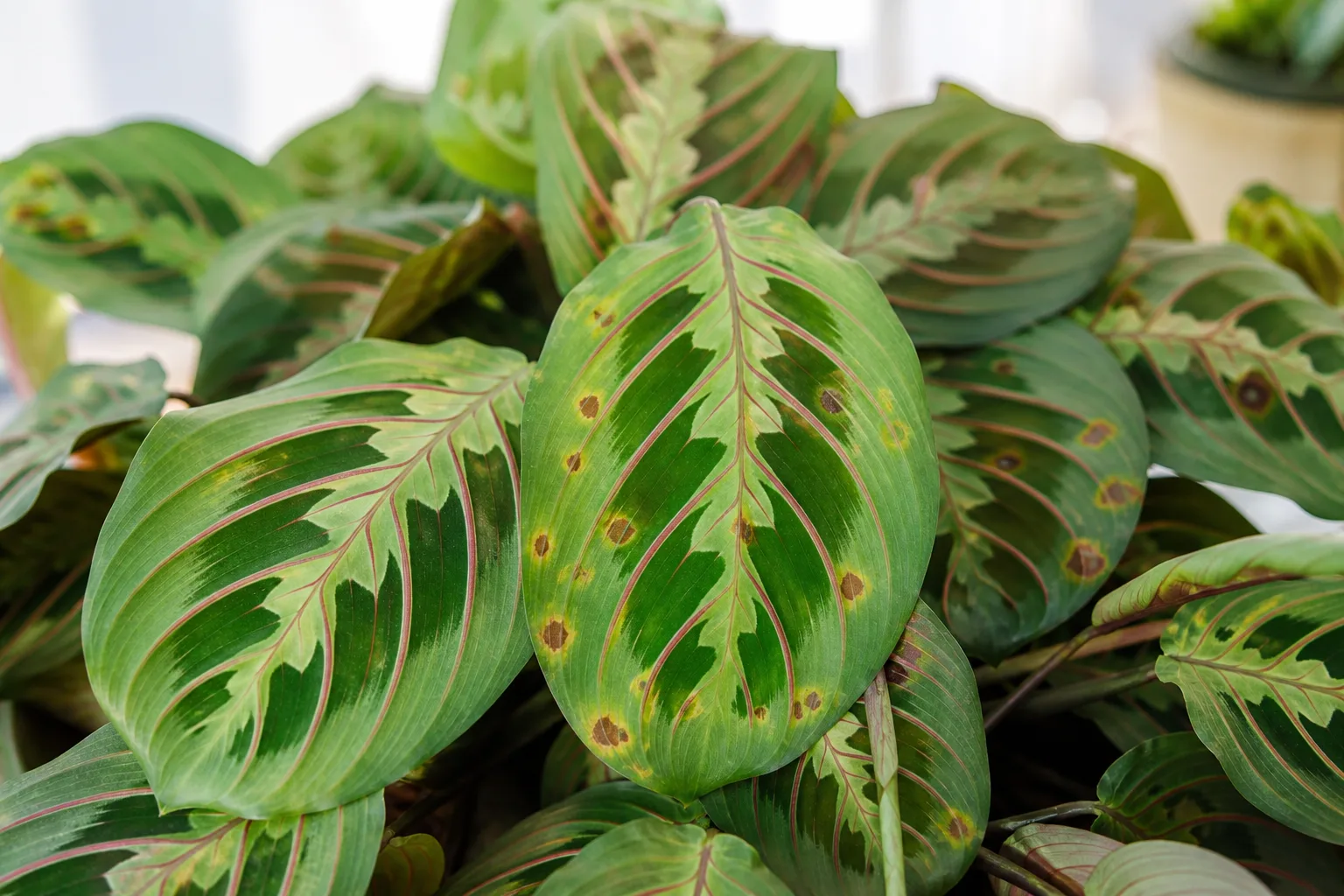
Leaf Spot Disease on Maranta Leuconeura: Causes, Checks & Fixes
This guide covers leaf spot disease on Maranta Leuconeura. See also the general Leaf Spot Disease guide, watering, and light pages for this plant.
Leaf Spot Disease on Maranta Leuconeura: Causes, Checks & Fixes
Quick answer
Leaf spot on Maranta leuconeura (prayer plant) is almost always fungal infection on wet, stagnant foliage-not a flaw in the plant’s natural red, green, and cream patterning. Prayer plants need humidity, but leaf spot and tip browning may occur when leaves stay wet in crowded humid corners.
Variegation vs. disease on one leaf: Normal patterning repeats the same color blocks on every leaf of that cultivar and does not enlarge over a week. True leaf spot shows new tan or water-soaked lesions with yellow halos that grow on one colored section while neighboring tissue on the same leaf stays clean.
First step: isolate the plant, remove spotted leaves with sterilized scissors, and water at soil level so water does not stand on crowns or leaves overnight. Full crown-dry technique lives in our Maranta watering guide.
What leaf spot looks like on Maranta leuconeura
On prayer plant, true leaf spot shows small water-soaked spots that turn yellow and die, then merge into large irregular tan patches with a yellow halo-the pattern Penn State documents for Helminthosporium leaf spot on Maranta caused by Drechslera setariae.
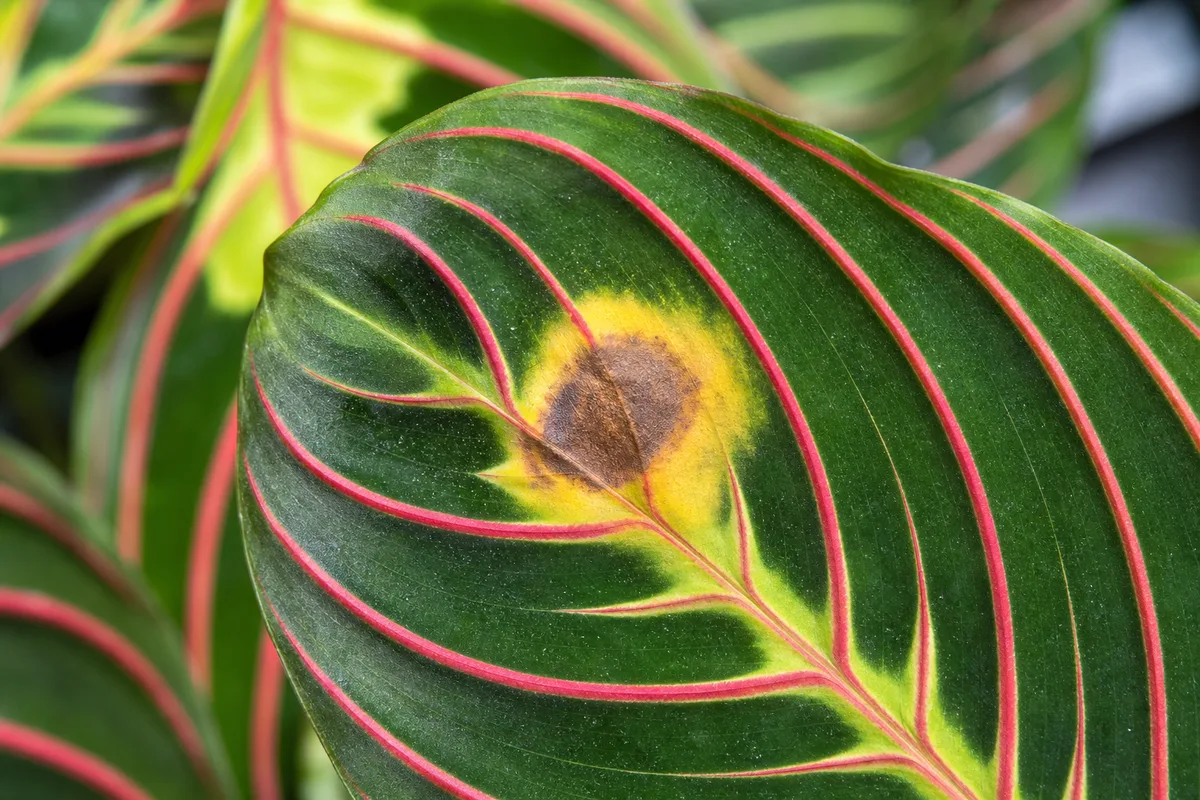
Leaf Spot Disease symptoms on Maranta Leuconeura - compare with healthy tissue on the same plant.
Spots often start on lower or inner leaves where splash from watering hits soil and bounces upward. On patterned foliage, a dark rim may appear on one colored section while neighboring tissue stays clean-unlike sun scorch, which usually bleaches or crisps exposed upper surfaces in direct light.
General houseplant leaf spot fungi produce oval brown or black spots, often with a yellow halo, and prayer plant is listed among commonly affected species. Lesions may show concentric rings or tiny black fruiting bodies in dead tissue. Severe infections cause leaf drop before the plant loses its nightly fold.
Bacterial leaf spots look more water-soaked and greasy at first, sometimes bounded by veins, with mushy collapse rather than dry tan centers. They spread fastest when humid air sits on wet leaves without airflow.
Helminthosporium leaf spot vs. rust vs. variegation
Three different problems look similar on patterned prayer-plant leaves. Read this before you trim healthy tissue or reach for fungicide.
| What you see | Likely cause | Quick check | Read next |
|---|---|---|---|
| Tan patches with yellow halos; spots enlarge after wetting; no powder rubs off | Helminthosporium leaf spot | Water-soaked start, dry tan center, spreads on lower leaves | This guide |
| Orange or rusty powder on leaf undersides; smear on white tissue when rubbed | Rust disease | Powder rub test leaves orange streak | Rust disease guide |
| Same color blocks on every leaf; mark size stable for weeks | Normal variegation | No halo, no spread, matches cultivar pattern | No treatment needed |
| Brown tips and margins with yellow border; no circular spots | Tip burn | Fluoride or dry air; static margins | Brown tips guide |
Penn State lists both Helminthosporium leaf spot and tip burn on Maranta separately-do not confuse tan spots with brown tips. If pustules rub off as powder, you are on the wrong page; use the rust disease guide instead.
Why prayer plant gets leaf spot disease
Maranta wants consistently moist soil and high humidity-conditions that tempt owners to mist leaves or group plants in steamy bathrooms. Wet foliage plus poor airflow is exactly what fungal leaf spot pathogens exploit indoors.
The humidity-without-wet-leaves paradox
Prayer plants need atmospheric moisture but suffer when leaf surfaces stay wet for hours. A steamy bathroom raises humidity around the pot-but shower spray plus stagnant air between layered leaves is a common leaf-spot trigger even when ambient humidity reads 65% or higher. Match humidity with pebble trays or humidifiers per our low humidity guide instead of evening mist on blades.
Overhead watering, misting, and shower-spray traps
Overhead watering and evening misting keep broad prayer-plant leaves damp for hours. Penn State specifically recommends avoiding overhead watering for Helminthosporium leaf spot on Maranta. Soil-level watering technique and crown-dry habits are covered in the Maranta watering guide.
Crowded shelves and wet crowns
Crowded shelves trap humid air between layered leaves. Prayer plants grow as low clumps; when vines and neighbors overlap, evaporation slows.
Wet crowns overlap with leaf spot risk. Illinois Extension warns do not allow water to stand on crowns-stems rot easily when crowns stay wet, and stressed crowns invite faster spread from spotted foliage.
Infected debris on soil reinfects new growth. Fungi survive on dead plant matter in the pot surface; splashing water moves spores back onto clean leaves. After heavy trimming, brush fallen tissue off the mix and top-dress lightly if the surface was heavily contaminated.
Stressed plants succumb faster. Recent Maranta Leuconeura repotting guide, root issues, cold below 60°F minimum, or oversaturated mix weaken tissue even though prayer plants are otherwise resilient houseplants.
How to confirm the cause
Do not treat every brown mark on patterned leaves as disease. Confirm in this order:
- Spread test - Do spots enlarge over 3–7 days after wetting? Static marks that never grow suggest lookalikes.
- Watering history - Recent misting, shower placement, or saucer splash strongly supports fungal leaf spot.
- Pattern check - Circular or irregular tan lesions with yellow halos vs. uniform tip browning from fluoride or dry air.
- Rub test - Wipe a spot with damp white tissue. Orange powder means rust, not Helminthosporium leaf spot.
- Crown feel - Soft stem bases at soil line suggest crown rot overlapping with spots; firm crowns with surface spots alone are less alarming.
- Pest check - Spider mites cause stippling and webbing, not discrete water-soaked lesions. Mealybugs leave white cottony clusters on stems.
If one outer leaf shows a small dry nick after brushing a shelf, physical damage is more likely than epidemic leaf spot.
First fix for Maranta leuconeura
Isolate the plant and remove spotted leaves-then keep foliage dry.
Move prayer plant away from neighbors until active spread stops. Cut each heavily spotted or yellowing leaf at the base of its petiole with clean scissors. Bag trimmed tissue and discard-do not compost indoors, where spores can reinfect the collection. Wipe blades with alcohol between cuts.
Stop misting leaves entirely. Water at the soil line until a small amount drains, then empty the saucer. Keep crowns dry when watering. Space plants so air can move between leaves; a low fan in the room helps if the plant is not in a cold draft.
Hold fertilizer until new growth looks clean. Stressed Maranta tissue does not need extra salts while recovering.
Step-by-step recovery
- Quarantine the plant away from other tropical collections.
- Remove all spotted, yellowing, or mushy leaves at the petiole base.
- Brush fallen debris off the soil surface; top-dress lightly if the surface is heavily contaminated.
- Water at the base until drain runs clear; never let water pool on crowns.
- Maintain high humidity (60% or more) with pebble trays or humidifiers-not evening mist on leaves.
- Monitor daily for new spots; repeat trimming if spread continues.
- If spots persist after 10–14 days of dry foliage and airflow, Penn State recommends applying a fungicide to protect plants per label directions-usually outdoors or in a well-ventilated area.
When to escalate to fungicide (indoors)
Cultural fixes-dry foliage, trimmed tissue, soil-level watering-should run 10–14 days before chemical treatment. Penn State advises fungicide to protect remaining healthy tissue, not as a substitute for removing infected leaves.
For indoor Maranta, choose a labeled houseplant or ornamental fungicide containing active ingredients such as chlorothalonil or copper, applied only per label rates in a well-ventilated room or briefly outdoors. Avoid soaking crowns; spray leaf surfaces lightly and let them dry before returning the plant to a humid shelf. Keep pets and children away during application and until sprays dry. Prayer plant is non-toxic to cats and dogs, but fungicide residues are not food-safe. If CMV bright line patterns appear, destroy the plant per Penn State-fungicide will not help a virus.
Recovery timeline and what to expect
Mild leaf spot with firm roots and a healthy crown may show clean new leaves in 2–4 weeks once foliage stays dry. Judge success by spot-free emerging leaves that still fold upward at night-not immediate fullness.
Spotted tissue does not heal; only new growth replaces it. Old patterned sections with tan centers will remain blemished even after the plant stabilizes.
A real recovery timeline
A red-veined prayer plant on a crowded bathroom shelf developed tan halos on eight lower leaves after two weeks of evening misting. The grower isolated the pot, trimmed all spotted blades at the petiole, brushed debris from the soil surface, and switched to soil-level watering with a pebble-tray humidifier instead of leaf mist. At 21 °C (70 °F) and roughly 65% ambient humidity, the first clean night-fold on a new leaf appeared on day 18; spread stopped within three weeks. Older blemished tissue was never cosmetically repaired-only new growth counted as recovery.
Severe crown involvement with soft base tissue and mass leaf drop often kills the clump. Take stem cuttings from clean tips if any firm tissue remains-see our Maranta propagation guide for division and stem-cutting salvage.
Lookalike symptoms - comparison table
| Symptom pattern | Spreads? | Key differentiator | Likely cause |
|---|---|---|---|
| Tan patches with yellow halos on lower leaves after wetting | Yes | Water-soaked start, dry tan center, no powder rub | Helminthosporium leaf spot |
| Orange powder on undersides; rubs onto tissue | Yes | Distinct rusty streak on white paper | Rust disease |
| Brown tips and margins with yellow border | No | Tips only; no circular lesions | Tip burn |
| Dry margins without halos; moist soil | No | Humidity-related crisping | Low humidity |
| Bleached or crisp patches on window-facing leaves | No | Direct sun exposure | Sun scorch |
| Bright yellow lines; small distorted new leaves | Yes | Virus pattern; no fungal halo | CMV - destroy plant |
| Fine stippling and webbing on undersides | Yes | Mite webbing, not water-soaked spots | Spider mites |
What not to do
Do not mist spotted prayer-plant leaves hoping humidity will help-it keeps pathogens wet. Do not overhead water in the evening. Do not leave infected leaves on the soil surface. Avoid fungicide baths on day one before removing tissue and fixing airflow. Do not fertilize a stressed plant immediately after heavy pruning. Do not confuse normal patterned variegation with infection and cut healthy tissue. Do not compost trimmed infected tissue indoors.
How to prevent leaf spot next time
Water at the soil line and allow leaf surfaces time to dry quickly-full technique in our watering guide. Space Maranta so leaves do not interlock with neighbors. Use pebble trays, grouped humidity, or humidifiers instead of wetting leaves nightly; see low humidity management for the humidity-without-mist approach.
After any trim session, brush debris from the soil surface and avoid placing pots where shower spray hits leaves for hours. Sterilize tools between plants. Quarantine new prayer plants before placing them in humid collections. Provide good air circulation while keeping root-zone moisture steady-not waterlogged.
Match Maranta Leuconeura light guide without strong direct sun so mix dries predictably between waterings. Prayer plant is non-toxic to cats and dogs-safe to handle during pruning, but still discard infected tissue promptly.
Maranta leuconeura care cross-check
Maranta Leuconeura overview needs humidity without wet leaves-the tension every prayer-plant owner must manage. A steamy bathroom helps atmospheric moisture, but shower spray plus stagnant air invites leaf spot. Match humidity to a moist-but-drained mix per the watering guide and keep crowns dry when watering.
When to worry / salvage decision checklist
Use this checklist instead of guessing whether to keep treating or start over.
| Situation | Action |
|---|---|
| Spots enlarging after 10–14 days of dry foliage and trimming | Try labeled fungicide per Penn State; ventilate during application |
| Spots doubled in size within one week; firm crown | Aggressive trim + isolate; review watering and shelf placement |
| Stems soft at soil line; sour smell | Crown rot likely-inspect roots; propagate from any firm stem tips |
| Bright yellow line patterns on small distorted leaves | CMV-destroy plant; do not treat as fungal leaf spot |
| No firm stem tissue left after trimming | Discard pot and soil; protect neighboring Marantaceae |
| Clean stem tips remain above soft crown | Take cuttings per propagation guide before rot climbs |
Escalate immediately if multiple humidity-loving plants on the same tray show matching lesions after shared misting or watering habits.
Leaf spot vs. rust - which page to read
Both pages cover wet-foliage triggers on Maranta, but the diagnosis differs:
- This page (leaf spot): tan or water-soaked lesions with yellow halos; tissue does not rub off as orange powder; Penn State names Drechslera setariae / Helminthosporium.
- Rust disease page: raised pustules on leaf undersides; orange or rusty powder wipes onto tissue; rub test is the fastest split.
When in doubt, do the rub test first. Powder on the tissue means rust. No powder with enlarging tan halos means stay on this leaf-spot guide.
About this guide
This guide was written by sai-ananth and reviewed by the LeafyPixels Review Board against botanical references including the Penn State Maranta diseases page, University of Illinois Extension prayer plant page, Missouri Botanical Garden PlantFinder entry for M. leuconeura, Clemson HGIC houseplant diseases, University of Maryland fungal leaf spots, and LeafyPixels watering, low humidity, rust disease, brown tips, and propagation guides. The sample recovery timeline is an editorial diagnostic synthesized from prayer plant growth habit and extension moisture guidance-not a single published case study from one lab.
When to use this page vs other Maranta Leuconeura guides
- Maranta Leuconeura watering guide - Use for routine moisture checks before assuming leaf spot disease is the main issue.
- Maranta Leuconeura problems hub - Browse all 40 common issues on this species.