Philodendron Brasil Care Guide: hederaceum 'Brasil' Indoors
Philodendron hederaceum 'Brasil'
Philodendron Brasil needs bright indirect light for vivid colour, watering every 7–10 days when top 3–5 cm is dry, and standard well-draining potting mix. Toxic to pets.
Philodendron Brasil Care Guide: hederaceum 'Brasil' Indoors
Start with wateringThe most common care mistake for Philodendron BrasilWatering guide →Philodendron Brasil care essentials
Light
bright indirect light, medium indirect light
Water
Every 7–10 days in summer - allow top 3–5 cm to dry. Every 10–14 days in winter.
Soil
Standard potting mix + 20–25 % perlite. Well-draining. pH 5.5–7.0.
Humidity
40–60%
Temperature
18–27°C (65–80°F)
Fertilizer
Feed lightly during active growth. Use monthly during spring and summer.
About Philodendron Brasil
Philodendron Brasil has a upright growth habit.
| Detail | Information |
|---|---|
| Growth habit | Upright |
| Scientific name | Philodendron hederaceum 'Brasil' |
Philodendron Brasil Care Guide: hederaceum 'Brasil' Indoors
Philodendron Brasil is one of those houseplants that looks effortless on Instagram and then quietly turns solid green in a dim corner. The lime-and-chartreuse streaks that make it worth buying are not decorative paint - they are patches of leaf tissue with less chlorophyll than the dark green areas, which means the plant has to work harder for the same amount of energy. Get the light right, keep the roots in airy soil that dries on a predictable rhythm, and Brasil becomes one of the fastest, most forgiving trailing philodendrons you can grow indoors. Get the light wrong, and you still have a living plant - just one that looks like a plain heartleaf philodendron with a memory of better days.
This guide covers Philodendron hederaceum ‘Brasil’ from identification through daily care, shape choices, propagation, pet safety, and the problems that actually show up in real homes. By the end you should know where to put it, when to water it, how to stop reversion, and whether it belongs in your house at all if you share the space with cats or dogs.
What Philodendron Brasil Actually Is (Heartleaf, Not a Separate Species)
Philodendron Brasil is not its own species. It is a variegated cultivar of Philodendron hederaceum, the heartleaf philodendron - a tropical trailing aroid in the Araceae family native from Mexico through Central America and the Caribbean into tropical South America, including Brazil. The North Carolina Extension Gardener Plant Toolbox lists Philodendron hederaceum as a cascading or climbing vine with glossy, heart-shaped (cordate) leaves, adventitious roots along the stems, and a rapid growth rate indoors. NCBI Taxonomy treats P. hederaceum as the accepted name, with older labels such as Philodendron scandens, Philodendron oxycardium, and Philodendron micans recorded as synonyms you will still see on nursery tags.
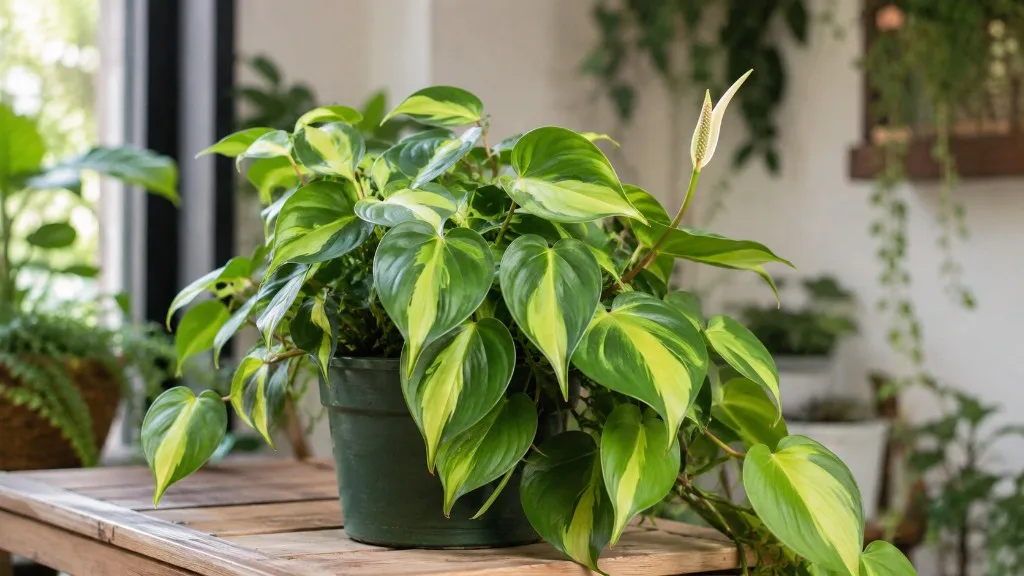
The ‘Brasil’ cultivar adds a central streak or splash of chartreuse to lime green on otherwise deep green leaves. The pattern shifts from leaf to leaf - some leaves are half lime, others carry a narrow stripe down the center - and the North Carolina Extension entry for ‘Brasil’ describes it as a variegated center stripe of yellow to light green with dark green borders. Photographs in the same toolbox note that ‘Brasil’ carries unstable variegation, which is botanically honest: the plant can produce fully green leaves even under good care, and it will produce more of them when light is weak.
The cultivar story matters because it sets expectations. It is not a genetically engineered plant and it is not a separate wild species - it is a selected cultivar of a common heartleaf philodendron that growers reproduce reliably from cuttings.
In the home, Brasil behaves like the species: it roots easily from nodes, tolerates a wider light range than many collector aroids, and grows quickly when conditions suit it. Mature indoor vines commonly reach 4–6 feet in length over time, per North Carolina Extension dimensions, though most hanging baskets are trimmed long before that. The leaves stay relatively small compared with climbing philodendrons on a moss pole - typically 3–6 inches long per North Carolina Extension species data - unless you give the plant something to climb and enough light for it to mature.
One identification note saves beginners a common mistake: Brasil is not a pothos. Epipremnum aureum looks similar at a glance, but heartleaf philodendrons have conspicuous stipules on new growth and non-grooved petioles, which North Carolina Extension uses to separate the two genera. If your plant came without a tag, check those details before you copy pothos care advice wholesale.
How ‘Brasil’ Differs From the Green Heartleaf and Other Cultivars
All Philodendron hederaceum cultivars share the same basic biology: vining stems, heart-shaped leaves, aerial roots at nodes, and a preference for warm, humid, bright understory conditions. Where they differ is how much light they need, how forgiving they are of dim rooms, and what happens when stress hits.
Brasil vs. Standard Philodendron hederaceum
The solid-green heartleaf philodendron is famous for surviving low light longer than most houseplants. North Carolina Extension notes it can endure extremely low light for long periods, though it prefers medium light and moist soil. Brasil is not identical to the green form in practice, even though it is the same species. Because the chartreuse portions contain less chlorophyll, the variegated tissue photosynthesizes less efficiently - this is the reason ‘Brasil’ needs brighter indirect light to maintain bold color and compact growth.
In a dim room, the green heartleaf will stretch slowly and stay green. Brasil will also stretch, but new leaves often emerge muddy, smaller, or fully green, and the plant effectively reverts toward the non-variegated phenotype. That is not disease; it is the plant optimizing for survival when light is insufficient to support variegated tissue. The green form is the better choice for a dark hallway. Brasil belongs closer to a window.
Watering tolerance is similar between the two: both prefer the mix to dry partially between waterings and both are sensitive to soggy soil. Brasil’s variegation does not change root rot on Philodendron Brasil risk, but a reverted, leggy vine in low light uses water slowly, which makes overwatering on Philodendron Brasil more likely if you keep a summer schedule all year.
Brasil vs. Lemon Lime, Rio, and Silver Stripe
North Carolina Extension lists several commercial P. hederaceum cultivars alongside ‘Brasil’. Knowing them helps you buy intentionally and diagnose “wrong plant” care expectations.
‘Lemon Lime’ is mostly bright yellow to chartreuse across the leaf rather than a green leaf with a lime stripe. It reads as a yellow vine from a distance; Brasil reads as a green vine with neon brushstrokes. Lemon Lime also needs strong indirect light to hold color, but the overall effect is lighter and it can bleach in direct sun faster than Brasil’s dark green margins shield the inner tissue somewhat.
‘Rio’ and ‘Silver Stripe’ carry cream and silver central variegation with dark green edges - cooler-toned than Brasil’s warm chartreuse. ‘Cream Splash’ and ‘Gabby’ push even more cream; Gabby can go nearly all cream in high light, which is a different maintenance problem (burn risk) than Brasil’s reversion problem.
If you wanted a philodendron that stays attractive in a poorly lit office, any of these variegated cultivars is the wrong target. If you wanted a fast trailer with high-contrast color near a bright window or under a grow light, Brasil is one of the easiest entry points in the group.
Light: The Variable That Makes or Breaks the Variegation
If you remember only one rule for Philodendron Brasil, make it this: bright, indirect light for most of the day. NC State Extension recommends partial shade for heartleaf philodendron indoors, and it matches how the plant grows in nature - climbing or scrambling through filtered tropical light, never baking in open sun.
Brasil tolerates medium indirect light for a while, especially if you accept some loss of contrast. It does not tolerate dim corners if you care about variegation. In low light, internodes lengthen, leaves shrink, and new growth comes out green. That pattern is so reliable it is essentially diagnostic.
Philodendron Brasil light guide and Why Variegated Leaves Need More
Variegation is not free. Chlorophyll captures light energy; tissue without it depends on neighboring green cells to export sugars. More variegation means the plant needs more light to produce the same biomass as a solid-green leaf. Clemson Extension notes philodendrons perform best in bright filtered light indoors - enough for compact growth without scorch.
Practical placement that usually works:
- East-facing window: One to three hours of gentle morning sun, then bright indirect the rest of the day. Often ideal.
- North-facing window: Acceptable in many homes if the plant sits close to the glass; watch for reversion and legginess.
- South- or west-facing window: Fine with sheer curtain or several feet of setback so midday sun does not scorch leaves.
- Grow light: A full-spectrum LED positioned 8–12 inches above the canopy for 12–14 hours daily if natural light is weak.
Direct midday sun through unfiltered glass produces bleached patches, brown scorch, and curled leaves. Direct early morning or late afternoon sun is tolerable in many climates, especially in winter. If you would not comfortably read a book in the beam without squinting, it is too strong for Brasil.
Rotate the pot a quarter turn weekly so both sides of the canopy receive light. Variegated philodendrons lean hard toward windows; uneven light produces lopsided baskets that are harder to correct later.
Watch the plant’s feedback before you watch the calendar. Compact nodes, firm stems, and new leaves with clear lime striping mean light is adequate. Long bare stems with small green leaves mean move it closer to the source or add supplemental light. Light changes should be gradual over a week or two if you are correcting a bad placement - sudden jumps from dim to intense can sun-stress foliage even when the new level is ultimately correct.
Watering: Let the Top Dry, Not the Whole Pot
Philodendron Brasil wants moisture without wet feet. It is a tropical vine, not a desert plant, but its roots still need oxygen. The most common killer is not underwatering on Philodendron Brasil - it is watering on autopilot while the plant sits in a dim spot using moisture slowly.
A reliable starting rhythm in many homes: water when the top 3–5 cm (1–2 inches) of soil has dried, which often works out to roughly every 7–10 days during active growth and every 10–14 days in winter, when shorter days and cooler rooms slow evaporation. That interval is a starting point, not a rule. A Brasil in a small terracotta pot under a grow light may need water twice a week in summer; the same cultivar in a large plastic pot in a cool north room may go two weeks between drinks in January.
Iowa State Extension recommends watering when the top of the soil is dry. The overlap with home practice - checking the top 1–2 inches before watering - is the message: partial drying, not bone-dry desiccation and not constantly wet surface soil.
When you water, water thoroughly until excess runs from the drainage holes, then empty the saucer within 30 minutes. Light sips every day keep the surface wet while the interior stays unpredictably dry or wet - a recipe for fungus gnats and uneven root death.
How to Read Soil Moisture Before You Water
Use your finger or a dry bamboo chopstick inserted to knuckle depth. If the soil at that depth feels cool and damp, wait. If it feels dry and the pot is noticeably lighter, water. Lift the pot regularly until you learn the weight difference - it is faster than sticking your finger in every basket on the shelf.
Thirst signals on Brasil are readable. Leaves may droop slightly and edges curl inward when the plant loses turgor from dryness. Water within a day and it usually perks up overnight. Chronic underwatering produces crispy brown tips and stunted new leaves.
Overwatering signals include yellowing lower leaves, soft stems, musty-smelling soil, and mushy roots if you unpot. Overwatering often co-occurs with low light because the plant cannot transpire fast enough to pull water from the mix. Fix light and roots together, not just the watering can.
Temperature of the water matters less than quality. Room-temperature water is fine. If your tap water is very hard, occasional flushing - watering heavily until runoff is clear - reduces salt buildup that shows up as brown tips independent of humidity.
Humidity and Temperature Indoors
Philodendron Brasil is adaptable by aroid standards. It grows well at ordinary indoor humidity of 40–60%, which covers most heated and air-conditioned homes. NC State Extension notes it prefers medium relative humidity indoors but can tolerate dry air. If your hygrometer reads above 40% and the plant is not browning at the tips, humidity is probably sufficient.
Raise humidity cheaply by grouping plants, using a pebble tray with the pot above the water line, or running a small humidifier nearby in dry winters. Misting leaves is optional and temporary; it does not substitute for ambient humidity and can spread foliar pathogens if airflow is poor.
Temperature comfort aligns with human comfort: about 65–80°F (18–27°C) during the day. The Missouri Botanical Garden lists heartleaf philodendron as a tropical indoor plant that suffers in cold drafts. Keep pots away from cold window glass on winter nights, blasting heat registers, and air-conditioning vents that drop temperature abruptly. Brasil does not need a terrarium unless you are also providing very high light.
Good air circulation matters more than misting. A ceiling fan on low or an occasionally open window in mild weather reduces stagnant pockets where fungal leaf spots and pests gain footing.
Soil, Pots, and Drainage
Brasil is not picky about brand-name mixes, but it is picky about structure. Roots need a blend that holds moisture briefly and then releases it, with enough macropores for oxygen.
A proven home recipe: standard peat- or coco-based potting mix with 20–25% perlite by volume, targeting pH 5.5–7.0 (slightly acidic to neutral). The Missouri Botanical Garden describes heartleaf philodendrons as preferring moist but well-drained soil. Add perlite or orchid bark if your bagged mix feels heavy or stays wet more than a week after watering.
Drainage holes are non-negotiable. Decorative cache pots without holes belong outside the watering workflow. Terracotta dries faster; plastic and glazed ceramic retain moisture longer - adjust watering accordingly, not the calendar.
Pot size should match the root mass. Brasil tolerates being slightly root-bound, which can even encourage trailing growth, but a plant that dries out in 24 hours or pushes roots from the holes needs the next size up - typically one inch (2.5 cm) wider at a time. Oversized pots hold excess water the roots cannot absorb and are a common post-repot rot trigger.
Fertilizer During Active Growth
Brasil is a moderate feeder, not a hungry monster. Fertilizer supports growth when light and water already work; it cannot substitute for dim light or damaged roots.
Feed monthly from spring through early fall with a balanced liquid fertilizer (such as 20-20-20) diluted to half the label strength, applied to already-moist soil. Skip feeding in late fall and winter unless the plant sits under strong grow lights and is visibly producing new leaves. Skip feeding for four to six weeks after Philodendron Brasil repotting guide, during pest recovery, and whenever the plant is yellowing from overwatering - salts worsen stress.
Slow-release granules at the manufacturer’s low indoor rate are an alternative if you prefer fewer applications. Watch for white crust on the soil surface or brown tips despite adequate watering; both can indicate salt accumulation. Flush the pot with plain water and reduce strength.
Trailing vs. Climbing: Shape and Support Choices
Philodendron Brasil is a vining aroid with a default habit of trailing or climbing depending on what you give it. North Carolina Extension describes the species as cascading from hanging baskets or climbing when supported. Neither choice is “correct” - they produce different leaf sizes and aesthetics.
Trailing from a shelf or hanging basket is the classic look: small to medium heart-shaped leaves on long, limp stems. This is the lowest-effort display and the one most sold in nurseries. Trim leggy leaders if the basket gets sparse on top; cuttings root easily to fill bare soil.
Climbing a moss pole, trellis, or bark board mimics the plant’s natural tree-climbing habit. Aerial roots attach to support, internodes often shorten, and leaves can grow larger than on a free-hanging vine because the plant senses stable vertical structure. Keep the moss or fabric support evenly moist if you want aerial roots to engage; dry poles still work visually but root less.
Brasil is faster and more forgiving than many collector philodendrons, but it still loses color in dim corners whether it trails or climbs. A moss pole in a dark room does not fix reversion - light does.
Pruning, Reversion, and Keeping the Color
Pruning serves three jobs on Brasil: control length, encourage bushiness, and remove reverted growth before it dominates the vine.
Reversion - solid green leaves on an otherwise variegated plant - is caused primarily by insufficient light, though occasional green leaves appear even in good conditions because the variegation is unstable by nature. Move the plant brighter and cut off reverted sections to encourage new variegated growth from remaining nodes.
Use sharp, clean scissors or pruners. Follow a reverted stem back to the last node that still shows variegation on the stem or leaf, and cut just above that node. Before you cut, inspect the stem stripe: some Brasil vines carry lime coloration in the stem tissue even when the leaf looks green; cutting back to a striped node preserves genetic variegation potential better than keeping a fully green section.
You can root pruned tip cuttings instead of discarding them, but know what you are propagating: a cutting from a fully reverted vine usually grows into a plain green heartleaf philodendron, which is effectively a free green plant but not a Brasil. Propagate from clearly variegated material if color matters.
Regular maintenance pruning - shortening long bare stems and pinching back tips - forces side shoots and keeps hanging baskets full. Spring and early summer are the easiest seasons to prune because recovery is fast.
Repotting Without Shock
Repot Brasil roughly every one to two years, or when roots circle the pot surface, water runs straight through without soaking in, or growth stalls despite good light. Spring and early summer, at the start of active growth, is the safest window.
Choose a pot one size larger with drainage holes. Gently loosen the outer root ball if it is circling, but you do not need to destroy healthy roots. Use fresh well-draining mix; bury stems no deeper than they were before - philodendrons are not deep bury plants like some stem-rooting tomatoes.
Do not repot on day one after purchase unless the mix is clearly failing or pests are present. A new Brasil needs time to acclimate to your light and Philodendron Brasil watering guide. Grower notes for this cultivar emphasize boring, stable care in the first month: quarantine from other plants, learn how fast the pot dries, and resist stacking repotting, fertilizing, and moving to a new window in the same week.
After repotting, water lightly and keep the plant in bright indirect light without direct sun stress until new growth appears. Skip fertilizer for the first month.
Propagation by Stem Cuttings
Propagation is where Brasil earns its reputation as an easy plant. Stem cuttings with at least one node root readily in water or moist soil.
Water propagation: Cut a 4–6 inch section below a node with clean shears. Remove leaves that would sit submerged. Place in a jar of room-temperature water with the node underwater and at least one leaf above the surface. Bright indirect light, no direct sun. Refresh water weekly. Roots typically appear in two to three weeks, though timing varies with season and light. Plant into potting mix when roots are 2–3 inches long.
Soil propagation: Stick the cutting node-deep in moist, well-draining mix, cover loosely with a clear bag or cloche to raise humidity, and keep evenly moist - not wet - until the cutting resists a gentle tug. Soil propagation avoids transplant shock from water to mix but requires more attention to moisture balance.
Either way, variegation in the cutting predicts variegation in the offspring only approximately. Take cuttings from strongly patterned parent growth for best odds. Multi-node cuttings produce fuller starter pots faster than single-node pieces.
Toxicity to Pets and People
Philodendron Brasil carries the same toxicity profile as the species: toxic to cats and dogs due to insoluble calcium oxalate crystals in the leaves, stems, and sap. The ASPCA lists Philodendron hederaceum (heartleaf philodendron) as toxic, with clinical signs including oral irritation, pain and swelling of mouth, tongue and lips, excessive drooling, vomiting, and difficulty swallowing.
North Carolina Extension rates human poison severity as low, with similar oral irritation mechanisms and notes that contact dermatitis can occur from sap on sensitive skin. This is a display plant, not a shelf plant in a home with chewing animals or toddlers at plant height.
Cats, Dogs, and What to Do If a Pet Chews It
Most exposures are unpleasant but not life-threatening: pawing at the mouth, drooling, reduced appetite, and occasional vomiting. Severity scales with amount ingested and pet size. Swelling severe enough to affect breathing is uncommon but is an emergency.
If a pet chews Brasil, remove plant material from the mouth if you can do so safely, rinse with water, and call your veterinarian or the ASPCA Animal Poison Control Center at (888) 426-4435. Do not induce vomiting unless a professional instructs you to. Choose a pet-safe trailing plant for accessible spots - peperomia, spider plant (non-toxic to dogs and cats per ASPCA), or tradescantia cultivars if your household tolerates mild sap irritation.
Wear gloves when pruning heavily if you know you react to oxalate saps. Wash hands after handling cut stems.
Common Problems and Real Fixes
Most Brasil problems are environmental, not mysterious pathogens. The diagnostic order is the same every time: soil moisture, then light, then pests, then salts.
Yellow leaves. Lower yellow leaves on wet soil point to overwatering or root rot. Yellow leaves on dry soil with curled foliage suggest underwatering. Uniform pale yellow on new growth in low light is often reversion or chlorosis from insufficient light, not nutrient deficiency. Single old yellow leaves at the base are normal senescence - shed them.
Brown tips and edges. Usually low humidity, underwatering, or fertilizer/tap-water salts. Flush the pot, adjust watering, and raise humidity if the air is very dry. Direct sun scorch also browns patches, but those are tan and papery, not tip-focused.
Leggy bare stems. Insufficient light is the cause. Move brighter, prune back to encourage branching, and propagate the cuttings to fill the pot.
Loss of variegation. Low light is the primary cause. Increase light, prune green growth, and accept that some leaves will always be greener than others because the cultivar is unstable.
Pests. Spider mites appear in dry air - fine webbing, stippled leaves. Shower the plant, raise humidity, treat with insecticidal soap. Mealybugs look like cotton in leaf axils; dab with isopropyl alcohol and follow with soap sprays. Scale forms hard bumps on stems. Fungus gnats mean the soil surface stays too wet; dry the top layer and use sticky traps.
Root rot. Mushy roots, sour smell, collapsing stems despite wet soil. Unpot, cut away black tissue, repot in fresh mix, and correct light and watering. Severe cases may not recover; take healthy cuttings early if you want insurance.
Disease. Leaf spot fungi can appear where leaves stay wet and airflow is poor. Remove affected leaves, improve air movement, and avoid overhead misting in dim corners.
Conclusion
Philodendron Brasil is a variegated heartleaf philodendron - Philodendron hederaceum ‘Brasil’ - bred for lime streaks on classic green foliage, not a separate species with separate rules. Treat it like the fast tropical vine it is: bright indirect light to hold the chartreuse color, water when the top few centimeters of soil dry, well-draining mix with perlite, ordinary indoor humidity and temperature, and monthly half-strength fertilizer only while it is actively growing. Let it trail or climb depending on the look you want, and prune reverted green vines before they take over the basket.
It propagates easily from stem cuttings, recovers from many beginner mistakes faster than finicky aroids, and fails predictably when kept dark and wet. It is also toxic to pets and irritating to mouths and skin, which makes placement as important as watering. If you can give it light and keep it out of reach of chewers, Brasil is one of the most rewarding trailing philodendrons in the trade - vivid, fast, and genuinely hard to kill once you stop fighting its one non-negotiable need for brightness.
When to use this page vs other Philodendron Brasil guides
- Philodendron Brasil overview - Canonical hub for this species - care topics and problems branch from here.
- Philodendron Brasil problems - Symptom-first path when you already know something is wrong.
Related Philodendron Brasil guides
- Philodendron Brasil watering
- Philodendron Brasil light
- Philodendron Brasil soil
- Philodendron Brasil propagation
- Philodendron Brasil fertilizer
- Philodendron Brasil repotting
- Philodendron Brasil pruning
- Ants on Plant on Philodendron Brasil
- Aphids on Philodendron Brasil
- Bacterial Wilt on Philodendron Brasil
- Brown Leaves on Philodendron Brasil
- Brown Tips on Philodendron Brasil
How to care for Philodendron Brasil?
How much light does Philodendron Brasil need?
bright indirect light, medium indirect light
- bright indirect light, medium indirect light - bright indirect light, medium indirect light.
When should you water Philodendron Brasil?
Every 7–10 days in summer - allow top 3–5 cm to dry. Every 10–14 days in winter.
- Check top 2 inches - Every 7–10 days in summer - allow top 3–5 cm to dry.
- Drain excess water - Empty the saucer after watering so the roots are not sitting in standing water.
What soil works best for Philodendron Brasil?
Standard potting mix + 20–25 % perlite. Well-draining. pH 5.5–7.0.
- Well-draining mix - Well-draining.
Grower notes for Philodendron Brasil
Brasil growth-pattern note
Philodendron Brasil is a vining heartleaf Philodendron with lime streaks that change from leaf to leaf. It is faster and more forgiving than many collector philodendrons, but it still loses color in dim corners. Prune long plain-green vines back to a more variegated node if the plant starts reverting. Give it a shelf, hanger, or pole depending on whether you want trails or larger climbing leaves.
How Brasil differs from Birkin
Brasil should be judged by vine health, node spacing, and color across many leaves. Birkin should be judged by crown shape and crisp striping. Brasil can be cut and restarted easily, so a sparse pot is simple to rebuild. Birkin is slower to reshape once the crown stretches or loses its compact habit.
What matters most with Philodendron Brasil
Philodendron Brasil is easiest to understand by its growth habit. Climbers need support for larger leaves, self-heading types need stable root moisture, and delicate velvet forms punish stale air faster than basic green philodendrons. In practice, the care checkpoint is simple: bright indirect light, medium indirect light. Pair that with standard potting mix + 20–25 % perlite. Well-draining; pH 5.5–7.0, and avoid changing water, pot size, and placement all at once.
Best placement in a real home
Philodendron Brasil belongs where bright indirect light, medium indirect light is realistic for most of the day, not only where the pot looks good. Every 7–10 days in summer - allow top 3–5 cm to dry. Every 10–14 days in winter. If the pot stays wet longer than expected, move the plant into better light or reassess the mix before watering again. Humidity target: 40–60%. Temperature comfort zone: 18–27°C (65–80°F).
Before you buy this plant
Choose Philodendron Brasil with firm new growth, clean leaf undersides, and soil that does not smell sour or feel compacted. Be cautious if you see yellow-leaves, sticky residue, collapsed crowns, or a pot that is wet in poor light. Cosmetic old-leaf damage is less worrying than weak roots or active pests.
First month after bringing it home
Do not repot Philodendron Brasil on day one unless the mix is failing or pests are obvious. Quarantine it, learn how fast the pot dries, and keep care boring while it adjusts. Watch especially for yellow-leaves, brown-tips, and root-rot. If problems appear, correct the condition first rather than stacking fertilizer, repotting, and pruning together.
Safety note for Philodendron Brasil
Philodendron Brasil is not a plant to keep within reach of pets or children. Treat it as an inaccessible display plant. Use gloves if sap or plant tissue is irritating, and pick a pet-safe alternative for floor pots or low shelves.
How to tell Philodendron Brasil is settling in
If you plan to multiply it later, common methods include Stem cuttings in water. If brown-tips shows up early, inspect light, watering, and roots before assuming the plant is permanently weak.
Is it pet safe?
Philodendron Brasil is toxic to cats and dogs.
Contains insoluble calcium oxalate crystals. Causes oral irritation, excessive drooling, and vomiting if ingested by pets.
Watering Philodendron Brasil
Every 7–10 days in summer - allow top 3–5 cm to dry. Every 10–14 days in winter.
Soil & potting for Philodendron Brasil
Standard potting mix + 20–25 % perlite. Well-draining. pH 5.5–7.0.
Humidity & temperature for Philodendron Brasil
Philodendron Brasil prefers 40–60%, though normal home humidity is usually fine. Keep temperatures around 18–27°C (65–80°F).
| Detail | Information |
|---|---|
| Humidity | 40–60% - normal home humidity is fine. |
| Ideal temperature | 18–27°C (65–80°F) |
Fertilizer & pruning for Philodendron Brasil
Use feed lightly during active growth. Use monthly during spring and summer. for Philodendron Brasil.
| Detail | Information |
|---|---|
| Fertilizer type | Feed lightly during active growth. Use monthly during spring and summer. |
Common problems on Philodendron Brasil
Likely cause: Jul 11, 2023 · If you have noticed ants crawling around your Philodendron Brasil plant , it is important to take action to prevent any potential damage or infestation. In this article, we will discuss effective methods to get rid of ants on
Quick fix: Confirm diagnosis on your Philodendron Brasil, then address the most likely care or pest factor described in current extension guidance.
Full fix guide →Aphids
MediumLikely cause: Jul 26, 2023 · If left untreated, aphids can quickly multiply and weaken your Philodendron Brasil . In this article, we will discuss effective methods to get rid of aphids and keep your plant healthy.
Quick fix: Confirm diagnosis on your Philodendron Brasil, then address the most likely care or pest factor described in current extension guidance.
Full fix guide →Bacterial Wilt
HighLikely cause: Aug 13, 2025 · Philodendron Brasil , a tropical plant, thrives within specific temperature ranges. Exposure to cold drafts or temperatures below 55-60°F (13-16°C) can cause temperature stress, leading to drooping leaves, black spots, or gen
Quick fix: Confirm diagnosis on your Philodendron Brasil, then address the most likely care or pest factor described in current extension guidance.
Full fix guide →Brown Leaves
MediumLikely cause: Aug 25, 2025 · Together, we are going to get to the bottom of your philodendron brasil brown leaves problem. We’ll explore the most common causes, from simple watering mistakes to environmental issues, and I’ll give you a clear, step-by-ste
Quick fix: Confirm diagnosis on your Philodendron Brasil, then address the most likely care or pest factor described in current extension guidance.
Full fix guide →Brown Tips
MediumLikely cause: Low humidity
Quick fix: Increase humidity to 50%+
Full fix guide →Calcium Deficiency
MediumLikely cause: Aug 4, 2022 · In addition to N-P-K, your Philodendron Brasil requires trace elements like calcium , magnesium, and iron. These micronutrients, though needed in smaller amounts, are still vital for healthy growth.
Quick fix: Confirm diagnosis on your Philodendron Brasil, then address the most likely care or pest factor described in current extension guidance.
Full fix guide →Black Spots
MediumLikely cause: Jun 18, 2024 · Overwatering leads to fungal infections , causing black spots on leaves. High humidity and poor air circulation can result in bacterial leaf spot. Regular inspection and maintenance are key to preventing black spots.
Quick fix: Confirm diagnosis on your Philodendron Brasil, then address the most likely care or pest factor described in current extension guidance.
Full fix guide →Caterpillars
MediumLikely cause: Jul 22, 2023 · By following these methods and tips, you can effectively get rid of caterpillars on your Philodendron Brasil plant and ensure its continued health and vitality. Remember to be patient and persistent in your efforts, as it may
Quick fix: Confirm diagnosis on your Philodendron Brasil, then address the most likely care or pest factor described in current extension guidance.
Full fix guide →Crispy Leaves
MediumLikely cause: Philodendron hederaceum is native to humid tropical forests and prefers humidity above 50%. The thin, heart-shaped leaves of the Brasil cultivar lose moisture through their tips and edges faster than thicker-leaved aroids, so crispy brown t
Quick fix: Confirm diagnosis on your Philodendron Brasil, then address the most likely care or pest factor described in current extension guidance.
Full fix guide →Cold Damage
MediumLikely cause: May 31, 2024 · When temperatures drop, Philodendron Brasil can suffer, leaving you with unsightly foliage. But don't worry—there's a way to bring your plant back to life. In this article, we'll explore the signs of cold damage , how to revi
Quick fix: Confirm diagnosis on your Philodendron Brasil, then address the most likely care or pest factor described in current extension guidance.
Full fix guide →Damaged Roots
MediumLikely cause: Jan 8, 2025 · If your Philodendron Brasil seems to be struggling, it could be root bound. This happens when the roots have outgrown the pot, limiting their ability to absorb water and nutrients.
Quick fix: Confirm diagnosis on your Philodendron Brasil, then address the most likely care or pest factor described in current extension guidance.
Full fix guide →Deformed New Growth
MediumLikely cause: Aug 13, 2025 · While generally low-maintenance, the Philodendron Brasil can encounter common issues that affect its health and appearance. Understanding these problems and their solutions helps maintain the plant’s lush growth and distincti
Quick fix: Confirm diagnosis on your Philodendron Brasil, then address the most likely care or pest factor described in current extension guidance.
Full fix guide →Draft Stress
MediumLikely cause: In fall and winter, reduce both watering and feeding as growth slows. Keep the plant in a warm, stable environment away from cold windows or drafts . With just a little seasonal attention, your Philodendron Brasil will continue to trail bea
Quick fix: Confirm diagnosis on your Philodendron Brasil, then address the most likely care or pest factor described in current extension guidance.
Full fix guide →Fungus Gnats
LowLikely cause: Jul 26, 2023 · If you have a Philodendron Brasil plant and notice gnats buzzing around it, don’t fret. There are several effective methods to eliminate these pesky pests and keep your plant healthy.
Quick fix: Confirm diagnosis on your Philodendron Brasil, then address the most likely care or pest factor described in current extension guidance.
Full fix guide →Heat Stress
MediumLikely cause: Oct 10, 2023 · In this article, we'll dig into the heat tolerance of Philodendron Brasil . We'll discuss what temperatures it can handle, signs of heat stress to watch for, and how you can create the perfect environment for your plant to th
Quick fix: Confirm diagnosis on your Philodendron Brasil, then address the most likely care or pest factor described in current extension guidance.
Full fix guide →Holes in Leaves
MediumLikely cause: Aug 23, 2025 · We’ll explore the stunning world of natural leaf splits, known as fenestrations, and I’ll share my best tips on how to encourage them. We’ll also put on our diagnostic hats to identify and treat the unwanted holes caused by p
Quick fix: Confirm diagnosis on your Philodendron Brasil, then address the most likely care or pest factor described in current extension guidance.
Full fix guide →Leggy Growth
MediumLikely cause: Insufficient light
Quick fix: Move to brighter indirect light
Full fix guide →Leaf Drop
MediumLikely cause: Philodendron hederaceum ‘ Brasil ' (Heart Leaf Philodendron ) is a vibrant and lush variety of Philodendron, beloved for its striking foliage and ease of care. This variegated cultivar adds a pop of color to any indoor garden with its heart
Quick fix: Confirm diagnosis on your Philodendron Brasil, then address the most likely care or pest factor described in current extension guidance.
Full fix guide →Mealybugs
MediumLikely cause: Jul 1, 2023 · Mealybugs can be a frustrating pest to deal with, but with a little patience and the right methods, you can effectively eliminate them from your Philodendron Brasil plant.
Quick fix: Confirm diagnosis on your Philodendron Brasil, then address the most likely care or pest factor described in current extension guidance.
Full fix guide →Leaf Miners
MediumLikely cause: Feb 21, 2024 · Philodendron Types with Pictures and Care Guide The green heartleaf Philodendron is a vining type of plant with dark-green leaves in a heart’s shape. This type of Philodendron can be grown …
Quick fix: Confirm diagnosis on your Philodendron Brasil, then address the most likely care or pest factor described in current extension guidance.
Full fix guide →Leaf Spot Disease
MediumLikely cause: Feb 21, 2024 · Philodendron Types with Pictures and Care Guide The green heartleaf Philodendron is a vining type of plant with dark-green leaves in a heart’s shape. This type of Philodendron can be grown …
Quick fix: Confirm diagnosis on your Philodendron Brasil, then address the most likely care or pest factor described in current extension guidance.
Full fix guide →No Flowers
LowLikely cause: Feb 4, 2025 · Philodendron Brasil is primarily grown for its brilliant foliage and although it may flower , the blooms are rather insignificant and rare when grown indoors. However, if you notice a green and white spathe growing from your p
Quick fix: Follow extension or botanical guidance for Philodendron Brasil no flowers; adjust care before applying broad treatments.
Full fix guide →Plant Leaning
MediumLikely cause: Philodendron is a large genus of flowering plants in the family Araceae. As of September 2025, the Plants of the World Online accepted 625 species; [2] other sources accept different numbers. [3][4] …
Quick fix: Confirm diagnosis on your Philodendron Brasil, then address the most likely care or pest factor described in current extension guidance.
Full fix guide →Pale Leaves
MediumLikely cause: Aug 24, 2025 · There’s nothing quite like the vibrant, painted leaves of a Philodendron Brasil. With its heart-shaped foliage splashed in shades of lime, emerald, and deep green, it’s a living work of art.
Quick fix: Confirm diagnosis on your Philodendron Brasil, then address the most likely care or pest factor described in current extension guidance.
Full fix guide →Overwatering
HighLikely cause: Feb 26, 2026 · This blog post will delve into the telltale signs of overwatering in Philodendron Brasils , providing a comprehensive guide to help identify, address, and prevent this common problem, ensuring the continued health and beauty
Quick fix: Confirm diagnosis on your Philodendron Brasil, then address the most likely care or pest factor described in current extension guidance.
Full fix guide →Not Enough Light
MediumLikely cause: Aug 25, 2025 · When the plant doesn ’ t get enough light , it goes into survival mode. It starts producing more chlorophyll to maximize every last ray of sun it can find. The result? The variegated parts shrink or disappear entirely as the
Quick fix: Confirm diagnosis on your Philodendron Brasil, then address the most likely care or pest factor described in current extension guidance.
Full fix guide →Root Rot
MediumLikely cause: Persistently wet soil
Quick fix: Repot in fresh draining mix
Full fix guide →Powdery Mildew
HighLikely cause: Aug 25, 2024 · Powdery mildew thrives in warm, humid conditions, so it’s essential to keep an eye out. If your Philodendron Brasil is showing signs of powdery mildew , here’s how to deal with it: Remove affected leaves: Trim away those with
Quick fix: Confirm diagnosis on your Philodendron Brasil, then address the most likely care or pest factor described in current extension guidance.
Full fix guide →Rust Disease
MediumLikely cause: Jul 7, 2024 · In this article, we'll cover what rust fungus is, how to identify it, and why it might be showing up on your Philodendron Brasil. We'll also dive into practical steps you can take to treat and prevent this fungus from taking h
Quick fix: Confirm diagnosis on your Philodendron Brasil, then address the most likely care or pest factor described in current extension guidance.
Full fix guide →Repotting Stress
MediumLikely cause: Jun 17, 2024 · After repotting , acclimating your Philodendron Brasil to its new home is key. Keep an eye out for stress signs like drooping leaves, which could signal transplant shock.
Quick fix: Confirm diagnosis on your Philodendron Brasil, then address the most likely care or pest factor described in current extension guidance.
Full fix guide →Potassium Deficiency
MediumLikely cause: Aug 4, 2022 · Philodendron Brasil thrives on a balanced diet of nitrogen, phosphorus, and potassium —often referred to as N-P-K. Nitrogen supports leaf growth, phosphorus aids in root and flower development, and potassium helps with overall
Quick fix: Confirm diagnosis on your Philodendron Brasil, then address the most likely care or pest factor described in current extension guidance.
Full fix guide →Salt Build-up
MediumLikely cause: Jan 8, 2025 · Salt Build - up : Over time, salts from water and fertilizer can accumulate in the soil, damaging the roots and causing brown tips. Flush the soil by watering it thoroughly until water drains from the bottom of the pot.
Quick fix: Confirm diagnosis on your Philodendron Brasil, then address the most likely care or pest factor described in current extension guidance.
Full fix guide →Root Bound
MediumLikely cause: Jan 21, 2024 · In this article, we'll cover everything you need to know about caring for a root - bound Philodendron Brasil . From identifying the signs of a root - bound plant to repotting, watering, and ensuring your plant stays healthy,
Quick fix: Confirm diagnosis on your Philodendron Brasil, then address the most likely care or pest factor described in current extension guidance.
Full fix guide →Scale Insects
MediumLikely cause: Jul 13, 2023 · To get rid of scale insects on your Philodendron Brasil plant, start by isolating the affected plant. Use a cotton swab dipped in rubbing alcohol or soapy water to manually remove the scales from the plant. You can also use i
Quick fix: Confirm diagnosis on your Philodendron Brasil, then address the most likely care or pest factor described in current extension guidance.
Full fix guide →Slugs and Snails
MediumLikely cause: Jul 24, 2023 · By following these preventive measures and employing effective slug control methods, you can successfully protect your Philodendron Brasil from slug damage. Remember, early detection and immediate action are key to minimizing
Quick fix: Confirm diagnosis on your Philodendron Brasil, then address the most likely care or pest factor described in current extension guidance.
Full fix guide →Soil Too Acidic
MediumLikely cause: Jul 21, 2023 · The ideal pH level for Philodendron Brasil is slightly acidic , ranging between 5.5 and 6.5. Test the pH level of the soil before planting your Philodendron Brasil or look for soil mixes specifically formulated for acid -lovi
Quick fix: Confirm diagnosis on your Philodendron Brasil, then address the most likely care or pest factor described in current extension guidance.
Full fix guide →Stem Rot
HighLikely cause: Jan 16, 2024 · In summary, stem rot in Philodendron Brasil is often a result of overwatering and poor drainage. By identifying the problem early and taking corrective action, you can save your plant and prevent future issues.
Quick fix: Confirm diagnosis on your Philodendron Brasil, then address the most likely care or pest factor described in current extension guidance.
Full fix guide →Soil Too Alkaline
MediumLikely cause: Aug 6, 2025 · Philodendrons prefer slightly acidic to neutral soil pH. Selecting natural, organic, and chemical-free mixes helps preserve soil health and mimics native jungle conditions, enhancing plant vigor.
Quick fix: Confirm diagnosis on your Philodendron Brasil, then address the most likely care or pest factor described in current extension guidance.
Full fix guide →Seedlings Falling Over
MediumLikely cause: Feb 10, 2024 · But what happens when your once-perky Philodendron Brasil starts looking a bit droopy or worse— falls over entirely? This article will explore common reasons why your Philodendron Brasil might be struggling to stay upright an
Quick fix: Confirm diagnosis on your Philodendron Brasil, then address the most likely care or pest factor described in current extension guidance.
Full fix guide →Slow Growth
LowLikely cause: While Philodendron Brasil can tolerate medium light conditions, its distinctive variegation will be less pronounced, and growth will be slower . Direct sunlight should be avoided at all costs, as it can easily scorch the delicate leaves, ca
Quick fix: Confirm diagnosis on your Philodendron Brasil, then address the most likely care or pest factor described in current extension guidance.
Full fix guide →Thin Stems
MediumLikely cause: Aug 24, 2025 · In low-light conditions, a Philodendron Brasil will stretch its vines toward the nearest light source. It prioritizes reaching the light over producing lush, full foliage, resulting in a thin , sparse appearance.
Quick fix: Confirm diagnosis on your Philodendron Brasil, then address the most likely care or pest factor described in current extension guidance.
Full fix guide →Likely cause: Dec 10, 2023 · Sunburn in plants can be a bit of a setback, but with a little tender care, your Philodendron Brasil can bounce back to its vibrant glory. In this post, we'll cover how to identify sunburn in your Philodendron Brasil , the st
Quick fix: Confirm diagnosis on your Philodendron Brasil, then address the most likely care or pest factor described in current extension guidance.
Full fix guide →Sticky Leaves
MediumLikely cause: Aug 24, 2025 · One of the most common problems with Philodendron Brasil is when it starts to lose its beautiful lime-green variegation and produces solid green leaves instead.
Quick fix: Confirm diagnosis on your Philodendron Brasil, then address the most likely care or pest factor described in current extension guidance.
Full fix guide →Underwatering
MediumLikely cause: Mar 22, 2026 · Recognizing the signs of underwatering early on is crucial for maintaining a healthy and thriving Philodendron Brasil . This blog post will guide you through the telltale signs that your plant is craving more moisture, helpin
Quick fix: Confirm diagnosis on your Philodendron Brasil, then address the most likely care or pest factor described in current extension guidance.
Full fix guide →Wrong Soil Mix
MediumLikely cause: Aug 13, 2025 · Learn to create the ideal soil mix for your Brasil Philodendron . Ensure your plant thrives with optimal growing conditions.
Quick fix: Confirm diagnosis on your Philodendron Brasil, then address the most likely care or pest factor described in current extension guidance.
Full fix guide →Yellow Leaves
MediumLikely cause: Overwatering
Quick fix: Allow top 3–5 cm to dry
Full fix guide →Drooping Leaves
MediumLikely cause: Drooping on Philodendron Brasil usually means roots cannot supply water-either the mix is too dry or too wet and roots are failing. Lift the pot and check soil moisture 3–5 cm deep before you change a
Quick fix: See plant-specific guide for step-by-step fixes.
Full fix guide →Low Humidity
MediumLikely cause: Low humidity on Philodendron Brasil shows as brown crispy leaf tips and slow unfurling on trailing vines-usually in heated winter rooms. Move the plant away from vents, then raise local humidity towar
Quick fix: See plant-specific guide for step-by-step fixes.
Full fix guide →Mold on Soil
MediumLikely cause: Fluffy white or gray mold on Philodendron Brasil soil means the surface has stayed damp too long. Scrape the top layer, let the upper 3–5 cm dry completely, and adjust watering before the wet conditio
Quick fix: See plant-specific guide for step-by-step fixes.
Full fix guide →Spider Mites
MediumLikely cause: Spider mites on Philodendron Brasil show as fine yellow stippling on heart-shaped leaves and silk webbing along trailing stems-especially near heating vents in winter. First step: isolate the plant an
Quick fix: See plant-specific guide for step-by-step fixes.
Full fix guide →Wilting
MediumLikely cause: Wilting on Philodendron Brasil usually means roots cannot supply water-either because the mix is bone dry or too wet and roots are failing. Lift the pot and check soil 3–5 cm deep before you water.
Quick fix: See plant-specific guide for step-by-step fixes.
Full fix guide →