How to Prune Philodendron Brasil: When, Where & What to Cut
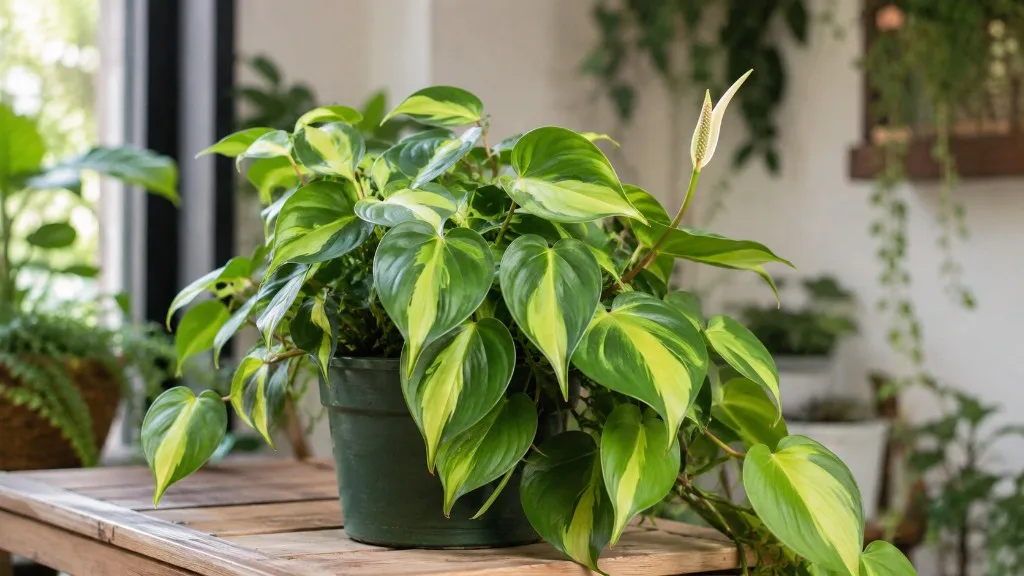
How to Prune Philodendron Brasil: When, Where & What to Cut
How to Prune Philodendron Brasil: When, Where & What to Cut
First, remove only dead, yellow, or clearly damaged leaves and stems with clean sharp scissors - snip at the petiole base or cut back into firm green tissue just above a healthy node. Philodendron Brasil (Philodendron hederaceum ‘Brasil’) stores energy in its vines and recovers quickly, but a sanitation pass shows you what is actually alive before you shorten anything for shape or revert control.
Quick Answer
Prune Philodendron Brasil for shape, density, and variegation in late spring through early summer, when the plant is actively growing. Make each shaping cut 6–10 mm (about ¼ inch) above a visible node - the slightly swollen point where a leaf attaches and a tiny aerial root may appear. Limit routine shaping to no more than one-third of total foliage per session. Cut plain-green revert vines back to the last node with good lime-green streaking before they dominate the pot. Emergency removal of mushy, pest-damaged, or fully dead stems can happen any time. Pruning breaks apical dominance at the vine tip and activates dormant buds at nodes below the cut, but it cannot replace adequate Philodendron Brasil light guide - legginess and revert will return quickly in a dim corner even after a hard trim.
What Pruning Does for Philodendron Brasil
Philodendron Brasil is a fast-growing vining cultivar of heartleaf philodendron, prized for heart-shaped leaves splashed with lime-green and dark green. NC State Extension describes Philodendron hederaceum as a climbing or trailing vine native to tropical Central America and the Caribbean, widely grown indoors for its foliage. Missouri Botanical Garden notes that cultivated heartleaf philodendrons can trail or climb several meters when given support. That growth speed is an advantage for pruning: clean cuts above nodes often produce visible new shoots within two to four weeks during active growth.
Without intervention, each vine follows apical dominance - the terminal bud at the growing tip produces auxin that suppresses lateral buds lower on the stem. The tip keeps extending, internodes stretch, and lower leaves age out, leaving bare runners with foliage clustered at the ends. Indoors, low light accelerates this pattern because the plant reaches toward the brightest available source. On Brasil specifically, dim conditions also trigger reversion - solid green leaves with more chlorophyll outgrow variegated sections, and those green stems can eventually take over the plant if left unchecked.
Pruning serves five practical jobs on Philodendron Brasil:
- Redirects growth by removing the dominant tip and waking buds at nodes below
- Controls revert by cutting all-green vines back to variegated nodes
- Removes failing tissue before pests or rot spread along soft stems
- Shortens leggy runners that have lost lower foliage
- Supplies propagation material - node-bearing cuttings root easily in water or soil (Iowa State University Extension)
Pruning does not fix chronic under-lighting. If internodes on new growth exceed roughly 10–15 cm (4–6 inches), or new leaves emerge mostly green, improve placement to bright filtered light before expecting compact, variegated regrowth.
When to Prune Philodendron Brasil
Philodendron Brasil tolerates light trimming year-round, but timing changes speed, not survival. Structural cuts during active growth produce faster branching, larger new leaves, and shorter internodes. The same cuts in late autumn or winter may sit visually unchanged for weeks while light and temperatures are low.
Best season for shaping cuts
Late spring through early summer is the ideal window for reshaping in most homes. By then daylight is increasing, the pot dries on a predictable rhythm, and new leaves are already unfurling. RHS philodendron guidance recommends pruning philodendrons in spring or summer to control size and encourage bushier growth. Early autumn works as a second option if your space stays warm and bright.
Avoid major cutbacks in late autumn and winter unless the plant is blocking a walkway or you accept a slower response. A one-third reduction that rebounds in three weeks during June may look unchanged until March if done in December. Light tip pinching during the off-season is fine; hard rejuvenation is not.
Cuts that cannot wait
Some trimming should not wait for spring:
- Blackened, mushy, or rotting stems - cut back into firm green tissue above a healthy node; sterilize blades between cuts on diseased material
- Stems with heavy active pest infestation - remove the worst sections once you have a treatment plan for the rest
- Fully brown, dry leaves - snip at the petiole base any time; they no longer photosynthesize
- Dominant revert vines - if a plain-green runner is clearly outpacing variegated growth, cut it back even outside the ideal season; revert does not pause for the calendar
Cosmetic shaping can wait for active growth. Health, sanitation, and revert-control cuts happen when you spot the problem.
What to Check Before You Cut
Walk the whole plant in good light before touching shears:
- Nodes and internodes - locate swollen points where leaves attach; Brasil branches from nodes, not bare stem tissue
- Variegation pattern - compare leaf to leaf; identify vines where lime streaks have disappeared and leaves are solid green
- Leaf quality - yellow climbing a stem, brown tips, or pest residue on undersides
- Vine length and density - which runners are bare in the middle, which tips are still producing healthy variegated leaves
- Root and water stress - wilting, sour-smelling soil, or roots circling the pot surface suggest care problems to fix before aggressive cuts
- Overall balance - one side full, one side sparse; crossed stems rubbing at leaf axils
If the plant was recently repotted, moved, or shows widespread yellowing from overwatering on Philodendron Brasil, resolve that stress first and wait one to two weeks before structural pruning.
Revert stems and variegation loss
Revert on Philodendron Brasil shows up as solid green leaves on one or more vines while neighboring stems still carry lime-green center streaks. Green sections photosynthesize more efficiently in low light, so they often grow faster and can shade out variegated tissue below. Before any cosmetic shortening, flag every revert vine and plan to cut each one back to the highest node that still shows acceptable variegation - a leaf with visible lime streaking, not just a faint hint at the petiole.
If an entire vine has reverted with no variegated leaves remaining, remove it entirely or cut it back to the soil line and root the tip cutting only if the top leaves still show color. Do not leave a dominant all-green runner hoping variegation will return on its own without a light improvement.
Leggy vines and long internodes
Leggy Philodendron Brasil is almost always stretched tip growth compounded by insufficient light. Measure internode length on the newest vine section. On a well-lit plant, nodes are often 5–8 cm (2–3 inches) apart. On a stretched plant, gaps can exceed 15 cm (6 inches). Pruning shortens the vine to a lower node and forces new shoots from that point - but moving gradually to brighter indirect light over seven to ten days prevents scorch and keeps new internodes short.
The First Cut to Make
After your sanitation pass, identify the longest bare, overextended, or fully reverted vine. Follow it back from the tip until you find a node that still has a healthy variegated leaf attached - or, if the entire lower run is leafless or all green, pick a node roughly two-thirds of the way toward the soil where you want new fullness to start.
Sterilize bypass shears with 70% isopropyl alcohol. Position the blade 6–10 mm above that node at a slight angle, with the node tissue remaining intact on the parent stem. Make one cut, then step back and assess balance before shortening the next vine. One deliberate cut above a node beats removing six random sections in a single pass.
How to Prune Philodendron Brasil Step by Step
This sequence assumes a healthy plant in active growth:
- Sterilize tools and set out a bag for clippings - especially important in pet-accessible homes
- Remove dead and yellow material at petiole bases or back to live nodes
- Cut back revert vines to the last node with good variegation on each all-green runner
- Shorten the worst leggy vines one at a time, cutting 6–10 mm above chosen nodes
- Pause between major cuts - remove no more than one-third of total foliage unless the plant is vigorous and in peak season
- Return the plant to stable light and normal watering; hold fertilizer until new shoots appear
Mature Brasil stems can reach pencil thickness on older specimens. Young growth cuts cleanly with sharp floral snips; older vines benefit from bypass pruning shears rather than crushing anvil blades.
Where to cut for maximum branching
Cut just above the node, not through it and not midway down the bare internode above it. The node is the bump where the leaf meets the stem; two small axillary buds typically flank it. Iowa State University Extension confirms that philodendron stem cuttings need at least one node to root - the same tissue that branches after pruning.
For maximum bushiness on one long vine, make multiple cuts along its length - each above a node - rather than trimming only the tip. Shortening a ten-node runner at nodes three, six, and nine activates three branching points instead of one. Leave enough remaining leaf area on each section to support recovery.
Tip pinching - removing the top one to two leaves and the apical bud just above the next node - is a lighter option for maintenance every few weeks during warm months. It interrupts dominance with minimal stress but cannot fill a long bare internode or reverse an all-green vine; that requires a lower stem cutback to a variegated node.
How much to remove at one session
The standard guideline is no more than one-third of total foliage at once. Philodendron Brasil grows quickly and often tolerates slightly more in spring and summer, but the one-third rule keeps outcomes predictable for beginners and for plants in average indoor light.
Severely leggy or revert-heavy plants benefit from a staged approach over four to six weeks: remove one-third including the worst revert runners, wait until new shoots are visible, then shorten the next longest sections. A single hard cutback to two or three nodes above the soil can work on a vigorous specimen, but prolonged bare appearance is more likely if light, roots, or watering are suboptimal.
Pruning Revert Stems to Protect Variegation
Revert control is the pruning task most owners skip - and the one most specific to Philodendron Brasil. When a vine produces consecutive solid green leaves, that stem will keep extending faster than variegated neighbors unless you intervene.
Follow each revert runner from tip to base. At every node, check the leaf for lime-green streaking. Cut 6–10 mm above the highest node where variegation still meets your standard - typically a visible lime band through the leaf center, not a single green leaf with a tiny pale edge. Remove the all-green section above that cut entirely; it will not regain variegation on existing tissue.
After cutting revert, place the plant in brighter indirect light within a week. Variegation is maintained by adequate light; pruning removes the green competitor but does not prevent new revert if the plant stays in a dim corner. Pair every revert cutback with a light check - not fertilizer, not Philodendron Brasil repotting guide on the same day.
Pruning Strategies for a Bushier Plant
Match technique to condition:
- Maintenance - tip pinching during active growth prevents legginess before it becomes severe
- Revert control - stem cutbacks to the last variegated node on all-green runners
- Corrective - stem cutbacks to lower nodes fix existing bare runners
- Rejuvenation - staged hard cutbacks reset an overgrown plant over multiple sessions
- Same-pot fill - root trimmed cuttings or layer pinned nodes at the soil surface while the parent vine branches above
- Climbing form - train remaining vines up a moss pole after pruning; supported stems often produce larger leaves than trailing ones
Bright indirect light is non-negotiable after corrective or rejuvenation pruning. A trimmed Brasil in a dim corner will branch slowly, stretch again, and push more green leaves within weeks.
Tip pinching vs stem cutbacks
Tip pinching removes the apical bud and one to two leaves at the vine end. Recovery is fast - side shoots often appear within ten to fourteen days in warm, bright conditions. Use this when vines are only slightly longer than you prefer and still variegated.
Stem cutbacks shorten the vine to a node farther from the tip, sometimes near the soil. This activates branching at that lower point and removes bare internode tissue entirely. Use cutbacks when leaves cluster only at the ends of long runners, when revert has taken over a section, or when you need to reduce hanging length by more than a few inches.
Combine both across a season: cut back the worst revert and leggy vines in spring, then pinch new tips through summer to keep branching dense.
Using cuttings in the same pot
One of the fastest ways to add fullness is rooting pruned cuttings in the parent pot. Each section with at least one node and one leaf can root - remove the lowest leaf to expose the node, bury it in moist potting mix at the base of the plant, and keep the soil evenly moist in bright indirect light. Roots often form in two to three weeks.
Alternatively, root cuttings in water until roots reach 2–5 cm (1–2 inches), then plant around the parent. Iowa State University Extension notes that philodendron cuttings root easily in water when they include at least one node. Soil layering - pinning nodes along the soil surface with floral pins until they root - fills wide pots without shortening the trailing display yet.
Choose cuttings from variegated sections when possible. All-green cuttings root just as easily but will grow plain-green vines unless the parent tissue at that node still carries the variegation trait.
After Pruning: Light, Water, and Recovery
Pruning redirects growth but does not create energy. The plant relies on remaining leaves and stored reserves to push new buds.
Place Philodendron Brasil in bright, indirect light - an east-facing window or several feet back from a south- or west-facing window. Avoid direct midday sun on freshly cut stems; Brasil leaves scorch more easily than plain green heartleaf forms. Water when the top 3–5 cm (1–2 inches) of soil dries, the same rhythm as before pruning; fewer leaves transpire less water, so check moisture before every session rather than keeping the old calendar schedule.
Hold fertilizer for two to three weeks after moderate to heavy pruning. Resume balanced liquid feed at half strength once several new leaves have unfurled.
Expect the first visible buds within two to four weeks during active growth, with meaningful fullness over six to ten weeks as secondary branches develop. Out-of-season pruning can double that timeline. If nothing emerges after six weeks in warm, bright conditions, re-check cut placement, root health, and pests.
Common Pruning Mistakes and Fixes
Pruning without improving light is the most common long-term error. New growth stretches again and reverts to green within weeks because the plant is still reaching for brighter conditions. Move to better filtered light, then prune - or prune and acclimate to brighter placement simultaneously.
Ignoring revert vines lets all-green stems dominate the pot. Cut them back before shortening variegated vines for shape - otherwise you are trimming the slow sections while the fast green runners keep extending.
Overwatering after a hard prune follows close behind. Fewer leaves need less water, but many growers maintain the old schedule. Let the pot dry further between sessions until new leaf area returns.
Discarding node-bearing cuttings wastes the easiest fullness opportunity. Keep a glass of water or small pot of mix ready before you start cutting.
Pruning a sick plant compounds stress from root rot on Philodendron Brasil, severe pests, or recent repotting shock. Fix the primary problem, let the plant stabilize, then trim.
Cutting in the wrong place
A cut in the middle of an internode - not near a node - produces a dead stub and no branching. If you notice immediately, make a second cut 6–10 mm above the nearest healthy node below your error. If the stub has browned and no growth appeared after four weeks, cut back to the node now.
Cutting below the node removes that branching point entirely. Cutting too close and crushing node tissue can delay bud break - watch for two weeks, then cut again just above the next node down if needed. Philodendron Brasil is forgiving; misplaced cuts delay fullness but rarely kill the plant.
Pruning With Pets and Safety in Mind
Philodendron Brasil is toxic to cats and dogs, according to the ASPCA. All parts contain insoluble calcium oxalate crystals that cause oral irritation, drooling, vomiting, and difficulty swallowing if chewed. Pruning does not reduce toxicity - cut stems, dropped leaves, and rooting water remain hazardous.
Keep pets away from the work area. Dispose of clippings in a sealed bag. Wash hands after handling sap, especially before touching pets or food. Wear gloves if skin is sensitive to Araceae sap. If a pet ingests plant material, contact your veterinarian or the ASPCA Animal Poison Control Center at (888) 426-4435.
Conclusion
Philodendron Brasil pruning for fuller, variegated growth comes down to consistent principles: cut just above the node, remove revert stems before they take over, take no more than one-third of foliage in one session under most conditions, prune during active growth for the fastest response, and pair every structural trim with adequate bright indirect light. Tip pinching maintains density on healthy plants; stem cutbacks correct leggy vines; revert cuts protect the lime-green pattern; rooted cuttings fill the pot base while you wait for branching. Start with the worst revert or leggy vine, make one clean cut above a variegated node, and give the plant two weeks before deciding it needs more - this fast-growing heartleaf philodendron rewards correct placement more than repeated guessing.