Leggy Growth on Philodendron Brasil: Causes, Checks & Fixes
Quick answer
Leggy growth on Philodendron Brasil is etiolation-long internodes and trailing vines reaching for light while lime streaks fade. First step: move the pot within 3–5 feet of an east or west window, or add a grow light 6–12 inches above the canopy for 12–14 hours daily. Prune plain-green tips only after two to three compact new leaves confirm the brighter spot works.
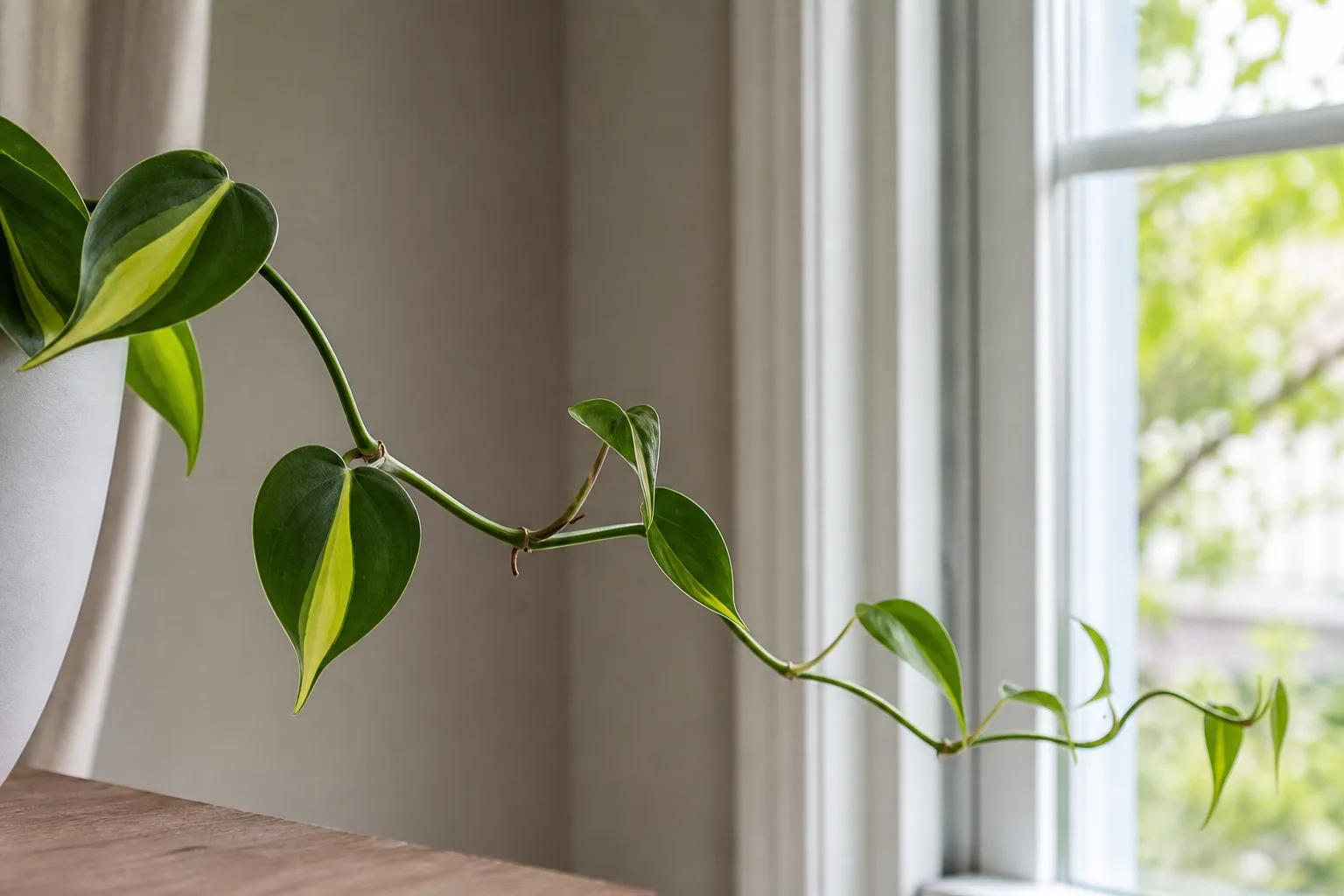
Leggy Growth on Philodendron Brasil: Causes, Checks & Fixes
This guide covers leggy growth on Philodendron Brasil. See also the general Leggy Growth guide, watering, and light pages for this plant.
Leggy Growth on Philodendron Brasil: Causes, Checks & Fixes
Quick answer
Leggy growth on Philodendron Brasil (Philodendron hederaceum ‘Brasil’) is etiolation-the plant stretching toward photons when light is too weak for compact growth. Stems develop long bare internodes, smaller heart-shaped leaves, and a visible lean toward the brightest window. The ‘Brasil’ cultivar is more prone to stretch than solid-green heartleaf in the same dim corner because variegated lime tissue carries less chlorophyll and needs brighter indirect light to hold short nodes and vivid streaks.
First step: move the pot within 3–5 feet of an east or west window, or add a full-spectrum grow light 6–12 inches above the canopy for 12–14 hours daily. Do not fertilize, repot, or increase watering on the same day. Stretched sections will not compact on their own-plan to prune plain-green tips back to the last variegated node after two to three compact new leaves confirm the brighter spot works. This page covers internode stretch, reversion pruning, and support; our not enough light guide focuses on lime fade and placement confirmation when color loss is your main concern.
Leggy growth vs not enough light vs thin stems on Brasil
All three problems often share the same root cause-too few photons-but owners search them for different reasons. Use this page when long bare stems, widely spaced leaves, or pruning and support are the headline.
| Your main question | Start here | Also check |
|---|---|---|
| Vines are long with wide gaps between heart leaves | This page - etiolation and internode stretch | Light guide for placement targets |
| New leaves losing lime streaks or turning solid green | Not enough light - variegation fade | This page if stems also stretched |
| Stems feel wiry and fragile, not just widely spaced | Thin stems - stem girth and strength | This page if internode gaps are the main signal |
| Bare lower stems with foliage only at vine tips | This page - prune after light fix | Pruning guide for cut placement |
| Wet soil + droop in a dim corner | Overwatering | Low light slows dry-down-fix both |
Improving light addresses stretch, fade, and weak stems together. Prune elongated vines after brightness increases, not before-you need compact new growth to judge success.
What leggy growth looks like on Philodendron Brasil
Etiolation on Brasil reads as structure first, variegation second. The vine may still show some lime while the architecture already tells you light is marginal.
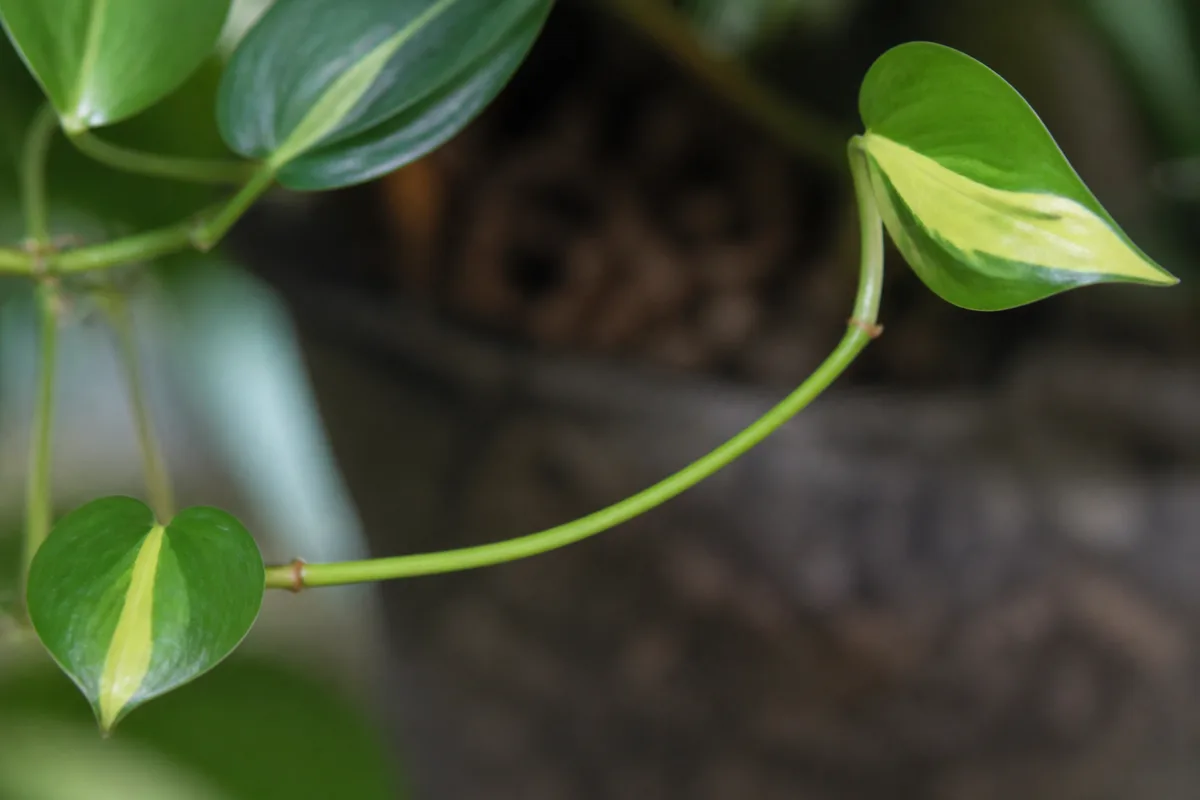
Leggy Growth symptoms on Philodendron Brasil - compare with healthy tissue on the same plant.
Primary Brasil-specific signals:
- Long gaps between heart-shaped leaves on new growth-the internode between nodes stretches while leaf size shrinks
- Thin, reaching stems that lean hard toward one window or lamp
- Smaller new leaves than older foliage higher on the same vine
- Lime streaks fading to muddy green or disappearing on the newest tips-often alongside stretch in the same dim spot
- Plain-green reversion on the thinnest sections while one variegated strand still looks stronger
- Bare lower stems with foliage clustered at the vine tips-a “palm tree” silhouette on an old trailing plant
- Soil that stays damp for a week or more despite a normal watering schedule
What compact healthy growth looks like for comparison:
- Moderate spacing between nodes on actively growing vines
- Lime variegation visible on most new leaves, even when the pattern varies leaf to leaf
- Glossy heart blades roughly 3–6 inches on mature sections
- Pot weight drops predictably between waterings when you allow the top 3–5 cm to dry
What winter slow growth looks like-different urgency:
- Growth pauses or slows uniformly in short days without dramatic new internode stretch
- Existing leaves may deepen slightly with age-normal maturation, not etiolation
- Concern is warranted when new growth keeps spacing out on the same sill through winter while the plant leans
Missouri Botanical Garden notes that when philodendron conditions are too dark, stems become spindly. On Brasil, spindly almost always pairs with variegation loss-not random bad luck.
Why Philodendron Brasil gets leggy
Plants stretch toward light when photon supply falls below what the species needs for compact architecture. On Brasil, that biology intersects with cultivar-specific variegation economics.
Phototropism and etiolation. Heartleaf philodendron is a tropical climbing vine that scales tree trunks toward broken canopy light. Indoors, weak light triggers the same response: elongated internodes, smaller leaves, and directional lean. Insufficient light causes leggy stretch and fading leaf color on many foliage houseplants-Brasil is not exempt.
Variegated chlorophyll demand. Solid-green heartleaf philodendron can survive in extremely low light-that forgiving reputation gets applied to Brasil too often. The ‘Brasil’ cultivar carries a variegated center stripe of yellow to light green on dark green borders, and variegation is unstable by nature. Less chlorophyll in lime patches means the plant needs more usable light, not less, to photosynthesize at the same pace as an all-green vine.
Brasil vs solid-green heartleaf in the same corner. A plain-green heartleaf beside Brasil in the same dim hall develops longer internodes sooner on the variegated plant because the lime sectors cannot carry the same photosynthetic load. Reversion to solid green accelerates in dim light-the reverted tissue actually grows faster and can overtake variegated sections.
Climber biology without support. Trailing Brasil allowed to run unchecked for years naturally sheds lower leaves, leaving bare stems even when light is adequate. Combine aging vines with dim placement and you get severe legginess fast. A moss pole or trellis does not replace brightness, but it gives climbing stems larger heart leaves once light improves.
The dim-room overwatering trap. A stretched Brasil in a back shelf transpires slowly. Owners who keep a bright-window watering rhythm see yellow leaves and sour soil-symptoms labeled overwatering that start when light slows metabolism. Brighter light increases water use; dim light demands patience before the next drink. Cross-check overwatering if mix stays wet for weeks.
Winter light drop. Shorter days and lower sun angle reduce usable light at the same window. Growth that was compact in summer may come out stretched and pale from late fall through early spring unless you move the plant closer or add supplemental lighting.
Lookalike symptoms
| Pattern | Stem spacing | New leaf color | Soil / roots | First fix |
|---|---|---|---|---|
| Etiolation (this page) | Long new internodes; lean toward light | Lime fade or solid green | Often slow dry-down in dim rooms | Brighter indirect light, then prune |
| Normal winter pause | Little new growth; old spacing unchanged | No new leaves to compare | Normal dry-down for season | Wait for spring; optional grow light |
| Overwatering in dim corner | May stretch if light also low | Yellowing lower leaves | Wet mix 10+ days; soft roots | Dry-down correction + light |
| underwatering on Philodendron Brasil | Uncommon in dim rooms | Slightly curled, firm leaves | Lightweight dry pot | Water thoroughly; see underwatering |
| Spider mites | Not primary | Pale stippling, fine webbing | Normal dry-down | Isolate and treat pests-not a light fix alone |
| Nutrient deficiency | Rare when real issue is weak light | Uniform pale new growth | Varies | Fix light first; do not fertilize dim stressed vines |
Use new growth as the tiebreaker. If the youngest section keeps spacing out while the plant tilts toward glass, etiolation is active-not dormant winter rest or a feeding shortage.
How to confirm the cause
Work through this checklist before assuming fertilizer, Philodendron Brasil repotting guide, or pest treatment is needed:
-
Internode spacing on the newest section - Measure the gap between the last two leaves. Gaps over 2–3 inches on a summer vine point to ongoing stretch from insufficient light.
-
Lean direction - Consistent tilt toward one window or grow lamp confirms phototropic stretch.
-
Hand-shadow test - At midday, hold your open hand where the foliage sits. Bright indirect light usually casts a soft, defined shadow. Barely visible shadow means the spot is too dim for a variegated heartleaf. Sharp, dark shadows with hot leaf surfaces mean direct sun-different problem.
-
Newest-leaf variegation trend - Compare the last three leaves on the longest vine. If each new leaf has less lime than the one before, light is the limiting factor-not a nutrient deficiency.
-
Two-week window move - Shift the pot closer to the brightest suitable glass (or add a grow light) and change nothing else. If the next one to two leaves emerge closer together with restored lime streaks, light was the limiter.
-
Water-use check - Push your finger 3–5 cm into the mix. If soil feels wet days after watering while growth is slow, low light may be slowing uptake. Confirm roots are still firm-not rot masked as thirst.
-
Pest scan - Flip a few leaves and check undersides. Spider mites can pale foliage in dry dim conditions, but they leave stippling and fine webbing. Uniform stretch without pests confirms light stress.
If stretch, green reversion, and wet-soil slowness cluster together, you have a confirmed light problem-not a fertilizer shortage.
First fix for Philodendron Brasil
Move the pot to brighter indirect light within 3–5 feet of an east or west window-or add a full-spectrum grow light 6–12 inches above the canopy for 12–14 hours daily-and leave watering, fertilizer, and pot size alone for two weeks.
Concrete placements that often restore compact growth:
- East windowsill or table within a few feet of east glass - morning sun may touch leaves briefly; afternoon stays bright and indirect
- Filtered west window - afternoon rays softened by sheer curtain, pot far enough back to avoid hot direct glass contact
- Interior room with grow light - full-spectrum LED above the canopy when windows fall short
If the plant lived in a very dim interior room for months, acclimate over 7–14 days: move one step closer every two to three days, or add a sheer curtain if bleached patches appear. Avoid plunging a dim-adapted Brasil into unfiltered south-window sun-that risks scorch, not recovery.
Grow-light setup when windows fall short: Mount a full-spectrum LED fixture 6–12 inches above the top of the vine, timer set for 12–14 hours daily. Combine with weak natural light if available; avoid running lights more than 16 hours total so the plant still receives a dark period. Window maps and seasonal supplementation details live in the light guide.
After moving:
- Do not fertilize until new growth looks firm and variegated for two weeks
- Do not repot unless mix is clearly failing
- Recheck soil moisture every few days-brighter light usually means faster dry-down
Step-by-step recovery: light, then prune, then propagate
Once exposure improves, follow this sequence-pruning before light correction often produces another round of stretch within weeks:
-
Hold position for two weeks - One deliberate placement change beats daily shuffling. Read the next leaf before adjusting again.
-
Confirm compact new growth - Wait for two to three new leaves with shorter internodes and visible lime streaks before any hard cutback. That proves the brighter spot works.
-
Prune reverted plain-green tips - Cut each elongated whip back to the last node that still shows lime variegation. Brasil propagates easily from stem cuttings, so trimmings can root in water while the parent fills in. Full cut placement and staging live in the pruning guide.
-
Propagate cuttings to fill bare bases - Healthy node sections root readily in water or soil. Plant three rooted cuttings around a naked crown to hide bare stems while new shoots emerge from low nodes.
-
Add support if desired - A small moss pole or trellis gives climbing stems larger heart leaves. Trailing vines in dim light stay small; brighter light plus support produces the fuller foliage Brasil is known for.
-
Hold fertilizer two to three weeks after pruning - Then resume balanced feeding at half strength only if growth rate stabilizes. Extra nitrogen on a previously dim vine pushes weak elongation-see the fertilizer guide for the leggy-vine sequence.
Pet note: Heartleaf philodendron is toxic to cats and dogs if chewed. Wear gloves or wash hands after handling cut vines during pruning if pets may contact trimmings. Keep elevated shelves and hanging baskets out of pet reach when you chase brighter window placement.
Recovery timeline
| Stage | What to expect |
|---|---|
| 1–2 weeks | Lean may reduce slightly; next leaf spacing is the first real signal |
| 2–4 weeks | New leaves emerge closer together with restored lime streaks in warm bright conditions |
| 4–8 weeks | Safe window for hard prune of worst plain-green runners after compact growth confirmed |
| 1–2 months | Multiple fresh shoots from low nodes after spring cutback; cuttings root in parallel |
| 3+ months | Display-quality compact vine if light stays adequate; old stretched sections remain unless pruned |
Judge success on new internode length and variegation, not nostalgia for old whips. Old stretched stems and solid-green blades never shorten or re-variegate without pruning even after light improves permanently.
If four to six weeks pass with no improvement on new foliage, the spot is still too dim-move closer to the window or add a grow light rather than reaching for fertilizer.
What not to do
- Hard-pruning before confirming brighter light works - Legginess returns within weeks if photons are still scarce.
- Over-fertilizing to compensate for low light - Nutrients cannot replace photons. High nitrogen in dim light pushes more weak stretch.
- Jumping from deep shade to unfiltered south or west sun in one day - Photobleaching can appear within hours on thin variegated leaves. Acclimate gradually.
- Expecting bare internodes to sprout leaves - Only nodes produce new shoots. Leafless stem sections stay leafless unless you cut back to a node or fill with cuttings.
- Staking alone without more light - A moss pole organizes the vine but does not create compact growth in shade.
- Repotting to “fix” stretch - Fresh mix does not substitute for brightness.
- Ignoring plain-green reversion - Solid-green stems grow faster and can overtake variegated sections. Prune reverted tips once light improves.
How to prevent leggy growth next time
- Default placement: Within 3–5 feet of a bright east or west window-not just where the hanger looks best
- Rotate weekly during active growth for even variegation across the canopy
- Pinch or trim soft plain-green tips in spring and summer before they overtake variegated sections
- Seasonal light audit: Retest the hand-shadow test in late November; add a grow light before winter stretch sets in
- Clean windows at least twice a year-film and screens cut more light than owners expect
- Match watering to placement - Dim rooms need longer dry-down intervals; see the watering guide
- Pair brighter light with well-drained mix and water when the top 3–5 cm dries-not on a fixed calendar
Brasil survives dim corners longer than many houseplants-but survival is not a compact lime-streaked cascade. Treat it like a variegated cultivar with climbing habit, not like indestructible solid-green heartleaf, if short nodes and vivid streaks matter to you.
When to worry
Cosmetic etiolation alone is rarely fatal on philodendron. Worry when stretch pairs with other stress:
- Mix wet for two weeks or more with yellow lower leaves and soft stems at the base-low light plus excess moisture raises root stress
- Variegation gone on every active vine - prune and relight before the pot becomes a plain-green heartleaf
- No compact new growth after six weeks in a spot that passes the hand-shadow test-verify with a grow light; the window may still be too dim for this cultivar
- Repeated stretch after multiple prunes - Light, not shears, is still the limiter. Re-read the light guide before cutting again
A healthy Brasil with firm stems and stretched-but green-vines is recoverable. Move it to brighter indirect light, wait for compact new growth, then prune and propagate as needed.
When to use this page vs other Philodendron Brasil guides
- Philodendron Brasil watering guide - Use for routine moisture checks before assuming leggy growth is the main issue.
- Philodendron Brasil problems hub - Browse all 46 common issues on this species.
- Not Enough Light on Philodendron Brasil - Different entry point when symptoms overlap with leggy growth.
- Slow Growth on Philodendron Brasil - Different entry point when symptoms overlap with leggy growth.
- Leaf Drop on Philodendron Brasil - Different entry point when symptoms overlap with leggy growth.
Related Philodendron Brasil guides
- Philodendron Brasil overview
- Philodendron Brasil watering
- Philodendron Brasil light
- Philodendron Brasil soil
- Not Enough Light on Philodendron Brasil
- Slow Growth on Philodendron Brasil
- Leaf Drop on Philodendron Brasil
- Yellow Leaves on Philodendron Brasil
- Plant Leaning on Philodendron Brasil
- Philodendron Brasil problems