Brown Tips on Philodendron Brasil: Causes, Checks & Fixes
Quick answer
Brown tips on Philodendron Brasil usually mean dry winter air, uneven watering, fluoride or salt in tap water, sun scorch on variegated leaves, or spider mites-not disease. First step: push your finger 3–5 cm into the mix and note whether leaves are firm or limp; firm leaves with crisp tips on moist soil near a heating vent usually mean humidity or water quality, not drought.
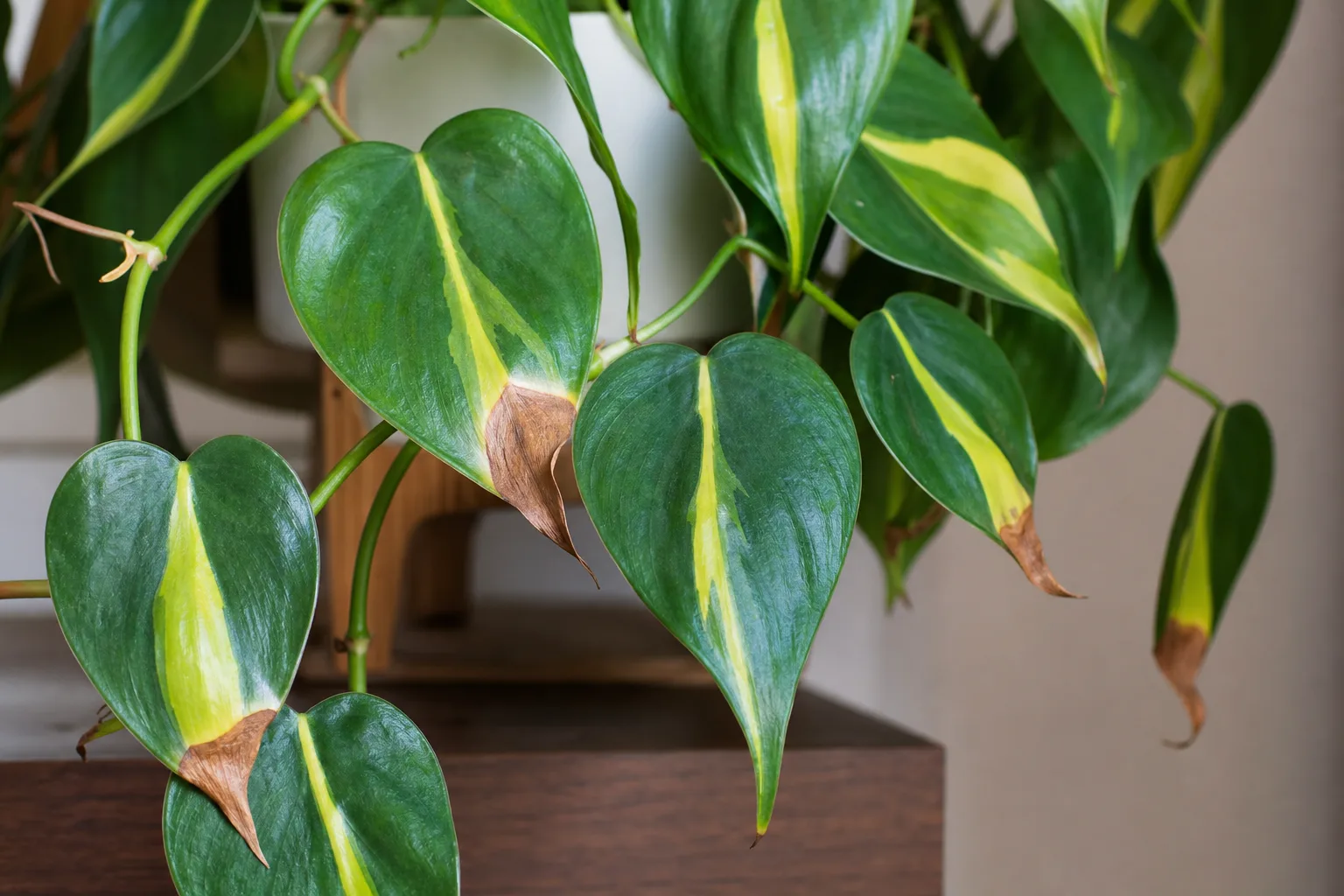
Brown Tips on Philodendron Brasil: Causes, Checks & Fixes
This guide covers brown tips on Philodendron Brasil. See also the general Brown Tips guide, watering, and light pages for this plant.
Brown Tips on Philodendron Brasil: Causes, Checks & Fixes
Quick answer
Brown tips on Philodendron Brasil (Philodendron hederaceum ‘Brasil’) are almost always an environmental stress signal, not a mysterious disease. On glossy cordate heart-shaped leaves with lime-green variegation, damage usually starts at the very tip or along the outer margin and turns dry and papery on otherwise firm tissue-distinct from soft brown bases that often mean root trouble.
The most common causes on this trailing vine are dry winter air below about 40% humidity, salt or fertilizer buildup, hard tap water minerals and fluoride, uneven drought-and-flood watering, direct sun scorch on variegated tissue, and spider mites in hot dry air. Philodendrons tolerate average home humidity but grow best with moderate humidity in the 40–60% range-winter heating can still crisp margins on vines that look healthy otherwise.
First step: push your finger 3–5 cm into the mix and lift the pot before changing anything. A light dry pot with limp vines means drought-see underwatering. Firm turgid leaves with crisp tips on moist soil near a heating vent usually means humidity or water quality-see low humidity. White crust on the soil points to salt flush, not more fertilizer. Full species context: Philodendron Brasil overview.
When to use this page vs. the low-humidity guide
This page is the multi-cause brown-tip hub-humidity, salts, tap water, sun, drought, pests, and rot differentials in one place. Use it when you see crispy margins but are not sure which branch fits.
The dedicated low-humidity guide goes deeper on winter heater air, hygrometer workflow, vent placement, and trailing-vine microclimates once you have already ruled out salt crust, drought, and sun scorch. Start here for the decision tree; switch to low-humidity when a hygrometer confirms dry air is the only problem left.
| Your main clue | Start here | Go deeper at |
|---|---|---|
| Crispy tips on firm leaves, dry winter air, no salt crust | This page - humidity branch | Low humidity |
| White crust on soil or pot rim | This page - salt branch | Salt build up |
| Tan bleached patches after a windowsill move | This page - sun branch | Sunburn and scorched leaves |
| Light dry pot, limp vines | This page - drought branch | Underwatering |
| Soft brown bases, sour wet soil | This page - rot differential | Root rot |
| Stippling plus webbing in dry air | This page - pest branch | Spider mites |
Lookalike symptoms to rule out
| Pattern | Leaf texture | Soil / pot clues | Most likely cause |
|---|---|---|---|
| Dry brown tips on longest trailing stems | Firm, turgid | Normal dry-down; moist at depth | Low humidity - see low humidity |
| Brown margins spreading inward on many leaves | Firm | White crust on rim or soil surface | Salt or fertilizer buildup - see salt build up |
| Crispy tips, no crust, hard tap water | Firm | Moist, normal weight | Fluoride or mineral sensitivity - filtered water |
| Tan bleached zones on window-facing side | Firm | Wet or dry | Sun scorch - see sunburn |
| Crisp edges on thin limp leaves | Limp, papery | Very light, dry pot | Underwatering - see underwatering |
| Soft brown leaf bases, yellow lower leaves | Limp | Wet, heavy, sour smell | Root rot - see root rot |
| Fine dots, webbing, bronze patches | Dull, stippled | Any moisture | Spider mites - see spider mites |
What brown tips look like on Philodendron Brasil
Brasil keeps the heartleaf philodendron form: glossy cordate blades with a lime-green stripe down the center on thinner tissue than solid-green heartleaf or pothos in the same room. Heartleaf philodendron leaves are softer and thinner than pothos leaves, so tip dieback from dry air often appears on Brasil before a Golden Pothos beside it complains.
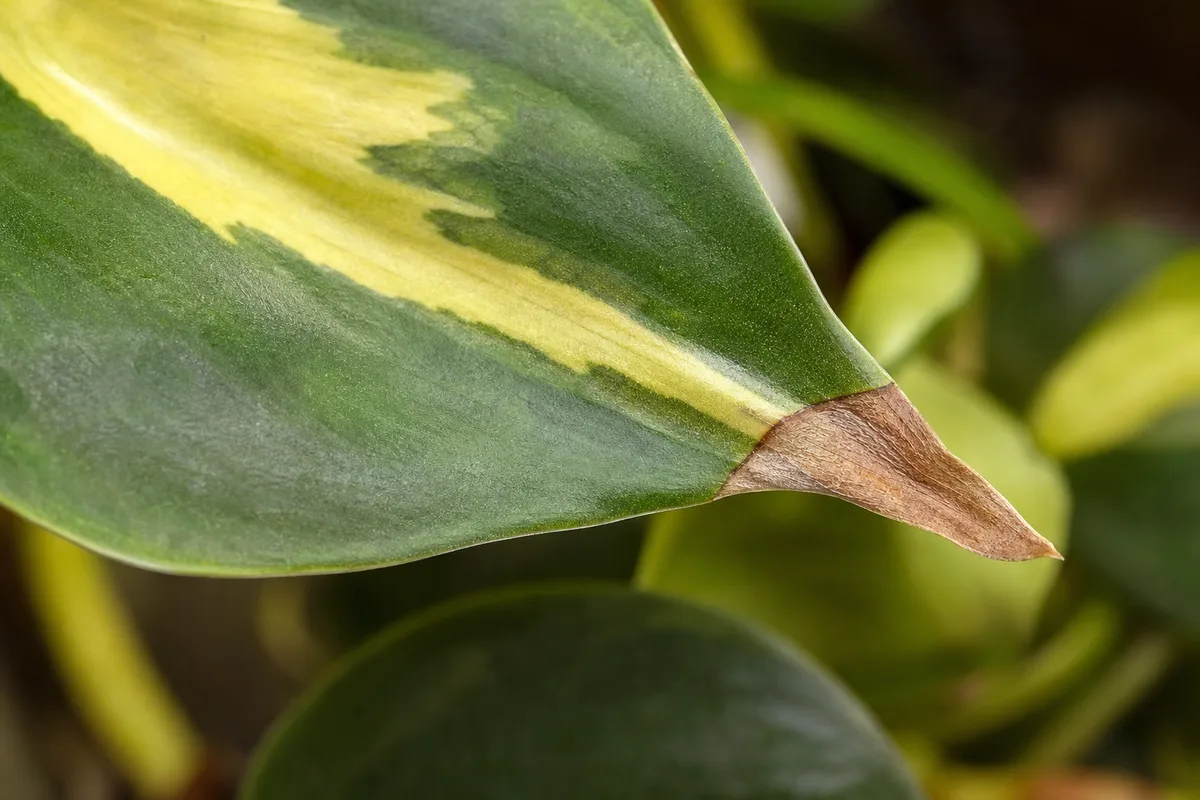
Brown Tips symptoms on Philodendron Brasil - compare with healthy tissue on the same plant.
Typical humidity or water-quality tip burn:
- Dry brown or tan crispy edges on otherwise firm heart-shaped leaves
- Worst on the longest trailing stems farthest from the pot, not clustered on one side only
- Lime variegation looks dull alongside edge burn, but stems stay firm
- Soil follows your normal dry-down rhythm; the pot is not unusually heavy
- Leaf scorch and tip dieback often follow low humidity or intense light
Salt or fertilizer burn:
- Brown margins that spread inward from tips on multiple leaves
- White or grey crusty deposits on soil surface or pot rim
- Persists even when watering rhythm seems correct
- Brown tips and leaf margins can result from salt accumulation in potting soil
Sun scorch on variegated tissue:
- Tan or bleached patches turning crisp brown on leaves facing a bright window
- Often follows a move from a dim corner to direct sun within days
- Damage hits exposed surfaces, not uniform tip-only browning on every trail
- Differs from slow winter humidity burn, which affects margins evenly on outer vines
Drought crisp edges:
- Crisp brown edges on thin, limp leaves-often oldest foliage on long hangers first
- Very light pot; mix pale or pulled away from the pot wall
- Vines may perk after watering; tips on damaged leaves stay brown
What brown tips usually do not look like:
- Soft brown bases with sour-smelling wet soil (root rot)
- Uniform yellowing starting on lower leaves with saturated mix (overwatering)
- Stippling, webbing, or fine dots on leaf undersides (spider mites)
- Circular brown spots with yellow halos (fungal leaf spot-not typical tip-only burn)
Why Philodendron Brasil gets brown tips
Heartleaf philodendrons evolved in warm, humid understory conditions. Brasil keeps that biology on a fast-growing trailing vine. When relative humidity drops-especially late fall through early spring when furnaces run-transpiration pulls water from leaf margins faster than roots deliver it. Placement magnifies the problem: hanging baskets near ceiling heat registers, pots on radiator covers, and vines pressed against cold winter glass all create microclimates drier than the rest of the room.
Most indoor environments lack sufficient humidity for healthy houseplants, particularly in winter. On Brasil, that gap often appears as cosmetic tip burn long before the vine stops growing entirely.
Uneven watering also stresses margins. Alternating bone-dry spells with heavy soaking damages fine roots and leaves unevenly-tips crisp while the owner assumes the plant got enough water because the last soak was heavy. Water when the top 1–2 inches of soil has dried in well-drained potting mix; a fixed calendar schedule ignores how fast Brasil dries in bright light versus a dim shelf.
Hard tap water adds fluoride and mineral salts that concentrate at leaf tips through transpiration. Some houseplants are sensitive to fluoride or chlorine in tap water, and excess fertilizer can also burn leaf margins even when soil feels moist.
Too much direct sun after a dim-corner move scorches the thinner variegated tissue Brasil uses for its lime streaks. The damage reads as tan crispy patches on exposed blades rather than slow uniform margin crispness from dry air.
Because Brasil grows quickly when happy, owners sometimes interpret crispy tips as a watering issue and add moisture at the roots while the real stress is at the leaf surface-or the opposite, blaming humidity when the pot has gone bone dry for weeks.
How to confirm the cause
Work through these five checks before changing your whole care routine:
-
Soil moisture at depth - Push your finger 3–5 cm into the mix near the root ball. Crispy tips with appropriately drying soil fit humidity or water-quality stress. A very light dry pot with limp vines points to underwatering. Constantly wet heavy soil with soft brown bases points to root rot instead.
-
Measure local humidity - Place a hygrometer within a few feet of the pot at vine height. Readings consistently below about 40% during heating season support low humidity as a contributor. Above ~45% with tips still crisping on moist soil, inspect salts and tap water before blaming dry air alone.
-
Inspect the pot rim and soil surface - White or grey crust strongly points to salt build up. No crust with dry winter air and firm leaves fits the humidity branch.
-
Map heat, light, and recent moves - Note AC vents, radiators, fireplace proximity, and whether trailing stems touch exterior window glass. Tip burn that appeared within a week of shifting to a brighter windowsill often traces to sun scorch or a local air change, not sudden root failure.
-
Rule out pests - Shake a stem over white paper and check undersides with a hand lens. Dry winter rooms can favor spider mites; stippling plus webbing needs pest treatment, not humidity alone.
If humidity near the plant is reasonable and tips still crisp while soil stays wet, look at water quality, fertilizer salts, or light scorch before assuming one cause.
First fix for Philodendron Brasil (by confirmed cause)
Match one first fix to the branch you confirmed-do not stack humidity changes, repotting, and fertilizer on the same day.
Low humidity (firm leaves, dry winter air, no salt crust)
Move the vine away from heating vents, radiators, or cold-glass contact, then raise local humidity toward 40–60%. A small cool-mist humidifier nearby works better than occasional misting. Grouping plants together raises humidity in their shared area. Full hygrometer workflow and vent-placement detail live in the low-humidity guide.
Salt or fertilizer buildup (white crust, margins spreading inward)
Stop feeding immediately and leach the pot with plain room-temperature water until it drains freely-use at least twice the pot volume. Scrape surface crust first. See the salt-build-up guide for the full flush protocol and when to repot instead.
Hard tap water (firm leaves, no crust, tips persist after humidity fix)
Switch to filtered, distilled, or rainwater at room temperature. Let tap water stand 24 hours before use to dissipate chlorine; fluoride requires filtration or alternate water sources.
Drought (light dry pot, limp vines)
Give one thorough soak until water runs from drainage holes, then return to a dry-down rhythm-see underwatering and the watering guide for Brasil-specific intervals.
Sun scorch (tan patches after bright-window move)
Shift the pot back to bright indirect light without harsh midday sun on variegated leaves. Acclimate gradually if you need more light for growth-see sunburn and scorched leaves.
Spider mites (stippling, webbing)
Isolate the plant and rinse leaf undersides thoroughly with plain water before any spray. Dry air stress and mite damage can overlap-confirm active pests first. See spider mites.
Do not increase watering frequency to treat dry leaf edges. Wet roots in dry air still produce crispy tips on a plant that needs oxygen in the mix between drinks.
Recovery timeline
Cosmetic tip burn does not heal in place. Damaged tissue will not re-green.
- One to two weeks - New damage should stop spreading once humidity, water quality, or watering rhythm stabilizes
- Two to four weeks - First new lime-streaked leaves at vine tips should emerge with clean margins in typical indoor conditions
- Three to six weeks - Heavily damaged trailing sections may look full again as the vine pushes replacement growth from nodes closer to the pot
Judge recovery by new growth at vine tips, not by old brown margins turning green. If stems stay firm, roots are white or tan on spot checks, and new leaves keep opening cleanly, the plant is recovering even when older blades still show brown edges.
Widespread collapse, soft stems at the soil line, or yellowing on wet mix means pivot to root rot or overwatering instead.
What not to do
- Do not water more often because leaf tips look dry - that invites root rot on an aroid that already needs its mix to dry between drinks
- Do not mist heavily at night on trailing vines in dim corners; wet foliage that stays damp for hours encourages fungal spotting
- Do not fertilize stressed vines to “push new growth” - salts worsen margin burn when roots are already struggling
- Do not repot on day one unless you confirm mushy roots or chronic salt-loaded soil that will not leach clean
- Do not prune heavily while humidity is still low - remove only fully dead tip tissue; keep foliage that still photosynthesizes
- Do not assume every crispy edge is humidity without checking pot weight, salt crust, and light history first
How to prevent brown tips next time
Target 40–60% humidity in the room or within a few feet of grouped plants during heating season. A humidifier helps when indoor air runs dry in winter.
Keep the vine in bright indirect light without harsh midday sun on variegated tissue. Use filtered or rainwater if municipal tap water is hard. Drench periodically to leach salts when you fertilize during active growth-details in the fertilizer guide.
Follow the watering guide dry-down rhythm instead of a fixed calendar. Weigh the pot weekly in problem seasons so drought crisp edges are caught before widespread tip burn.
Acclimate nursery plants gradually when bringing them home in dry weather-sudden drops from greenhouse humidity to a heated living room often produce a flush of tip burn in the first two weeks.
When trimming damaged leaves, remember Brasil is toxic to cats and dogs if chewed-keep cuttings and hanging trails out of reach.
When to worry
Brown tips alone rarely kill Philodendron Brasil. Worry when crispy tips spread alongside limp stems, wet sour soil, pest webbing, or complete stall of new growth for more than a month after corrections. Those combinations point to compounded stress-roots, pests, or light-not dry air by itself.
Treat as urgent if brown patches spread with fine webbing and stippling-active spider mites can defoliate a trailing philodendron in dry air.
Escalate if brown margins spread inward on new leaves despite flushing, humidity changes, and corrected watering-persistent mineral load may need repotting per the salt-build-up guide.
Seek root inspection if tips brown alongside yellow limp leaves on wet soil-wilted leaves with wet soil can mean rotting roots cannot take up water, the opposite of dry-air tip burn on firm vines.
Related Philodendron Brasil guides
- Philodendron Brasil overview - full care hub
- Low humidity - winter heater air and hygrometer workflow
- Watering - dry-down rhythm and seasonal intervals
- Salt build up - white crust and leaching protocol
- Sunburn and scorched leaves - variegated tissue scorch
- Underwatering - drought crisp edges on a light pot
- Root rot - soft brown bases on wet mix
- Spider mites - stippling and webbing in dry air
- Crispy leaves - broader margin damage patterns
- Brown leaves - whole-blade browning vs. tip-only burn
Conclusion
Brown tips on Philodendron Brasil reward a short diagnostic pause. Soil moisture at depth, pot weight, leaf firmness, salt crust, humidity near the vine, light direction, and pest signs separate winter humidity burn on firm trailing leaves from salt buildup, hard tap water, sun scorch on variegated tissue, drought, and root trouble. Match the first fix to the branch you confirmed-humidity and water quality, salt flush, one thorough soak, light adjustment, or pest treatment-and judge recovery by clean new lime-streaked leaves at vine tips, not old brown margins. The cultivar is forgiving once the real stressor stops.