Scale Insects on Philodendron Brasil: Causes, Checks & Fixes
Quick answer
Scale insects on Philodendron Brasil appear as small, immobile tan or brown bumps glued to green petioles, wiry stems, and leaf undersides-often hidden where trailing vines overlap. First step: isolate the plant and scrape every visible bump with a cotton swab dipped in 70% isopropyl alcohol before spraying anything.
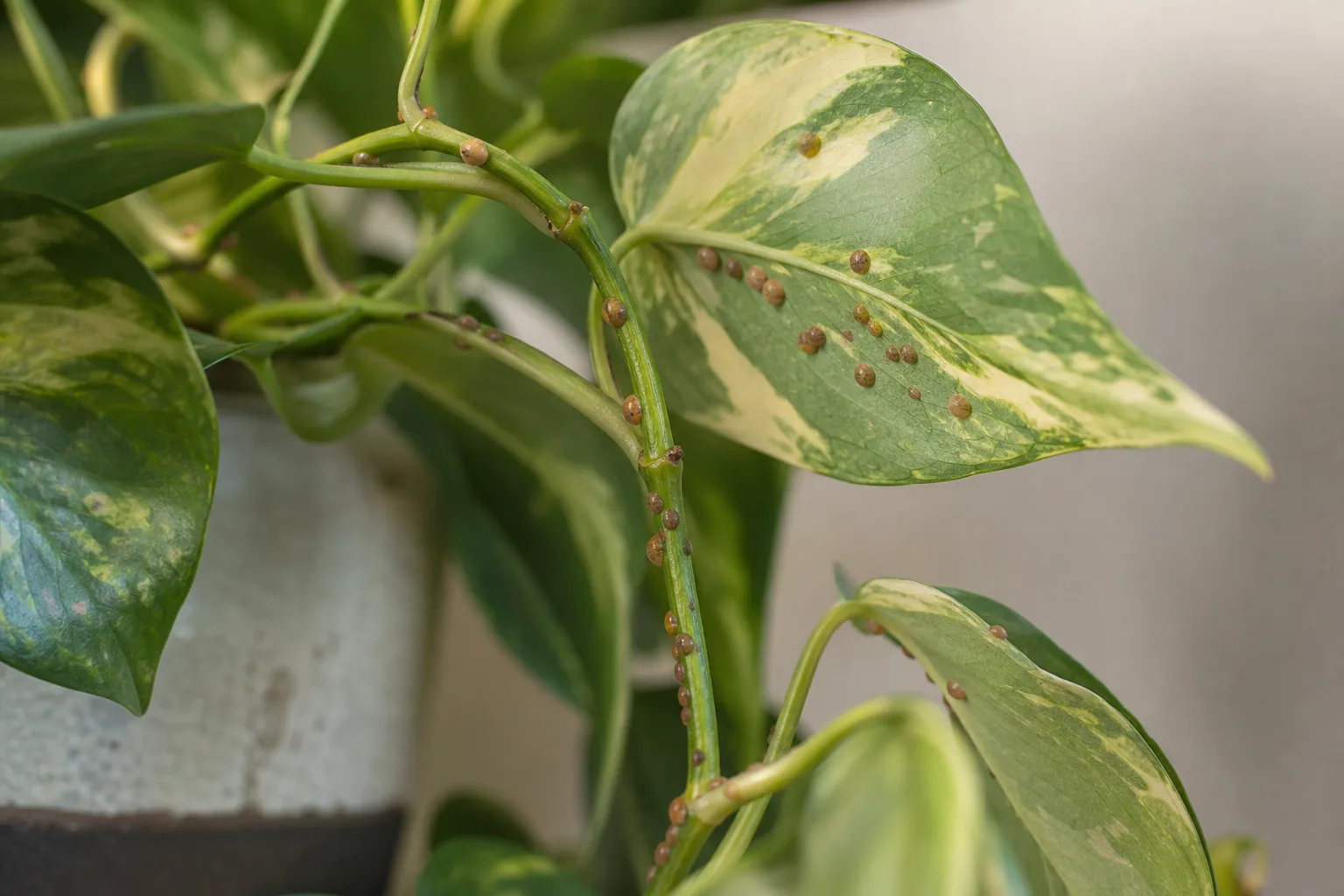
Scale Insects on Philodendron Brasil: Causes, Checks & Fixes
This guide covers scale insects on Philodendron Brasil. See also the general Scale Insects guide, watering, and light pages for this plant.
Scale Insects on Philodendron Brasil: Causes, Checks & Fixes
Quick answer
Scale insects on Philodendron Brasil (Philodendron hederaceum ‘Brasil’) show up as small, immobile tan, brown, or gray bumps glued to green petioles, wiry stems, and leaf undersides along trailing vines. They pierce tissue, drain sap, and-on soft scale species-excrete sticky honeydew that can lead to black sooty mold on the lime-and-green heart leaves below. If tacky leaves are your first clue, read the sticky leaves guide to separate scale honeydew from harmless extrafloral nectar at nodes.
First step: isolate the plant and scrape every visible scale with a cotton swab dipped in 70% isopropyl alcohol. On this fast-growing vining philodendron, contact removal beats a single blanket spray because overlapping strands and tight node angles hide adults that foliar mists never reach. Work stem by stem through the trailing mass before starting repeat oil or soap treatments.
What scale insects look like on Philodendron Brasil
Scale insects are sap-feeding pests protected by a waxy or shell-like cover that makes adults essentially immobile. On Philodendron Brasil they are easy to miss until colonies build:
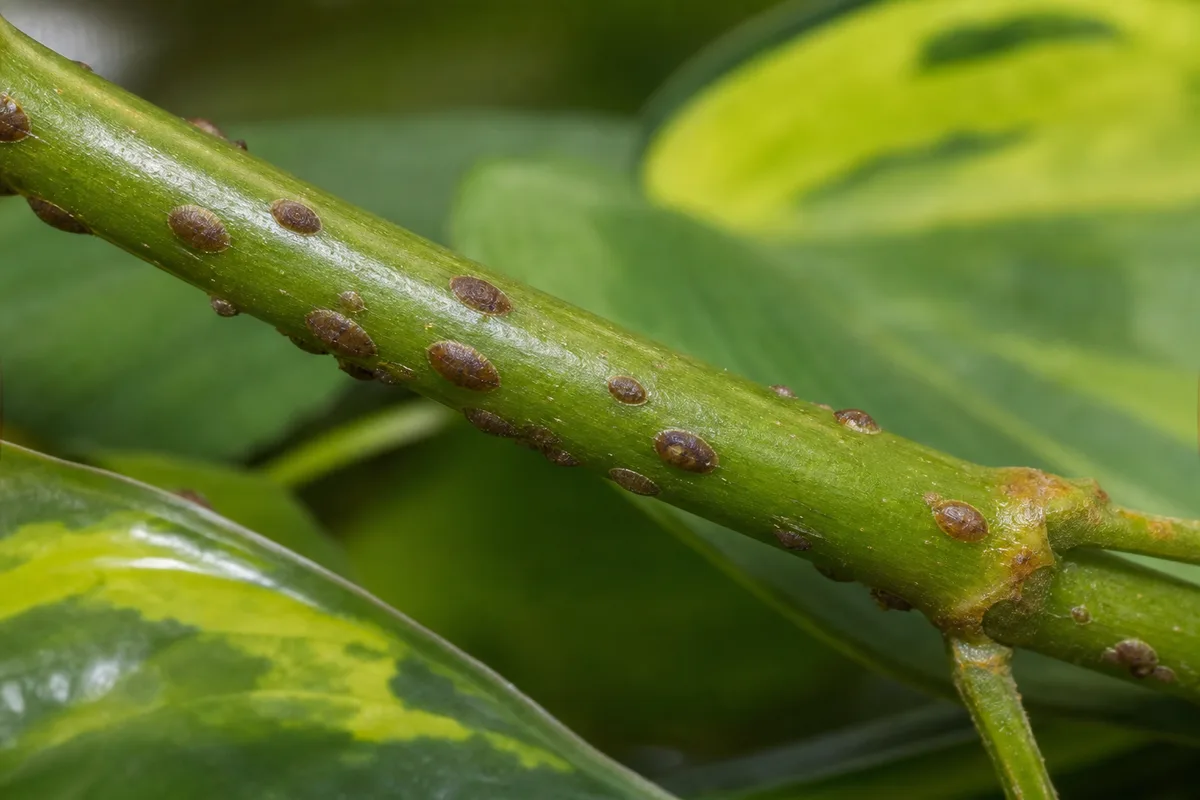
Scale Insects symptoms on Philodendron Brasil - compare with healthy tissue on the same plant.
- Flat or dome-shaped bumps on green petioles, vine nodes, and where each heart-shaped leaf meets its stem
- Uniform color patches that match stem tone-tan, brown, or gray-until you look closely and see individual disks in rows
- Sticky, shiny honeydew on lower lime-streaked leaves (typical of soft scale such as brown soft scale)
- Black sooty mold on sticky leaf surfaces; it wipes off but returns until insects are controlled
- Ant trails on pot rims or saucers-ants harvest honeydew and protect scale colonies (see ants on plant when ants appear before you spot bumps)
- Yellowing hearts, premature leaf drop, and stalled new growth on Philodendron Brasil when feeding is heavy on growing tips
Philodendron Brasil makes inspection harder than on an upright plant. Long trailing vines drape over each other on shelves and hangers, giving scale dozens of sheltered joints where bumps blend with green petiole color-and can hide under the lime-streaked portion of each heart leaf. Fast-growing vining heartleaf philodendron stems stay firm and glossy, so a few bumps can look like natural texture until honeydew or yellowing appears on nearby leaves.
Press a suspect bump with a fingernail or toothpick. Scale should flake off with gentle pressure; mealybugs smear waxy cotton instead. Mealybugs look like white fluffy clusters in leaf axils. Aphids gather on soft new tips as pinhead-sized moving insects. Chalky mineral deposits or perlite specks do not produce honeydew or sit on stems in neat rows.
Soft scale vs. armored scale on Brasil
Most houseplant scale on philodendrons is soft scale. Telling the two apart changes what you expect during treatment:
| Sign | Soft scale (common on Brasil) | Armored scale (less common) |
|---|---|---|
| Cover | Waxy, often brown or tan; may look slightly raised | Hard, flat shell; often gray with a central spot |
| Honeydew | Usually present-sticky lower leaves, sooty mold | Little or no honeydew |
| Ant activity | Common when honeydew is present | Less common |
| Alcohol scrape | Coating dissolves; insect dies on contact | Shell may stay; live insect underneath can survive one dab |
| Oil spray response | Effective with repeat cycles | Often needs more thorough oil coverage and longer treatment |
Mississippi State Extension notes that soft scales produce honeydew while armored scales generally do not, and that most scales on houseplants are soft scales. If your Brasil declines with spreading bumps but no stickiness, inspect stem undersides and soil-line joints for armored scale before assuming a watering problem.
Why Philodendron Brasil gets scale insects
Scale insects are common houseplant pests worldwide that hitchhike on nursery stock, cuttings, and plants moved between indoor and outdoor locations. Year-round mild indoor temperatures allow overlapping generations because natural predators are absent indoors. UMD Extension lists philodendron among the aroids commonly affected by scale indoors.
Philodendron Brasil adds plant-specific risk:
- Node-heavy trailing habit. Every heart leaf creates a crevice at the petiole base where flat scale disks mimic stem texture until the colony is large.
- Overlapping vines. Trailing philodendrons grouped on shelves or hung in rows shield lower stems from sprays and casual glances.
- Shared collections. Brasil is often kept near pothos, monstera, and other aroids-exactly the neighbors scale crawlers reach after hatching.
- Introduction from new plants. Scale commonly arrives on nursery stock. Skipping quarantine before placing a new pot beside an established Brasil is the most common entry route-the overview quarantine guidance applies here.
- Stressed specimens in dim corners. Plants in very low light push soft, stretched growth that is easy sap for crawlers after hatching.
Brasil tolerates 40–60% humidity with Philodendron Brasil light guide and watering when the top 3–5 cm of mix dries per the watering guide. overwatering on Philodendron Brasil does not attract scale directly, but soggy mix weakens roots without eliminating pests-stressed vines recover more slowly after treatment. Dense hanging baskets look healthy from across the room while bumps build at inner nodes along vines looped behind furniture.
How to confirm the cause
Work through these checks before you commit to a spray schedule:
- Bump test - Try to flick a suspect disk off with a fingernail or toothpick. Scale that flakes away confirms the pest; waxy smears point to mealybugs instead.
- Honeydew test - Touch a lower heart-shaped leaf below a bumpy stem. Tacky residue that transfers to your finger confirms sap feeding (soft scale). Clear droplets at repeated node positions without insects may be extrafloral nectar-see sticky leaves.
- Sooty mold check - Black film that wipes off with a damp cloth points to honeydew above, not a fungal leaf infection starting on the leaf itself.
- Ant activity - Ants marching up the pot rim or hanger usually mean a sap-feeding colony is active somewhere on the vine above.
- Soil-line and crown check - Lift vines near the pot rim. Bumps on stem bases, inner pot walls, or unglazed terracotta without obvious foliar clusters suggest a hidden reservoir.
- Neighbor scan - Inspect plants within a few feet, especially those whose leaves touch or share a watering tray. Scale crawlers walk short distances before settling.
- Recent purchases - Trace any new plant added in the last two to three weeks; scale often appears first on the newest introduction.
If you find immobile bumps plus honeydew, ants, or yellowing along infested stems, you have enough to treat as scale. If stems look clean but the plant keeps declining with no sticky residue, look for armored scale on undersides-or inspect stem bases at the soil line before assuming the problem is watering alone.
Lookalike symptoms to rule out
Mealybugs form white cottony tufts in leaf axils, not hard flat disks on petioles. Spider mites leave fine webbing and stippling in hot dry air, not immobile bumps. Aphids are soft moving insects on tender new tips. Powdery mildew forms flat white powder on leaf faces, not stem disks. Mineral or hard-water deposits wipe off dry; scale does not. Normal low-humidity crisping starts at leaf edges without bumps or stickiness. Extrafloral nectar stays localized at nodes without insects-covered on the sticky leaves page.
First fix for Philodendron Brasil
Move the plant away from others, then scrape and dab every visible scale with a cotton swab soaked in 70% isopropyl alcohol.
This is the right opening move on Philodendron Brasil because:
- Alcohol dissolves the protective coating on contact and kills exposed insects without soaking the whole pot-important for a plant that needs well-draining mix and can develop root problems in soggy conditions.
- Scraping removes adults that sprays cannot penetrate; dead shells may remain, but fewer live insects means faster monitoring feedback.
- You map the infestation as you work, revealing hidden bumps in the vine tangle behind other foliage.
Test alcohol on one hidden leaf axil and wait 24 hours before treating the whole plant; variegated philodendron leaves can show burn if alcohol sits too long in direct sun. Dab and scrape pests directly rather than saturating entire leaves if your Brasil sits in a hot window.
After manual removal, keep the plant isolated in bright indirect light with stable watering-water when the top 3–5 cm dries, matching Brasil’s normal rhythm per the watering guide without letting the pot sit in standing water. Do not repot on day one unless bumps cover stem bases at the soil line-Philodendron Brasil repotting guide before knockdown spreads crawlers through the bench.
Philodendron Brasil is toxic to cats and dogs; wear gloves when handling treated vines and keep pets away from freshly dabbed or sprayed plants until products dry. If a pet chews a treated vine, call your veterinarian or ASPCA Animal Poison Control at (888) 426-4435-the same number listed on our overview page.
Step-by-step recovery
Once isolation and alcohol scraping are done, follow this sequence based on severity:
Light infestation on a few vine sections
- Scrape and dab all visible scale every three to five days.
- After the first pass, spray horticultural oil or insecticidal soap to labeled directions, coating petiole bases and leaf undersides where vines cross. Horticultural oils smother scale by clogging breathing pores and are often more reliable than soap alone against protected adults.
- Repeat sprays on the label interval-typically every five to seven days-for at least three to four cycles to catch newly hatched crawlers.
- Wipe fresh honeydew from leaves with a damp cloth so sooty mold does not spread.
- Return the plant to the collection only after two weeks with no new bumps on weekly checks. That two-week clean window is an editorial monitoring threshold we use-not a single published prescription for P. hederaceum ‘Brasil’-but it matches how extension sources describe needing multiple treatment cycles before pests are gone.
Moderate infestation across multiple trailing stems
- Complete a full scrape-and-dab session, working from soil line to vine tips along every trailing stem.
- Optionally rinse foliage with lukewarm water in a sink, keeping the pot upright so mix does not stay saturated. Let leaves dry the same day.
- Apply horticultural oil thoroughly to all petiole bases and node joints. On Brasil, lift trailing vines so spray reaches undersides and overlapping layers.
- Prune only heavily infested leaves or vine sections that are already yellowed and collapsing-bag and discard cuttings in the trash, not compost.
- Continue weekly treatments until no live insects appear on inspection for two consecutive weeks.
Heavy infestation or recurring bumps at the soil line
If stems look mostly clean but scale keeps returning on stem bases, soil surface, or inner pot walls:
- Unpot carefully over paper to catch falling insects.
- Scrape visible scale from stem bases with alcohol on a swab.
- Discard old mix; repot into fresh airy potting mix with perlite in a clean pot.
- Follow foliar oil intervals on any remaining aboveground colonies.
Do not stack repotting, heavy pruning, and strong oil sprays on the same day-pick the urgent step first, then let the plant stabilize between stressors. Do not fertilize a stressed Brasil during active treatment.
For severe cases where most of the vine is compromised, start a clean plant from a pest-free node cutting-Brasil roots easily in water when salvage is needed. Follow the propagation guide for node selection and quarantine of new cuttings.
Recovery timeline
Scale treatment is a weeks-long process, not a one-day fix. Eggs hatch on staggered schedules, and a single pass leaves the next generation untouched.
What to expect:
- Days 1–3: Scraped bumps darken or disappear where alcohol contacted them; some honeydew may still appear from missed insects.
- Week 1–2: New crawlers settle-this is normal and why repeat treatments matter. Fewer live bumps on each inspection means the cycle is working.
- Week 3–6: With consistent treatment, new bumps should stop appearing. Yellowed leaves will not green up, but new lime-streaked hearts at vine tips should look firm and bump-free.
- Week 6+: Two clean weekly inspections justify ending quarantine. Brasil’s fast growth helps refill bare sections within a growing season if you pruned lightly.
Signs treatment is working: fewer bumps, no new honeydew, clean new growth at nodes, no ants returning.
Signs the infestation is winning: scale spreading to new vines despite weekly oil sprays, widespread yellowing, vine dieback from soil line upward, or bumps reappearing on stem bases after repotting. At that point, compare continued treatment against starting a clean plant from a pest-free node cutting via the propagation guide.
Mistakes to avoid
- Do not ignore a few bumps because the vine still looks full-scale multiplies at hidden nodes along trailing stems.
- Do not move the plant back among others after one treatment; crawlers travel to neighboring pots.
- Do not rely on a single soap spray without scraping-adult shells block contact products.
- Do not pour undiluted alcohol over the entire root zone or pool it inside unfurling new leaves.
- Do not fertilize until new growth is clean and watering is stable.
- Do not confuse sticky honeydew with guttation or extrafloral nectar-the sticky leaves guide walks through the difference.
- Do not let treated vines dangle within pet reach-Brasil sap irritates mouths if chewed.
How to prevent scale insects next time
Quarantine every new plant two to three weeks before placing it near your Brasil-the same window recommended on our overview page. Trailing philodendrons are often grouped on shelves or hung in rows-exactly how scale crawlers reach neighboring pots.
During weekly care, lift one trailing vine and glance at petiole bases and nodes behind it. Keep bright indirect light so new leaves open with strong lime variegation rather than soft plain-green growth. Water when the top 3–5 cm dries per the watering guide; chronically wet mix weakens roots without eliminating pests. Rotate hanging pots so both sides of the vine get inspected.
Disinfect scissors with alcohol after pruning any plant with suspected pests. Inspect plants that shared a nursery bench whenever one shows bumps. When moving Brasil outdoors for summer, check vine nodes for hitchhikers before bringing it back inside.
When to worry
Treat scale as medium severity on Philodendron Brasil-but escalate if:
- Bumps spread along most trailing vines within one to two weeks
- New heart leaves stop emerging or open mostly plain green with little lime variegation
- Ants persist on the pot despite plant treatment
- Sooty mold covers large sections of variegated foliage and blocks light
- Bumps reappear on stem bases after repotting and repeated oil cycles
If repeated weekly treatment for six weeks fails, consider discarding a heavily infested plant rather than risking your entire collection-heavily infested houseplants are often best discarded when scale coats most nodes along multiple vines. That six-week threshold is our editorial escalation point, not a universal extension rule; UMD and other sources emphasize that scale is difficult to eliminate and that discarding may be the practical choice when infestation is widespread.
Related tool
Use the Pest Identifier Tool to narrow causes for scale insects on this plant before changing multiple variables at once.
Related guides
- Philodendron Brasil overview - hub page for care and quarantine
- Sticky leaves on Philodendron Brasil - honeydew vs. extrafloral nectar triage
- Mealybugs on Philodendron Brasil - cottony lookalike in leaf axils
- Ants on Philodendron Brasil - honeydew-farming signal
- Philodendron Brasil watering - normal dry-down rhythm during recovery
- Philodendron Brasil propagation - salvage cuttings when treatment fails
Conclusion
Scale insects on Philodendron Brasil are a sap-feeding pest problem, not a variegation or watering mystery. Confirm immobile tan or brown bumps on petioles and trailing stems plus sticky honeydew when present; act by isolating, scraping with alcohol, and repeating horticultural oil or insecticidal soap until two clean weeks pass. Prevent them by quarantining newcomers and inspecting vine nodes during routine care. Judge success by firm new lime-streaked growth and bump-free nodes-not by old foliage returning to perfect variegation.
This page was reviewed by the LeafyPixels Review Board against UMD Extension, Iowa State Extension, Minnesota Extension, NC State Philodendron hederaceum, Colorado State Extension, Mississippi State Extension, Clemson HGIC, and ASPCA toxicity data, plus our sticky leaves, mealybugs, overview, watering, and propagation guides, before publication. Author: sai-ananth. Reviewed: 2026-06-17. We lead with trailing-vine inspection and alcohol scraping before spray cycles because overlapping Brasil foliage hides scale at inner nodes-distinct from the honeydew triage depth on the sticky-leaves page.
When to use this page vs other Philodendron Brasil guides
- Philodendron Brasil watering guide - Use for routine moisture checks before assuming scale insects is the main issue.
- Philodendron Brasil problems hub - Browse all 46 common issues on this species.
- Sticky Leaves on Philodendron Brasil - Different entry point when symptoms overlap with scale insects.
- Ants on Plant on Philodendron Brasil - Different entry point when symptoms overlap with scale insects.
- Yellow Leaves on Philodendron Brasil - Different entry point when symptoms overlap with scale insects.
Related Philodendron Brasil guides
- Philodendron Brasil overview
- Philodendron Brasil watering
- Philodendron Brasil light
- Philodendron Brasil soil
- Sticky Leaves on Philodendron Brasil
- Ants on Plant on Philodendron Brasil
- Yellow Leaves on Philodendron Brasil
- Mealybugs on Philodendron Brasil
- Aphids on Philodendron Brasil
- Leaf Drop on Philodendron Brasil
- Philodendron Brasil problems