Philodendron Birkin Care Guide: Light, Water & Variegation
Philodendron 'Birkin'
Philodendron Birkin needs bright indirect light for pinstripe variegation, watering every 7–10 days when top 3–5 cm is dry, 50–60 % humidity, and no moss pole needed. Toxic to pets.
Philodendron Birkin Care Guide: Light, Water & Variegation
Start with wateringThe most common care mistake for Philodendron BirkinWatering guide →Philodendron Birkin care essentials
Light
bright indirect light, medium indirect light
Water
Every 7–10 days - allow top 3–5 cm to dry. Every 10–14 days in winter. Well-draining soil is essential.
Soil
Standard potting mix + 20–25 % perlite + 10 % orchid bark. Well-draining. pH 5.5–7.0.
Humidity
50–60%
Temperature
18–26°C (65–79°F)
Fertilizer
Feed lightly during active growth. Diluted balanced liquid fertilizer at half strength and stop if the plant is stressed, newly repotted, or not actively growing.
About Philodendron Birkin
Philodendron Birkin has a upright growth habit.
| Detail | Information |
|---|---|
| Growth habit | Upright |
| Scientific name | Philodendron 'Birkin' |
Philodendron Birkin Care Guide: Light, Water & Variegation
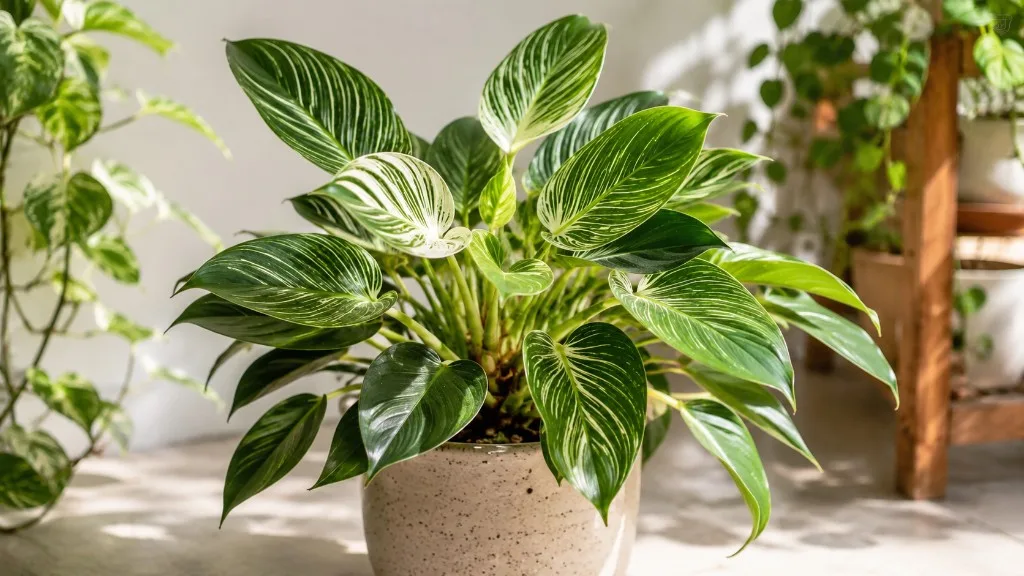
Walk into a houseplant shop and you will see Philodendron Birkin on a desk display or a bright shelf, its glossy dark-green leaves traced with creamy white pinstripes like someone drew fine lines with a brush. What the tag rarely explains is that Birkin is not a trailing vine, its variegation is genetically unstable, and the stripes you paid for can disappear if the plant reverts to its parent form. This guide covers the full indoor care routine - light, water, soil, humidity, feeding, Philodendron Birkin repotting guide, propagation - and spends real time on the two topics that confuse Birkin owners most: keeping pinstripes crisp and managing reversion.
The goal is straightforward. By the end you should know what Birkin actually is botanically, how to place it for strong variegation without scorching pale tissue, how to water a self-heading aroid without rotting the roots, what to do when stripes fade or leaves come in solid green, and exactly why Philodendron Birkin overview belongs on a tabletop, not wrapped around a moss pole.
What Philodendron Birkin Actually Is (Self-Heading, Not a Climber)
Philodendron ‘Birkin’ is a cultivated houseplant in the Araceae (arum) family, the same family as monsteras, peace lilies, and pothos. The North Carolina Extension Gardener Plant Toolbox describes it as an evergreen, herbaceous perennial with a dense, erect, self-heading growth habit - meaning new leaves emerge from a central crown at the base rather than from a lengthening vine that needs support. Mature size indoors runs from about 6 inches to 3 feet tall and equally as wide, with thick upright stems and slow, compact growth. That size profile makes Birkin a tabletop specimen, not a ceiling-hung trailer.
The plant’s origin is debated in trade literature, but North Carolina Extension notes it is believed to be either a spontaneous chimeric mutation of Philodendron ‘Rojo Congo’ or a hybrid of Philodendron ‘Congo’ and Philodendron ‘Imperial Green’ cultivars. For care purposes, the practical takeaway is the same: Birkin behaves like a compact self-heading philodendron, not a wild species with documented rainforest ecology.
Leaves are thick, glossy, cordate (heart-shaped), and alternate along the upright stem. Each leaf carries a unique pinstripe pattern in creamy white, pale yellow, or light green against a dark green background, and the Extension entry notes that pinstripes become more pronounced as leaves mature. Birkin can produce typical aroid flowers - a spadix surrounded by a greenish-white spathe - but like most foliage houseplants, it rarely blooms indoors. The visual appeal is entirely in the leaves.
One distinction worth making early: Birkin is not a climber. It will not send out long internodes searching for a tree trunk. It will not attach to a moss pole and produce dramatically larger leaves the way a Monstera deliciosa or a heartleaf philodendron might. Treating it like a vine leads to frustration and unnecessary hardware. The care checkpoint for Birkin is stability - consistent Philodendron Birkin light guide, a potting mix that drains fast, and a Philodendron Birkin watering guide matched to how the mix actually dries in your room.
The White Pinstripe Variegation and Its Unstable Genetics
The pinstripes are the entire reason Birkin exists in the houseplant market, and they are also the most misunderstood feature. The variegation is chimeric, which means the plant contains two genetically distinct cell populations in the same tissue. In Birkin, certain cells in the outer layers of the growing tip produce chloroplasts in a striped pattern, creating white or cream sectors against green tissue. The mutation is believed to exist primarily in the L1 and L2 meristematic layers of the shoot apical meristem, while deeper L3 layer cells retain the original Rojo Congo genetics - solid burgundy-red to dark green foliage with no striping capacity.
That layered anatomy is why reversion is possible even in a well-cared-for plant. During normal cell division at the growing tip, the variegated outer layers can be displaced, damaged, or outcompeted by the faster-growing inner cells. When new growth emerges from the L3 layer, the resulting leaves look like Rojo Congo - solid green or reddish-green with no pinstripes. This is not a care failure in every case; it is an inherent property of chimeric mutations. Tissue culture stabilizes the look for commercial production, but it does not erase the underlying genetic instability.
How New Leaves Develop Their Stripes
New Birkin leaves often emerge lighter - creamy white, pale yellow, or washed-out green - and develop their final color and stripe pattern as they harden off. That progression is normal and is one reason owners panic at the wrong moment. A pale new leaf is not automatically reverting; it may simply be immature. Watch the second and third leaves after a pale one. If striping returns and strengthens, the plant is expressing normal chimeric variation. If successive leaves arrive progressively greener with shorter internodes still compact but pattern absent, you are likely seeing true reversion.
Light intensity strongly influences how crisp the stripes look. Inadequate light pushes the plant to produce more chlorophyll, which shows up as greener leaves with faint or absent pinstripes. Excessive direct sun can push the opposite extreme - highly pale or nearly white leaves that cannot photosynthesize efficiently and may brown or die. The workable band is bright, filtered indirect light strong enough to support variegation without blasting the pale tissue. Rotate the pot a quarter turn weekly so both sides of the crown receive similar light and growth stays symmetrical.
Birkin vs Philodendron Brasil and Other Lookalikes
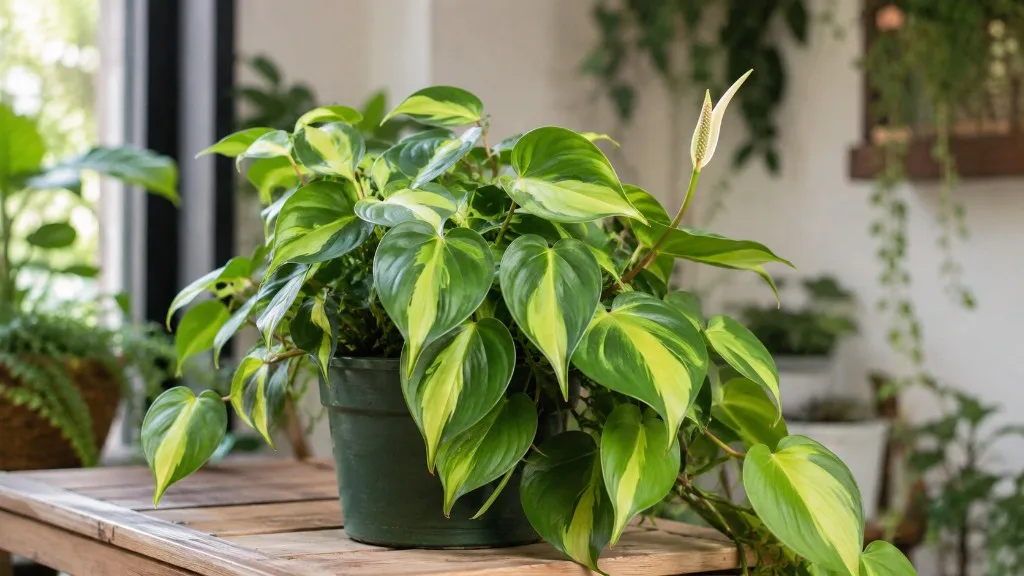
Buyers sometimes confuse Birkin with other philodendrons because the genus is enormous and many cultivars share heart-shaped leaves. Philodendron hederaceum ‘Brasil’ is the most common mix-up. Brasil is a fast trailing or climbing vine with lime-green and dark-green variegation in broad patches, not fine pinstripes. It wants support or regular pruning to manage length. Birkin is a compact upright rosette with white line variegation and no meaningful vining habit. The care overlap - bright indirect light, aroid mix, moderate watering - is real, but the design use is completely different: Birkin is a stationary specimen; Brasil is a moving vine.
Other philodendrons occasionally sold near Birkin include Rojo Congo itself (solid dark leaves, reddish petioles), Imperial Green (solid green self-header), and various cream-splashed hybrids. If your plant’s new growth is coming in solid burgundy-red with dark petioles and no striping at all, you may have a Rojo Congo reversion rather than a Birkin expression. That is not a disaster - Rojo Congo is a fine plant - but it is not what the Birkin label promised.
Light for Crisp Pinstripes Without Scorch
Light is the single most important environmental factor for Birkin because it controls both growth structure and variegation expression. The North Carolina Extension Gardener Plant Toolbox recommends bright, filtered sunlight and warns that too much sun scorches leaves, while insufficient light causes loss of variegation, leggy growth, and small leaves. That aligns with what Birkin owners see in practice: a plant on a dark bookshelf slowly turns green; a plant in direct western afternoon sun develops brown crispy patches on the pale stripes.
Indoors, aim for the kind of light you would get within 3 to 6 feet of an east-facing window, or behind a sheer curtain at a south- or west-facing window. Birkin tolerates medium indirect light if variegation is already strong, but it will not maintain crisp pinstripes in a dim hallway or a north room far from the glass. If you are unsure whether a spot is bright enough, watch new leaves over four to six weeks: compact internodes, firm glossy leaves, and visible striping on fresh growth mean the light is working. Longer gaps between leaves, smaller blade size, and progressive greening mean the plant wants more light.
Direct sun is the other failure mode. Pale variegated tissue has less chlorophyll and less capacity to dissipate intense radiation. Morning sun for an hour or two through glass is often tolerable on an acclimated plant, but midday and afternoon direct beams frequently cause bleached patches that turn brown and papery. If you see sun-facing damage, move the plant back or add a filter curtain before trimming leaves. Acclimate gradually when increasing light - a plant grown in a nursery shade house can scorch if moved straight to a bright south window.
Window Placement and Grow Lights
East windows are the easiest win for Birkin in most homes: strong morning light, softer afternoon. North windows can work if the plant sits close to the glass and the room is not heavily shaded outside. South and west windows need diffusion - sheer curtains, frosted film, or a few feet of setback from the pane. Birkin does not need to touch the glass; it needs consistent ambient brightness at the leaf surface.
If natural light is weak, a full-spectrum LED grow light placed 12 to 18 inches above the canopy for 10 to 14 hours daily can maintain variegation through winter. Choose a light rated for houseplants rather than seed-starting-only units that skew too blue or too dim. Watch leaf temperature - if the canopy feels warm to the touch, the fixture is too close. Grow lights are especially useful in offices and apartments where the only window is obstructed or faces a light well.
Watering: Let the Top Mix Dry Without Going Bone Dry
Birkin is often marketed as an easy philodendron, and that is mostly true - until watering goes wrong. The plant is not impervious to overwatering on Philodendron Birkin. Soggy mix leads to mushy stems, yellow leaves, and root rot on Philodendron Birkin, which is the fastest way to lose a Birkin and trigger stress-induced reversion. The safer approach is to water when the top 3 to 5 cm (roughly 1 to 2 inches) of potting mix has dried, then soak thoroughly until water runs from the drainage holes. In active growth, that often works out to every 7 to 10 days; in cooler, dimmer winter months, every 10 to 14 days is a common rhythm. Treat those intervals as starting points, not commandments.
The reason calendar watering fails is that pot size, soil structure, light, humidity, and season all change evaporation rate. A Birkin under a grow light in a small terracotta pot dries faster than a Birkin in a large plastic pot on a cold windowsill. The reliable method is to check the mix before every watering rather than watering on Tuesday because you watered last Tuesday. Lift the pot when you can - a dry pot is noticeably lighter than a wet one - and use a finger or wooden chopstick to feel moisture below the surface.
When you water, water fully. A shallow sip every day keeps the surface damp while the center stays unpredictably wet or dry. Birkin roots want a full wet-dry cycle: thorough saturation, then oxygen-rich mix as the water drains and air refills the pore spaces. Always empty the saucer within 30 minutes so the pot is not sitting in runoff. If the mix smells sour, stays wet for a week after a modest drink, or fungus gnats appear in clouds, assume drainage or frequency is off before blaming the plant.
Reading Soil Moisture by Touch
Insert your index finger to the second knuckle. If the soil at that depth feels cool and slightly damp, wait. If it feels dry and the pot is light, water. For deeper pots, a moisture meter or a chopstick left inserted for ten minutes helps - if the stick comes out with mix clinging and darkened, there is still moisture below. Birkin prefers moist, well-drained conditions per North Carolina Extension, which sounds contradictory until you understand it means even moisture in an airy mix, not wet feet in a dense peaty block.
In winter, lean drier. Growth slows, transpiration drops, and a wet pot in a cold room is a root-rot setup. Do not stop watering entirely - roots still need periodic hydration - but stretch the interval and verify with touch every time. Resume your summer rhythm when new leaves are clearly emerging in spring.
Humidity and Temperature Indoors
Philodendron Birkin is a tropical cultivar derived from hybrids bred for warm, humid greenhouse conditions. Indoors, it is less demanding than velvet-leaf philodendrons or many calatheas, but it still performs best with moderate humidity around 50 to 60 percent and stable temperatures between 18 and 26°C (65 to 79°F). North Carolina Extension cites a slightly wider range of 65 to 85°F (18 to 29°C) and the same 50 to 60 percent humidity target. Most heated homes sit in that temperature band already; the harder variable is dry winter air.
Below about 40 percent humidity, you may see brown leaf tips and margins, especially on newer variegated tissue that desiccates faster than solid green leaves. A pebble tray (pot sitting above water, not in it), grouping plants, or a small humidifier are the reliable fixes. Misting is a poor substitute - the humidity bump lasts minutes, and wet foliage in weak airflow can invite fungal spotting. If you mist to clean leaves, do it in the morning so surfaces dry before night.
Temperature swings matter as much as averages. Cold drafts from winter windows, air-conditioning vents pointed at the pot, and sudden drops below about 10°C (50°F) stall growth and can damage leaves. Birkin is not frost-tolerant and is grown as a houseplant outside only in USDA zones 10a through 12b per North Carolina Extension. In temperate climates, keep it indoors year-round or move it to a sheltered patio only in warm summer months.
Soil, Pot Choice, and Drainage
As an aroid, Birkin wants a well-draining, airy potting mix that holds some moisture without collapsing into a waterlogged brick. A practical recipe that matches LeafyPixels plant-care data: standard indoor potting mix plus 20 to 25 percent perlite and 10 percent orchid bark, targeting pH 5.5 to 7.0. The perlite and bark increase pore space so roots get oxygen after watering. North Carolina Extension lists loam and sand textures with good drainage, slightly acidic to neutral pH, which aligns with commercial aroid blends sold as “monstera mix” or “philodendron mix.”
The exact brand matters less than the behavior. When you water, water should penetrate quickly and exit the drainage holes within seconds, not pool on the surface. If water runs straight down the sides of a shrunken root ball and out the bottom without wetting the center, the mix has dried too much or the plant is root-bound - a different problem, but one that mimics drought stress.
For pots, drainage holes are non-negotiable. Terracotta dries faster and forgives slight overwatering; plastic retains moisture longer and suits growers who tend to underwater. Birkin does not need a deep pot - its roots are relatively compact for a self-header - but it does need width stability so the upright crown does not topple. Go up only one pot size at repotting. An oversized pot holds excess mix that stays wet beyond what the root system can use, which is the most common post-repot root-rot trigger.
Fertilizer Schedule and When to Hold Back
Birkin is not a heavy feeder. Light, balanced fertilization during active growth supports glossier leaves and steadier new pinstripes without the burn risk of full-strength doses. A workable schedule: every 4 to 6 weeks from spring through early fall, using a balanced liquid houseplant fertilizer diluted to half the label strength, applied to already-moist soil. North Carolina Extension and general houseplant guidance align on the principle: feed when the plant is growing, not when it is stressed or dormant.
Two rules prevent most fertilizer damage. Never feed dry soil - water first, then fertilize - so salts move through the root zone without concentrating and burning roots. Pause feeding after repotting, during winter slowdown, while recovering from root rot or pest treatment, and any time new growth has stopped. Unused salts accumulate and show up as crispy leaf tips and a white crust on the mix surface. If you see that, flush the pot with plain water until runoff is clear and skip the next feeding.
Fertilizer will not force variegation back on a reverting plant. Striping is a genetic expression problem, not a nutrient deficiency - though genuinely nitrogen-starved plants may grow pale and weak overall. If stripes are fading, fix light and prune reverted stems before reaching for the bottle.
Repotting a Compact Self-Heading Philodendron
Repot Birkin roughly every 1 to 2 years, or when you see roots circling the drainage holes, water running straight through without soaking in, or a top-heavy plant wobbling in its pot. The best timing is early active growth in spring, when the plant has a full warm season to re-establish. Avoid repotting on day one after purchase unless the mix is clearly failing or pests are visible - quarantine and observation come first.
Choose a pot one size larger with drainage holes. Gently remove the root ball, tease apart only lightly circling roots, and replant at the same depth as before. Use fresh aroid-style mix; do not reuse sour or compacted old soil. Water lightly after repotting and keep the plant in bright indirect light without direct sun for the first week while torn roots heal. Hold fertilizer for four to six weeks.
Because Birkin is self-heading, repotting is usually straightforward - no moss pole to work around, no long vines to coil. The main mistake is jumping two pot sizes to “give it room,” which gives excess wet mix instead.
Propagation by Stem Cuttings
The North Carolina Extension Gardener Plant Toolbox lists stem cuttings as the recommended propagation strategy for Philodendron ‘Birkin’. The method is standard aroid practice: take a cutting that includes at least one node (the knuckle where a leaf meets the stem and roots can form), optionally with a leaf attached, and root it in water, moist sphagnum moss, or a well-draining perlite-heavy mix. Roots typically form in 4 to 6 weeks in warm, bright conditions.
Use a clean, sharp blade and cut below the node. If rooting in water, change the water every few days and move to mix once roots are 2 to 3 cm long so they do not become too fragile for soil transition. Keep humidity moderate and light bright but indirect. Variegation in the cutting is not guaranteed to match the parent - chimeric tissue may not divide evenly in the new plant, which is another expression of the same instability that causes reversion.
Do not propagate a stressed, rotting, or pest-infested parent. Cuttings inherit the parent’s problems and fail at higher rates when taken from weak tissue. Stabilize the mother plant first, then propagate from the healthiest upright stem.
Variegation Reversion and How to Manage It
Reversion is the elephant in the Birkin care room. Because the pinstripes depend on unstable chimeric tissue, any Birkin can produce non-variegated leaves, even with excellent care. Low light accelerates greening because the plant prioritizes chlorophyll production. Overwatering, root damage, cold stress, and physical damage to the growing tip can also shift which cell layer dominates new growth. Sometimes reversion appears random - a single solid-green leaf after months of perfect striping - because cell division at the meristem is not fully predictable.
Learn to distinguish normal leaf-to-leaf variation from reversion. Normal variation: stripes differ in width and cream tone leaf by leaf, but each new leaf still shows some striping. Reversion: two or more consecutive leaves emerge solid green or reddish-green like Rojo Congo, often with reddish-brown petioles and a subtly different leaf texture. Once the growing tip switches to the non-variegated cell line, subsequent leaves from that stem will stay solid unless the meristem randomly re-expresses the mutation - which is not something you can count on.
Pruning Reverted Growth Before It Spreads
When you identify a reverted stem, prune it back to the last node that produced clearly striped foliage. Use sterile pruners and cut just above a node so the plant can branch or resume growth from variegated tissue. If the entire plant has reverted, pruning may leave little above soil level; in that case you are deciding whether to grow it as Rojo Congo, replace the plant, or try a stem cutting from any remaining variegated section. There is no guarantee pruning restores pinstripes, but allowing reverted tissue to dominate increases the odds the meristem permanently shifts to the solid form.
Prevention is partial, not absolute. Maintain bright indirect light, stable watering, prompt removal of reverted shoots, and avoid nicking the central crown during cleaning or repotting. Even then, chimeric plants carry lifelong reversion risk. Manage expectations accordingly - Birkin is a beautiful but genetically temperamental cultivar.
Toxicity to Pets and People
Philodendron Birkin is toxic to cats and dogs per the ASPCA philodendron listing, which covers the genus broadly. The toxic principle is calcium oxalate crystals in the leaves, stems, roots, and sap. Ingestion causes oral pain, swelling of the mouth and tongue, excessive drooling, vomiting, and difficulty swallowing. Contact with sap can irritate skin in sensitive people. North Carolina Extension rates poison severity as low for humans but still lists problems for cats, dogs, children, and contact dermatitis.
Practical placement matters more than panic. Birkin is a display plant, not a floor plant in a home with chewing pets or toddlers. Elevate it on a desk, shelf, or credenza out of reach. If you suspect ingestion, contact ASPCA Animal Poison Control at 888-426-4435 (US) and your veterinarian promptly. Do not induce vomiting unless a professional directs you to.
For humans, wash hands after handling if you are pruning or repotting, especially before touching your face or food. Gloves are reasonable if sap contact bothers your skin. The risk is real but manageable with basic placement discipline.
Common Birkin Problems and Practical Fixes
Most Birkin problems are environmental and show up as a small set of leaf symptoms. The diagnostic order is the same every time: check soil moisture, then light, then inspect for pests, then review recent changes (repot, move, heating season). Fix the condition first; prune cosmetic damage after the plant stabilizes.
Yellow leaves usually mean overwatering, root stress, or natural aging of lower leaves. If yellowing spreads up the plant on soft stems with wet mix, unpot and inspect roots - trim black mushy tissue, repot in fresh mix, and reduce watering frequency. If only the oldest bottom leaf yellows while new growth is healthy, it may be normal senescence. Uniform yellowing on a dry pot suggests underwatering on Philodendron Birkin or extreme light stress.
Brown tips and crispy edges point to low humidity, inconsistent watering, salt buildup, or hot dry airflow from a vent. Raise humidity toward 50 to 60 percent, water on a check-not-calendar rhythm, and flush the pot periodically with plain water. Trim brown tips with sterile scissors if they bother you cosmetically.
Fading variegation without full reversion often means insufficient light. Move to a brighter filtered position and watch the next three leaves. If stripes return, light was the issue. If leaves keep arriving solid green, treat it as reversion and prune.
Leggy or small new leaves mean the plant is reaching for light even if the room looks bright to human eyes. Shorten the distance to the window or add a grow light; do not compensate with extra water.
Pests - spider mites in dry air, mealybugs in leaf axils, scale on stems, aphids on new growth - respond best to early intervention. Isolate the plant, shower the foliage, hand-wipe visible pests, and follow with insecticidal soap weekly for two to three cycles. Quarantine until you see clean new growth.
Root rot presents as wilting on wet soil, black mushy roots, and a sour smell. Act fast: unpot, cut away rot, repot in fresh airy mix, withhold water briefly, then resume careful watering. Severe rot may not be recoverable; prevention through drainage and check-before-water habits is far easier.
Why You Do Not Need a Moss Pole
This section exists because search volume and forum questions prove people try to moss-pole their Birkin anyway. Do not bother. Birkin is self-heading with thick upright stems that support themselves. It does not produce adventitious roots along a vine seeking vertical structure, and it will not reward a moss pole with dramatically larger leaves the way a climbing Monstera or a heartleaf philodendron might.
What Birkin needs instead is even light on the crown (rotate the pot), stable root moisture, and space for leaves to open without brushing walls or shelves. A moss pole takes up pot space, holds moisture against the stem base, and signals a care model that does not match the plant’s architecture. Save the pole for actual climbers; give Birkin a sturdy ceramic pot on a well-lit tabletop.
Conclusion
Philodendron Birkin is a compact, self-heading aroid prized for glossy dark-green leaves with creamy white pinstripes, bred from a chimeric mutation believed to originate from Philodendron Rojo Congo and propagated commercially by tissue culture. The care that keeps it healthy is straightforward: bright filtered indirect light, water when the top 3 to 5 cm of mix dries, 50 to 60 percent humidity, temperatures around 18 to 26°C, a well-draining aroid mix with perlite and bark, and light feeding during active growth. The care that keeps it Birkin-looking adds one more layer: protect variegated tissue from direct sun, watch for reversion, and prune solid-green shoots promptly.
It is toxic to pets, not a climber, and genetically prone to losing its stripes even under good care. If you want a low-drama philodendron for a dim corner or a pet-safe floor pot, choose something else. If you want a striking tabletop plant and you are willing to manage light and reversion, Birkin earns its place. Treat the stripes as a living pattern, not a permanent paint job, and the plant becomes much less stressful to grow.
When to use this page vs other Philodendron Birkin guides
- Philodendron Birkin overview - Canonical hub for this species - care topics and problems branch from here.
- Philodendron Birkin problems - Symptom-first path when you already know something is wrong.
Related Philodendron Birkin guides
- Philodendron Birkin watering
- Philodendron Birkin light
- Philodendron Birkin soil
- Philodendron Birkin propagation
- Philodendron Birkin fertilizer
- Philodendron Birkin repotting
- Philodendron Birkin pruning
- Ants on Plant on Philodendron Birkin
- Cold Damage on Philodendron Birkin
- Brown Tips on Philodendron Birkin
- Damaged Roots on Philodendron Birkin
- Calcium Deficiency on Philodendron Birkin
How to care for Philodendron Birkin?
How much light does Philodendron Birkin need?
bright indirect light, medium indirect light
- bright indirect light, medium indirect light - bright indirect light, medium indirect light.
When should you water Philodendron Birkin?
Every 7–10 days - allow top 3–5 cm to dry. Every 10–14 days in winter. Well-draining soil is essential.
- Check top 2 inches - Every 7–10 days - allow top 3–5 cm to dry.
- Drain excess water - Well-draining soil is essential.
What soil works best for Philodendron Birkin?
Standard potting mix + 20–25 % perlite + 10 % orchid bark. Well-draining. pH 5.5–7.0.
- Well-draining mix - Well-draining.
Grower notes for Philodendron Birkin
Birkin growth-pattern note
Philodendron Birkin is a compact self-heading plant with white pinstripe variegation, not a trailing vine like Brasil. Its appeal depends on short internodes and clean striped new leaves. If it is too dark, the plant can stretch and the striping may become less crisp; if it is too bright, pale streaks can brown. Keep it upright, rotate it, and do not expect a moss pole to turn it into a large climbing philodendron.
How Birkin differs from Brasil
Birkin is a tabletop rosette with fine white markings, while Brasil is a fast trailing or climbing vine with lime and green heart-shaped leaves. Birkin needs stability and an evenly lit display position. Brasil needs pruning or support because the stems will run. The care overlap is real, but the design use is completely different: Birkin is a compact specimen, Brasil is a moving vine.
What matters most with Philodendron Birkin
Philodendron Birkin is easiest to understand by its growth habit. Climbers need support for larger leaves, self-heading types need stable root moisture, and delicate velvet forms punish stale air faster than basic green philodendrons. In practice, the care checkpoint is simple: bright indirect light, medium indirect light. Pair that with standard potting mix + 20–25 % perlite + 10 % orchid bark. Well-draining; pH 5.5–7.0, and avoid changing water, pot size, and placement all at once.
Best placement in a real home
Philodendron Birkin belongs where bright indirect light, medium indirect light is realistic for most of the day, not only where the pot looks good. Every 7–10 days - allow top 3–5 cm to dry. Every 10–14 days in winter. Well-draining soil is essential. If the pot stays wet longer than expected, move the plant into better light or reassess the mix before watering again. Humidity target: 50–60%. Temperature comfort zone: 18–26°C (65–79°F).
Before you buy this plant
Choose Philodendron Birkin with firm new growth, clean leaf undersides, and soil that does not smell sour or feel compacted. Be cautious if you see yellow-leaves, sticky residue, collapsed crowns, or a pot that is wet in poor light. Cosmetic old-leaf damage is less worrying than weak roots or active pests.
First month after bringing it home
Do not repot Philodendron Birkin on day one unless the mix is failing or pests are obvious. Quarantine it, learn how fast the pot dries, and keep care boring while it adjusts. Watch especially for yellow-leaves, brown-tips, and root-rot. If problems appear, correct the condition first rather than stacking fertilizer, repotting, and pruning together.
Safety note for Philodendron Birkin
Philodendron Birkin is not a plant to keep within reach of pets or children. Treat it as an inaccessible display plant. Use gloves if sap or plant tissue is irritating, and pick a pet-safe alternative for floor pots or low shelves.
How to tell Philodendron Birkin is settling in
If you plan to multiply it later, common methods include Stem cuttings. If brown-tips shows up early, inspect light, watering, and roots before assuming the plant is permanently weak.
Is it pet safe?
Philodendron Birkin is toxic to cats and dogs.
Contains calcium oxalate crystals; causes oral pain, drooling, and GI upset if ingested.
Watering Philodendron Birkin
Every 7–10 days - allow top 3–5 cm to dry. Every 10–14 days in winter. Well-draining soil is essential.
Soil & potting for Philodendron Birkin
Standard potting mix + 20–25 % perlite + 10 % orchid bark. Well-draining. pH 5.5–7.0.
Humidity & temperature for Philodendron Birkin
Philodendron Birkin prefers 50–60%, though normal home humidity is usually fine. Keep temperatures around 18–26°C (65–79°F).
| Detail | Information |
|---|---|
| Humidity | 50–60% - normal home humidity is fine. |
| Ideal temperature | 18–26°C (65–79°F) |
Fertilizer & pruning for Philodendron Birkin
Use feed lightly during active growth. Diluted balanced liquid fertilizer at half strength and stop if the plant is stressed, newly repotted, or not actively growing. for Philodendron Birkin.
| Detail | Information |
|---|---|
| Fertilizer type | Feed lightly during active growth. Diluted balanced liquid fertilizer at half strength and stop if the plant is stressed, newly repotted, or not actively growing. |
Common problems on Philodendron Birkin
Likely cause: Jul 16, 2023 · By following these steps, you can effectively get rid of ants on your Philodendron Birkin plant and prevent further infestations. Remember to be persistent and consistent in your efforts, as it may take some time to completel
Quick fix: Confirm diagnosis on your Philodendron Birkin, then address the most likely care or pest factor described in current extension guidance.
Full fix guide →Cold Damage
MediumLikely cause: May 31, 2024 · In this article, we'll navigate the signs of cold damage in your Philodendron Birkin and discuss practical steps to nurse it back to health. We'll also explore ways to prevent future cold damage and keep your plant thriving,
Quick fix: Confirm diagnosis on your Philodendron Birkin, then address the most likely care or pest factor described in current extension guidance.
Full fix guide →Brown Tips
MediumLikely cause: Low humidity or fluoride in water
Quick fix: Increase humidity to 55%+; use filtered water
Full fix guide →Damaged Roots
MediumLikely cause: Aug 8, 2025 · Shake or rinse away old soil to expose the root system for inspection. Use clean, sharp pruning shears to trim away all affected roots . Healthy roots are typically firm and white or light tan, while diseased roots are dark, m
Quick fix: Confirm diagnosis on your Philodendron Birkin, then address the most likely care or pest factor described in current extension guidance.
Full fix guide →Calcium Deficiency
MediumLikely cause: The Philodendron ‘Birkin’ has leaves that contain calcium oxalate crystals that are toxic to pets and humans if swallowed. Some side effects from these toxins can cause rashes, pain, inflammation, drooling, and loss of speech.
Quick fix: Confirm diagnosis on your Philodendron Birkin, then address the most likely care or pest factor described in current extension guidance.
Full fix guide →Downy Mildew
MediumLikely cause: There can be various reasons behind fungus growth on your philodendron . The main problem is that your philodendron is exposed to unfavorable conditions. But there can be other reasons also. Let’s look at some common reasons behind fungus i
Quick fix: Confirm diagnosis on your Philodendron Birkin, then address the most likely care or pest factor described in current extension guidance.
Full fix guide →Fertilizer Burn
MediumLikely cause: Aug 14, 2024 · Come winter, or the plant's dormant phase, the Philodendron ' Birkin ' does not need as much fertilizing . During these months, it's crucial to reduce feeding to avoid nutrient overload, which can lead to fertilizer burn or s
Quick fix: Confirm diagnosis on your Philodendron Birkin, then address the most likely care or pest factor described in current extension guidance.
Full fix guide →High Humidity
MediumLikely cause: Jan 21, 2024 · Ideally, the Philodendron Birkin prefers humidity levels between 60% and 70% . This range closely mimics their natural environment and helps them thrive indoors. That said, these plants can tolerate lower humidity levels, dow
Quick fix: Confirm diagnosis on your Philodendron Birkin, then address the most likely care or pest factor described in current extension guidance.
Full fix guide →Heat Stress
MediumLikely cause: Oct 10, 2023 · In this article, we'll explore the heat tolerance of Philodendron Birkin , looking at the ideal temperature range for these plants, the signs of heat stress , and how to protect your plant during sweltering days.
Quick fix: Confirm diagnosis on your Philodendron Birkin, then address the most likely care or pest factor described in current extension guidance.
Full fix guide →Leggy Growth
LowLikely cause: Insufficient light
Quick fix: Move to brighter indirect light
Full fix guide →Leaf Miners
MediumLikely cause: Feb 21, 2024 · Philodendron Types with Pictures and Care Guide The green heartleaf Philodendron is a vining type of plant with dark-green leaves in a heart’s shape. This type of Philodendron can be …
Quick fix: Confirm diagnosis on your Philodendron Birkin, then address the most likely care or pest factor described in current extension guidance.
Full fix guide →Leaf Drop
MediumLikely cause: Feb 21, 2024 · Philodendron Types with Pictures and Care Guide The green heartleaf Philodendron is a vining type of plant with dark-green leaves in a heart’s shape. This type of Philodendron can be grown …
Quick fix: Confirm diagnosis on your Philodendron Birkin, then address the most likely care or pest factor described in current extension guidance.
Full fix guide →Low Humidity
LowLikely cause: Mar 15, 2026 · Most apartment dwellers struggle with the Philodendron Birkin because modern HVAC systems strip air of its moisture, often dropping humidity below 30% . When the ambient humidity falls this low, the plant’s transpiration rate
Quick fix: Confirm diagnosis on your Philodendron Birkin, then address the most likely care or pest factor described in current extension guidance.
Full fix guide →Not Enough Light
MediumLikely cause: Dec 28, 2025 · Understanding philodendron birkin light requirements is key to keeping those stunning white-striped leaves vibrant and healthy. This guide will walk you through everything you need to know about providing the optimal indoor l
Quick fix: Confirm diagnosis on your Philodendron Birkin, then address the most likely care or pest factor described in current extension guidance.
Full fix guide →Mealybugs
MediumLikely cause: Jul 26, 2023 · Dealing with mealybugs on your Philodendron Birkin plant can be frustrating, but with the right approach, you can successfully eliminate these pests and prevent future infestations.
Quick fix: Confirm diagnosis on your Philodendron Birkin, then address the most likely care or pest factor described in current extension guidance.
Full fix guide →Overwatering
HighLikely cause: Aug 23, 2025 · We’ll cover exactly how to spot the signs of overwatering , dive into an emergency step-by-step rescue plan to save your plant, and then set you up with the best practices to make sure your Birkin thrives for years to come.
Quick fix: Confirm diagnosis on your Philodendron Birkin, then address the most likely care or pest factor described in current extension guidance.
Full fix guide →Pale Leaves
MediumLikely cause: Sep 16, 2025 · It stands out because of the unique creamy white or yellow streaks on the green leaves . It has a thick, upright, self-supporting stem, promoting a more tree-like appearance. Slow-growing and compact, it's a great plant for s
Quick fix: Follow extension or botanical guidance for Philodendron Birkin pale leaves; adjust care before applying broad treatments.
Full fix guide →Nutrient Lockout
MediumLikely cause: Aug 17, 2022 · Before we jump into specific fertilizers, it's crucial to understand the nutritional needs of a Philodendron Birkin . Like many houseplants, it thrives on a balance of macronutrients : nitrogen (N), phosphorus (P), and potass
Quick fix: Confirm diagnosis on your Philodendron Birkin, then address the most likely care or pest factor described in current extension guidance.
Full fix guide →Poor Potting Setup
MediumLikely cause: Sep 16, 2025 · Here are the main care requirements for growing a philodendron birkin : Place it in a location with bright, indirect light. Use a potting mix for aroids or make your own. Water only when the top layer of soil has dried out. K
Quick fix: Follow extension or botanical guidance for Philodendron Birkin poor potting setup; adjust care before applying broad treatments.
Full fix guide →Pot Too Small
MediumLikely cause: May 2, 2023 · A pot that's too small can restrict root growth, leading to a lack of nutrients and water. On the other hand, a pot that's too large might retain too much moisture, putting your plant at risk of root rot.
Quick fix: Confirm diagnosis on your Philodendron Birkin, then address the most likely care or pest factor described in current extension guidance.
Full fix guide →Purple Leaves
MediumLikely cause: Sep 16, 2025 · What Does a Mature Philodendron Birkin Look Like? A mature philodendron birkin has likely grown taller (up to 3 feet tall) with leaves branching off the main stem in alternating directions, and less dense growth. Some leaves
Quick fix: Follow extension or botanical guidance for Philodendron Birkin purple leaves; adjust care before applying broad treatments.
Full fix guide →Plant Leaning
MediumLikely cause: Philodendron is a large genus of flowering plants in the family Araceae. As of September 2025, the Plants of the World Online accepted 625 species; [2] other sources accept different numbers. [3][4] …
Quick fix: Confirm diagnosis on your Philodendron Birkin, then address the most likely care or pest factor described in current extension guidance.
Full fix guide →Red Leaves
MediumLikely cause: Sep 16, 2025 · What Does a Mature Philodendron Birkin Look Like? A mature philodendron birkin has likely grown taller (up to 3 feet tall) with leaves branching off the main stem in alternating directions, and less dense growth. Some leaves
Quick fix: Follow extension or botanical guidance for Philodendron Birkin red leaves; adjust care before applying broad treatments.
Full fix guide →Repotting Stress
MediumLikely cause: Apr 1, 2025 · The best time to repot philodendron birkin is in early spring or fall when the weather is mild, reducing stress on the roots and giving the repotted philodendron birkin the best chance to get established.
Quick fix: Confirm diagnosis on your Philodendron Birkin, then address the most likely care or pest factor described in current extension guidance.
Full fix guide →Salt Build-up
MediumLikely cause: Sep 29, 2023 · This method allows water to thoroughly permeate the soil and reach its root system. As a bonus, this good soak also flushes out salt build - ups that might harm your plant over time.
Quick fix: Confirm diagnosis on your Philodendron Birkin, then address the most likely care or pest factor described in current extension guidance.
Full fix guide →Root Rot
MediumLikely cause: Persistently wet soil
Quick fix: Repot in fresh draining mix
Full fix guide →Potassium Deficiency
MediumLikely cause: Jan 21, 2024 · Philodendron Birkin , like most houseplants, requires a balance of nutrients to grow and maintain its stunning leaves. The primary nutrients-often referred to as macronutrients-are nitrogen (N), phosphorus (P), and potassium
Quick fix: Confirm diagnosis on your Philodendron Birkin, then address the most likely care or pest factor described in current extension guidance.
Full fix guide →Seedlings Falling Over
MediumLikely cause: Jul 21, 2023 · If you find your Philodendron Birkin leaning or toppling over , don’t panic! In this article, we will explore the possible reasons behind this issue and provide practical solutions to help your precious plant regain its uprig
Quick fix: Confirm diagnosis on your Philodendron Birkin, then address the most likely care or pest factor described in current extension guidance.
Full fix guide →Rust Disease
MediumLikely cause: Jul 7, 2024 · In this article, we’ll chat about what rust fungus is, how it affects your Philodendron Birkin, and, most importantly, what you can do about it. From prevention to treatment, we’ve got you covered to ensure your plant stays he
Quick fix: Confirm diagnosis on your Philodendron Birkin, then address the most likely care or pest factor described in current extension guidance.
Full fix guide →Scale Insects
MediumLikely cause: Mar 18, 2024 · Scale : Scale insects appear as small, immobile bumps on stems and leaves. They can be tough to spot at first. Now that you know what to look out for, it's time to dive into how to treat these common pests. If you've ever not
Quick fix: Confirm diagnosis on your Philodendron Birkin, then address the most likely care or pest factor described in current extension guidance.
Full fix guide →Seeds Not Germinating
MediumLikely cause: Jul 4, 2023 · By following these guidelines, you can successfully store, sow, and germinate Philodendron Birkin plant seeds . Remember that growing plants from seeds requires patience and care, but the reward of watching your own Philodendr
Quick fix: Confirm diagnosis on your Philodendron Birkin, then address the most likely care or pest factor described in current extension guidance.
Full fix guide →Slugs and Snails
MediumLikely cause: Jul 14, 2023 · If you notice snails on your Philodendron Birkin plant, it’s important to take immediate action to get rid of them. In this article, we will discuss some effective methods to eliminate snails from your beloved plant.
Quick fix: Confirm diagnosis on your Philodendron Birkin, then address the most likely care or pest factor described in current extension guidance.
Full fix guide →Sticky Leaves
MediumLikely cause: Clusters of tiny yellow specks on new leaves are one of the most common Philodendron Birkin problems, often signaling a pest infestation – typically from spider mites or thrips. These pests pierce the leaf surface and suck out its juices, l
Quick fix: Confirm diagnosis on your Philodendron Birkin, then address the most likely care or pest factor described in current extension guidance.
Full fix guide →Spider Mites
MediumLikely cause: Jan 20, 2025 · In this post, we'll walk through everything you need to know about identifying and treating spider mites on your Philodendron Birkin . From understanding what spider mites are and how they operate, to practical steps for erad
Quick fix: Confirm diagnosis on your Philodendron Birkin, then address the most likely care or pest factor described in current extension guidance.
Full fix guide →Transparent Leaves
MediumLikely cause: Download the Philodendron birkin leaves on transparent background botanical illustration 57183452 royalty free PNG from Vecteezy for your project and explore over a million other illustrations, icons and clipart graphics!
Quick fix: Confirm diagnosis on your Philodendron Birkin, then address the most likely care or pest factor described in current extension guidance.
Full fix guide →Thrips
MediumLikely cause: Jul 1, 2023 · Thrips infestation can be problematic for your Philodendron Birkin plant, but with prompt action and the right methods, you can eliminate these pests and restore the health of your beloved plant.
Quick fix: Confirm diagnosis on your Philodendron Birkin, then address the most likely care or pest factor described in current extension guidance.
Full fix guide →Underwatering
MediumLikely cause: Jan 21, 2024 · On the flip side, underwatering can also pose problems for your Philodendron Birkin . While these plants are more tolerant of drought than overwatering , they still need consistent moisture to thrive.
Quick fix: Confirm diagnosis on your Philodendron Birkin, then address the most likely care or pest factor described in current extension guidance.
Full fix guide →Water Stress
MediumLikely cause: May 10, 2026 · Place it where curious pets can't nibble. Water when the top 1-2 inches of soil feel dry - roughly once a week in the growing season, less in winter. The Birkin prefers consistent moisture but not soggy roots. Ensure thorough
Quick fix: Confirm diagnosis on your Philodendron Birkin, then address the most likely care or pest factor described in current extension guidance.
Full fix guide →Thin Stems
MediumLikely cause: Jun 29, 2023 · The stems of a Philodendron Birkin are just as important as their roots. They provide support for the leaves and help transport water and nutrients throughout the plant.
Quick fix: Confirm diagnosis on your Philodendron Birkin, then address the most likely care or pest factor described in current extension guidance.
Full fix guide →Transplant Shock
MediumLikely cause: How can I prevent transplant shock in philodendron ' Birkin '? Minimize root disturbance, water well, and keep philodendron ' Birkin ' in a stable environment to lessen transplant shock risks.
Quick fix: Confirm diagnosis on your Philodendron Birkin, then address the most likely care or pest factor described in current extension guidance.
Full fix guide →Yellow Seedlings
MediumLikely cause: Sep 16, 2025 · It stands out because of the unique creamy white or yellow streaks on the green leaves. It has a thick, upright, self-supporting stem, promoting a more tree-like appearance. Slow-growing and compact, it's a great plant for sm
Quick fix: Follow extension or botanical guidance for Philodendron Birkin yellow seedlings; adjust care before applying broad treatments.
Full fix guide →Yellow Leaves
MediumLikely cause: Overwatering or insufficient light
Quick fix: Allow top 3–5 cm to dry; move to brighter indirect light
Full fix guide →