Scale Insects on Philodendron Birkin: Causes, Checks & Fixes
Quick answer
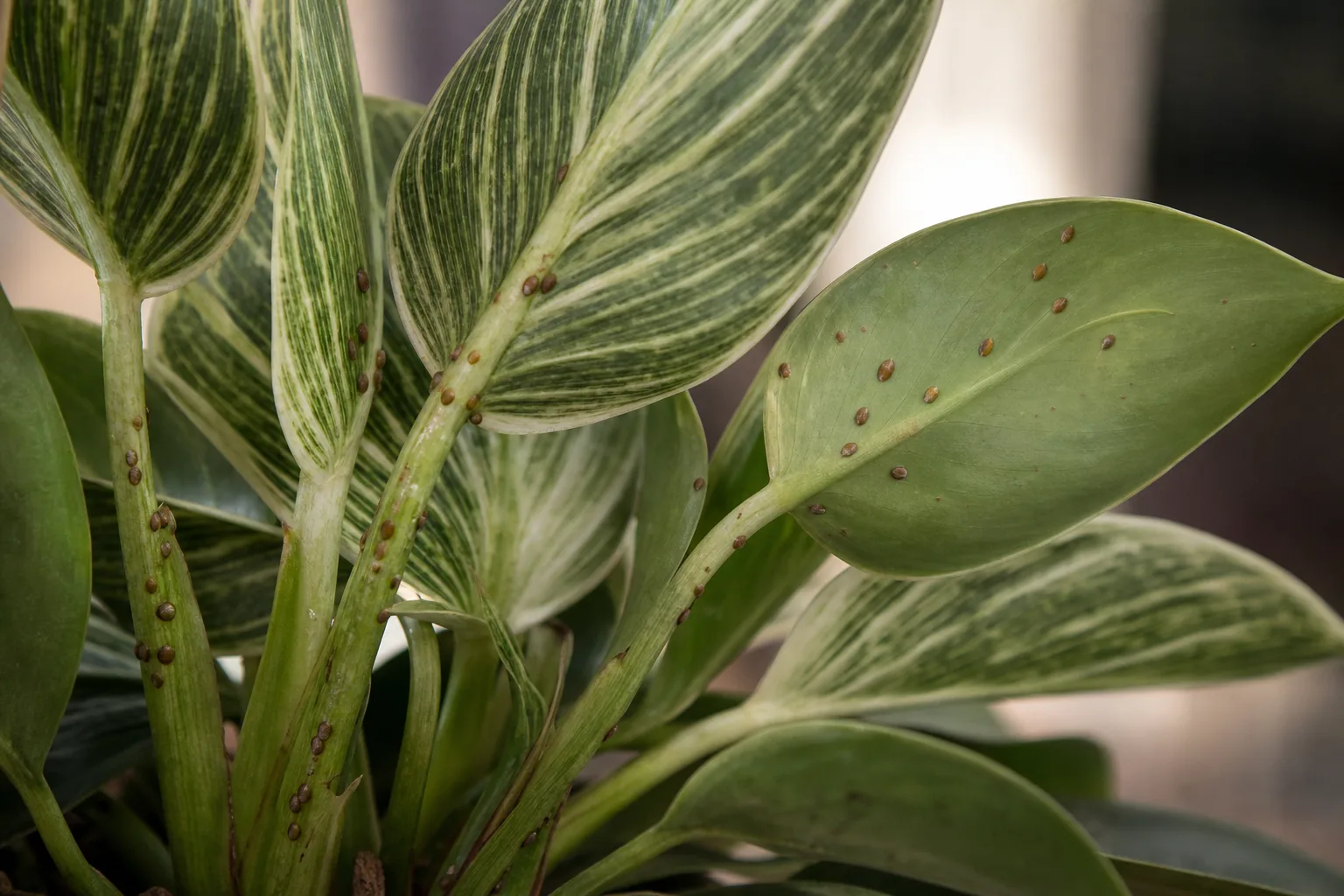
Scale on Philodendron Birkin looks like small immobile brown or tan bumps along the thick upright stem, leaf petioles, and veins-not part of the pinstripe pattern. First step: isolate the plant and scrape every visible scale with a cotton swab dipped in alcohol before applying any spray.
Scale Insects on Philodendron Birkin: Causes, Checks & Fixes
This guide covers scale insects on Philodendron Birkin. See also the general Scale Insects guide, watering, and light pages for this plant.
Scale Insects on Philodendron Birkin: Causes, Checks & Fixes
Quick answer
Scale insects on Philodendron Birkin appear as small, immobile bumps on the thick upright stem, leaf petioles, and along leaf veins-often mistaken for part of the plant or a harmless blemish. Soft scales excrete sticky honeydew that can coat lower glossy leaves and invite black sooty mold, which is not part of Birkin’s normal white variegation.
First step: isolate the plant and scrape every visible scale with a cotton swab dipped in 70% isopropyl alcohol. Birkin’s compact, self-heading rosette hides scale in tight leaf-stem crevices where pinstriped foliage meets the thick stem. Manual removal kills adults on contact and lets you confirm the pest before coating the whole plant in spray. Do not reach for horticultural oil until you have scraped and inspected-one spray rarely clears a sheltered colony.
What scale insects look like on Philodendron Birkin
Scale does not look like an insect at first glance. Adults are immobile and suck plant juices through strawlike mouthparts, often appearing as waxy or shell-like bumps glued to stems and leaves. On Birkin, the most common indoor types are soft scales (rounded, honeydew-producing) and armored scales (flatter, no honeydew).
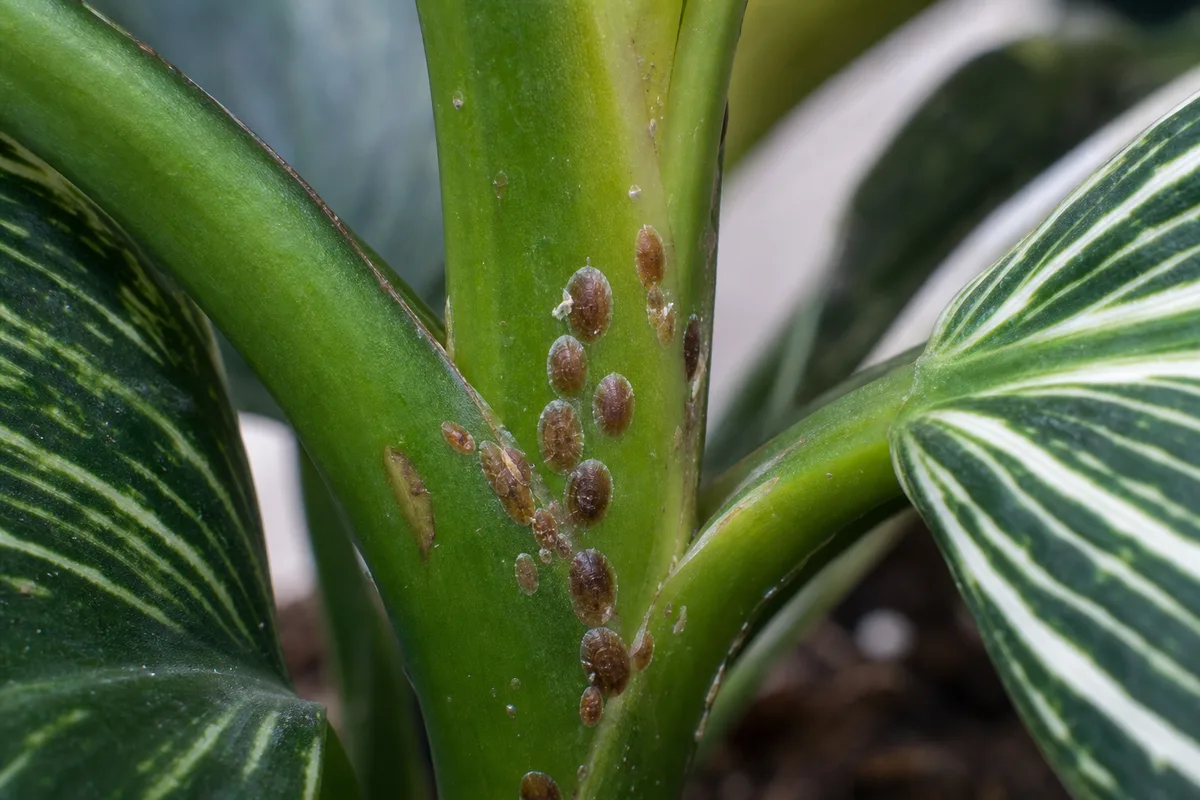
Scale Insects symptoms on Philodendron Birkin - compare with healthy tissue on the same plant.
Confirmed scale signs:
- Flat or rounded tan, brown, or yellow-green bumps on the upright stem, leaf petioles, or along leaf veins
- Bumps that do not wipe off like dust-they stay fixed until scraped
- Sticky honeydew on leaf surfaces or pot rims below feeding sites (soft scale)
- Black sooty mold that smears when wiped-fungus growing on honeydew deposits
- Yellowing or premature leaf drop on otherwise well-watered Birkin
- Ant trails on the pot exterior, often before you notice the bumps
- Reduced vigor and slow new pinstriped growth when feeding is heavy
Where to look on Birkin specifically:
- Base and length of the thick upright stem-scale clusters here on self-heading philodendrons
- Every junction where a pinstriped leaf meets the stem along the rosette
- Leaf undersides along mid-veins and petiole attachments
- Crevices between overlapping leaves in the tight crown
- Soil line and lowest leaf sheaths still attached to the stem
Not scale:
- Creamy white or yellow pinstripes are normal variegation-flat, smooth, and present from leaf emergence
- Mineral dust on glossy leaf tops wipes off dry without a hard shell underneath
- Mealybugs on Philodendron Birkin form fluffy white wax clusters in axils, not hard immobile bumps
- Leaf spots from wet foliage are flat lesions without attached insects
Why Philodendron Birkin gets scale insects
Philodendron Birkin is a self-heading houseplant with an erect, compact growth habit-not a trailing vine. Its thick stems hold overlapping heart-shaped leaves close together, creating sheltered microclimates at every axil and along the stem surface. Brown soft scale infests philodendron and other aroids on foliage along leaf veins, leaf undersides, and young stems-exactly where Birkin’s structure concentrates pests.
NC State Extension recommends monitoring philodendrons for scale insects alongside spider mites, mealybugs, and aphids. Birkin is not uniquely vulnerable, but its slow growth and tight rosette make infestations easier to miss until honeydew, yellowing, or ant activity appears.
Common introduction routes:
- New plants without quarantine - scale hitchhikes on nursery stock and spreads when Birkin sits in a mixed display
- Stressed or overwatered plants - Birkin needs the top 3–5 cm of mix to dry between drinks; soggy soil weakens roots and slows replacement leaf production
- Crowded plant shelves - touching leaves between specimens gives crawlers a bridge to neighboring pots
- Ant protection - ants harvest honeydew and disturb natural enemies that would otherwise control soft scale
- Dusty foliage - dust blocks light and makes small bumps harder to spot on glossy pinstriped leaves
Birkin’s decorative variegation can distract from early yellowing until feeding is moderate. By the time stickiness shows on lower foliage, colonies often extend several nodes down the stem.
How to confirm the cause
Work through these checks in order:
- Bump test - Try to flick a suspect spot with a fingernail or toothpick. Scale should flake off with pressure; variegation and leaf tissue do not.
- Cover test - On armored scale, the waxy cover lifts off separately from the body underneath. Soft scale covers are attached to the insect body.
- Honeydew check - Rub a sticky lower leaf. Honeydew feels tacky and may support sooty mold. Armored scale produces no honeydew.
- Stem and vein scan - Examine stems and leaf undersides along mid-veins with a hand lens. Birkin’s compact form requires lifting each leaf away from the stem.
- Crawler watch - Tiny yellow mobile crawlers may appear after scraping adults or during warm indoor conditions. Multiple overlapping generations occur year-round on houseplants.
- Ant check - Ants on the pot strongly suggest honeydew producers on or above the plant.
- Neighbor scan - Check philodendrons, ficus, and palms on the same shelf. Crawlers walk short distances between pots.
If you find only flat variegation, no fixed bumps, and no stickiness, the markings are normal Birkin pattern-not pests.
First fix for Philodendron Birkin
Move the plant away from other houseplants and scrape every visible scale with a cotton swab dipped in 70% isopropyl alcohol.
This single step kills soft-bodied stages on contact and immediately reduces the population. UMN Extension recommends physically removing small numbers of scale with a fingernail file or similar tool; a cotton swab with alcohol works well on Birkin’s thick stem and petioles without damaging pinstriped foliage.
Work methodically: start at the soil line, scrape along the full stem length, open each leaf axil, and treat bumps on petioles and leaf veins until swabs come back clean. Maryland Extension notes that physical removal also makes it easier to monitor rebound after later treatments.
Do not fertilize, repot, or mist heavily until you know how widespread the infestation is. Do not spray insecticide before confirming pests-unnecessary chemicals stress a slow-growing Birkin without solving a misidentified problem.
Step-by-step recovery
After isolation and alcohol scraping:
- Repeat scraping every three to five days until inspections find no new bumps. Eggs and crawlers hatch on cycles, so one pass rarely clears an infestation.
- Apply horticultural oil or insecticidal soap if colonies persist after several scraping rounds. Oils must fully coat the pest to suffocate it-cover stems, petioles, leaf undersides, and vein lines thoroughly. Repeat at label intervals; these products have little residual activity and must contact insects directly.
- Test on one leaf first - Birkin’s variegated foliage can be sensitive. Read product labels; not all houseplants tolerate every pesticide.
- Wash honeydew and sooty mold from lower leaves with plain water once feeding stops. Mold does not infect Birkin tissue-it grows on honeydew deposits.
- Trim badly encrusted or distorted leaves after two weeks with no new scale. Birkin replaces foliage slowly; removing the worst leaves improves appearance without shocking the plant.
- Manage ants if present. Ant stakes or barriers on pot rims help natural enemies reach scale when plants summer outdoors.
- Consider systemic imidacloprid for soft scale only on stubborn infestations-effective against soft scales but not armored species. Use only products labeled for indoor houseplants and keep treated Birkin away from pets until dry.
Keep Birkin isolated until you see no new bumps for at least two weeks after the last treatment.
Recovery timeline
Alcohol scraping shows results within a few days on light infestations. A full oil or soap course with label-interval repeats typically takes four to eight weeks because scale eggs hatch on overlapping cycles. Birkin’s slow growth means new clean pinstriped leaves may take four to ten weeks to look fully normal after pests are gone.
Judge recovery by:
- No new bumps on stem and petiole inspection
- Honeydew production stopped-leaves feel dry, not tacky
- New leaves opening with normal striping, not yellowed or distorted
- Firm upright growth resuming at the crown
Old yellowed or sooty-coated leaves may not recover cosmetically. Focus on clean new growth rather than waiting for damaged foliage to green up.
Lookalike symptoms to rule out
Normal variegation: Fixed white, cream, or yellow stripes along leaf veins from the moment a leaf opens. No hard bumps, no honeydew, no ants.
Mealybugs: White cottony masses in leaf axils-not shell-like bumps on stems. Both can produce honeydew.
Spider mites: Fine stippling and silk webbing, not immobile bumps. Confirm with a tap test over white paper.
Thrips: Silvery scratch marks and black fecal specks; no fixed shell-like bumps glued to stems.
Edema or mineral deposits: Flat dry spots on leaf tops without attached insects underneath.
Nutrient or watering stress: Uniform yellowing without bumps, stickiness, or ant activity. Check whether the top 3–5 cm of mix dries between waterings before treating for pests.
Mistakes to avoid
Do not confuse pinstripes with pests or stem bumps with normal leaf scars. Treating variegation wastes time and exposes Birkin to unnecessary sprays.
Do not return an isolated plant to the shelf after one scraping session. Multiple insecticide treatments are usually necessary, and monitoring must continue until crawlers stop emerging.
Do not overwater while fighting pests. Wet soil stresses roots and slows the slow-growing Birkin’s ability to push replacement leaves.
Do not use homemade soap sprays. UMN Extension warns that non-label soap mixtures can burn plants-use products labeled for houseplants.
Do not assume one spray type fits all scale. Armored and soft scales differ in biology and treatment response-imidacloprid helps soft scale but not armored species.
Handle Birkin with care during treatment-philodendrons contain calcium oxalate crystals that irritate skin and are toxic to pets. Wash hands after contact and keep treated plants away from cats and dogs until sprays dry.
How to prevent scale next time
Quarantine every new Birkin or companion plant for at least two weeks before placing it near your collection. Inspect thoroughly before bringing plants indoors-focus on stems and leaf veins where Birkin’s pests hide.
Scout stems and petioles during weekly watering. Birkin’s compact rosette takes only a minute to check if you lift leaves systematically from crown to base.
Keep Birkin in bright filtered light with 50–60% humidity and water when the top 3–5 cm of mix is dry. Healthy firm growth resists pest buildup better than stressed, overwatered tissue.
Wipe dust from glossy leaves occasionally so brown bumps stand out against dark green foliage.
Avoid crowding plants so leaves do not touch. Give Birkin airflow on the shelf or tabletop.
WSU Extension notes scale thrive on plants with higher nitrogen levels-hold fertilizer during active infestations until new growth looks stable for two weeks.
When to worry
Treat as urgent when bumps cover multiple stem nodes, new pinstriped leaves yellow and fail to open, or ants swarm the pot. Birkin’s tight rosette lets populations shelter through casual inspection-delay allows crawlers to spread to neighboring plants on the same shelf.
Consider discarding a severely infested Birkin if repeated alcohol scraping, oil, and soap cycles over eight to twelve weeks fail to reduce colonies. Maryland Extension notes heavily infested plants are best discarded rather than risking endless chemical treatment-especially when other philodendrons sit nearby.
A single small bump on one petiole on otherwise healthy growth is manageable with isolation and alcohol-not an emergency, but not ignorable on a slow-growing specimen.
Conclusion
Scale on Philodendron Birkin hides as hard bumps on the upright stem and leaf veins-not on the decorative pinstripes. Isolate first, confirm shell-like insects in leaf-stem crevices, scrape with alcohol, and repeat oil or soap treatments until crawlers stop. Birkin recovers slowly, so judge success by clean new growth at the crown rather than old damaged leaves. Regular stem inspection during weekly care catches hitchhikers before they coat your whole collection.
When to use this page vs other Philodendron Birkin guides
- Philodendron Birkin watering guide - Use for routine moisture checks before assuming scale insects is the main issue.
- Philodendron Birkin problems hub - Browse all 42 common issues on this species.
- Sticky Leaves on Philodendron Birkin - Different entry point when symptoms overlap with scale insects.
- Ants on Plant on Philodendron Birkin - Different entry point when symptoms overlap with scale insects.
- Yellow Leaves on Philodendron Birkin - Different entry point when symptoms overlap with scale insects.
Related Philodendron Birkin guides
- Philodendron Birkin overview
- Philodendron Birkin watering
- Philodendron Birkin light
- Philodendron Birkin soil
- Sticky Leaves on Philodendron Birkin
- Ants on Plant on Philodendron Birkin
- Yellow Leaves on Philodendron Birkin
- Mealybugs on Philodendron Birkin
- Leaf Drop on Philodendron Birkin
- Philodendron Birkin problems