Philodendron Birkin Light Needs: Best Window, Sun & Warning
Philodendron Birkin Light Needs: Best Window, Sun & Warning Signs
Philodendron Birkin Light Needs: Best Window, Sun & Warning Signs
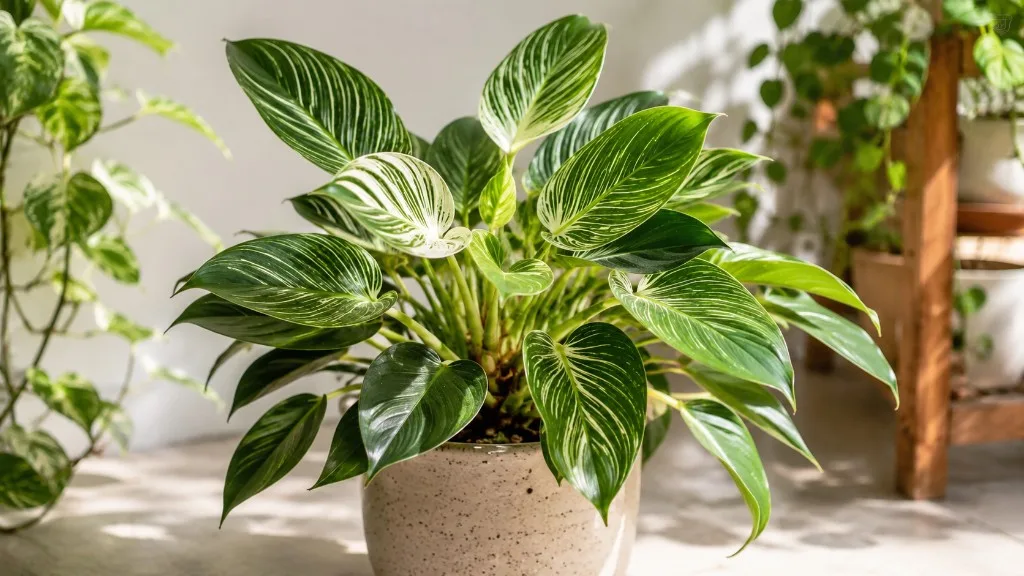
Philodendron Birkin light is not a generic “bright indirect” checkbox. Philodendron ‘Birkin’ is a compact, self-heading aroid whose entire appeal sits in white pinstripe variegation on glossy heart-shaped leaves - tissue with less chlorophyll than solid green philodendron leaves. That biology means Birkin reads light differently from trailing types like Brasil: too little exposure and variegation fades with leggy, smaller new growth; too much unfiltered sun and the pale stripes scorch before the green tissue shows stress. The practical mistake is judging by how bright the room looks to your eyes instead of how much usable light reaches the leaf surface where photosynthesis happens.
North Carolina Extension lists Birkin’s cultural preference as bright, filtered (dappled) sunlight indoors - the same category Clemson Extension describes for philodendrons generally as indirect or curtain-filtered sunlight that avoids leaf scorch from direct rays. This guide translates those principles into placement you can act on today: which window direction fits a tabletop rosette, how far from the glass to start, when grow lights beat a dim north exposure, a two-week acclimation sequence for brighter moves, and how to tell variegation fade from sunburn before you change watering or soil at the same time.
Reviewed by LeafyPixels Review Board · Author: sai-ananth · Methodology: Recommendations checked against NC State Extension, Clemson HGIC, University of Minnesota Extension supplemental-light guidance, and ASPCA plant-toxicity records, then aligned with LeafyPixels Birkin cluster data.
Quick Answer - What Light Philodendron Birkin Needs
Place Philodendron Birkin where it receives bright, filtered sunlight for most of the day - roughly 250 to 1,000 foot-candles at the leaf surface (about 2,500 to 10,000 lux), which feels like a room where you can read comfortably without a lamp and see a soft, defined hand shadow near the foliage. An east window two to three feet back, or a filtered south or west window three to five feet back, is a reliable starting point for a 6-inch tabletop pot. Judge success by new leaves: crisp pinstripes, normal leaf size, and short internodes - not by whether older leaves from a previous location still look acceptable.
Birkin is not a low-light plant long term. It may survive a dim corner for months, but insufficient light causes loss of variegation and leggy growth or small leaves per NC State. It is also not a full-sun windowsill plant without acclimation: too much sun scorches leaves, especially the white-striped sections. When natural light is weak - north windows in winter, interior offices - add a full-spectrum grow light for 12 to 14 hours daily with foliage houseplants 12 to 24 inches from the lamp per University of Minnesota Extension.
Why Birkin Light Is Not About Room Brightness
Human vision adapts to dim interiors. A living room with a large south window can look adequately lit while a Birkin on a bookshelf across the room receives only a fraction of the photons hitting the glass. Plants do not adapt that way. Light intensity drops sharply with distance and with every obstruction - furniture, sheer vs. open curtains, tinted glass, overhangs, neighboring buildings, and seasonal sun angle all change the number that matters at the leaf.
For Birkin specifically, the stakes are higher than for solid-green heartleaf philodendron. Variegated tissue carries less chlorophyll; the plant must capture enough light to support both green and striped sections. In shade, Birkin often responds by producing greener, larger-area chlorophyll patches or longer internodes reaching toward the window - both read as “the plant is fine” until pinstripes disappear on successive new leaves. That is why extension guidance pairs low light with variegation loss rather than immediate death.
The New-Growth Test for Light Quality
Old leaf damage is historical evidence. New growth is today’s light report. After any placement change, wait for one to two fully hardened leaves before deciding the spot works.
Healthy light looks like: firm new blades with visible white or cream pinstripes, leaf size similar to the previous mature leaf, and internodes short enough that the rosette stays compact on a tabletop - consistent with Birkin’s upright self-heading habit growing 6 inches to 3 feet tall indoors.
Too little light looks like: smaller new leaves, weak or missing striping, visible stretch between leaves, and slow unfurling - the pattern NC State groups under leggy growth in insufficient light. See the dedicated not-enough-light and leggy growth guides if several new leaves show this trajectory.
Too much light looks like: bleached or tan patches on sun-facing variegated tissue, crisp brown edges on white stripes, or sudden damage within days of a move - overlapping with heat stress when glass intensifies afternoon sun.
Rotate the pot a quarter turn every two to three weeks if growth leans toward the window. Leaning is normal phototropism; rotation keeps the display symmetrical without fixing a fundamentally dim location.
Best Light for Philodendron Birkin Indoors
The target category is bright indirect light or bright filtered sun - strong ambient brightness at the leaf without prolonged harsh direct beams on variegated tissue. Clemson Extension notes that most philodendrons prefer indirect or curtain-filtered sunlight and that self-heading tree philodendrons grow best with medium to bright light near east, west, or south windows - a useful parallel for Birkin’s upright rosette even though Birkin stays much smaller.
Birkin’s slow indoor growth rate means light problems develop gradually. You will not get an overnight collapse from a slightly dim shelf; you will get three months of subtly greener, slightly longer internodes until the plant no longer matches the pinstriped specimen you bought. Treat that drift as urgent - variegation recovery is easier when caught on the second or third compromised leaf, not after six months of reversion.
Foot-Candles and the Hand-Shadow Test
You do not need a light meter to succeed, but numbers help calibrate expectations. University of Minnesota Extension groups medium-light foliage houseplants around 250 to 1,000 foot-candles - the band where Birkin typically holds variegation and compact growth. Low light below roughly 250 foot-candles may maintain existing leaves but often triggers the variegation and stretch issues NC State documents.
Field test without instruments: On a clear day, hold your hand between the Birkin and its light source. A soft shadow with readable edges suggests adequate bright indirect light. A faint or absent shadow means low light - survivable briefly, poor for pinstripes. If the leaf surface feels hot within an hour of direct sun hitting it, intensity is too high without filtration or distance.
Duration matters as much as peak intensity. University of Maryland Extension notes that most houseplants need a regular daily light period and should not receive more than 16 hours of total light daily when combining window and lamp exposure - not a single harsh hour of afternoon sun alone.
Best Window Placement by Direction
Window compass direction is a starting framework, not a guarantee. Outdoor tree shade, deep window wells, and sheer curtains all modify the label. Still, orientation gives you a reliable first guess in the northern hemisphere.
Place the pot where leaves receive light, not where the room receives light. A Birkin on a coffee table six feet from an east window often gets less usable intensity than one two to three feet from the same pane - especially with a self-heading rosette whose lower leaves shade themselves.
Window Direction Table and Expected Symptoms
| Window | Typical intensity for Birkin | Starting placement | Watch for |
|---|---|---|---|
| East | Gentle morning direct sun + bright indirect day | 2–3 ft from glass, or filtered sill | Usually ideal; monitor summer morning heat on sill |
| South | Highest total daily light | 3–5 ft back or behind sheer curtain | Bleached pinstripes, crisp brown variegation if too close |
| West | Strong late-day sun and heat load | 3–5 ft back; extra summer distance | Scorched white tissue, leaf curl in heat waves |
| North | Gentle indirect all day; often low in winter | As close to glass as possible | Leggy stretch, fading striping, slow growth - add grow light |
An east-facing window is the default recommendation for variegated tabletop philodendrons in most homes: enough brightness for pinstripes without the thermal load of unfiltered west or south afternoon sun. North can work in bright summers but often falls below Birkin’s variegation needs in winter when day length and sun angle drop - plan supplemental light rather than accepting permanent fade.
Tabletop Distance From the Glass
Self-heading Birkin sits low in the pot with a tight crown. Light intensity drops with distance, but a trailing philodendron can hang nearer the sill because more leaf area sits in the bright zone. For Birkin, treat distance as a dimmer switch:
- 2 to 3 feet from east or filtered west glass is a common sweet spot for 6-inch display pots.
- 3 to 5 feet from unobstructed south glass, or behind sheer fabric, reduces scorch risk on variegated tissue.
- North windows: place as close as practical; if new leaves lose striping within two unfurlings, add a lamp rather than moving farther away.
Reflective pale walls behind the plant increase usable brightness slightly; dark corners absorb it. One foot of movement toward or away from glass often matters more than switching from east to west.
Can Philodendron Birkin Take Direct Sun?
Some direct sun - usually gentle morning exposure - can work when the plant is acclimated and variegated tissue is protected from harsh midday and afternoon beams. NC State is explicit that Birkin prefers bright, filtered sunlight and that too much sun scorches leaves. Clemson Extension similarly notes philodendrons prefer indirect or curtain-filtered sunlight rather than harsh direct exposure.
Direct sun through glass concentrates heat on pale pinstripes before green tissue shows equivalent damage. A Birkin grown under store fluorescent lighting and then placed on an unfiltered south sill in July may show permanent bleached or brown patches within days. Sunburn on variegated sections does not green out again - you live with the scar or remove the leaf.
Safer direct-sun entry points: east windowsill with morning rays only; south or west with sheer curtain; gradual acclimation over two weeks (see below). High-risk placements: unfiltered west afternoon sun; south sill in summer for plants previously kept dim; sudden move after winter in a north room.
Low-Light Limits and Variegation Loss
Low light is a poor long-term strategy for Birkin even though many philodendrons tolerate shade. Heartleaf philodendron survives very low light per Clemson Extension; Birkin’s variegation makes it less shade-tolerant in practice because the plant must maintain stripes that reduce photosynthetic area.
NC State states plainly that insufficient light can result in loss of variegation and leggy growth or small leaves. In dim conditions you may also see yellowing lower leaves when the plant cannot sustain its crown - overlapping with yellow leaves from other causes, which is why the new-growth test matters.
If Birkin sits in low light, reduce watering frequency to match slower metabolism - wet soil in dim corners is a common path to root rot on Philodendron Birkin. Fix light before assuming the plant needs more water or fertilizer.
Reversion and Sport Instability Under Stress
Birkin is a chimeric cultivar - unstable variegation that can sport back toward greener or reddish parent forms (NC State notes it may be a rare mutation of Philodendron ‘Rojo Congo’) under prolonged stress, including low light. Solid green or red-leaning leaves on individual stems can appear after months of shade or sudden environmental shifts.
Honest uncertainty: a single pale new leaf after a move may recover striping on the next leaf once light stabilizes. A stem producing several consecutive non-striped leaves may not return to pinstripes without pruning that stem - expert opinion varies, and NC State documents variegation loss from insufficient light without specifying reversibility. Treat early fade as reversible; treat persistent reversion on one stem as potentially permanent on that stem.
Using Grow Lights for Philodendron Birkin
When natural light is insufficient - north rooms in winter, office desks far from windows, interior hallways - a full-spectrum LED grow light is more reliable than hoping ceiling fluorescents reach the pot. University of Minnesota Extension recommends 12 to 14 hours daily for foliage houseplants and suggests placing lamps 12 to 24 inches above the canopy, adjusting distance based on leaf response: bleaching means too close; stretch means too far.
Iowa State Extension notes that supplemental light duration generally falls between 10 and 16 hours per day for indoor plants - Birkin fits the 12 to 14 hour middle band well. Use a timer so light is consistent; irregular bursts of lamp light stress variegated aroids less than total darkness but still produce uneven growth.
Hours, Distance, and Office Desk Setups
Practical starting setup for a tabletop Birkin:
- Full-spectrum LED with color temperature near 5000–6500K (daylight-balanced).
- 12 to 14 hours on via timer; avoid 24-hour continuous light - plants need dark periods for normal metabolism.
- 12 to 18 inches initial lamp height for a 6-inch pot; raise if white stripes bleach, lower if internodes stretch.
- Heat check: if leaf surfaces feel warm after 30 minutes, raise the fixture - heat plus light scorches variegation faster than light alone.
Office overhead fluorescent light alone rarely delivers enough intensity at desk level for crisp Birkin pinstripes unless the desk sits very close to a window path. A small clip-on or desk-bar grow light aimed at the rosette outperforms ambient ceiling light for variegation maintenance.
How to Move or Acclimate Birkin Safely
Sudden light jumps cause leaf drop, curling, scorch, or stalled growth - especially when moving from a dim shop or winter north window to strong summer sun. Change one variable at a time: light first, then wait for two new leaves before adjusting watering or fertilizer.
Two-week acclimation example - dim interior shelf to filtered east window:
| Day | Action | What to watch |
|---|---|---|
| 1–3 | Move to bright indirect spot 5–6 ft from east window | No scorch; slight lean toward light is normal |
| 4–6 | Move to 3–4 ft from same window | Newest leaf firmness; no bleaching on stripes |
| 7–10 | Move to 2–3 ft or add one hour of gentle morning sill sun | Pinstripe clarity on unfolding leaf |
| 11–14 | Hold final position; rotate pot | Internode length on next leaf vs. previous |
If bleaching appears, step back one stage and wait for a healthy new leaf before advancing again. If stretch appears, the new spot is still too dim - move closer or add a lamp rather than waiting for “adaptation.”
Warning Signs - Too Much vs. Too Little Light
Use this decision flow when symptoms are mixed:
Too little light (priority fix: brighten or add lamp):
- Successive new leaves with fading or absent pinstripes
- Longer gaps between leaves on the same stem (leggy growth)
- Smaller new blades than older mature leaves
- Soil staying wet for weeks without plant use
- Plant leaning sharply with weak petioles
Too much light (priority fix: filter, distance, or acclimate back):
- Bleached white or tan patches on sun-facing variegation
- Crisp brown edges on striped tissue while green areas still look fine initially
- Curling or wilting during brightest hours despite moist soil
- Sudden damage within 3–7 days of a bright move
- Leaf surface hot to touch near glass
Correct light (hold placement):
- New leaves show crisp pinstripes and stable size
- Short internodes; compact tabletop silhouette
- Steady but slow growth - Birkin is not a fast vine
- Soil dries on a predictable rhythm matching your room (see watering guide)
Severity ranking: active scorch on new variegated tissue warrants immediate shade; slow striping fade warrants light increase within the week; single older yellow leaf may be unrelated - confirm with new-growth pattern.
Seasonal Light Adjustments Through the Year
Sun angle and day length shift indoor intensity even when you never move the pot. A Birkin 2 feet from an east window may thrive from April through September and show fading striping on the same sill from November through February.
Winter (short days, low sun angle): North and east exposures dim noticeably. Move Birkin closer to glass where safe from cold drafts, or add 1–2 hours of grow-light time. Extend the new-growth test - slower unfurling in cool rooms is normal; missing pinstripes are not.
Summer (long days, high heat load): South and west glass intensifies. Pull Birkin slightly farther back or add sheer curtain during heat waves. Watch variegated tissue first - it scorches before green sections.
After HVAC season changes: Heating and air-conditioning alter humidity and sometimes plant placement. NC State recommends 50 to 60% humidity and 65 to 85°F (18 to 29°C) - dry winter air can brown leaf tips independently of light, but do not misread tip browning as “needs more sun” when the real issue is humidity or overwatering on Philodendron Birkin in dim conditions.
Common Philodendron Birkin Light Mistakes
Judging by room brightness instead of leaf-level intensity - the most common error; fix by moving the pot, not the plant label.
Comparing Birkin to Brasil in the same dim corner - trailing heartleaf philodendron tolerates lower light; Birkin pinstripes will fade first.
Moving to a south sill without acclimation after purchase from low-light retail display - causes immediate variegation scorch.
Rotating without relocating when the fundamental spot is too dim - rotation symmetry does not replace photons.
Stacking light, repot, and fertilizer changes the same week - makes failure diagnosis impossible; change light alone first.
Ignoring winter dimming on north windows - accepts gradual reversion as “normal winter rest.”
Using grow lights too far above the crown - ceiling fixtures rarely substitute for a lamp 12 to 24 inches above the rosette per extension distance guidance.
Light Changes Watering - What to Adjust
Light and water use move together. A Birkin that moves from a hallway to an east window will dry its mix faster; one moved dimmer after scorch recovery will dry slower. NC State links overwatering to root rot and yellowing leaves - a risk that rises when low light slows water uptake while owners keep the same calendar schedule.
After any light change:
- Wait two weeks before rewriting your watering rhythm.
- Check the top 3–5 cm of mix, do not pour on schedule alone.
- If the pot stays wet 14+ days in the new spot, light may still be too low - or drainage needs review on the soil guide.
- If the pot dries in 3–4 days in bright summer sun, increase check frequency - not necessarily volume per watering.
Cross-read the overview and propagation guides when adjusting care holistically, but fix light first when variegation and stretch are the primary symptoms.
Know Your Plant, Pet Safety, and Birkin vs. Brasil
Philodendron ‘Birkin’ is an upright self-heading hybrid in the arum family (Araceae) - not a climbing vine. It grows as a compact rosette with thick, glossy, heart-shaped leaves marked by pinstriped variegation unique on each blade. That display habit means Birkin needs an evenly lit tabletop position rather than a moss pole or hanging basket strategy.
Birkin vs. Brasil: Philodendron hederaceum ‘Brasil’ is a fast trailing vine with lime-green heart leaves; it tolerates lower light and different pruning logic. Birkin is a compact specimen; Brasil is a moving vine. They share aroid family care overlap but not interchangeable light placement - do not deduce Birkin needs from a thriving Brasil in the same room.
Pet and human safety: NC State notes low-severity oxalate poisoning and possible contact dermatitis from plant sap. The ASPCA lists Philodendron species as toxic to cats and dogs, causing oral irritation, drooling, vomiting, and swallowing difficulty if chewed. UF/IFAS Extension confirms philodendrons contain insoluble calcium oxalate crystals with similar symptoms. Keep Birkin on elevated surfaces pets cannot reach; contact your veterinarian or ASPCA Animal Poison Control at (888) 426-4435 if ingestion occurs.
Conclusion
Philodendron Birkin rewards bright, filtered light with crisp pinstripes and compact growth - and punishes both deep shade and harsh unfiltered sun on variegated tissue. Start two to three feet from an east window or behind sheer fabric on south/west, judge placement by new leaves not old scars, acclimate brighter moves over two weeks, and add 12 to 14 hours of supplemental light when north windows or offices cannot sustain striping. When light is right, sync your watering checks to faster dry-down; when pinstripes fade or scorch, fix exposure before Philodendron Birkin repotting guide, fertilizing, or pruning. That sequence protects the variegated rosette that makes Birkin worth the window real estate.
When to use this page vs other Philodendron Birkin guides
- Philodendron Birkin overview - Start here for whole-plant context before deep-diving this topic.
- Philodendron Birkin problems hub - Jump to symptom-specific fix guides when this care topic does not resolve the issue.
- Not Enough Light on Philodendron Birkin - Escalate here when light adjustments are not enough.
- Leggy Growth on Philodendron Birkin - Escalate here when light adjustments are not enough.
- Leaf Drop on Philodendron Birkin - Escalate here when light adjustments are not enough.
Related Philodendron Birkin guides
- Philodendron Birkin overview
- Philodendron Birkin watering
- Philodendron Birkin soil
- Philodendron Birkin propagation
- Philodendron Birkin fertilizer
- Philodendron Birkin repotting
- Not Enough Light on Philodendron Birkin
- Leggy Growth on Philodendron Birkin
- Leaf Drop on Philodendron Birkin
- Philodendron Birkin problems