Philodendron Birkin Fertilizer: When, How, and Mistakes
Philodendron Birkin Fertilizer: When, How, and Mistakes
Philodendron Birkin Fertilizer: When, How, and Mistakes
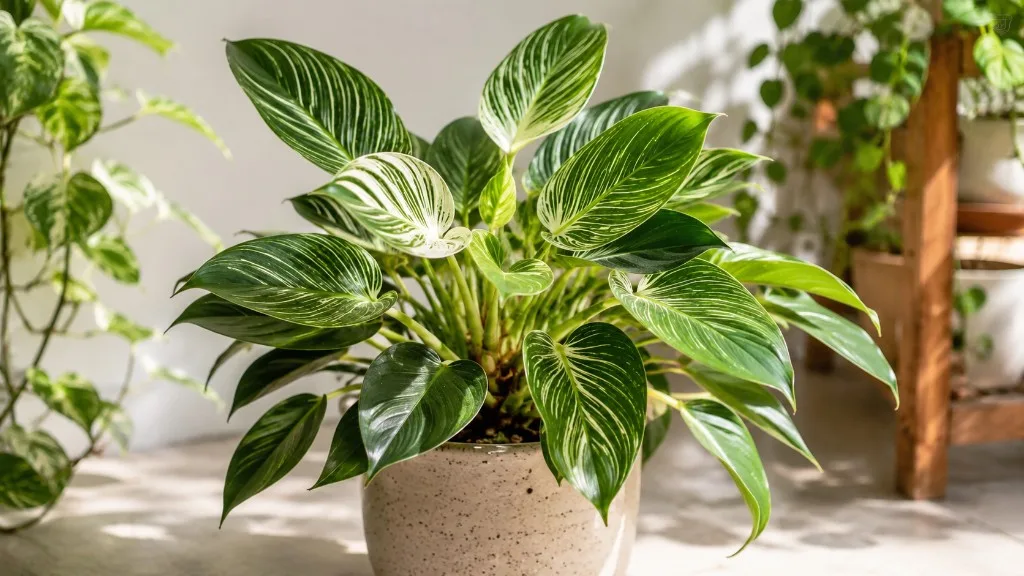
Philodendron Birkin fertilizer decisions start with the plant’s biology, not the bottle on your shelf. Philodendron ‘Birkin’ is a compact, self-heading hybrid - not a trailing vine - with thick glossy leaves marked by creamy white pinstripes that collectors want crisp on every new leaf. That variegation comes from unstable chimeral tissue: green cells photosynthesize efficiently, while white sectors carry less chlorophyll. Birkin grows slowly indoors, typically reaching 6 inches to 3 feet tall, which means it uses nutrients gradually - but its upright rosette often sits in a small display pot where fertilizer salts concentrate faster than they would in a large trailing philodendron basket. For full care context, see the Philodendron Birkin overview.
The workable default for most homes: a balanced liquid fertilizer at half the label strength every four to six weeks from spring through early fall, applied to already-moist soil, with a plain-water leach every four to six months to flush soluble salts. Pause entirely in late fall and winter when growth slows. Never feed a dry, stressed, or newly repotted plant. Fertilizer supports healthy new striped leaves when light, watering, and soil are already in range - it cannot fix dim corners, soggy roots, or stripe loss driven mainly by insufficient light.
Reviewed by LeafyPixels Review Board · Author: sai-ananth · Methodology: Recommendations checked against NC State Extension Birkin profile, Iowa State philodendron and houseplant fertilizer guidance, RHS philodendron feeding notes, and University of Minnesota Extension spring houseplant care, then aligned with LeafyPixels Birkin cluster data.
Why Fertilizer Matters for Variegated Birkin
Philodendron Birkin pulls nitrogen, phosphorus, potassium, and trace elements from its potting mix to build new leaves, roots, and the thick upright stems that define its rosette form. Watering leaches some nutrients over time. Root growth and microbial activity consume others. Fertilizer replaces what the plant uses - but Birkin’s slow metabolism and limited chlorophyll in white sectors mean it tolerates lean feeding far better than heavy doses.
Iowa State Extension recommends fertilizing philodendrons lightly - once or twice a month while actively growing in spring and summer - with a balanced all-purpose fertilizer. That guidance applies to Birkin alongside other self-heading hybrids like ‘Xanadu’ listed on the same page. The goal is not maximum leaf size; it is steady, even growth with stable variegation patterning on each new leaf. Overfeeding does not paint on pinstripes - but it can push soft, fast green tissue that outcompetes variegated sectors in unstable chimeral cultivars, while soluble salts damage roots in the small pots Birkin usually occupies.
North Carolina Extension notes that insufficient light can result in loss of variegation or smaller leaves on Birkin. Light is the primary driver of stripe stability; fertilizer is secondary support when the plant is actively photosynthesizing enough to use the nutrients you add. Treat feeding as one lever in a system that includes bright filtered light, consistent moisture checks, and a well-draining mix.
Birkin Biology: Self-Heading Hybrid, Stripes, and Growth Rhythm
Understanding Birkin’s growth habit explains why its fertilizer routine differs from trailing philodendrons like Brasil or heartleaf types. Birkin is classified among non-climbing, self-heading philodendrons - Iowa State groups it with compact hybrids that stay upright rather than vining (Growing Philodendrons at Home). New leaves emerge from a central crown with short internodes, producing a dense tabletop rosette rather than extending long runners.
Each leaf is unique in its stripe pattern - NC State describes pin-striped variegations of creamy white, yellow, or light green that become more pronounced as leaves mature. Because white tissue photosynthesizes less efficiently than green tissue, Birkin already runs a tighter energy budget than a solid-green philodendron of the same size. That is why conservative feeding wins: the plant does not need - and often cannot process - the nutrient load a fast vine might use in the same four-inch pot.
Self-heading architecture also changes salt dynamics. Trailing philodendrons in hanging baskets often have more soil volume relative to leaf mass, and excess water drains freely from the bottom. Birkin in a 6-inch cachepot on a desk may have a compact root ball, shaded soil surface under the leaf rosette, and slower evaporation at the crown. Fertilizer salts from tap water and feeding accumulate near the surface where you see white crust first - a pattern that shows up on Birkin sooner than on a pothos in an open hanging pot with more airflow.
Quick-Reference Feeding Card
Use this card as a starting framework, then adjust based on new leaf quality, soil salt crust, and your room’s light and temperature. “Every four to six weeks” and “about once a month” describe the same practical range for a slow-growing Birkin in typical indoor light.
| Situation | What to do |
|---|---|
| Active growth (spring–early fall), healthy plant | Half-strength balanced liquid feed every 4–6 weeks on moist soil |
| Bright light + steady new striped leaves | Stay at 4–6 weeks; do not increase strength |
| Dim light or slow/no new growth | Skip feed; improve light first |
| Late fall through winter (most homes) | Pause fertilizer entirely |
| White crust on soil or pot rim | Leach with plain water; pause feeding 4–6 weeks |
| Just repotted or propagated | No fertilizer for 4–6 weeks until stable new growth |
| Small 4–6 inch pot | Same dilution, lean toward 6–8 week intervals |
When to Fertilize: Active Growth vs. Rest
Timing follows Birkin’s metabolism, not a wall calendar. Feed when the plant is pushing new leaves with firm stems and moist - not saturated - soil, and stop when growth slows sharply in shorter days. A Birkin that keeps old leaves upright through December can look fine while producing almost no new tissue; unused nutrients then accumulate as harmful salts.
The Royal Horticultural Society advises feeding philodendrons during the growing season from April through September with a general houseplant fertiliser. That window aligns with when most temperate-climate homes have enough daylight for Birkin to use nutrients. University of Minnesota Extension recommends starting spring feeding gently with balanced fertilizer at half strength every two to four weeks as houseplants shift into active growth (Spring houseplant care). For slow Birkin, the four-to-six-week end of that range is usually safer than biweekly feeding.
Spring and Summer Feeding Window
Begin feeding when you see active new growth - a leaf spike unfurling from the crown, firm new petioles, or visibly faster dry-down in the pot after the spring light increase. In most homes that means April through September, though heated bright rooms may extend the window slightly.
During peak growth, apply half-strength balanced liquid fertilizer every four to six weeks. If your Birkin sits in strong filtered light per the light guide and pushes a new striped leaf every few weeks, four-week intervals at half strength are reasonable. If growth is slower - common for Birkin - six-week intervals or roughly once a month match Iowa State’s once-or-twice-a-month ceiling without forcing food the roots cannot use.
| Month (temperate indoor climate) | Growth phase | Feeding guidance |
|---|---|---|
| March–April | Waking up, first new leaves | First half-strength feed when new growth visible |
| May–August | Peak slow growth | Every 4–6 weeks on moist soil |
| September | Slowing | Taper to one light feed or skip if growth stalls |
| October | Wind-down | Final feed only if actively growing, then pause |
| November–February | Rest indoors | No fertilizer for typical setups |
Reconcile the monthly vs. every-four-to-six-weeks question this way: once a month is the simple shorthand; four to six weeks is the precision range for slow Birkin. Both are correct if dilution stays at half strength and you skip feeds when the plant is not growing.
Fall Taper and Winter Pause
Cut back in early fall as day length drops. One practical approach: if Birkin still pushes new leaves in September, give a final half-strength feed, then pause from late October through February. Birkin is not frost-tolerant and prefers warm indoor conditions; cooler rooms slow metabolism further, making winter feeding especially risky for salt buildup.
Exception: if you grow under strong supplemental grow lights and Birkin produces new striped leaves all winter, you may feed lightly at half strength every eight to ten weeks - but watch for salt crust and default to skipping if unsure. Winter rest is safer than forcing growth with nutrients the plant cannot process.
Best Fertilizer Type for Philodendron Birkin
The best Philodendron Birkin fertilizer for most homes is a complete, water-soluble, balanced houseplant formula - not slow-release pellets, not bloom boosters, and not full-strength outdoor garden concentrations relabeled for a windowsill pot.
Liquid formulas win because you control dilution precisely. Iowa State Extension notes that when using general all-purpose fertilizers on houseplants, you should mix them at half or quarter the label strength because indoor plants grow slower than the outdoor plants label directions assume. That guidance applies directly to Birkin in a 4-to-8-inch container.
Balanced Liquid Formulas, NPK, and Variegation Caution
A 10-10-10 or 20-20-20 water-soluble fertilizer diluted to half strength is the standard recommendation across extension houseplant guidance. Equal NPK ratios keep feeding simple when your goal is healthy foliage rather than flowers - Birkin rarely blooms indoors, and feeding does not trigger it.
Variegation caution: Do not reach for high-nitrogen leaf-boost formulas hoping for fuller pinstripes. Nitrogen drives chlorophyll production and green tissue growth. On chimeral cultivars like Birkin, aggressive nitrogen feeding can encourage soft, predominantly green new leaves even when light is adequate - a pattern consistent with general variegated-houseplant physiology, though no extension source documents Birkin stripe reversion from nitrogen alone. NC State links variegation loss primarily to insufficient light. A balanced formula at half strength, paired with bright filtered light, supports steady striped growth more reliably than pushing nitrogen.
Skip slow-release granules in small pots - they release unpredictably and are difficult to leach if you overapply. Skip foliar feeding; philodendrons absorb nutrients primarily through roots, and fertilizer on Birkin’s glossy leaves risks cosmetic burn without meaningful benefit.
Organic and Slow-Release Options to Skip or Use Carefully
Fish emulsion, worm castings, and compost tea can work on Birkin only when applied at very low concentration and infrequently - roughly half the interval you would use for synthetic liquid feed, with extra attention to odor and fungus gnat risk indoors. Organic sources break down unevenly in small pots; a single heavy worm-casting top-dress in a 4-inch Birkin can concentrate nitrogen at the crown where salts are already problematic. If you use organics, treat them as occasional supplements, not monthly feed replacements, and leach more often when crust appears.
Slow-release pellets are a poor default for desk Birkins. Release rate depends on temperature and moisture; in a warm bright window, pellets can dump nutrients faster than slow roots can use them, and you cannot easily reverse an overdose without repotting. Stick with liquid half-strength feeds unless you are experienced with measured pellet counts in open, well-draining nursery pots.
How Much and How Often (Dilution Math)
Half strength means half the fertilizer concentration the label recommends for houseplants, not half the water volume. Read your bottle carefully: many labels give separate indoor and outdoor dilutions; use the indoor rate, then halve it again for Birkin.
Worked example: If your label says 1 teaspoon (5 ml) per gallon (3.8 L) of water for indoor plants, mix ½ teaspoon per gallon for Birkin. For a 6-inch pot holding roughly 3–4 cups of soil, prepare one gallon of dilute solution, then water until a little drains from the bottom - you will use only a fraction of the gallon per plant. Discard saucer water so roots do not reabsorb concentrated salts.
University of Minnesota Extension warns that too much fertilizer too soon in spring can cause weak stretchy growth or salt buildup (Spring houseplant care). Start the season conservatively. If the newest leaf after feeding shows good stripe contrast, firm texture, and no tip burn, your dose is appropriate. If tips brown or crust appears within two weeks, halve the dose further or extend the interval to six to eight weeks.
Plan a plain-water leach every four to six months - or sooner if you feed frequently or use hard tap water. University of Maryland Extension recommends leaching houseplants on that schedule to prevent soluble salt buildup that inhibits water uptake (Watering indoor plants). Nebraska Extension specifies using twice the pot’s water volume for a thorough leach (Success With Houseplants - Fertilization).
Step-by-Step: How to Feed Birkin Safely
- Check the calendar and the plant. Confirm it is spring through early fall (or winter only if under strong grow lights with active new leaves). Confirm Birkin is not recently repotted, drought-stressed, or showing salt crust.
- Check soil moisture. The top 3–5 cm should feel lightly dry to partially dry - not bone dry, not wet. If dry, water with plain water first and feed the next day.
- Mix fertilizer at half indoor label strength in room-temperature water.
- Pour slowly over the soil surface, avoiding the leaf crown, until a little water exits the drainage holes.
- Empty the saucer within 30 minutes. Never let Birkin sit in runoff.
- Mark the date and watch the next one or two new leaves for stripe quality and tip health.
- Schedule the next leach if it has been more than four months since the last plain-water flush.
Pre-Feed Checks and the Moist-Soil Rule
Iowa State’s philodendron guidance pairs feeding with even moisture management - water when the top of the soil is dry, but do not let plants sit in soggy soil. Fertilizer application follows the same logic: apply to already-moist soil, never to dust-dry roots. Concentrated fertilizer solution on dry roots causes osmotic burn - the same mechanism that damages roots when salt levels spike in wet soil.
Before every feed, verify: soil is moist at depth, no white crust on the surface, newest leaf is not yellowing from overwatering on Philodendron Birkin, and the season is active growth. If any check fails, skip fertilizer and fix the underlying issue using the watering guide or overview first.
Signs Your Birkin Is Well Fed
A well-fed Birkin in appropriate light shows steady but slow new growth - one new striped leaf every several weeks in summer, firm upright petioles, and deep green sectors with crisp white or cream pinstripes on the newest leaf. Older leaves naturally age; focus on the youngest fully opened leaf as your report card.
Soil surface stays free of heavy white crust. Drainage holes are clear. The pot does not smell sour. Growth is compact rather than leggy - though legginess usually signals low light before it signals hunger. If pale color persists despite conservative feeding and good light, rule out overwatering and root issues before increasing fertilizer.
Signs of Over-Fertilizing and Stripe Stress
Over-fertilizing is one of the most common Birkin fertilizer mistakes because symptoms overlap with watering errors and low humidity. Watch for these fertilizer-linked patterns:
- Brown or crispy leaf tips and margins, especially on newest leaves shortly after feeding
- White or yellow crust on soil surface, pot rim, or drainage holes - classic soluble salt accumulation
- Wilting despite moist soil - roots damaged by salts cannot absorb water
- Sudden leaf drop after a heavy feed or repeated feeding on wet soil
- New leaves mostly green with reduced pinstriping after aggressive feeding - may coincide with soft, fast growth; also check light, since NC State ties variegation loss to insufficient light as well
Pale leaves alone rarely mean under-fertilizing on Birkin. Check light, roots, and moisture first. Tip burn with crust is the clearest fertilizer signal.
How to Flush Birkin After Over-Feeding
If you see salt crust or tip burn after feeding, stop fertilizer immediately and leach the pot:
- Scrape off visible surface crust - no more than ¼ inch of soil, per Nebraska Extension leaching guidance.
- Move the pot to a sink. Water slowly with plain room-temperature water until it runs freely from drainage holes.
- Repeat until you have passed roughly twice the pot’s volume in water - for a 6-inch pot holding about 5 cups, use roughly 10 cups total across multiple passes.
- Let drain completely and empty the saucer. Do not let the plant sit in leachate.
- Pause fertilizer for four to six weeks while watching the next new leaf.
- Resume at half strength with a longer interval (six to eight weeks) if the plant recovers.
Badly burned leaves will not revert to green - wait for the next one or two new leaves to confirm recovery. If crust returns within weeks, extend intervals further and check whether a decorative cachepot is trapping salts.
Open Pot vs. Cachepot: Where Salts Hide on Desk Birkins
Birkin’s self-heading rosette makes it a popular desk specimen - often displayed in a decorative cachepot without drainage. That setup changes how fertilizer salts behave even when your dilution and schedule are correct.
| Setup | Salt behavior | Leach difficulty | Birkin risk |
|---|---|---|---|
| Open nursery pot with drainage holes | Runoff exits; salts flush with each soak-and-drain | Easy - water at sink until twice pot volume drains | Lower salt buildup if saucer emptied |
| Nursery pot lifted from cachepot to water | Good if you drain completely before returning | Moderate - must lift inner pot every time | Medium - fine when drainage discipline is consistent |
| Cachepot catching all runoff | Leachate re-wicks into mix; rim crust common | Hard - salts recycle at bottom of inner pot | High - monthly feed + trapped runoff = fast crust |
| No drainage decorative pot | Salts have nowhere to exit | Very hard - leaching ineffective | Very high - repot into holed pot before feeding program |
Practical rule: If your Birkin lives in a cachepot, lift the inner nursery pot to the sink for every feed and every leach. Empty the outer shell completely. Never pour fertilizer into a sealed outer container. White crust on the inner pot rim is an early warning that salts are concentrating - leach before the next scheduled feed, not after tip burn appears.
Seasonal and Situational Adjustments
Beyond the standard calendar, several situations change how aggressively you should feed Birkin.
After moving to brighter light in spring: Wait two weeks for the plant to adjust before the first feed. Brighter light increases nutrient use slightly, but start with the standard four-to-six-week schedule rather than doubling dose.
Hard tap water: Mineral salts from water add to fertilizer salts. Leach more frequently - every three to four months - if white crust appears even with conservative feeding.
Grow-light winter exception: Feed only if new striped leaves keep appearing; use half strength every eight to ten weeks maximum.
Repotting, Propagation, and Small-Pot Adjustments
Withhold fertilizer for four to six weeks after repotting or propagation. Disturbed roots are vulnerable to burn, and fresh potting mix already contains some nutrients. Follow the repotting guide for timing - spring is ideal - and resume feeding only when Birkin shows stable new growth.
After taking stem cuttings per the propagation guide, feed the parent lightly only once it has recovered; cuttings in water or moss do not need fertilizer until potted and rooted.
Small 4-to-6-inch pots concentrate salts faster because there is less soil volume to buffer ions. Use the same half-strength dilution but lean toward six-to-eight-week intervals and leach on the shorter end of the four-to-six-month schedule.
Fertilizer and Other Birkin Care
Fertilizer only works when the rest of the routine is in range. Birkin in bright filtered light and a well-draining mix uses nutrients efficiently; the same plant in a dim corner with soggy soil accumulates salts while growth stalls.
Cross-check these cluster guides before increasing feed frequency:
- Watering - moist-soil rule and soak-and-drain rhythm
- Light - primary driver of stripe stability
- Soil - drainage and salt buffering
- Repotting - when to refresh depleted mix instead of feeding harder
- Overview - full Birkin care context
If brown tips persist after correcting fertilizer, see the fertilizer burn and salt build-up problem guides.
Common Birkin Fertilizer Mistakes
Feeding every watering. Constant low-dose fertilizer in the irrigation water builds salts faster than Birkin’s slow roots can use them, especially in small pots. Use a clear schedule and plain water between feeds.
Using full label strength. Outdoor label rates assume faster growth and larger soil volumes. Iowa State’s half-to-quarter strength rule exists because houseplants - especially slow ones like Birkin - cannot process full concentrations without salt injury.
Feeding in winter on autopilot. Growth pause means nutrient accumulation. Skip unless grow lights keep new leaves coming.
Chasing pinstripes with high nitrogen. Balanced half-strength feeding plus adequate light preserves stripes better than nitrogen pushes that favor green tissue.
Ignoring salt crust. White crust is not cosmetic - it signals ion levels that restrict water uptake. Leach promptly.
Feeding stressed plants. Dry soil, recent repot, root rot on Philodendron Birkin recovery, or heat/cold shock - fix the stress first. Fertilizer on compromised roots accelerates damage.
Leaving Birkin in a full cachepot after feeding. Runoff re-wicks salts to the root zone within hours. Lift and drain every time.
Pet safety oversight. Birkin contains calcium oxalate crystals toxic to cats and dogs. Store fertilizer bottles and the plant out of reach; wash hands after handling sap or soil.
Frequently Asked Questions
Does Philodendron Birkin need fertilizer?
Birkin benefits from light feeding during active spring and summer growth but tolerates lean conditions better than heavy feeding. Use half-strength balanced liquid fertilizer every four to six weeks on moist soil while the plant pushes new striped leaves. Skip fertilizer in fall and winter, after repotting, and whenever the plant is dry, stressed, or showing salt crust.
Will fertilizer affect my Birkin’s white stripes?
Fertilizer does not create pinstripes, but feeding strategy still matters for this chimeral cultivar. Balanced half-strength feeds during active growth support healthy new leaves when light is adequate. High-nitrogen or full-strength feeding can push soft, greener new growth, while NC State links variegation loss primarily to insufficient light. Prioritize bright filtered light and conservative feeding over nitrogen boosts.
How often should I fertilize a small Birkin in a 4-inch pot?
Use the same half-strength dilution as larger plants, but extend the interval to every six to eight weeks because salts concentrate faster in small soil volumes. Leach with plain water every three to four months if you see white crust on the rim or surface. Never increase strength to compensate for the small pot - increase patience instead.
Can I over-fertilize Philodendron Birkin?
Yes - over-fertilizing is common and damaging. Symptoms include brown leaf tips, white crust on soil, wilting despite moist mix, and sudden leaf drop. Stop feeding, leach the pot with twice the pot volume in plain water, empty the saucer, and pause fertilizer for four to six weeks. Resume at half strength with longer intervals once new leaves look healthy.
Should I use high-nitrogen fertilizer for fuller Birkin leaves?
No - avoid high-nitrogen formulas for Birkin. This slow-growing variegated cultivar needs balanced nutrition at half strength, not leaf-boost nitrogen. Excess nitrogen favors green tissue growth and increases salt-burn risk without improving pinstripe patterning. A 10-10-10 or 20-20-20 liquid fertilizer diluted to half the indoor label rate is the better default.
Conclusion
Philodendron Birkin rewards a conservative, seasonal feeding rhythm: half-strength balanced liquid fertilizer every four to six weeks during active growth, applied to moist soil, with periodic plain-water leaching to keep salts low in compact self-heading pots. Pause in winter, withhold after repotting, and prioritize bright filtered light over nitrogen when pinstripe stability is the goal. If you grow in a cachepot, lift the inner pot to drain after every feed - salts hide at the bottom long before tips brown. Watch the newest leaf, not the calendar. When in doubt, skip a feed, leach the pot, and confirm watering and light before adding more.
When to use this page vs other Philodendron Birkin guides
- Philodendron Birkin overview - Start here for whole-plant context before deep-diving this topic.
- Philodendron Birkin problems hub - Jump to symptom-specific fix guides when this care topic does not resolve the issue.
- Salt Build-up on Philodendron Birkin - Escalate here when fertilizer adjustments are not enough.
- Fertilizer Burn on Philodendron Birkin - Escalate here when fertilizer adjustments are not enough.