Best Soil for Philodendron Birkin: Mix, Drainage & Repotting
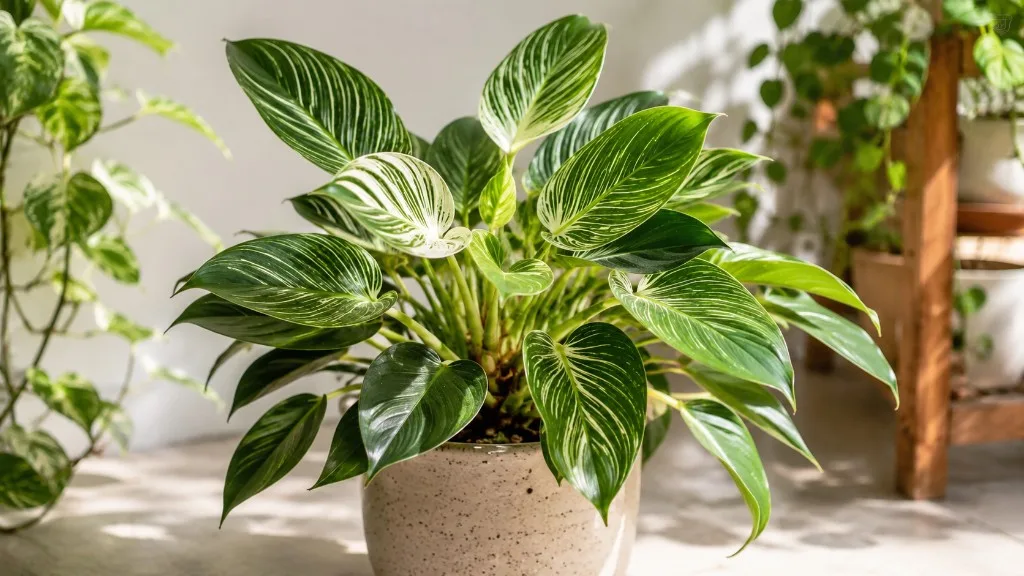
Best Soil for Philodendron Birkin: Mix, Drainage & Repotting
Best Soil for Philodendron Birkin: Mix, Drainage & Repotting
Philodendron Birkin soil problems usually show up as a watering mistake - but the failure often starts in the bag of mix the plant arrived in. A Birkin bought from a nursery in spring frequently sits in dense, peat-heavy retail soil that holds water at the crown for days while the surface looks merely “damp.” The owner waters on schedule, the pot feels heavy, pinstripes on new leaves blur or brown at the tips, and lower foliage yellows. The real issue is not thirst; it is a compressed root zone with too little air between soaks. Philodendron ‘Birkin’ is a compact, self-heading hybrid in the arum family (Araceae) whose value depends on crisp white pinstripes on short internodes - and that display collapses fast when roots sit in stale, oxygen-poor mix.
North Carolina Extension describes Birkin’s preference for moist, well-drained, slightly acidic soils of loam and sand in warm, humid indoor conditions - not permanently wet peat. The Royal Horticultural Society advises philodendrons generally to use loose, free-draining compost and never leave plants standing in water, because saturated compost leads to root rot. This guide covers the best soil mix for Philodendron Birkin, DIY volume recipes, commercial aroid options, perlite adjustments for your home, drainage and pot pairing for tabletop displays, pH and salt flush steps, diagnostic checks, a numbered spring repot workflow, and how soil ties to watering and light. For genus-level aroid physics, see the general philodendron soil guide; for full repot technique after mix refresh, see the Birkin repotting guide.
Reviewed by LeafyPixels Review Board · Author: sai-ananth · Methodology: Recommendations checked against NC State Extension, Royal Horticultural Society, Iowa State Extension, and Missouri Botanical Garden houseplant references, cross-read with LeafyPixels Birkin cluster data.
Why Birkin Soil Fails Before You Blame Watering
The most common Birkin soil failure mode indoors is slow dry-down in a decorative tabletop pot - not “wrong brand” potting soil in the abstract. Retail mixes optimized for greenhouse production retain moisture so staff water less often. On a desk or shelf in average home humidity, that same structure collapses after months of watering: peat particles compress, pore space disappears, and water channels around a hydrophobic root mat while the center stays sour.
Missouri Botanical Garden explains what happens next at the root level: roots in saturated soil [cannot absorb the oxygen they need](https://www.missouribotanicalgarden.org/gardens-gardening/your-garden/help-for-the-home-gardener/advice-tips-resources/insects-pests-and-problems/environmental/[overwatering on Philodendron Birkin](/plants/philodendron-birkin/overwatering/)), die back, and leave the plant unable to take up water even when the mix is wet. Birkin’s thick, glossy leaves hide stress longer than thin-leaved plants, so owners often add more water when they see dull pinstripes - accelerating overwatering and root rot symptoms that look like a watering schedule problem but trace back to mix texture.
Case vignette (home observation, 15 cm tabletop pot): A Birkin in unchanged nursery peat took 9–11 days for the top 3–5 cm to dry in a bright east window; after repotting into a perlite-bark blend in the same pot and light, dry-down normalized to 5–7 days, and the next two leaves opened with sharper cream pinstripes within one growth cycle. Your room will differ - the lesson is to measure your pot’s dry-down before changing water frequency.
Birkin’s Self-Heading Roots and Tabletop Pot Geometry
Iowa State Extension lists ‘Birkin’ among non-climbing, self-heading philodendron hybrids alongside ‘Xanadu’ and ‘Moonlight’ - distinct from trailing heartleaf types like Brasil. Birkin grows as an upright, compact plant with thick, upright stems and a slow growth rate indoors, typically reaching 6 inches to 3 feet tall. That architecture changes soil decisions in three practical ways.
First, the root mass stays relatively compact for the leafy crown - especially in a 15 cm display pot - so the outer soil volume can stay wet long after the surface looks ready for water. Second, Birkin’s tight rosette shades the mix surface, slowing evaporation compared with a trailing philodendron whose stems expose more edge to air. Third, self-heading Birkin tolerates slightly less aggressive chunkiness than a mounted epiphyte but still needs open structure; Iowa State’s baseline of all-purpose potting soil must be amended for indoor containers, not used straight from a moisture-retentive bag.
Iowa State also notes philodendrons do well when slightly pot-bound because soil dries more quickly between waterings. Birkin’s slower root exploration means you can stay slightly tight longer than Brasil - but decomposed peat in a tight pot is still a trap. Match mix openness to pot depth: a shallow 12 cm bowl dries differently from a deep 15 cm cylinder with the same diameter.
Best Soil Mix Recipes for Philodendron Birkin
NC State lists cultural requirements for Birkin as good drainage with moist - not waterlogged - conditions on loam and sand textures at slightly acidic to neutral pH. The LeafyPixels baseline indoor recipe extends Iowa State’s all-purpose starting point and RHS free-draining guidance into a measurable blend:
- 65–70% peat-free indoor potting compost (structure and nutrients)
- 20–25% perlite (drainage and pore space)
- 10–15% orchid bark or pine bark fines (chunky air channels)
Label note: those percentages are an editorial indoor heuristic for typical room humidity and tabletop dry-down - not a species prescription from extension bulletins. Adjust upward on perlite in humid, dim rooms; slightly reduce perlite in very dry, bright setups if the plant cannot retain moisture between checks.
Core Perlite-Bark Blend
For one 15 cm (6-inch) repot, measure by volume:
| Component | Parts | Approximate volume |
|---|---|---|
| Peat-free potting compost | 7 parts | ~3½ cups |
| Perlite | 2 parts | ~1 cup |
| Orchid bark (medium grade) | 1 part | ~½ cup |
The finished mix should feel crumbly and springy when squeezed - not sticky, not mud. Water should exit the drainage holes within about a minute on a full soak in a properly holed pot (see drainage checks below).
Mixing the Batch Step by Step
- Moisten compost lightly in a tub - dry peat repels water and floats perlite to the top during the first watering.
- Add perlite and fold until grains are distributed evenly; no white-only pockets.
- Fold in bark last so chunks stay intact; crushing bark to dust defeats the purpose.
- Test texture: squeeze a handful; it should hold shape briefly then crumble apart.
- Pot with the root crown at the same depth as before - never bury the self-heading stem base to “stabilize” the plant.
Wear gloves if you have sensitive skin; Birkin sap can irritate, and NC State lists contact dermatitis from sap on susceptible people.
Optional Amendments (Charcoal, Worm Castings, Coir)
| Amendment | Typical add rate | When it helps Birkin |
|---|---|---|
| Horticultural charcoal | 5–10% of total volume | Mild odor control in closed cachepot setups; not a substitute for drainage holes |
| Worm castings | Up to 10% of compost portion | Gentle organic matter in a refresh repot; skip if plant is stressed or recovering from rot |
| Coir (replacing part of peat base) | Swap up to 30% of compost | Faster initial wetting in dry homes; monitor salt content on variegated leaf tips |
Do not add sphagnum moss as a bulk ingredient for Birkin - it holds water at the crown and suits propagation boxes more than long-term self-heading display pots. A thin top dress for aesthetics is fine; a moss-heavy core is not.
Commercial Aroid Mix vs DIY
Bagged aroid or “philodendron” mixes from reputable houseplant brands are acceptable when the label shows perlite and bark in the ingredient list - not peat alone with a drainage marketing claim. DIY wins when you can tune perlite for your room: humid bathrooms may need 25–30% perlite; dry, bright offices may sit at 20% if dry-down is already fast.
| Factor | Bagged aroid mix | DIY perlite-bark blend |
|---|---|---|
| Cost | Higher per repot | Lower if you repot multiple plants |
| Customization | Fixed texture | Tune perlite/bark to room |
| Quality control | Varies by brand/batch | You control freshness |
| Best for | Quick refresh, one plant | Tuning tabletop dry-down, rot recovery |
If the bag feels spongy and sticks together when dry, amend with extra perlite and bark before potting Birkin - same rule as generic potting soil.
How Much Perlite by Home Conditions
Perlite percentage is a home-climate dial, not a loyalty test. Start at 20–25% perlite and 10% bark, then adjust based on dry-down at 3–5 cm depth (the same check used in the watering guide):
| Room profile | Starting perlite | Signal to increase perlite |
|---|---|---|
| Humid, moderate light, plastic pot | 25–30% | Top stays cool/wet >10 days; fungus gnats; sour smell |
| Average home, bright indirect light | 20–25% | Balanced dry-down 5–10 days |
| Dry, warm, terracotta, bright light | 18–22% | Mix dries fully in <3 days; leaf curl despite wet checks passing |
Change one variable - perlite OR pot material OR placement - and observe for two weeks before stacking changes. Birkin’s slow growth rate means feedback arrives on new leaf quality, not overnight.
Drainage Speed and Container Systems
Drainage speed is how fast water moves through the entire root profile after a full soak - not how fast water disappears from the saucer. Birkin needs the profile to wet uniformly once, then dry predictably at the depth you check before the next watering. NC State’s good drainage requirement paired with moist conditions describes that balance: air returns between waterings without desiccating fine roots.
Drainage Holes, Cachepots, and Saucers
A drainage hole is not optional for long-term Birkin care in indoor containers. Decorative cachepots are fine only when the inner grow pot lifts out easily and no water sits in the outer shell after watering. The one-minute drainage check (below) fails instantly if the plant lives in a sealed pot-in-pot with a flooded bottom - the most common hidden cause of “I only water weekly but soil stays wet.”
Gravel layers do not fix bad mix. They reduce soil volume and can create a perched water table above the stones. Fix texture in the blend, not the bottom of the pot.
Pot Size and Depth for Compact Self-Heading Growth
Choose a pot one size up - roughly 2–5 cm (1–2 inches) wider than the root ball - unless recovering from root rot, when same size or slightly smaller is safer. Oversized decorative pots are the single most common Birkin soil mistake after heavy peat: unused volume stays saturated at the bottom while the top looks dry, inviting repeated soaks into anaerobic mix.
Depth matters for self-heading Birkin. A wide, shallow bowl and a tall cylinder of equal volume behave differently: deep pots with short Birkin roots hold more bottom moisture. Prefer a pot depth roughly comparable to its width for tabletop specimens; avoid deep cachepot cylinders “for stability” unless you compensate with higher perlite and brighter light.
Iowa State recommends repotting into a container one size larger when overcrowded or when soil dries too fast to maintain - the second signal is less common on slow Birkin than on trailing types.
pH, Salt Buildup, and When to Flush
NC State lists Birkin soil pH as acid (<6.0) to neutral (6.0–8.0). The practical indoor target 5.5–7.0 sits inside that range. Variegated Birkin shows salt stress early on white pinstripes and pale streaks - tip burn and crust on the mix surface often precede widespread yellowing.
Flush procedure when crust appears (no repot yet):
- Water slowly with room-temperature water until twice the pot volume runs from drainage holes.
- Let the pot drain fully; empty the saucer.
- Allow the top half of the profile to dry before the next normal soak.
- If crust or tip burn returns within two weeks, plan a full mix refresh at repot rather than repeated flushing alone.
Hard tap water accelerates buildup; the watering guide covers tap versus filtered choices. Fertilizer without occasional flushing in a closed indoor system compounds salts - pair feeding from the fertilizer guide with open, refreshed mix.
One-Minute Drainage Checks
After a full watering, watch the pot for 60 seconds:
- Pass: Water exits drainage holes steadily; surface sinks evenly; no long-lived puddle on top.
- Fail: Water sits on surface, runs down the inside wall leaving the center dry, or cachepot fills with runoff you did not empty.
Repeat after any repot or mix change. This check is more reliable than judging by leaf pinstripes alone - variegation also fades with insufficient light, so diagnose soil and light separately.
Root-Zone Smell and Wrong-Soil Signs
Fresh mix smells earthy. Sour, swampy, or stagnant odor around Birkin means anaerobic conditions - roots may already be declining before leaves show full damage. Pair smell with these Birkin-specific soil-failure signs:
- Blurred or browning pinstripes on new leaves while older leaves hold pattern - often root stress, not normal variegation drift
- Lower yellowing with wet-feeling mix at depth - NC State links overwatering to root rot and yellowing leaves
- Fungus gnats hovering at the crown - surface stays moist too long
- Water runs straight through a dense root mat - peat collapsed; inner ball never rewets properly
- White mold on mix surface - chronic dampness; increase airflow and perlite
If smell is sour and roots are mushy when you probe gently, skip cosmetic refresh and follow root rot recovery before upgrading pot size.
When to Repot and Refresh Mix
Refresh Birkin mix when it compacts, smells sour, dries in odd patterns, or no longer supports healthy pinstriped new growth - not because one lower leaf yellowed. Spring through early summer is the safest window; avoid optional winter repots in cool, dim rooms unless the root zone is clearly failing.
Numbered Spring Repot Workflow
- Confirm timing - active growth period; plant not in simultaneous pest or light crisis.
- Choose pot - one size up with drainage holes; same or smaller if recovering from rot.
- Prepare fresh mix - perlite-bark blend as above; pre-moisten lightly.
- Unpot and inspect - healthy roots white and firm; trim only black, mushy, sour tissue.
- Tease circling roots at bottom and sides; keep most old mix unless rotting.
- Set crown at prior depth - do not bury the self-heading stem base.
- Water once thoroughly; drain fully; empty saucer.
- Recover in bright filtered light - hold fertilizer one month; expect normalized dry-down in 2–4 weeks.
Full detail and post-repot watering rhythm live in the repotting guide. Most tabletop Birkins need mix refresh every 1–2 years - a home heuristic aligned with slow growth, not a fixed calendar.
Common Birkin Soil Mistakes
- Repotting into an oversized decorative pot “for growth room” - bottom stays wet for weeks.
- Using straight moisture-control potting soil without perlite or bark - collapses indoors.
- Gravel drainage layer instead of fixing mix texture.
- Burying the crown or stem base during repot - self-heading Birkin rots at buried nodes.
- Cachepot water accumulation - outer shell becomes a stagnant reservoir.
- Adding moss as bulk mix - holds water at the rosette center.
- Repotting on day one after purchase when mix still drains - see overview quarantine guidance first.
- Stacking repot + light move + fertilizer in the same week - change one variable.
How Soil Connects to Birkin Watering and Light
Soil is the storage layer for the watering rhythm in the Birkin watering guide. Open mix forces you to check depth before soaking; dense mix makes calendar watering feel “correct” while roots suffocate. After any mix change, re-learn dry-down for two weeks before trusting old intervals.
Light changes water use independently. A Birkin moved to brighter filtered light per the light guide drinks faster; dim corners slow uptake while mix stays wet longer. Fix light first when variegation fades; fix mix first when smell, gnats, or wilt-on-wet-soil appear. If both guides check out and problems persist, inspect for pests before repotting again.
For propagation from offsets during a soil refresh, see the propagation guide. For genus-wide aroid physics beyond Birkin’s self-heading geometry, cross-read philodendron soil basics.
Conclusion
Philodendron Birkin rewards a loam-and-sand mindset in a container: airy perlite-bark blend, honest drainage holes, tabletop-appropriate pot depth, and mix refreshed before peat collapses into a sour plug. Start with 65–70% peat-free compost, 20–25% perlite, and 10–15% bark; dial perlite to your room; run the one-minute drainage and smell checks; repot on a spring workflow when dry-down or pinstripe quality fails. Pair this page with watering, light, and repotting guides so soil, water, and light move together - not as three conflicting rules.
When to use this page vs other Philodendron Birkin guides
- Philodendron Birkin overview - Start here for whole-plant context before deep-diving this topic.
- Philodendron Birkin problems hub - Jump to symptom-specific fix guides when this care topic does not resolve the issue.
- Root Rot on Philodendron Birkin - Escalate here when soil adjustments are not enough.