String of Hearts Care: Light, Water & Soil
Ceropegia woodii
String of Hearts needs bright indirect light and watering only when soil is nearly dry-every 10–14 days in summer. It's non-toxic to cats and dogs and propagates easily from the bead-like tubers on its strands.
String of Hearts Care: Light, Water & Soil
Start with wateringThe most common care mistake for String of HeartsWatering guide →String of Hearts care essentials
Light
bright indirect light, some direct morning sun
Water
Water when the soil is mostly or completely dry-roughly every 10–14 days in summer. This plant has tuberous roots that store water.
Soil
Fast-draining mix similar to a cactus blend.
Humidity
Low to moderate humidity (30–50%)
Temperature
18–27°C (65–80°F)
Fertilizer
Feed lightly during active growth. Diluted balanced liquid fertilizer at quarter to half strength and stop if the plant is stressed, newly repotted, or not actively growing.
About String of Hearts
String of Hearts has a upright growth habit.
| Detail | Information |
|---|---|
| Growth habit | Upright |
| Scientific name | Ceropegia woodii |
String of Hearts Care: Light, Water & Soil
What Is String of Hearts?
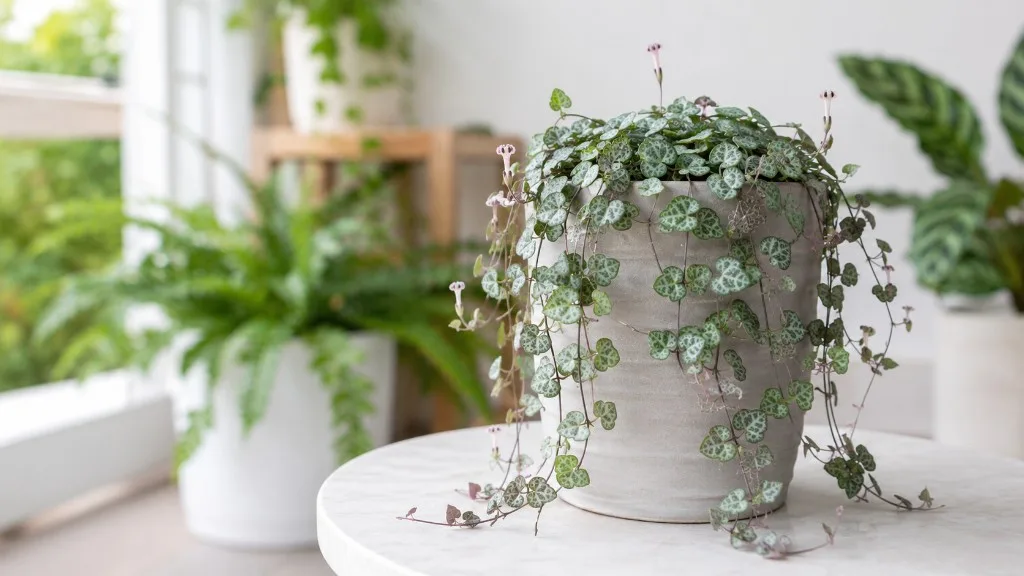
String of Hearts is a trailing succulent vine grown for long, threadlike stems lined with small, heart-shaped leaves and occasional waxy, lantern-shaped flowers. The accepted name is Ceropegia woodii, though many references still list it as Ceropegia linearis subsp. woodii - both refer to the same plant for practical care purposes. Common names include chain of hearts, rosary vine, collar of hearts, and sweetheart vine, all pointing to the same species rather than a random assortment of lookalikes.
Indoors, string of hearts typically forms trailing stems several feet long over time, though plants in bright, stable conditions can eventually reach impressive lengths. In its native habitat, vines can scramble up to 12 feet through surrounding vegetation according to NC State Extension. Growth is moderate in good light and slows sharply when light weakens or temperatures drop. The leaves are roughly 1 to 2 cm wide, dark green marbled with silver on top and greener to purplish underneath, attached to pinkish-purple stems that look delicate but store real drought tolerance.
If you are deciding whether String of Hearts overview fits your home, the honest summary is this: string of hearts rewards bright light, fast-draining soil, and a String of Hearts watering guide built around dry-down - and it punishes low light, heavy mix, and sympathy watering. It is easier than a finicky fern and harder than a snake plant only if you treat it like a thirsty tropical vine. The payoff is one of the most photogenic trailing plants you can grow, with aerial tubers along the stems that make propagation unusually straightforward. For pet owners, there is another major plus: the ASPCA lists Ceropegia woodii as non-toxic to cats and dogs, which makes it one of the safer trailing options compared with pothos or philodendron.
Botanical Background and Native Range
String of hearts belongs to the family Apocynaceae, specifically the milkweed subfamily Asclepiadoideae. That lineage matters because many Apocynaceae succulents share a storage strategy: tubers and thickened roots that hold water through dry spells. The genus name Ceropegia comes from Greek words meaning wax fountain, a reference to the waxy, tubular flowers. The species epithet woodii honors John Medley Wood, a collector of native African plants in the nineteenth century.
The plant is native to southern Africa, with a range extending from Zimbabwe through eastern South Africa and into Mozambique and Eswatini, according to SANBI PlantZAfrica and NC State Extension. In the wild it climbs through other vegetation as a straggly evergreen vine, bearing small tubers at leaf nodes that look like beads on a string - hence rosary vine. Those tubers are not decorative trivia; they are the plant’s backup water supply and a built-in propagation tool.
Flowers appear mainly in summer and fall, though indoor plants may bloom sporadically at other times. The blooms are unusual: pale magenta tubes with a hairy, cage-like structure evolved to trap pollinating flies briefly. Most growers care about the foliage cascade, not the flowers, but blooming is a useful signal that light and watering are aligned with active growth.
Why the Succulent Habit Changes Care
Treating string of hearts like a moisture-loving tropical vine is the fastest way to kill it. Its native climate includes seasonal dryness, and the plant’s body is built for that reality. Leaves, stems, and especially the underground and aerial tubers store water, which is why the species tolerates missed waterings far better than soggy soil.
That storage biology drives three practical rules. First, drainage beats richness - the mix should dry quickly and stay airy around the roots. Second, water on dryness, not on calendar days - the plant communicates through leaf firmness and pot weight more reliably than a schedule app. Third, winter is a rest period, not a growth sprint - reduce water and skip fertilizer when new growth slows, even if the plant stays green indoors.
The trailing shape adds one more layer. Hanging baskets look perfect for this species, and they usually are, but a pot suspended in dim corner light will still produce thin, stretched vines with small, widely spaced leaves. The succulent label does not mean low-maintenance in a dark room. It means forgiving of drought, unforgiving of rot and shade.
Best Growing Conditions for String of Hearts
String of hearts performs best when your home approximates its native rhythm: bright light, warm stable temperatures, airy soil, and deliberate drought between drinks. The four conditions that decide almost every outcome are light, water, soil, and temperature. Nail those and feeding, String of Hearts repotting guide, and propagation become routine. Get any one badly wrong - especially water in heavy soil or light in a back corner - and the plant will look sad long before you identify a mysterious disease.
Light Requirements
String of hearts needs bright, indirect light for most of the day, with tolerance for some direct morning sun once acclimated. A few feet from a south- or west-facing window with filtered light, or directly in a north- or east-facing window, is a workable starting range according to experienced indoor growers and extension summaries. It is not a low-light plant; it may survive dim conditions temporarily, but vines stretch, leaves shrink, and the silver marbling fades.
A practical test beats guesswork about foot-candles: new growth should be compact, firm, and well patterned. Long internodes - large gaps between leaves along the stem - mean the plant wants more light. Bleached, crisp patches or leaves that curl during the brightest hours mean too much unfiltered afternoon sun. If you move the plant to a brighter spot, acclimate over one to two weeks so leaves formed in lower light do not scorch immediately.
Grow lights help when natural light is weak in winter. Use a full-spectrum LED positioned far enough to avoid heat on the foliage, and run it long enough to supplement, not replace, a decent baseline of daylight. Rotate the pot occasionally so both sides of the cascade receive light; trailing plants otherwise lean dramatically toward the window.
Temperature and Humidity
String of hearts prefers warm, stable indoor temperatures, roughly 65 to 80°F (18 to 27°C), with a practical minimum around 60°F (15°C) according to University of Wisconsin Horticulture Extension. Cold drafts from winter windows, air-conditioning vents, or frequently opened doors can stall growth and yellow leaves without any watering mistake involved.
Humidity is a secondary concern. Low to moderate humidity, around 30 to 50 percent, suits the plant well because it is adapted to dry air during drought periods. Very dry winter air can encourage spider mites, but misting leaves is a poor fix - the moisture evaporates in minutes and wet foliage can invite fungal spotting. If your home is extremely dry, grouping plants or using a humidifier nearby helps more than a spray bottle.
Do not confuse warmth with wetness. A plant above a radiator may feel cozy while the pot dries in hours; a plant in a cool back room may need water less often even if the leaves look fine. Temperature changes water use, so adjust checking frequency seasonally rather than assuming the same interval year-round.
Soil and Drainage
Use a fast-draining mix similar to a commercial cactus and succulent blend, amended if needed with extra perlite, pumice, or coarse sand for larger pots. The goal is simple: water should pass through quickly, and the root zone should hold air as well as moisture. Heavy peat-based indoor mixes compact over time, stay wet too long, and are one of the most common root-rot pathways for this species.
A workable DIY blend for many homes is two parts potting soil, one part perlite, and one part coarse sand or pumice, adjusted toward more grit if your environment is cool or dim. Exact recipes matter less than the outcome - the top of the mix should dry within a few days after a thorough watering in active growth, and the deeper layers should not remain soggy.
Drainage holes in the pot are non-negotiable. Decorative cache pots without holes look tidy until the inner pot sits in stagnant water. Terra-cotta dries faster than glazed ceramic, which can be an advantage for beginners who tend to water generously. Whatever container you choose, empty the saucer after each watering so roots are not re-absorbing runoff.
How to Water String of Hearts
The general rule is: water when the soil has dried substantially - often when the top one to two inches feel dry, or when the top two-thirds of the pot has lost moisture in active growth. More precisely, plan around checking the actual mix in your home rather than a fixed calendar. Pot size, soil grit, light intensity, and season all change the interval; a plant in a sunny window may need water every 7 to 14 days in summer, while the same plant in winter dormancy may go three weeks or longer between drinks.
Use your finger, a wooden chopstick, or a moisture meter to assess the root zone before you water. If deeper soil is still damp, wait. When it is time, water thoroughly until a little runs from the drainage holes, then discard saucer water. Partial sips that only wet the surface teach roots to stay shallow and leave tubers thirsty below.
Watch the leaves as a secondary cue. Healthy string of hearts leaves feel firm and slightly succulent. When the plant is genuinely dry, leaves may soften and look slightly deflated - a useful nudge to check the pot, not an emergency requiring instant flooding. If leaves soften while soil is wet, suspect overwatering, not drought.
Watering Rhythm During Active Growth
During active growth - typically spring through early fall when light is strong and new leaves appear along the vines - the plant uses water on a predictable dry-down cycle. That is when thorough watering followed by full drying produces the fullest, most closely spaced foliage.
Match frequency to how fast the pot dries in its current location, not to what an online chart says for someone else’s climate. A hanging basket in bright light dries faster than a dense ceramic pot on a shelf. Check weight as well as touch: a pot that feels light for its size is usually ready; a heavy pot with dry surface crust may still hold moisture deeper down.
After repotting into fresh gritty mix, water lightly the first week so any damaged roots heal without sitting in saturation. Resume a normal deep-watering rhythm once new growth resumes and the mix dries at a steady rate.
Seasonal Adjustments and Winter Rest
String of hearts benefits from a winter rest period even indoors. Growth slows, new leaves appear less often, and water needs drop sharply. Wisconsin Horticulture Extension recommends allowing the soil to dry more completely through the pot in winter and holding off on fertilizer during this time.
Stretch the interval between waterings when days shorten and the plant stops pushing new vines. Many healthy plants need half as much water in winter as in midsummer, sometimes less. Resume the active-season rhythm only when you see consistent new growth and faster dry-down again.
Temperature interacts with this cycle. A plant kept warm under grow lights may grow year-round and drink more often than one in a cool room with short days. The plant’s behavior matters more than the calendar month on your phone.
Common Watering Mistakes
The single most common mistake is watering on a schedule without checking the soil - especially continuing a summer weekly rhythm through a dim, cool winter. The second is using a pot without drainage or leaving runoff in the saucer, which mimics chronic overwatering even when you thought you were sparing.
Sympathy watering kills this plant quietly. Yellow leaves and mushy stems near the soil line often mean roots have been too wet for too long. If you suspect overwatering, stop watering, improve airflow around the pot, and let the mix dry completely before reassessing - recovery can take weeks, and severely rotted tubers may not come back.
Underwatering is less common but shows up as persistent leaf softening, slow growth, and dry, brittle lower leaves. Deep watering when the mix is fully dry usually fixes it faster than misting or pebble trays. When in doubt between wet and dry, wait - this species tolerates drought far better than rot.
How to Feed String of Hearts
String of hearts does not need heavy feeding. A balanced water-soluble houseplant fertilizer at half strength, applied no more than monthly during active growth, is enough according to extension guidance. Some growers feed even less and still see full vines, especially if the potting mix contained a starter charge.
Apply fertilizer to already-moist soil so salts move through the root zone without burning tender roots. Never feed a plant that is dry, stressed, recently repotted, or recovering from rot. Salts on dry roots cause tip burn and tuber damage that shows up weeks later as yellowing.
Pause feeding entirely during winter rest, after repotting until new growth appears, and while correcting an overwatering problem. Resume when the plant is clearly growing and the watering rhythm is stable. If vines look pale despite good light and proper watering, a single mid-season feeding may help - but pale, stretched vines with wide leaf spacing usually mean more light, not more fertilizer.
Repotting and Root Health
Repot string of hearts only when necessary, not on a rigid annual calendar. This species often performs best when slightly snug in the pot, and Wisconsin Extension notes it has few serious pest problems when not stressed by wet soil. The best time to repot is early spring, just as active growth resumes, so the plant has a full bright season to re-establish.
Choose a pot only one size larger - typically 1 to 2 inches wider in diameter. An oversized pot holds excess moisture the root system cannot use, which is the classic post-repot rot scenario. Use fresh gritty mix, keep the tuberous root crown at the same depth it occupied before, and water lightly for the first week.
After repotting, expect temporary pause in trailing growth while roots explore the new mix. That is normal. Worry instead if stems turn mushy or the mix stays wet for more than a few days without drying at the surface.
Signs It Is Time to Repot
The clearest signs are functional, not aesthetic. Repot when roots circle the drainage holes, water runs straight through without soaking, the pot dries unrealistically fast because roots fill every cubic inch, or the mix has broken down into dense, sour-smelling mud. If the plant is stable, growing, and drying at a healthy rate, leave it alone - especially if aerial tubers are rooting back into the same pot and filling the surface.
Broken pots, severe mealybug infestation in the root zone, or confirmed rot are also repot triggers, but in those cases you may need to trim damaged tubers and restart from healthy cuttings rather than simply moving the whole plant to a bigger home.
Propagation Methods for String of Hearts
String of hearts is easily propagated, which is part of its popularity. Wisconsin Horticulture Extension describes three practical routes: stem cuttings, aerial tubers, and seed. Home growers rely on the first two; seed is slow and rarely necessary.
For aerial tubers - the small potato-like structures at leaf nodes - press a tuber still attached to the vine into moist, well-draining mix in a small pot. Keep the medium lightly moist but not wet until roots form over several weeks. Once the tuber anchors and new growth appears, sever the vine from the parent plant. This method is ideal when you want a full pot quickly without cutting the main display vine short.
For stem cuttings, take a section with several nodes, remove leaves from the buried portion, and lay or pin the stem on moist gritty mix so nodes contact soil. String of Hearts light guide and gentle moisture produce roots at nodes; bottom heat speeds rooting if you have a mat. Water propagation works for some growers, but transfer water-rooted cuttings to mix promptly so tubers develop properly.
Propagate only from healthy, well-hydrated plants. Stressed parents yield weak cuttings that rot before rooting. Clean scissors reduce infection risk at cut sites.
Common String of Hearts Problems
Most problems with string of hearts are environmental, not exotic diseases. The plant shows stress early if you know where to look: internode length, leaf firmness, tuber health, and soil moisture tell most of the story before pests enter the picture.
Yellow Leaves, Thin Vines, and Pests
Yellow leaves often mean overwatering or poor drainage, especially if leaves are soft and the mix smells musty. Check roots and tubers for brown mushy tissue; trim affected areas and repot into fresh gritty mix if rot is localized. Yellow lower leaves on an otherwise firm plant may be normal aging - remove them and monitor new growth rather than doubling water or fertilizer.
Thin, stretched vines with small pale leaves almost always mean insufficient light. Move the plant closer to a bright window or add a grow light, then wait for new compact growth before judging success. Old stretched sections will not shorten; new growth reveals whether the fix worked.
Brown crisp patches on sun-facing leaves indicate too much direct afternoon sun or too-fast acclimation. Pull the plant back or filter harsh rays with a sheer curtain.
Soft, wrinkled leaves on dry mix suggest underwatering or root loss from past overwatering that left too few healthy roots to uptake water. Distinguish the two by inspecting tubers: firm white or tan tubers with dry mix mean drink deeply; mushy tubers mean rot protocol, not more water.
Mealybugs are the pest mentioned most often in extension notes - white cottony clusters in leaf axils and along stems. Catch them early with weekly inspection, isolate affected plants, remove bugs manually, and treat with insecticidal soap applied per label directions. Spider mites appear in very dry air as fine stippling and webbing; increase humidity modestly and rinse foliage gently. Scale along stems and fungus gnats over consistently wet surface mix round out the usual indoor lineup.
Is String of Hearts Safe for Pets?
String of hearts is non-toxic to cats and dogs according to the ASPCA’s toxic and non-toxic plants database, which lists Ceropegia woodii as safe. That makes it a strong trailing option for pet households compared with pothos, philodendron, or many tradescantia, which carry genuine toxicity concerns.
Non-toxic does not mean food. Eating any plant material can cause mild stomach upset in some pets - vomiting or loose stool from volume, not poison. Keep dangling vines out of reach if your cat treats them as toys, both to protect the plant’s appearance and to avoid unnecessary vet visits for digestive drama.
If your pet consumes a large amount of any plant and seems unwell, contact your veterinarian for advice. For suspected exposure to a known toxic plant elsewhere in the home, the ASPCA Animal Poison Control Center at (888) 426-4435 remains the standard U.S. resource (a consultation fee may apply). This section is general information, not veterinary advice.
For designers, string of hearts offers something rare: cascade aesthetics without the guilt of hanging a toxic vine at cat-eye level. It pairs well with confirmed pet-safe companions such as spider plants or peperomia in mixed hanging displays.
Conclusion
String of hearts (Ceropegia woodii) is a southern African trailing succulent vine that stores water in leaves, stems, and tubers, then rewards you with dense silver-marbled hearts when light is bright, soil drains fast, and water follows dry-down rather than habit. Hang it where it receives strong indirect light - with optional morning sun - keep temperatures above about 60°F, use a cactus-style mix, and water deeply only when the pot has genuinely dried. Feed lightly during active growth, rest it in winter, repot only when roots outpace the container, and propagate from aerial tubers or stem cuttings when you want more plants for free.
When something looks wrong, read the vine before panic-buying products: long gaps between leaves mean more light; soft yellow leaves on wet mix mean less water and better drainage; crisp sun-facing patches mean softer exposure; firm tubers on dry mix mean a deep drink is due. Fix the environment first, adjust watering second, and treat pests before they spread along the entire cascade. Do that, and string of hearts becomes one of the most forgiving beautiful trailers you can grow indoors - pet-safe, propagatable, and genuinely satisfying once you respect its drought-first biology.
When to use this page vs other String of Hearts guides
- String of Hearts overview - Canonical hub for this species - care topics and problems branch from here.
- String of Hearts problems - Symptom-first path when you already know something is wrong.
Related String of Hearts guides
- String of Hearts watering
- String of Hearts light
- String of Hearts soil
- String of Hearts propagation
- String of Hearts fertilizer
- String of Hearts repotting
- String of Hearts pruning
- Brown Leaves on String of Hearts
- Brown Tips on String of Hearts
- Bud Drop on String of Hearts
- Aphids on String of Hearts
- Cold Damage on String of Hearts
How to care for String of Hearts?
How much light does String of Hearts need?
bright indirect light, some direct morning sun
- bright indirect light, some direct morning sun - bright indirect light, some direct morning sun.
When should you water String of Hearts?
Water when the soil is mostly or completely dry-roughly every 10–14 days in summer. This plant has tuberous roots that store water.
- Check top 2 inches - Stick a finger or knuckle into the soil; water only when the top layer feels dry.
- Drain excess water - Water when the soil is mostly or completely dry-roughly every 10–14 days in summer.
What soil works best for String of Hearts?
Fast-draining mix similar to a cactus blend.
- Well-draining mix - Fast-draining mix similar to a cactus blend.
Grower notes for String of Hearts
What matters most with String of Hearts
String of Hearts is easiest to grow when you judge the whole plant: new growth, root-zone moisture, light exposure, and how quickly the pot dries after watering. In practice, the care checkpoint is simple: bright indirect light, some direct morning sun. Pair that with fast-draining mix similar to a cactus blend, and avoid changing water, pot size, and placement all at once.
Best placement in a real home
String of Hearts belongs where bright indirect light, some direct morning sun is realistic for most of the day, not only where the pot looks good. Water when the soil is mostly or completely dry-roughly every 10–14 days in summer. This plant has tuberous roots that store water. If the pot stays wet longer than expected, move the plant into better light or reassess the mix before watering again. Humidity target: Low to moderate humidity (30–50%). Temperature comfort zone: 18–27°C (65–80°F).
Before you buy this plant
Choose String of Hearts with firm new growth, clean leaf undersides, and soil that does not smell sour or feel compacted. Be cautious if you see root-rot, sticky residue, collapsed crowns, or a pot that is wet in poor light. Cosmetic old-leaf damage is less worrying than weak roots or active pests.
First month after bringing it home
Do not repot String of Hearts on day one unless the mix is failing or pests are obvious. Quarantine it, learn how fast the pot dries, and keep care boring while it adjusts. Watch especially for root-rot, drooping-leaves, and leggy-growth. If problems appear, correct the condition first rather than stacking fertilizer, repotting, and pruning together.
Safety note for String of Hearts
String of Hearts is not a plant to keep within reach of pets or children. Treat it as an inaccessible display plant. Use gloves if sap or plant tissue is irritating, and pick a pet-safe alternative for floor pots or low shelves.
How to tell String of Hearts is settling in
If you plan to multiply it later, common methods include Stem cuttings in water, Stem cuttings in moist soil, and Tuber division. If drooping-leaves shows up early, inspect light, watering, and roots before assuming the plant is permanently weak.
Is it pet safe?
String of Hearts is generally considered pet safe.
Watering String of Hearts
Water when the soil is mostly or completely dry-roughly every 10–14 days in summer. This plant has tuberous roots that store water.
Soil & potting for String of Hearts
Fast-draining mix similar to a cactus blend.
Humidity & temperature for String of Hearts
String of Hearts prefers low to moderate humidity (30–50%), though normal home humidity is usually fine. Keep temperatures around 18–27°C (65–80°F).
| Detail | Information |
|---|---|
| Humidity | Low to moderate humidity (30–50%) - normal home humidity is fine. |
| Ideal temperature | 18–27°C (65–80°F) |
Fertilizer & pruning for String of Hearts
Use feed lightly during active growth. Diluted balanced liquid fertilizer at quarter to half strength and stop if the plant is stressed, newly repotted, or not actively growing. for String of Hearts.
| Detail | Information |
|---|---|
| Fertilizer type | Feed lightly during active growth. Diluted balanced liquid fertilizer at quarter to half strength and stop if the plant is stressed, newly repotted, or not actively growing. |
Common problems on String of Hearts
Brown Leaves
MediumLikely cause: Below we will be going through the two main reasons why String of Hearts plants develop brown leaves so you can make the right changes to help your plant recover.
Quick fix: Confirm diagnosis on your String of Hearts, then address the most likely care or pest factor described in current extension guidance.
Full fix guide →Brown Tips
MediumLikely cause: Jun 23, 2023 · In summary, brown tips on your String of Hearts can result from a mix of factors like improper watering, light, humidity, soil conditions, and more. By understanding these elements and adapting your care routine, you can help
Quick fix: Confirm diagnosis on your String of Hearts, then address the most likely care or pest factor described in current extension guidance.
Full fix guide →Bud Drop
LowLikely cause: May 8, 2026 · In its native habitat on rocky ledges in Zimbabwe and South Africa — where annual rainfall can drop to 600 mm — these tubers are the plant’s primary vegetative dispersal mechanism. They detach, fall onto thin stony soil, and e
Quick fix: Confirm diagnosis on your String of Hearts, then address the most likely care or pest factor described in current extension guidance.
Full fix guide →Aphids
MediumLikely cause: Leaves curling on the String of Hearts can be due to lack of light, but it can also happen as a part of its natural growth or because of animals. When the chain of hearts is kept indoors, the growth slows, and the leaves do not get as thick
Quick fix: Confirm diagnosis on your String of Hearts, then address the most likely care or pest factor described in current extension guidance.
Full fix guide →Cold Damage
MediumLikely cause: Sep 30, 2023 · While the String of Hearts can tolerate slightly cooler temperatures for short periods, prolonged exposure to temperatures below 50°F (10°C) can be harmful. Anything below 40°F (4°C) is considered too cold and could lead to i
Quick fix: Confirm diagnosis on your String of Hearts, then address the most likely care or pest factor described in current extension guidance.
Full fix guide →Crispy Leaves
MediumLikely cause: Jul 27, 2022 · Ceropegia Woodii , also called String (or Chain) of Hearts, and Rosery Vine, is a beginner-friendly semi-succulent, that has gorgeous heart-shaped leaves , grows crazily fast, and can be propagated with ease.
Quick fix: Confirm diagnosis on your String of Hearts, then address the most likely care or pest factor described in current extension guidance.
Full fix guide →Calcium Deficiency
MediumLikely cause: Apr 24, 2026 · String of hearts will appreciate regular feeding with a fertilizer specifically designed for succulents. For the amount to use, follow product label instructions. May 15, 2024 · Avoid fertilizing your String of Hearts plant d
Quick fix: Follow extension or botanical guidance for String of Hearts calcium deficiency; adjust care before applying broad treatments.
Full fix guide →Curling Leaves
MediumLikely cause: Mar 10, 2024 · Leaves curling on the String of Hearts can be due to lack of light, but it can also happen as a part of its natural growth or because of animals. When the chain of hearts is kept indoors, the growth slows, and the leaves do n
Quick fix: Confirm diagnosis on your String of Hearts, then address the most likely care or pest factor described in current extension guidance.
Full fix guide →Downy Mildew
MediumLikely cause: Apr 24, 2026 · Although these plants can handle temperatures as low as 20ºF for short periods, string of hearts can't cope with prolonged exposure to the cold, especially if they have not retained sufficient moisture. May 5, 2024 · To treat
Quick fix: Follow extension or botanical guidance for String of Hearts downy mildew; adjust care before applying broad treatments.
Full fix guide →Draft Stress
MediumLikely cause: Apr 24, 2026 · String of hearts (Ceropegia woodii ) is a charming houseplant known for its trailing, evergreen succulent vines that make an eye-catching display in hanging baskets or on shelves. Mar 10, 2024 · In this article we will have a
Quick fix: Follow extension or botanical guidance for String of Hearts draft stress; adjust care before applying broad treatments.
Full fix guide →Drooping Leaves
MediumLikely cause: Underwatering leads to pale, thin, flat leaves on drooping strands
Quick fix: Water thoroughly; leaves should recover in texture within 1–2 days
Full fix guide →Dry Hydrophobic Soil
MediumLikely cause: Regular potting soil is too dense and water-retentive for String of Hearts . It lacks the coarse amendments like perlite, pumice, or bark that create air pockets.
Quick fix: Confirm diagnosis on your String of Hearts, then address the most likely care or pest factor described in current extension guidance.
Full fix guide →Exposed Roots
MediumLikely cause: The roots , and occasionally the stems, will often develop tubers. On the stems these tubers form at nodes and are likely the reason for the common name of rosary vine.
Quick fix: Confirm diagnosis on your String of Hearts, then address the most likely care or pest factor described in current extension guidance.
Full fix guide →Fertilizer Burn
MediumLikely cause: May 15, 2024 · In this guide, we will discuss the importance of fertilizing your String of Hearts plant, the best fertilizers to use, and when and how to fertilize effectively.
Quick fix: Confirm diagnosis on your String of Hearts, then address the most likely care or pest factor described in current extension guidance.
Full fix guide →Likely cause: Oct 14, 2025 · In this comprehensive guide, we’ll explain everything about string of hearts flowers : what they look like, when they appear, how to encourage blooming, the fascinating pollination mechanism, whether you should remove spent b
Quick fix: Confirm diagnosis on your String of Hearts, then address the most likely care or pest factor described in current extension guidance.
Full fix guide →Flowers Turning Brown
MediumLikely cause: String of hearts is sensitive to cold and can die back in temperatures consistently lower than 59°F (15°C). I should also highlight that a string of hearts can also turn brown due to sunburn, and the lower leaves drop off as a reaction to l
Quick fix: Confirm diagnosis on your String of Hearts, then address the most likely care or pest factor described in current extension guidance.
Full fix guide →Leaf Drop
MediumLikely cause: Below we have outlined 11 causes of leaf drop on your String of Hearts Plant and how to fix them. 1. Being Root-bound . A root-bound String of Hearts Plant is one whose roots have filled the pot and there is very little soil to hold water w
Quick fix: Confirm diagnosis on your String of Hearts, then address the most likely care or pest factor described in current extension guidance.
Full fix guide →Fungus Gnats
LowLikely cause: As far as I know String of Hearts is a succulent and will tolerate dry soil conditions for a while. I also heard that a moderately thick layer of cinnamon on the soil might also defend against the fungus that the pests feed on. May 13, 2024
Quick fix: Confirm diagnosis on your String of Hearts, then address the most likely care or pest factor described in current extension guidance.
Full fix guide →Holes in Leaves
MediumLikely cause: Oct 27, 2025 · Your String of Hearts may be struggling with overwatering (yellow mushy leaves , soggy roots) or underwatering (crispy edges, wilting). Improve drainage with well-aerated soil and pots with holes , water only when dry to the
Quick fix: Confirm diagnosis on your String of Hearts, then address the most likely care or pest factor described in current extension guidance.
Full fix guide →Leggy Seedlings
MediumLikely cause: Oct 14, 2025 · In insufficient light, string of hearts becomes leggy with long spaces (3-4 inches/7.5-10 cm or more) between tiny leaves. The silver marbling fades, and growth slows significantly. While the plant can survive in medium light
Quick fix: Confirm diagnosis on your String of Hearts, then address the most likely care or pest factor described in current extension guidance.
Full fix guide →Leggy Growth
LowLikely cause: Low light results in large gaps between leaves and pale washed-out colouration
Quick fix: Move to brighter light; trim back leggy strands to encourage denser growth
Full fix guide →Mold on Soil
LowLikely cause: Apr 24, 2026 · Monitor soil levels by only watering when the soil is dry about an inch below the surface. Also, soggy soil can adversely affect the plant, and when left unchecked, it can eventually lead to root rot. Symptoms include mushy s
Quick fix: Follow extension or botanical guidance for String of Hearts mold on soil; adjust care before applying broad treatments.
Full fix guide →Mealybugs
MediumLikely cause: Mealybugs hide at leaf nodes and in the dense tangle of strands
Quick fix: Treat with isopropyl alcohol; spray with diluted neem oil weekly
Full fix guide →No Drainage Hole
MediumLikely cause: Sep 6, 2022 · Without drainage holes , the water would simply pass through the soil and sit at the bottom of the pot, allowing rot to settle in. You can also use a breathable pot to enhance water evaporation.
Quick fix: Confirm diagnosis on your String of Hearts, then address the most likely care or pest factor described in current extension guidance.
Full fix guide →Nitrogen Deficiency
MediumLikely cause: Ceropegia Woodii was first discovered in 1881 by John Medley Wood who collected native African plants. He was also the curator of Durban Botanical Gardens and has sent a living String of Hearts specimen to the Kew Botanical Gardens in Engla
Quick fix: Confirm diagnosis on your String of Hearts, then address the most likely care or pest factor described in current extension guidance.
Full fix guide →No Flowers
LowLikely cause: Apr 24, 2026 · With the right warm conditions, moisture levels, and filtered light, string of hearts is fast-growing and will flower abundantly. It is known for being robust and is a good plant for inexperienced houseplant growers, as it ca
Quick fix: Follow extension or botanical guidance for String of Hearts no flowers; adjust care before applying broad treatments.
Full fix guide →Poor Drainage
MediumLikely cause: Ceropegia woodii hails from South Africa, Swaziland, and Zimbabwe, where it scrambles over sun-baked rocks and in well- draining crevices. The Royal Horticultural Society (RHS) classifies it as a tender succulent, emphasizing its need for e
Quick fix: Confirm diagnosis on your String of Hearts, then address the most likely care or pest factor described in current extension guidance.
Full fix guide →Potassium Deficiency
MediumLikely cause: Apr 24, 2026 · String of hearts will appreciate regular feeding with a fertilizer specifically designed for succulents. For the amount to use, follow product label instructions. May 19, 2026 · Potassium is a mineral and an electrolyte, whic
Quick fix: Follow extension or botanical guidance for String of Hearts potassium deficiency; adjust care before applying broad treatments.
Full fix guide →Powdery Mildew
HighLikely cause: Powdery mildew is a fungal disease that adversely affects the growth and aesthetic appeal of String of hearts. It causes powdery white spots on the leaves, stunting growth and causing leaf distortion and wilt. Early detection and prompt tre
Quick fix: Confirm diagnosis on your String of Hearts, then address the most likely care or pest factor described in current extension guidance.
Full fix guide →Repotting Stress
MediumLikely cause: 1 day ago · String of hearts stores water in its tubers — over-potting double-saturates roots. Get the 2–3 year repotting schedule, soil ratios, and the 7-day dry callus rule that prevents rot.
Quick fix: Confirm diagnosis on your String of Hearts, then address the most likely care or pest factor described in current extension guidance.
Full fix guide →Root Bound
MediumLikely cause: Given their trailing habit, string of hearts tend to develop dense masses of roots as they grow in pots. The good news is these plants generally tolerate being root-bound quite well . In fact, they seem to thrive when their roots completely
Quick fix: Confirm diagnosis on your String of Hearts, then address the most likely care or pest factor described in current extension guidance.
Full fix guide →Root Rot
HighLikely cause: Overwatering the tuberous roots which are prone to rot in moist conditions
Quick fix: Unpot and inspect tubers; remove any soft or black ones; repot in fresh fast-draining mix
Full fix guide →Scale Insects
MediumLikely cause: Feb 6, 2026 · The string of hearts plant can be affected by pests such as mealybugs, aphids, and scale insects , which may cause yellowing, wilting, and stunted growth. The most serious issue is root rot, which is a result of overwatering.
Quick fix: Confirm diagnosis on your String of Hearts, then address the most likely care or pest factor described in current extension guidance.
Full fix guide →Seeds Not Germinating
MediumLikely cause: Mar 17, 2024 · We will guide you through the process of starting String of Hearts from seed, including preparing the seeds , planting them, and providing the right conditions for germination .
Quick fix: Confirm diagnosis on your String of Hearts, then address the most likely care or pest factor described in current extension guidance.
Full fix guide →Soil Too Acidic
MediumLikely cause: Jul 17, 2025 · Neutral to slightly acidic pH: String of Hearts prefers a slightly acidic to neutral soil pH, ranging from 6.0 to 7.0. A pH outside this range can lead to nutrient deficiencies and other growth problems.
Quick fix: Confirm diagnosis on your String of Hearts, then address the most likely care or pest factor described in current extension guidance.
Full fix guide →Soil Too Alkaline
MediumLikely cause: Mar 15, 2026 · To keep Ceropegia woodii thriving in an apartment, prioritize light over all else. Provide bright, indirect sunlight, and only water when the leaves feel soft and pliable—a method known as the “taco test.” Avoid dense, moistu
Quick fix: Confirm diagnosis on your String of Hearts, then address the most likely care or pest factor described in current extension guidance.
Full fix guide →Rust Disease
MediumLikely cause: Jul 9, 2024 · In this article, we're going to talk about what rust fungus is, why it shows up on your String of Hearts, and most importantly, how you can manage and prevent it.
Quick fix: Confirm diagnosis on your String of Hearts, then address the most likely care or pest factor described in current extension guidance.
Full fix guide →Stunted Growth
MediumLikely cause: Feb 6, 2026 · The string of hearts plant can be affected by pests such as mealybugs, aphids, and scale insects, which may cause yellowing, wilting, and stunted growth . The most serious issue is root rot, which is a result of overwatering.
Quick fix: Confirm diagnosis on your String of Hearts, then address the most likely care or pest factor described in current extension guidance.
Full fix guide →Stem Rot
HighLikely cause: Jan 18, 2024 · In this article, we'll walk you through everything you need to know about String of Hearts stem rot . We'll cover the causes, how to identify the problem early, steps to treat it, and preventive measures to keep your plant th
Quick fix: Confirm diagnosis on your String of Hearts, then address the most likely care or pest factor described in current extension guidance.
Full fix guide →Likely cause: Apr 24, 2026 · String of hearts plants (Ceropegia woodii ) are trailing, evergreen, succulent vines with distinctive heart-shaped foliage and interesting tubular flowers . Ceropegia woodii is celebrated for its long, trailing vines adorned
Quick fix: Follow extension or botanical guidance for String of Hearts small flowers; adjust care before applying broad treatments.
Full fix guide →Transparent Leaves
MediumLikely cause: Oct 14, 2025 · String of hearts care made simple! Learn watering, light, soil, tuber secrets & propagation for delicate heart-shaped leaves . Grow thriving vines easily.
Quick fix: Confirm diagnosis on your String of Hearts, then address the most likely care or pest factor described in current extension guidance.
Full fix guide →Whiteflies
MediumLikely cause: Apr 24, 2026 · If you are a fan of big, showy flowers, then the string of hearts vine might disappoint, since it only has small, demure blooms. They are tubular and about an inch long, with a bulbous base that forms into enclosed beads, ins
Quick fix: Follow extension or botanical guidance for String of Hearts whiteflies; adjust care before applying broad treatments.
Full fix guide →Likely cause: Dec 12, 2023 · In this post, we'll cover what signs to look for in a sunburnt String of Hearts, how to treat it, and tips to prevent sunburn in the future. We'll also explore the best care practices to help your plant thrive indoors.
Quick fix: Confirm diagnosis on your String of Hearts, then address the most likely care or pest factor described in current extension guidance.
Full fix guide →Thin Stems
MediumLikely cause: 4 days ago · Its delicate, heart-shaped leaves are strung together on long, thin stems , creating a cascading effect that makes it a popular choice for hanging baskets. One of the reasons why the string of hearts plant has become so popular
Quick fix: Confirm diagnosis on your String of Hearts, then address the most likely care or pest factor described in current extension guidance.
Full fix guide →Wrong Soil Mix
MediumLikely cause: Jan 16, 2026 · Because this semi-succulent stores water in its leaves and specialized root structures, the wrong soil can quickly lead to failure. Selecting a potting mix that mimics its natural environment is the most important factor for
Quick fix: Confirm diagnosis on your String of Hearts, then address the most likely care or pest factor described in current extension guidance.
Full fix guide →Low Humidity
MediumLikely cause: Low humidity rarely hurts String of Hearts-this semi-succulent stores water in tubers and handles normal indoor air well. If leaves look dry or crispy, check watering rhythm, sun exposure near hot win
Quick fix: See plant-specific guide for step-by-step fixes.
Full fix guide →Not Enough Light
MediumLikely cause: String of Hearts needs bright indirect light with some direct morning sun-not a dim shelf or north window. When light is too weak, vines stretch, silver marbling fades, and soil stays wet longer. Firs
Quick fix: See plant-specific guide for step-by-step fixes.
Full fix guide →Overwatering
MediumLikely cause: Overwatering on String of Hearts shows as yellow wilting leaves while the mix stays wet, a heavy pot, or softening tubers-not thin leaves on bone-dry soil. Stop watering immediately, confirm tuber fir
Quick fix: See plant-specific guide for step-by-step fixes.
Full fix guide →Slow Growth
MediumLikely cause: Slow growth on String of Hearts is often insufficient light at the crown, an oversized wet pot, or normal winter dormancy-not a disease. One new heart-shaped leaf pair every few weeks in summer is hea
Quick fix: See plant-specific guide for step-by-step fixes.
Full fix guide →Spider Mites
MediumLikely cause: Spider mites on String of Hearts show as yellow or bronze speckles on small heart-shaped leaves and fine silk along wiry trailing strands-especially in hot, dry air near bright windows. First step: is
Quick fix: See plant-specific guide for step-by-step fixes.
Full fix guide →Underwatering
MediumLikely cause: Underwatering on String of Hearts shows as thin flat heart-shaped leaves and limp trailing strands during active growth-not soft tubers on wet soil. Water deeply once, then wait for the mix to dry com
Quick fix: See plant-specific guide for step-by-step fixes.
Full fix guide →Wilting
MediumLikely cause: Wilting on String of Hearts looks the same for opposite problems. Lift the pot first: light and dry means underwatering; heavy and wet with soft tubers means overwatering or rot. Never water a wilting
Quick fix: See plant-specific guide for step-by-step fixes.
Full fix guide →Yellow Leaves
MediumLikely cause: Yellow leaves on String of Hearts are most often overwatering or root trouble on tuberous roots, not nutrient deficiency. Check soil moisture deep in the pot and squeeze underground tubers for firmnes
Quick fix: See plant-specific guide for step-by-step fixes.
Full fix guide →