Holes in String of Hearts Leaves: Causes, Checks & Fixes
Quick answer
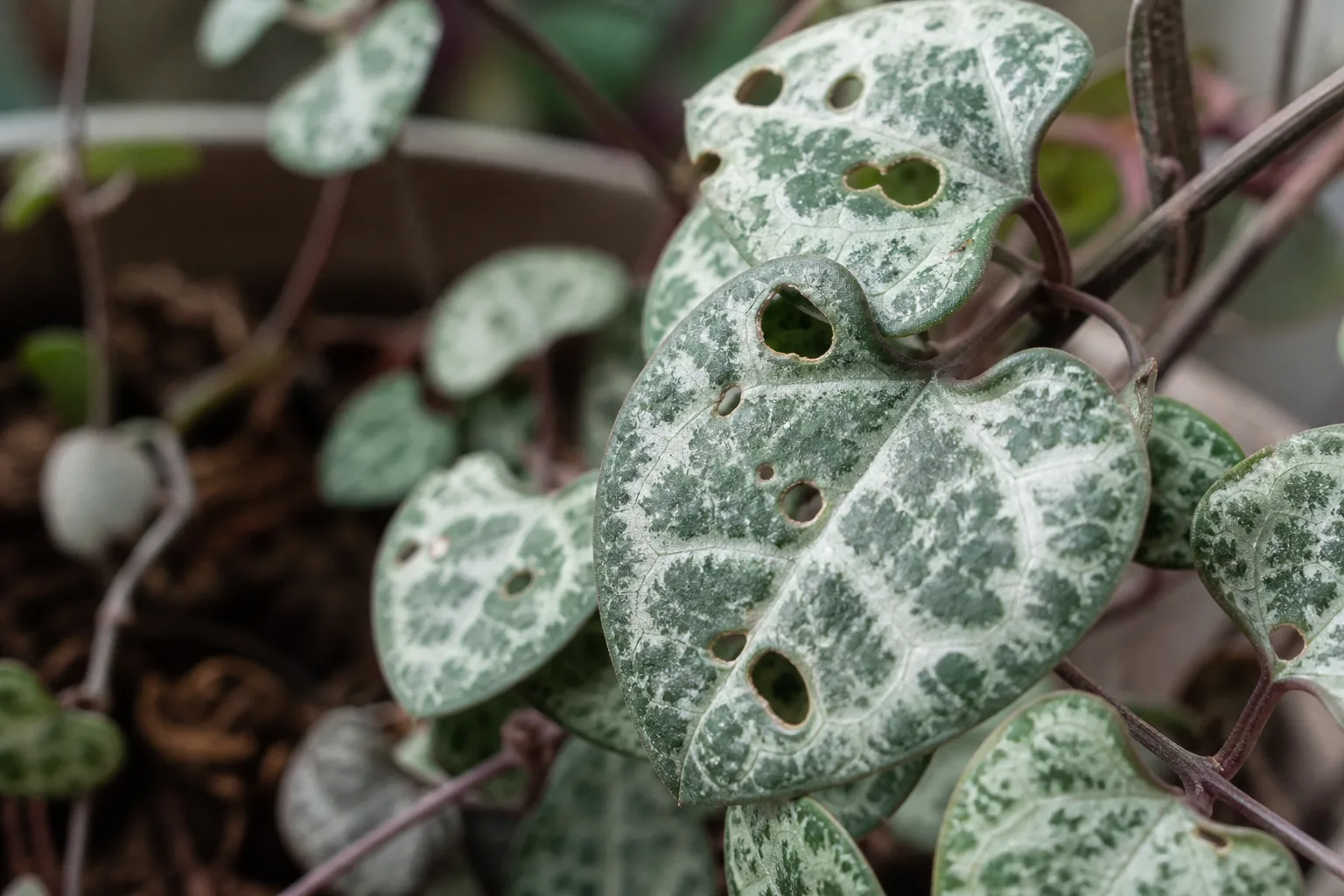
Holes in String of Hearts leaves are usually thrips rasping, a chewing pest, or physical damage from trailing vines catching on hooks and shelves-not a watering mistake. First step: spread the hanging strands apart and inspect leaf undersides and growing tips for insects, silver streaks, or frass before treating anything.
Holes in String of Hearts Leaves: Causes, Checks & Fixes
This guide covers holes in leaves on String of Hearts. See also the general Holes in Leaves guide, watering, and light pages for this plant.
Holes in String of Hearts Leaves: Causes, Checks & Fixes
Quick answer
Holes in String of Hearts (Ceropegia woodii) leaves almost always mean something is piercing, rasping, or tearing the small heart-shaped foliage-not a root-zone watering error. The leaves are only about 1–2 cm wide, so damage reads as crescent notches, pinprick tears, or thin papery patches rather than the large ragged holes you see on broad-leaf houseplants.
First step: spread the trailing mass apart and inspect purple leaf backs, strand tips, and tuber nodes under good light. Look for thrips silver streaks, black frass specks, crawling insects, or slime trails before you change watering or reach for fungicide. Ceropegia has few pests overall, but the ones that do show up hide inside the dense overlap of a hanging basket.
What holes in String of Hearts leaves look like
String of Hearts carries opposite, heart-shaped leaves-dark green with silver marbling on top and purple underneath-spaced along long pink wiry stems. Hole patterns on this small succulent tissue are distinctive:
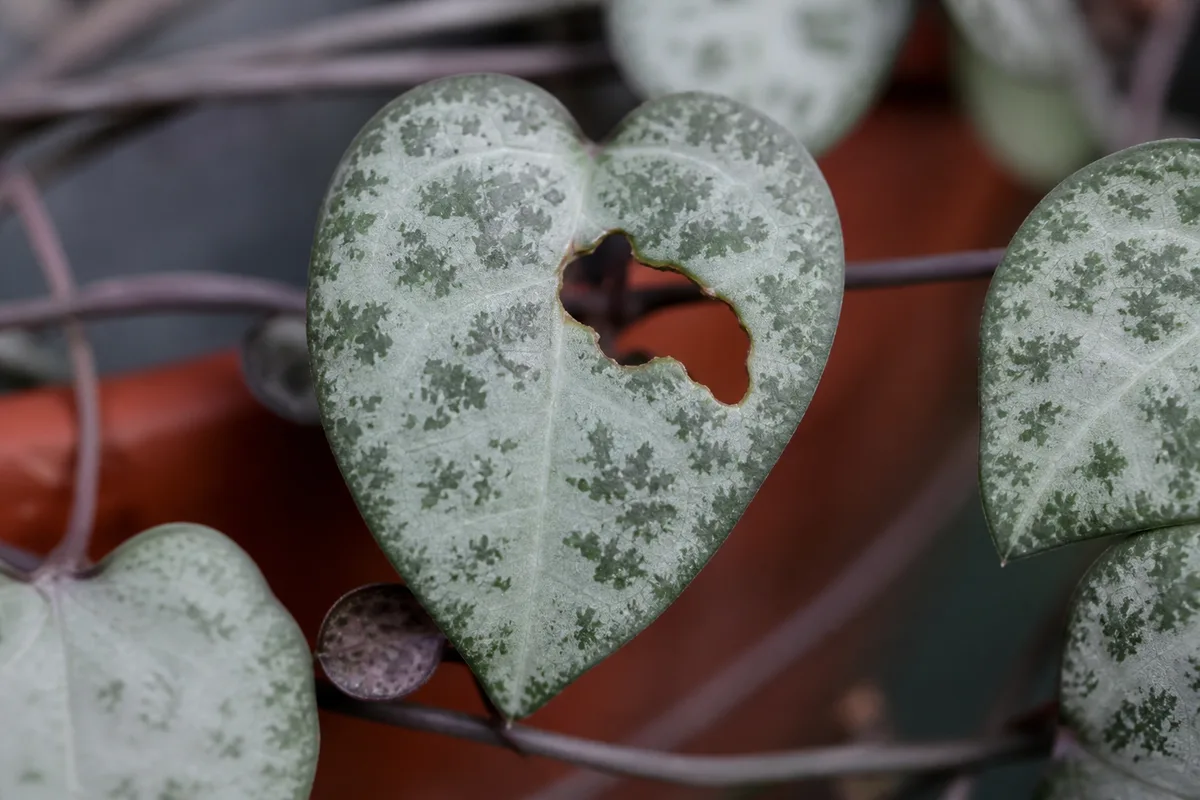
Holes in Leaves symptoms on String of Hearts - compare with healthy tissue on the same plant.
- Crescent notches or clean tears along leaf margins, often on outer strands that brush a wall, shelf, or basket hook
- Tiny round or irregular punctures with pale halos when thrips or other sap feeders have rasped the tissue thin enough to tear
- Silvery streaks or bleached patches that later split into small holes-classic thrips damage on narrow leaves
- Black varnish-like specks on purple leaf backs near feeding sites (thrips frass)
- Ragged chewed edges with visible dark frass pellets when a caterpillar or earwig is present
- Clustered damage on new strand tips when aphids or mealybugs pierce soft growth, sometimes leaving collapsed pinholes
Chewed or holed hearts do not close up. The marbled tissue is permanent once torn. Judge recovery by new hearts emerging without fresh damage along growing tips and bead-like tubers-not by old notched leaves along mature vine length.
Why String of Hearts gets holes in leaves
The most common indoor cause is not a disease-it is where and how the plant hangs. Ceropegia woodii is built as a trailing succulent with vining purplish stems that grow several feet long. In a basket, outer strands constantly scrape doorframes, window latches, and neighboring pots. Those thin hearts tear easily compared with thick succulent pads.
When insects are involved, these patterns fit String of Hearts best:
Thrips rasp leaf surfaces with asymmetrical mouthparts, leaving irregular silvery streaks and splotches that can thin until tissue tears. On 1–2 cm hearts, that damage quickly looks like holes rather than long streaks. Thrips favor young leaves, margins, and the nooks where leaf stalks meet wiry stems-exactly the joints hidden inside a tangled hanger. Heavy feeding leaves black shiny frass deposits on leaf backs.
Chewing pests such as caterpillars and earwigs create larger irregular holes overnight. They are uncommon on indoor String of Hearts but do appear on houseplants and can be hand-picked when a plant spent summer outdoors or arrived from a greenhouse with hitchhikers.
Sap-sucking pests monitored on Ceropegia-aphids, mealybugs, and scale per NC State Extension-pierce tissue rather than chewing wide holes. Still, repeated feeding at nodes can collapse small areas into pinholes, especially on soft new tips. Sticky honeydew and cottony wax clusters point to these pests instead of thrips.
Physical and pet damage also matters. String of Hearts is generally considered non-toxic to cats and dogs, but curious pets may mouth trailing strands, leaving torn hearts with no insects present. Bumping the basket when watering or vacuuming can snap strands against sharp hooks.
Overwatering, underwatering, and root rot on String of Hearts change leaf color and texture-yellowing, mushiness, crisp flat hearts-but they do not typically punch clean holes through healthy marbled tissue. If holes are your only symptom and soil moisture is normal, look at pests and placement first.
How to confirm the cause
Work through these checks in order:
- Spread-and-scan - Lift trailing strands away from the basket rim and wall contact points. Holes only on outer, longest vines with no insects strongly suggest physical snagging.
- Purple-back inspection - Flip hearts toward the light and check undersides along midribs and margins. Thrips leave silvering and black frass; spider mites leave fine stippling and webbing, not classic chew holes.
- Growing-tip focus - Examine the softest new leaves and strand tips. Aphids cluster there as pinhead soft bodies; thrips scar tissue before leaves fully harden.
- Tap test - Hold a suspect heart over white paper and tap sharply. Moving specks confirm live thrips or mites; static debris does not.
- Night check for chewers - If holes are large and ragged, inspect after dark with a flashlight for caterpillars or earwigs on stems and pot rims.
- Sticky-card clue - Yellow or blue sticky traps near the basket catch flying thrips and winged aphids, confirming insect cause when damage pattern is unclear.
- Soil moisture cross-check - Confirm the fast-draining mix is mostly dry between waterings. Soggy soil causes yellow mushy leaves and tuber rot-not scattered holes on firm marbled hearts.
Confirmed insects or fresh slime trails mean biological damage. Clean tears on strands that touch a shelf, with no pests anywhere, mean mechanical damage.
First fix for String of Hearts
Isolate the hanging basket from neighbors and rinse every trailing strand with a firm stream of lukewarm water, targeting purple leaf backs and strand tips.
Wrap the pot if you shower the plant in a sink so the cactus-style mix does not turn to mud. Spread vines with one hand and spray upward with the other so water hits undersides directly. This single step knocks down thrips, aphids, and dust while letting you see what remains after the wash.
Do not repot, prune heavily, or fertilize on day one. Ceropegia woodii is easily stressed by stacked interventions and killed by overwatering-neither helps torn leaves heal. If damage is clearly mechanical only, skip sprays and rehang with clearance so strands stop catching on hooks and walls.
Step-by-step recovery
After the initial rinse and isolation:
- Reposition the basket - Move hooks and shorten trailing length if outer strands scrape surfaces. Add a few inches of clearance from window latches and shelves.
- Hand-remove obvious chewers - Pick off caterpillars, earwigs, or slugs if found; drop them into soapy water.
- Treat confirmed sap feeders on schedule - If thrips frass or live insects remain after rinsing, apply insecticidal soap or horticultural oil labeled for houseplant ornamentals, covering every leaf surface especially undersides. Repeat at label intervals; thrips hide in tissue and soil life cycles.
- Address mealybugs or aphids at nodes separately - Cottony clusters and honeydew point to contact alcohol dabs at nodes before blanket spraying. See the dedicated guides for those pests if colonies are dense.
- Prune only holed strands that are mostly brown or crisp - Snip back to healthy tissue above a tuber node. Bag clippings if pests were confirmed.
- Keep watering on the dry side of soggy - Water when the mix is mostly or completely dry. Wet stagnant roots plus damaged foliage invite rot on tuberous roots String of Hearts overview does not forgive easily.
If you use oils or soaps, treat in morning or evening-not on sun-stressed hearts at midday.
Recovery timeline
Mechanical tears stop appearing as soon as strands no longer snag-often within days of rehanging. Insect recovery takes longer. Expect fewer fresh holes on new growth within one to two weeks after consistent rinsing or labeled sprays if the infestation is moderate.
Old notched hearts never refill. Watch new hearts along tips and tuber nodes for two to three weeks. Clean emerging foliage means control is working. Ceropegia rebuilds trailing length slowly; a heavily damaged outer curtain may take a full growing season to look full again.
Worsening signs: new hearts holed before they expand, spreading silver streaks, or webbing and frass across multiple strands despite repeated treatment. Escalate to systemic options only per label directions, or discard a severely infested plant to protect the collection.
Lookalike symptoms to rule out
Sun scorch bleaches or browns leaves closest to hot glass in blocked patches-not scattered crescent tears along strands that brush furniture. Scorch follows a window move or summer sun shift.
Spider mite stippling shows fine yellow or bronze pinpricks with silk on undersides. Mites rarely cut clean holes; they bleach tissue uniformly first.
Underwatering produces pale, thin, flat hearts on limp strands with a very lightweight dry pot-not silver thrips streaks with black frass.
Fungal leaf spot on String of Hearts is uncommon in bright, airy placements. Shot-hole patterns with yellow halos and spreading brown centers suggest damp stagnant conditions-not the dry trailing-basket setup this succulent prefers.
Normal aging drops an occasional old heart at the soil line without margin tears or streaking on neighbors.
Mistakes to avoid
Do not assume holes mean overwatering and cut back water sharply. Dry tubers plus torn foliage weaken the plant without fixing the cause.
Do not spray fungicide on mechanical tears. You add stress without addressing snagging or insects.
Do not treat only the tops of heart-shaped leaves. Thrips, aphids, and mites feed on purple undersides and stem joints.
Do not hang the basket back against a wall before confirming whether strands were snagging.
Do not compost pest-infested clippings near other houseplants.
Do not overwater to “help recovery.” Fast-draining dry cycles protect tuberous roots while foliage heals.
Do not ignore autumn quarantine. Plants moved indoors from patios often carry thrips that explode once furnace heat dries the room.
String of Hearts care cross-check
While addressing holes, keep core care stable. Ceropegia woodii needs bright indirect light with some direct morning sun to hold sharp marbling, but outer strands need physical clearance as much as photons. Water when the mix is mostly or completely dry-roughly every ten to fourteen days in active summer growth, less in winter rest.
Maintain moderate airflow without blasting heat directly on trailing foliage. Stagnant damp corners invite fungal issues; hot dry drafts favor thrips and spider mites that thrive in dry, warm indoor conditions on houseplants.
String of Hearts is generally pet safe, but rinse hands after handling treated vines and keep sprays off surfaces pets lick.
How to prevent holes next time
Hang with enough slack that longest strands do not brush walls, blinds, or shelf edges. Shorten or coil excess length on the hook rather than letting vines snag.
Quarantine new plants two weeks before placing them beside a trailing basket. Inspect purple backs during weekly watering checks.
Rinse trailing vines occasionally in dry winter months. Light showers remove dust, dislodge early thrips, and give a regular look at new hearts.
Use sticky traps near the basket in winter to catch flying thrips early.
When moving baskets indoors in fall, inspect every strand before returning to a shared hook.
When to worry
Treat as urgent when new hearts emerge already holed, black frass covers multiple purple backs, or damage jumps to several strands within a week. Slow tuber-backed growth means sustained feeding costs months of vine length.
Discard and bag a plant only when most strands show active thrips scarring, repeated labeled treatments fail, and neighboring hangers are at risk. Cover the basket with a bag before moving it.
A single notched heart on one outer strand that touches a shelf is low urgency-reposition first. Widespread silver streaking on the newest growth is not-act the same day.
Conclusion
Holes in String of Hearts leaves come from thrips rasping, chewing pests, sap-feeder damage, or trailing vines snagging on hooks and walls-not from ordinary watering mistakes. Spread strands apart, inspect purple leaf backs, rinse thoroughly, then treat confirmed insects on schedule while you rehang with clearance. Old torn hearts will not heal-watch clean new growth on tips and tubers. That path protects a slow, tuber-backed trailing plant without drowning its roots on day one.
When to use this page vs other String of Hearts guides
- String of Hearts watering guide - Use for routine moisture checks before assuming holes in leaves is the main issue.
- String of Hearts problems hub - Browse all 45 common issues on this species.