String of Hearts Watering Guide: Dry-Down Care
String of Hearts Watering Guide: Dry-Down Care
String of Hearts Watering Guide: Dry-Down Care
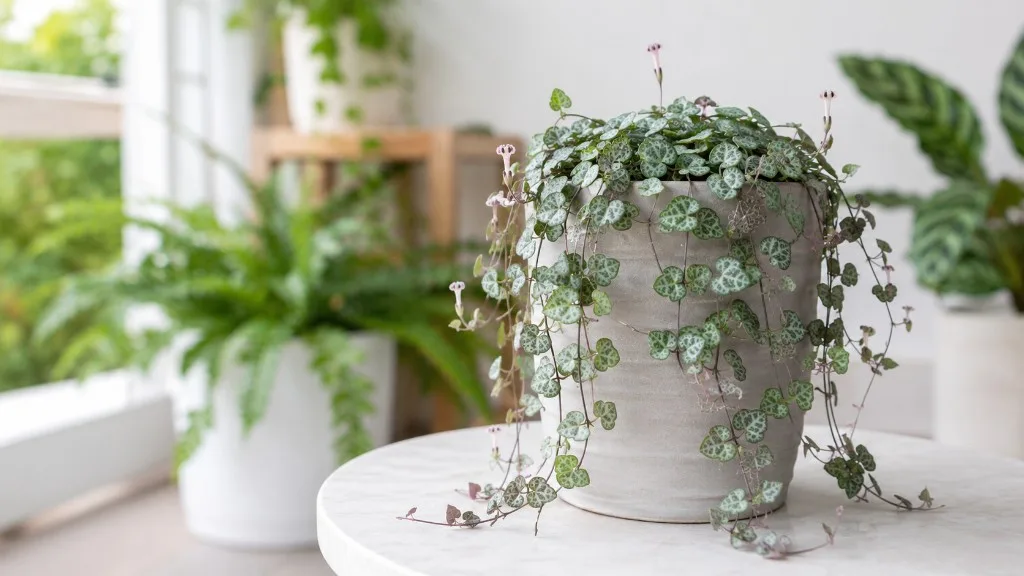
String of hearts watering is less about memorizing a schedule and more about reading how fast your particular pot dries. Ceropegia woodii - the trailing plant most people call string of hearts, rosary vine, or chain of hearts - is a semi-succulent from South Africa’s dry scrublands. It evolved to store water in fleshy leaves, succulent stems, underground tubers, and the bead-like aerial tubers that form along the vines. That storage system means the plant tolerates dry intervals far better than it tolerates sitting in wet soil. The practical rule is simple: water thoroughly when the root zone has dried down to the right depth for the season, then let it dry again before the next drink. A fixed weekly calendar fails because soil drying speed changes with light, pot size, mix texture, room temperature, and whether the plant is actively growing or resting.
Most string of hearts deaths trace back to overwatering, not neglect. Growers see dry-looking surface soil, assume the plant is thirsty, and add water while the lower root zone is still damp. Waterlogged mix becomes oxygen-poor, feeder roots stop functioning, and pathogens like Pythium can colonize tissue that stays wet too long. By the time stems feel mushy or leaves yellow in clusters, root damage is often advanced. An underwatered string of hearts, by contrast, usually wrinkles, shrivels, and looks dramatic - then recovers within a day or two of a proper soak. Erring slightly dry is safer than erring wet.
This guide covers how often to water, which moisture checks actually work, seasonal dry-down depth, step-by-step watering technique, and how to tell whether your plant needs more water, less water, or a change in pot and light before you touch the watering can again.
Why String of Hearts Needs Dry-Down Watering, Not a Calendar
Houseplant advice often defaults to “water every seven days” or “every two weeks” because calendars are easy to remember. String of hearts punishes that habit. The same plant in the same home can need water every five days in July and every three weeks in January - not because the plant changed species, but because transpiration, root activity, and soil evaporation all shift with season and placement.
Dry-down watering means you wait until a defined depth of soil has lost usable moisture, then give a full soak that recharges the entire root zone. You are not trying to keep the mix slightly damp at all times. You are cycling between adequately wet and appropriately dry, the way the plant experiences rain and drought in its native habitat. NC State Extension describes Ceropegia woodii as preferring well-drained sandy potting soil and allowing the mix to dry out completely between waterings - guidance that matches Missouri Botanical Garden’s summary of a tuberous, trailing South African perennial suited to bright light and well-drained conditions (Missouri Botanical Garden - Ceropegia woodii). That origin story is the backbone of every watering decision indoors.
Three variables override any calendar rule: how much light the plant receives, how fast your potting mix drains and re-wets, and whether the plant is in active growth or semi-dormant rest. A string of hearts hanging in strong indirect light with some morning sun will pull water through leaves and stems faster than one on a shelf five feet from a north window. A gritty cactus blend in a small terracotta pot dries in a fraction of the time the same plant needs in a large plastic container filled with peat-heavy indoor mix. Treat the calendar as a reminder to check moisture, never as permission to water automatically.
How String of Hearts Stores Water in Leaves, Stems, and Tubers
Understanding where string of hearts keeps its water reserve explains both its drought tolerance and its sensitivity to rot. The heart-shaped leaves are thick and succulent, designed to hold moisture during dry spells. The thin trailing stems are also succulent - they wrinkle visibly when the plant draws down internal stores. Below the soil surface, tuberous roots anchor the plant and function as a water battery. Along the vines, aerial tubers - small round beads that look like tiny potatoes - form at nodes and can root into soil or moss if given contact. Some mature specimens also develop a visible caudex, a swollen base where stem meets root, that stores additional reserves.
When you skip a watering cycle, string of hearts does not immediately panic. It taps leaf tissue, stem tissue, and tuber reserves in that order. Leaves may feel softer or fold slightly. Stems may look thinner. Aerial tubers may shrink a little. That is normal drought signaling, not necessarily damage - as long as you respond before repeated cycles deplete the root system itself. The mistake is interpreting any visual change as an emergency and watering before the soil has actually dried, which keeps the underground tubers in wet conditions they never evolved to handle long-term.
What Makes Ceropegia Woodii a Semi-Succulent
String of hearts sits between true desert succulents and thirsty tropical foliage plants. It is not a cactus that wants to stay bone-dry for weeks in a shallow dish, and it is not a fern that wants evenly moist soil at all times. The semi-succulent label matters because it sets expectations: the plant wants full drinks separated by real dry intervals, not frequent small sips that keep the surface damp while the core stays stale.
Semi-succulent physiology also explains why string of hearts recovers well from underwatering but recovers poorly from chronic overwatering. Drought stress is reversible at the tissue level until roots themselves are damaged by repeated desiccation. Rot is a breakdown of root structure that limits the plant’s ability to absorb water even when you finally get the schedule right. Respect the dry-down rhythm and you work with the plant’s design. Fight it with constant moisture and you fight the plant’s entire evolutionary history.
How Often to Water String of Hearts
There is no single interval that works in every home. As a starting framework for typical indoor conditions - moderate room temperatures, String of Hearts light guide, a well-draining cactus-style mix, and a pot with drainage holes - most growers water roughly every 7 to 14 days during active growth and every 14 to 21 days (sometimes longer) during cooler, slower months. Those ranges are not instructions. They are benchmarks to compare against your own pot after you run moisture checks for two or three weeks and learn your plant’s actual rhythm.
The authoritative source is always the soil at depth, not the number of days since the last watering. If your finger says the target zone is still cool and damp, wait - even if an app reminder says today is watering day. If the pot is light, the skewer pulls out clean and dry, and a sample leaf fails the taco test, water - even if only four days have passed.
Growing Season: Spring and Summer Rhythm
From mid-spring through late summer, string of hearts is usually in active growth: new leaves unfurl along the vines, internodes extend, aerial tubers form, and roots metabolize at full speed. Transpiration increases, so the pot dries faster. During this window, allow the top 1 to 2 inches (roughly 3 to 5 cm) of soil to dry before watering again. In a warm, bright room with a appropriately sized pot, that often translates to a cycle of about 7 to 10 days, though high light and small pots can shorten it further.
Water thoroughly when you do water. A half-hearted splash that only wets the top inch trains roots upward and leaves the lower root zone chronically under-hydrated, which encourages shallow rooting and makes the plant more vulnerable to both drought and inconsistent moisture. One deep soak that drains freely beats three anxious top-waterings in the same week.
Dormant Season: Fall and Winter Rhythm
As daylight shortens and indoor temperatures cool from early fall onward, string of hearts slows growth and draws on tuber reserves. Root activity declines. The plant draws more on tuber and caudex reserves and needs far less supplemental water. Continuing a summer schedule through December is one of the most common ways healthy plants develop winter root rot on String of Hearts.
From fall through winter, push your dry-down standard deeper. Let roughly half to two-thirds of the pot depth go dry in fall, and approach full dry-down between waterings in the heart of winter. Practical intervals often land around 14 to 21 days, and some plants in cool, dim rooms go three weeks or more without needing a drink. The soil test depth - not the calendar - determines timing. If you probe 3 to 4 inches down and still feel cool moisture, hold off even if the top looks pale and dusty.
The Best Soil Moisture Checks Before You Water
Reliable string of hearts watering starts with a consistent check you repeat the same way every time. Pick one or two methods below and use them for at least two weeks until you can predict how your pot dries. Switching between guesswork and rigorous checks every other day makes it hard to learn the plant’s pattern.
The four checks that matter most:
- Finger or knuckle test at 1 to 2 inches deep in spring and summer; deeper in fall and winter
- Dry wooden skewer or chopstick inserted to the pot’s lower third - soil should not cling when it is dry enough to water
- Pot weight - lift the container when you know the soil is fully dry after a thorough watering; compare before each decision
- Leaf feel (taco test) - a firm, plump leaf bends reluctantly; a dehydrated leaf folds easily like a soft taco shell
No single check tells the whole story alone. Surface soil lies. A decorative top dressing of pebbles or dry-looking mix can hide damp peat underneath. Pot weight and a depth probe together are the most honest combination for experienced growers. Leaf feel is a useful secondary signal, especially on long vines where reaching the pot is awkward, but leaves can look slightly soft from heat stress or recent handling too - so pair leaf feel with soil data when you can.
Finger Test, Skewer, and Pot Weight
The finger test is the fastest daily check. Push your index finger or knuckle into the mix at the target depth for the season. If it feels cool and slightly damp, wait. If it feels dry and loose with no cling, consider watering. In winter, do not stop at one inch - go deeper, or use a skewer instead, because the surface dries faster than the core and tricks you into underwatering the top while the middle stays wet.
A dry wooden skewer or bamboo chopstick gives you depth without dirty fingernails. Push it to the bottom third of the pot, leave it for a few minutes, pull it out, and feel the stick. Damp soil leaves a dark mark and cool feel. Dry soil pulls out clean. This method is especially valuable in deep hanging baskets where your hand cannot reach the root zone easily.
Pot weight is the skill that separates casual growers from confident ones. After a thorough watering and complete drainage, lift the pot and notice the heft. As the mix dries, the pot gets noticeably lighter. When a terracotta pot feels almost hollow and a plastic pot swings easily with one finger through the hanger, the root zone is likely ready. Weight is also the best way to catch a false dry surface - the pot still feels heavy even when the top inch looks pale.
Electronic moisture meters can help on peat-based mixes but often read inconsistently on gritty cactus blends with large perlite chunks. If you use a meter, treat it as one data point, not a verdict, and verify with finger or skewer until you trust the readings for your specific soil.
The Taco Test and Leaf Feel
The taco test is a popular string of hearts trick because the leaves are conveniently accessible on trailing vines. Pinch a mature leaf between your thumb and finger and try to fold it lengthwise. A well-hydrated leaf feels firm and resists folding - like a stiff piece of cardstock. A thirsty leaf feels thin and bends easily, like a soft taco shell. When several leaves along the vine fail the taco test and the soil depth check agrees, it is time to water.
Leaf feel lags behind soil dryness slightly and leads it slightly in recovery. After you water, leaves may still feel soft for several hours while roots rehydrate tissue. After the soil has been dry too long, leaves wrinkle before roots are catastrophically damaged. Use the taco test as a confirming signal, not the only signal - especially in winter when the plant may draw on tuber reserves while soil still holds moderate moisture. A plant that passes the taco test but sits in soggy soil is overwatered regardless of how firm one leaf feels.
Step-by-Step: How to Water String of Hearts Correctly
Once your checks say the pot is dry enough, the goal is a single thorough irrigation followed by complete drainage - not a series of small top-ups that keep the crown damp.
- Confirm drainage is clear. Make sure holes are not blocked by roots, a pebble layer, or a mat. If the pot sits inside a cachepot or decorative cover, plan to empty it after watering.
- Water slowly and evenly across the soil surface until water runs steadily from the drainage holes. For very dry mix that has pulled away from the pot edge, water in two passes a few minutes apart so the first pass re-wets the mix and the second pass saturates the root zone.
- Avoid soaking foliage unnecessarily. String of hearts tolerates average humidity and does not need leaf misting. Wet leaves in low airflow can develop spotting. Water the soil, not the vine display.
- Let the pot drain fully for 15 to 30 minutes. Do not return a dripping pot to a hanging macramé hanger over a bookshelf.
- Empty the saucer or cachepot so the plant never sits in standing runoff. Stale water wicks back into the mix and reverses the dry-down you waited for.
Bottom watering - setting the pot in a tray of water and letting the mix wick upward - works for string of hearts when top watering runs off too quickly on very dry soil. Soak until the surface glistens, then remove and drain. Bottom watering alone can leave salt buildup over time on indoor plants, so an occasional top-water flush helps leach minerals. Either method is fine as long as the outcome is the same: evenly moistened root zone, then a return to dry-down.
Seasonal Watering Schedule for Indoor Growers
Use the table below as a framework, then adjust based on your moisture checks. If your plant sits within two feet of a large south- or west-facing window, lean toward the shorter intervals. If it lives five or more feet from the nearest window or in a cool room, lean toward the longer end.
| Season | Typical interval (indoor) | Soil dry-down target | Plant activity |
|---|---|---|---|
| Spring (March–May) | Every 7–12 days | Top 1–2 inches dry | Growth resumes; tubers refill after winter |
| Summer (June–August) | Every 7–10 days | Top 1–2 inches dry | Peak growth; highest water demand |
| Fall (September–November) | Every 12–16 days | Top half of pot approaching dry | Growth slowing; reduce frequency |
| Winter (December–February) | Every 14–21+ days | Lower two-thirds to fully dry | Semi-dormant; tubers supply reserves |
Temperature and heating matter as much as month names. A string of hearts above a radiator may dry fast even in January. The same plant in an unheated porch that drops below 15°C (59°F) at night needs far less water and may show cold stress before drought stress. Light is the other hidden variable. Growers who run supplemental grow lights through winter sometimes see continued active growth and should water slightly more often - still checking soil depth, not reverting to a summer calendar blindly.
After String of Hearts repotting guide, expect slower drying for several weeks. Fresh mix without a full root mass holds moisture longer. Many growers accidentally overwater newly repotted string of hearts because the old schedule no longer matches the new container. Pause your assumptions and re-learn the pot weight after repotting.
Signs You Are Overwatering String of Hearts
Overwatering can cause root rot and yellowing leaves on string of hearts, and it is the mistake most indoor growers run into. The plant does not always scream immediately - early signs are subtle and easy to blame on something else.
Watch for these patterns together:
- Yellowing leaves, often starting on lower or inner sections, not just one old leaf at a time
- Soft, mushy stems near the soil line or at nodes that should feel firm
- Leaves that feel plump but soil stays wet for many days - a sign roots are not taking up water because they are damaged
- Musty or sour smell from the potting mix when you lift the plant or probe the soil
- White fungus gnats hovering around the surface - they breed in persistently damp organic mix
- Black or brown mushy roots visible when you gently slide the plant from the pot for inspection
String of hearts in low light plus heavy soil plus no drainage is the classic overwatering setup. The plant transpires slowly, so the grower waits less time between waterings because the surface looks dry, and the core stays wet for weeks. Cachepots and closed hanging planters that trap runoff create the same problem without any calendar mistake at all.
If you suspect overwatering, stop watering immediately. Let the mix dry down more aggressively than usual, improve airflow, and move the plant to brighter indirect light if it was in a dim spot - brighter light speeds soil drying and supports recovery, provided you avoid harsh midday sun shock. If several stems are mushy and roots are brown and slimy, propagation from healthy vine cuttings or firm aerial tubers may be safer than saving the mother plant. Catch the problem early, and a dry-down reset often works within one to two weeks.
Signs of Underwatering and How to Recover
Underwatered string of hearts is dramatic but usually forgiving. The plant is built for this.
Common underwatering signals include:
- Wrinkled or shriveled leaves that pass the taco test easily
- Thin, ropey stems that lose their plump succulent look
- Dry, hardened soil that shrinks away from the pot wall and sheds water down the sides instead of absorbing it
- Slowed growth and smaller new leaves - distinct from winter dormancy if the soil has been dust-dry for weeks
- Crispy brown tips on a few leaves after repeated drought cycles, even after rehydration
A single missed watering rarely kills a mature plant with established tubers. Recovery is straightforward: water thoroughly, let the pot drain, and wait. Leaves often plump back within 24 to 48 hours. Do not compensate with twice-daily sips afterward - that swings the pendulum toward rot. One full soak, then return to your normal dry-down checks.
If soil has become hydrophobic - water runs straight through and out the bottom while the core stays dry - bottom water the pot for 30 to 45 minutes, then top water once to settle the mix. For extreme cases, submerge the root ball briefly in a bucket of room-temperature water, then drain completely. Going forward, a gritty mix with adequate perlite or pumice prevents re-compaction.
Repeated chronic underwatering is a different story. Fine feeder roots can die back, and when water finally returns, damaged roots cannot absorb it efficiently - the plant looks wilted in wet soil, which confuses growers into watering even more. If that happens, trim clearly dead vines, repot into fresh well-draining mix if roots are sparse, and rebuild the watering rhythm conservatively.
Water Quality, Temperature, and Technique
String of hearts is not finicky about water chemistry the way some calatheas are, but room-temperature water is still best. Cold tap water shocks warm roots and slows uptake. Let chlorinated tap water sit for a few hours if your municipality treats heavily, or use filtered water - the difference is minor for most growers, but consistent room-temperature application reduces stress.
Hard water leaves white mineral crust on pot rims and soil over time. Occasional thorough top-water flushes that run freely through the drainage holes help leach buildup. If crust is heavy, consider repotting into fresh mix in spring rather than chasing symptoms with more water.
Watering time of day matters less indoors than outdoors, but morning watering gives any splashed foliage time to dry in ambient daytime airflow. Avoid leaving the plant wet-footed in a cold windowsill at night immediately after a heavy soak - the combination of cool soil and low root activity can slow drying uncomfortably in winter.
How Pot Size, Soil Mix, and Light Change Watering Needs
Every string of hearts watering decision is really three decisions bundled together: how much root mass is in the pot, how fast the mix releases water, and how hard the plant is working in its current light.
Pot size changes drying time immediately. A vine recently moved from a 4-inch nursery pot into an 8-inch bowl has a small root system relative to soil volume. That mix stays wet longer - sometimes uncomfortably long - until roots explore outward. Water less often after upsizing, even if the plant looks large above the soil. Conversely, a root-bound plant in a small pot may need water every few days in summer because there is little mix to buffer moisture.
Soil mix is the second lever. Fast-draining cactus or succulent blends with perlite, pumice, or coarse sand dry quickly and forgive occasional over-enthusiastic watering better than peat-heavy indoor mixes. Heavy mixes compact over months, hold water at the center, and require longer dry-down intervals even when the plant would prefer more frequent cycles in bright light. If your pot takes more than ten days to reach the dry target in summer despite strong light, the mix - not the plant - may be the bottleneck.
Light intensity drives transpiration. String of hearts wants bright indirect light with some direct morning sun for best growth. In that environment, the plant uses water actively and the dry-down cycle spins faster. In low light, the same pot dries slowly, roots work less, and overwatering risk rises - not because you watered too much in volume, but because the plant could not use what you provided. Fixing light often fixes a watering problem that looked mysterious.
Hanging Baskets, Cachepots, and Drainage Mistakes
String of hearts is often grown as a hanging basket or trailing shelf plant, which introduces watering traps standard pots avoid.
No drainage holes is the worst offender. Any sealed container - ceramic cachepot, glass globe, closed terrarium-style planter - removes your ability to run water through and forces you to guess how much is enough. String of hearts can survive careful watering in a cachepot only if you are meticulous about volume and emptying, but a pot with holes is always safer.
Trapped saucers and outer pots cause the same damage as no holes when runoff is not emptied. Water sits, wicks upward, and the bottom third of the mix stays anaerobic while the top looks fine. After every watering, lift the inner pot, dump the outer vessel, and confirm no standing water remains.
Long trailing vines make growers reluctant to move the basket to the sink. Top watering in place is fine if drainage is real and saucers are emptied, but periodic sink soaks help you verify full saturation and flush salts. Macramé hangers that hold water in folded fabric can keep the pot bottom damp - check that the base dries between waterings.
Moss poles and coir wraps used for aesthetic displays can hold moisture against aerial tubers. That helps deliberate propagation but can rot tubers pressed against constantly wet material in low light. Separate display goals from core watering health: a happy string of hearts in a simple plastic nursery pot inside a decorative hanger outperforms a stressed plant in a trendy setup with poor drainage.
Common String of Hearts Watering Mistakes
Even experienced growers slip on these patterns:
- Watering because the top looks dry while the lower soil is still damp - the single most common error
- Using a fixed weekly reminder without a soil check, especially across season changes
- Giving tiny sips frequently instead of thorough soak-and-drain cycles, which keeps upper roots wet and lower roots starved
- Leaving runoff in cachepots after every watering
- Increasing water when leaves yellow without checking whether soil is actually wet - yellow from overwatering and yellow from drought require opposite responses
- Watering on repot day one out of anxiety when the nursery mix is still appropriately moist
- Misting vines as a watering substitute - humidity from misting is brief and does not replace root-zone moisture
- Ignoring winter slowdown and maintaining summer frequency through heating season
- Pairing heavy soil with low light and compensating with still more water when growth stalls
The fix for most mistakes is not a exotic product. It is slowing down, checking deeper, and watering less often in cool months - then observing how the plant responds over two full dry-down cycles before changing again.
Troubleshooting Watering Problems by Symptom
When something looks wrong, read the soil moisture and stem firmness together before you act.
Limp leaves with wet soil and a heavy pot: Likely overwatering or root damage. Pause watering, improve drainage and light, inspect roots if decline continues. Do not fertilize a stressed root system.
Limp leaves with dry soil and a light pot: Underwatering. Soak thoroughly, drain, and resume dry-down checks. Leaves should recover within one to two days.
Yellow leaves scattered on an otherwise firm plant in appropriate dry soil: May be natural aging of older leaves, sudden light change, or cold draft - check environment before assuming water fault.
Vines growing sparse with wide gaps between leaves: Usually insufficient light, not insufficient water. More water in low light worsens the situation.
Plant wilted after you watered: Possible root rot limiting uptake, or hydrophobic soil that never re-wet. Check drainage, probe soil at depth, inspect roots if wilting persists in damp mix.
Fungus gnats persistent despite “careful” watering: Soil staying moist too long near the surface. Extend dry-down, top-dress with coarse sand or perlite to speed surface drying, and address mix drainage.
One stable rule: change one variable at a time. If you adjust watering, pot, light, and fertilizer in the same week, you cannot know which fix helped or hurt.
Conclusion
String of hearts rewards growers who treat it like the semi-succulent it is - a South African trailer built to store water in leaves, stems, and tubers, then wait for the next real rain. String of hearts watering succeeds when you match soak-and-drain thoroughness to seasonally appropriate dry-down depth: top 1 to 2 inches dry in active growth, much deeper dry intervals in winter rest. Calendar reminders are useful only as prompts to check the pot, never as automatic watering permission.
Learn your container’s weight when dry. Use a finger or skewer at the right depth. Confirm with the taco test when vines are within reach. Water fully, drain completely, and empty every cachepot. The plant forgives drought far more willingly than it forgives soggy soil, and a confident dry-down rhythm is what keeps those heart-shaped leaves plump on vines that trail for years.
When to use this page vs other String of Hearts guides
- String of Hearts overview - Start here for whole-plant context before deep-diving this topic.
- String of Hearts problems hub - Jump to symptom-specific fix guides when this care topic does not resolve the issue.
- Root Rot on String of Hearts - Escalate here when watering adjustments are not enough.
- Drooping Leaves on String of Hearts - Escalate here when watering adjustments are not enough.
- Mold on Soil on String of Hearts - Escalate here when watering adjustments are not enough.
Related String of Hearts guides
- String of Hearts overview
- String of Hearts light
- String of Hearts soil
- String of Hearts propagation
- String of Hearts fertilizer
- String of Hearts repotting
- Root Rot on String of Hearts
- Drooping Leaves on String of Hearts
- Mold on Soil on String of Hearts
- String of Hearts problems
Related tool
Try the Plant Watering Calculator with string-of-hearts pre-selected to estimate needs for your setup.